


Many parents and coaches watch a young pitcher stumble off the mound or spray throws all over the place and chalk it up to nerves or weak mechanics. What they’re often missing is something far more fundamental: pitching balance. Balance isn’t just about standing steady on one leg. It’s the invisible thread connecting every part of the pitching motion, from the first lift of the knee to the final snap of the wrist. When it breaks down, control suffers, velocity drops, and injury risk climbs. This guide explains what pitching balance really means, why it matters so much for developing athletes, and exactly how to build it.
Table of Contents
- What is pitching balance?
- Why is pitching balance essential for young athletes?
- How pitching balance works: The science inside the motion
- Practical ways to train pitching balance at home or practice
- Why most youth pitching balance advice falls short
- Take the next step toward better pitching balance
- Frequently asked questions
Key Takeaways
| Point | Details |
|---|---|
| Pitching balance basics | Pitching balance is the ability to control the body throughout the pitching motion for both power and accuracy. |
| Biomechanical importance | Effective balance connects trunk, pelvis, and arm action—critical for velocity and reducing injury risk. |
| Trainable skill | Pitching balance can be improved with targeted, age-appropriate drills and simple at-home routines. |
| Practical tools matter | Using proper equipment and consistent routines helps young players build balance faster and more safely. |
What is pitching balance?
Most people hear “pitching balance” and picture a player teetering on one foot during the windup. That image isn’t wrong, but it’s only part of the story. Pitching balance is the ability to maintain full body stability and control from the very start of the windup all the way through the release point and follow-through.
It’s not just about the legs. True pitching balance involves the coordinated movement of the trunk (the upper body, including the core and spine) and the pelvis (the hips). These two regions have to work together in a precise sequence. When they do, the pitcher stays on a consistent path and delivers the ball with repeatable mechanics. When they don’t, the whole motion falls apart.
“Pitching balance isn’t a single moment in time. It’s a continuous process of control that runs through every phase of the delivery.”
Here’s what good pitching balance actually involves:
- Stable base: The stride foot lands in a controlled position, not too wide or too narrow.
- Trunk alignment: The upper body stays upright and doesn’t collapse toward the plate too early.
- Hip-to-shoulder separation: The pelvis rotates first, followed by the trunk, creating power without losing control.
- Repeatable motion: The pitcher can execute the same sequence throw after throw without stumbling or compensating.
Research confirms that trunk and pelvis coordination is directly tied to pitching stability and ball velocity. This isn’t just relevant for college or professional pitchers. For youth players still developing motor patterns, building this coordination early sets the foundation for everything that comes later.
Why is pitching balance essential for young athletes?
Balance is the foundation that every other pitching skill is built on. A young pitcher might have a great arm, strong legs, and solid coaching, but without balance, none of those assets translate reliably to the mound.
Here’s why balance matters so much at the youth level specifically:
- Consistency: Pitchers who maintain balance throw more strikes. When the body follows the same path each time, the arm follows too.
- Velocity development: As players grow and get stronger, balance allows them to channel that power into the ball instead of wasting it on compensation movements.
- Injury prevention: A pitcher who loses balance mid-delivery often compensates with the arm or shoulder, putting extra stress on joints that aren’t designed to absorb it.
- Confidence: When a young pitcher knows their body is under control, they pitch with more confidence and composure.
One of the biggest misconceptions among youth coaches is that strength training alone will fix mechanical problems. Strength helps, but it doesn’t automatically create balance. A strong kid with poor balance will just throw hard and wild. Both qualities need to be developed together.
Studies show that peak trunk velocity predicts ball velocity, and the interaction between pelvis and trunk rotation maximizes power output. This means the order and coordination of movement matters as much as raw strength. For youth pitchers, this is great news: you don’t need to wait until a player is big and strong to start improving their velocity. Better balance and coordination can produce measurable gains even in smaller, younger athletes.
Stat callout: In collegiate pitchers, the coordination between pelvis and trunk rotation was one of the strongest predictors of ball speed, outperforming isolated strength measures in several analyses.
How pitching balance works: The science inside the motion
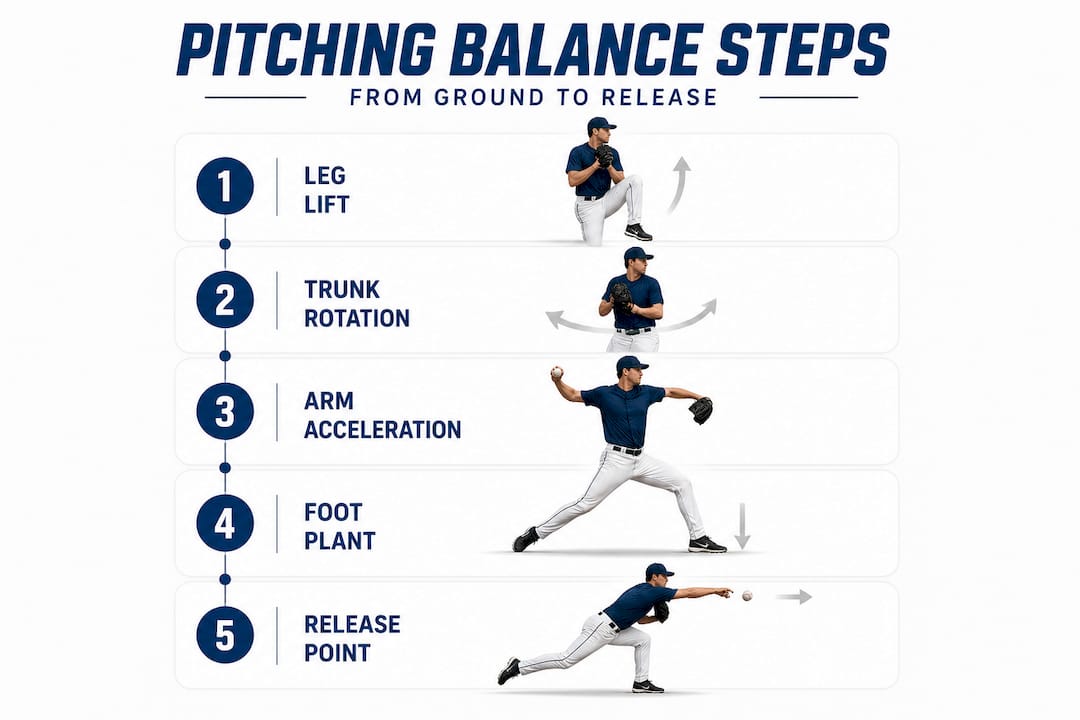
The pitching motion is a chain reaction. It starts at the ground, moves through the hips, travels up through the core and trunk, and finally releases through the arm and hand. Every link in that chain depends on the one before it. If any link is weak or mistimed, the whole chain loses efficiency.
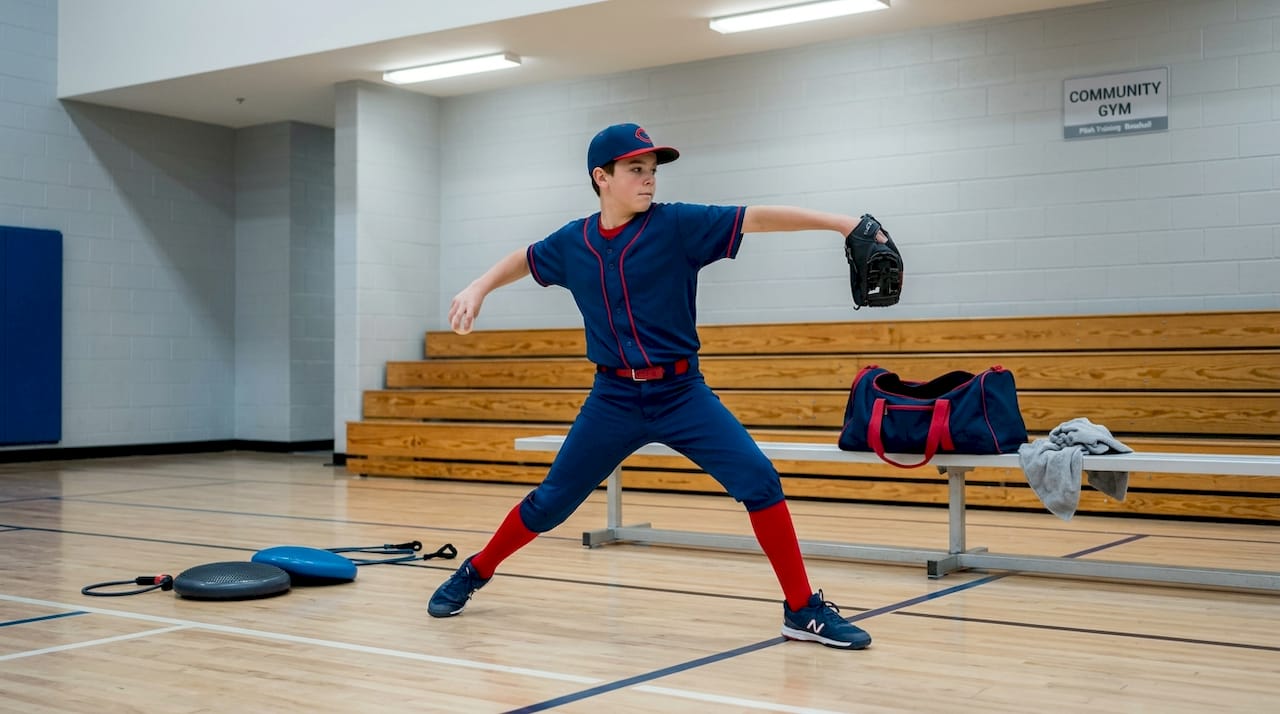
Here’s how the key phases connect:
| Phase | Body part involved | Balance demand |
|---|---|---|
| Windup and leg lift | Stance leg, core | Single-leg stability, hip control |
| Stride | Hips, pelvis | Controlled forward momentum |
| Hip rotation | Pelvis, lower core | Timed rotation without early trunk opening |
| Trunk rotation | Upper core, spine | Coordinated follow-through after hips |
| Arm acceleration | Shoulder, elbow | Stable platform from trunk and hips |
| Follow-through | Full body | Deceleration without falling off the mound |
Research on collegiate pitchers found that the trunk twist angle on the throwing-arm side strongly correlates with ball speed, with a correlation coefficient of 0.64. That’s a strong relationship. It means that how well a pitcher rotates their trunk, not just how hard they try to throw, is a major driver of velocity.
The concept of center of mass (where your body weight is centered) and center of pressure (where force is applied through the feet) is also critical. When these two points stay aligned and move together smoothly, the pitcher stays in control. When they drift apart, balance breaks down. Studies show that balance training can actually change how the body manages this relationship between center of mass and center of pressure, leading to better overall stability.
Pro Tip: Don’t just train the arm. When you work on pitching drills for baseball or improving softball pitching balance, always include drills that challenge the hips and core together. That’s where real balance gains happen.
Tools like wobble boards and balance pads are useful precisely because they force the body to constantly adjust its center of mass. This trains the small stabilizing muscles in the hips, ankles, and core that don’t get much attention during regular throwing practice. Over time, those muscles become better at keeping the pitcher on track during the delivery.
Practical ways to train pitching balance at home or practice
The good news is that you don’t need a fancy facility or expensive equipment to start building better pitching balance. Many of the most effective drills require nothing more than a flat surface and a little focus. Here’s a step-by-step progression that works for players from about age 8 and up.
-
Single-leg balance hold: Have the pitcher stand on their stride-leg side, lift the opposite knee to hip height, and hold for 10 seconds. Eyes open first, then eyes closed for an added challenge. This builds the foundational stability needed during the windup.
-
Rocker drill: The pitcher goes through the leg lift phase of the windup in slow motion, pausing at the top of the lift for a full two seconds before striding forward. This teaches control at the most vulnerable moment of the delivery.
-
Step and hold: The pitcher takes a full stride forward and freezes in the landing position, holding for three seconds before completing the throw. This reinforces a stable landing position before the arm even gets involved.
-
Eyes-closed balance walk: Walk a straight line heel to toe with eyes closed. This sounds simple but is surprisingly hard for kids who rely on visual cues for balance. It trains the proprioceptive system, which is the body’s internal sense of position.
-
Wobble board pitching stance: Have the pitcher stand on a wobble board or balance pad in their pitching stance for 30 seconds at a time. Progress to practicing the leg lift on the board once they’re comfortable.
-
Dynamic step-and-throw: Using a pitching target net, have the pitcher take a lateral step, reset their balance, and then deliver a throw to a specific zone. This connects balance training directly to throwing accuracy.
Research confirms that postural balance training in both stable and unstable conditions produces measurable improvements in stability, even when the training isn’t sport-specific. When you apply these principles directly to pitching movements, the transfer to the mound is even stronger.
Pro Tip: Consistency beats intensity every time. Five minutes of focused balance work before every throwing session will do more for a young pitcher than one long balance workout per week. Repetition builds the neural pathways that make balance automatic.
A few common mistakes to avoid: Don’t push young players to unstable surfaces too quickly. Build single-leg stability on flat ground first. Also, avoid letting players rush through balance holds. The pause is the point. Rushing defeats the purpose entirely. You can also add fun challenges like tossing a sliding mitt for pitchers back and forth while maintaining a single-leg stance to keep youth pitching drills engaging for younger athletes.
Why most youth pitching balance advice falls short
Here’s something we’ve noticed after working with countless parents and coaches: the most common balance advice given to young pitchers is “stay balanced.” That’s it. Two words, no context, no progression, no feedback. And it almost never works.
The problem isn’t that coaches don’t care. It’s that vague cues don’t give a young athlete anything concrete to act on. Telling a 10-year-old to “stay balanced” is like telling them to “throw better.” It sounds right but provides zero actionable direction.
What actually works is a structured progression. Start with static holds. Build to slow-motion mechanics. Then add dynamic movement. Then add a ball. Then add a target. Each step gives the player a specific challenge they can succeed at and build on. Without that ladder, kids either get frustrated and disengage or develop compensations that look like balance but are actually just workarounds.
Another gap we see constantly is the lack of feedback loops. Balance training only sticks when players can feel the difference between balanced and unbalanced movement. Drills that include a pause, a hold, or a target force that awareness. Throwing at a wall with no feedback doesn’t.
Parents and coaches deserve resources that show not just what to do but how to progress from one level to the next. Generic tip lists don’t cut it. The athletes who improve fastest are the ones whose coaches use evidence-based pitching tools and build training around incremental, measurable challenges. That’s the standard worth holding yourself to.
Take the next step toward better pitching balance
The drills and principles in this article are a strong starting point, but having the right tools makes a real difference in how quickly young pitchers improve.

At Pitch Training Baseball, we’ve designed our equipment specifically for youth athletes working on exactly these skills. Our pitch training baseball system gives players a structured way to practice mechanics with real feedback built in. Our colorful pitching target net turns balance-focused throwing drills into engaging, goal-oriented sessions that kids actually want to repeat. Whether you’re a parent setting up a backyard practice or a coach running a team session, you’ll find everything you need in our baseball training essentials collection. Give your pitcher the tools to build real, lasting balance from the ground up.
Frequently asked questions
What age should players start training balance for pitching?
Players can benefit from balance drills as young as 7 to 8 years old, starting with simple single-leg holds and progressing to more dynamic movements as they develop coordination and strength.
How long does it take to see improvement in pitching balance?
With consistent, focused balance work integrated into every practice session, many young pitchers show visible improvement within 2 to 4 weeks.
Are balance drills safe for all youth pitchers?
Yes, when age-appropriate progressions and safe equipment are used, balance training is both safe and highly beneficial for developing athletes at every skill level.
Can poor balance increase injury risk for young pitchers?
Yes, breakdowns in balance disrupt trunk and pelvis control during the delivery, which places extra stress on the shoulder and elbow and raises the risk of overuse injuries.
Is pitching balance only important for power, or does it help with control too?
Pitching balance supports both. The kinetic chain balance that drives velocity is the same chain that keeps the arm on a consistent path, making balance essential for accuracy and control as well.