


For most youth players, the smartest setup pairs a compact practice mound for daily bullpen reps with a 6-inch portable game mound for actual games. Coaches and travel teams that play in multiple divisions often need both. Parents working solo at home usually only need the practice mound. The rest of this guide walks through which one fits your situation, how to size it correctly, and how to set it up safely.
TL;DR:
- Most youth leagues use a 6-inch mound for players aged 9 to 12, with higher heights for older divisions, so verify your league’s specific specifications before purchasing.
- Proper slope design of about 1 inch of rise per foot of run ensures consistent mechanics and reduces injury risk, making slope accuracy critical for safety and performance.
- Lightweight practice mounds under $200 are ideal for backyard or indoor use but may lack the realism and durability needed for tournament-level play, which typically costs over $500.
- Using a pitching target net alongside a mound and balls provides essential command and accuracy training, especially for younger players building confidence.
- Always set up on flat, firm ground, check for stability, and transport the mound carefully, especially if it is full-size, to prevent damage and ensure safety during use.
Table of Contents
- Types of Portable Pitching Practice Equipment
- How Do You Choose the Right Mound Height and Size?
- How Do You Safely Transport and Set Up a Portable Mound?
- What Drills Work Best on a Portable Mound?
- Why Consistent Mound Slope Matters for Safety and Skill
- How Pitch Training Baseball Kits Fit a Portable Setup
- A Coach’s Take on What Actually Matters
- Sources
- FAQ
Types of Portable Pitching Practice Equipment
Not every mound serves the same purpose, and buying the wrong category is the single most common mistake parents make. Four types cover almost every use case.
Practice mounds are lightweight, often foam or molded plastic shells designed for garages, backyards, and gyms. They sacrifice some realism for the ability to carry them with one hand and store them in a closet.
Youth game mounds are built heavier, with a full-size shell, turf top, and a slope that matches actual league regulation. They’re meant to sit on a field for tournament day, not get hauled in and out of a minivan every afternoon.
Compact wedges are the stripped-down version. Just enough rise to teach a downhill pitching motion, minimal footprint, and usually the cheapest entry point into mound work.
Pitching mats skip the slope entirely and focus on a flat, durable throwing surface with a marked rubber. They’re the right call for pure mechanics and target work when elevation isn’t the priority.
Here’s how that breaks down by situation:
- Indoor training or garage sessions — practice mound or flat mat, both easy to store between uses
- Daily backyard reps — practice mound, light enough for a kid to set up alone
- Tournament or league game day — full-size youth game mound built to league height and slope
- Bullpen and command work — either a practice mound or wedge, depending on how much slope feel you want
The tradeoff runs in a predictable direction: more realism means more weight, more cost, and more storage space. A full-size game mound costs more and takes up real garage real estate, but it matches what a pitcher will feel on the field. A practice mound costs less and moves in seconds, but it won’t replicate tournament conditions exactly.
How Do You Choose the Right Mound Height and Size?
Height is the decision that matters most, and it’s tied directly to your player’s division. Get this wrong and you’re either training bad habits or wasting money on a mound your kid will outgrow in one season.
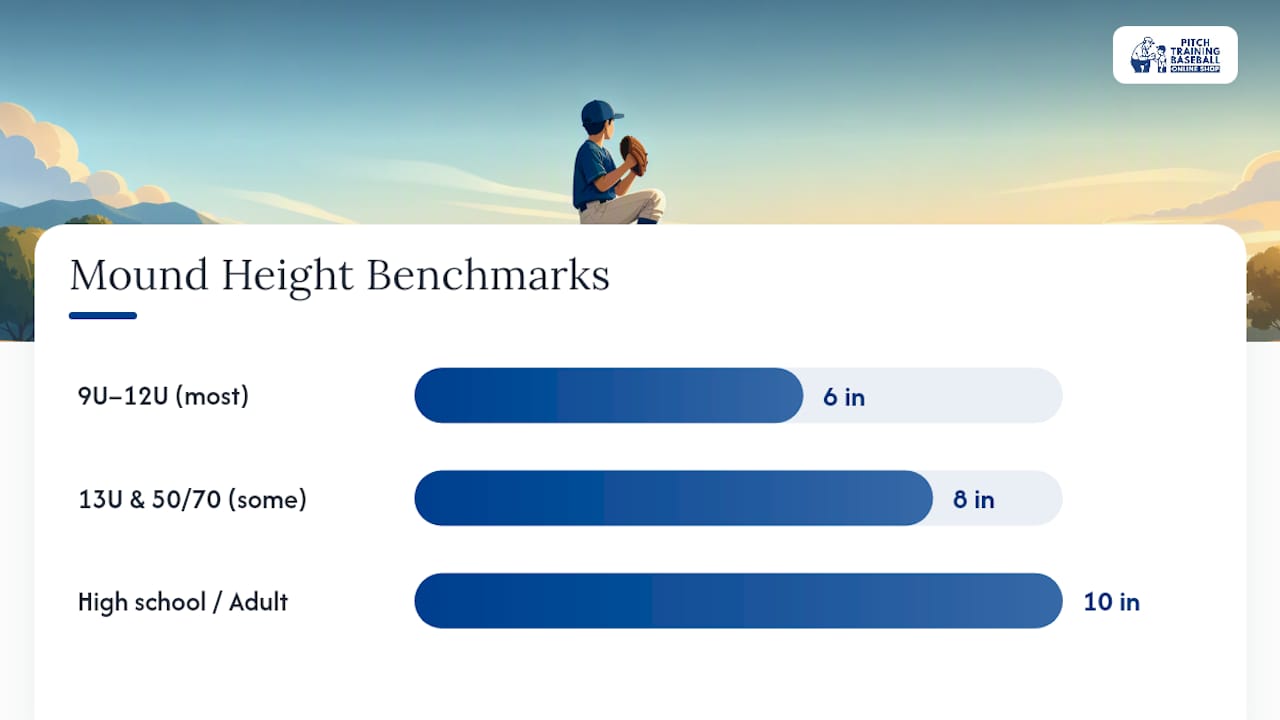
Most youth programs use a 6-inch mound for the 9U through 12U range, stepping up to 8 inches for some 13U and 50/70 divisions, according to Baseball Scouter’s youth mound guide. High school and adult regulation sits at 10 inches. Before you buy, check your own league’s rulebook. Little League’s official field specifications list exact heights and pitching distances by division, and those numbers can vary slightly by district or tournament organizer.
Pro Tip: Don’t guess at your division’s height from memory. Pull up your league’s current specification sheet the same week you shop, since some districts adjust mound rules season to season.
Slope matters just as much as height. A well-designed mound uses a gradual, repeatable slope of about 1 inch of rise per foot of run, paired with a landing zone long enough for a secure plant step, per Portable Shop’s buying guide. A mound that drops off too fast near the front edge teaches a pitcher to shorten their stride, which is exactly the wrong habit to build.
Run through this checklist before you buy:
- Height matches your division and, ideally, has room to adjust as your player moves up
- Slope is gradual and consistent, not a sharp drop near the pitching rubber
- Footprint fits your space — measure your garage, backyard, or bullpen lane first
- One-piece vs. two-piece construction — two-piece designs split the weight for easier solo carrying
- Material holds up outdoors if you’ll use it on grass or asphalt regularly
Portable mounds run anywhere from budget practice models under $200 to full-size youth game mounds well past $500, with the gap driven mostly by shell construction and turf quality, based on Baseball Scouter’s cost breakdown. Warranty coverage varies by manufacturer, so check whether the rubber and turf top are replaceable parts before you commit. A mound with swappable rubbers will outlast one where the whole top has to be replaced.
How Do You Safely Transport and Set Up a Portable Mound?
Full-size game mounds are heavy enough that they deserve two sets of hands. Practice mounds are light enough that one parent or player can usually manage several trips without strain.
Once you’re at the field or in the yard, run through this setup sequence every time:
- Scout a flat, firm spot free of holes, roots, or soft ground that could shift under weight.
- Clear debris — rocks, sticks, and loose turf can throw off the mound’s stability or damage the base.
- Align the rubber to the pitching axis so the mound points squarely at home plate or your target net.
- Press down on the base to seat it into the ground before anyone throws off it.
- Check for rocking by stepping on the front and back edges. If it shifts, reposition or add support underneath.
For indoor use, lay a rubber mat or turf square under the mound to protect gym floors and add grip. Outdoors on hard surfaces like asphalt, a mat also cuts down on slipping.
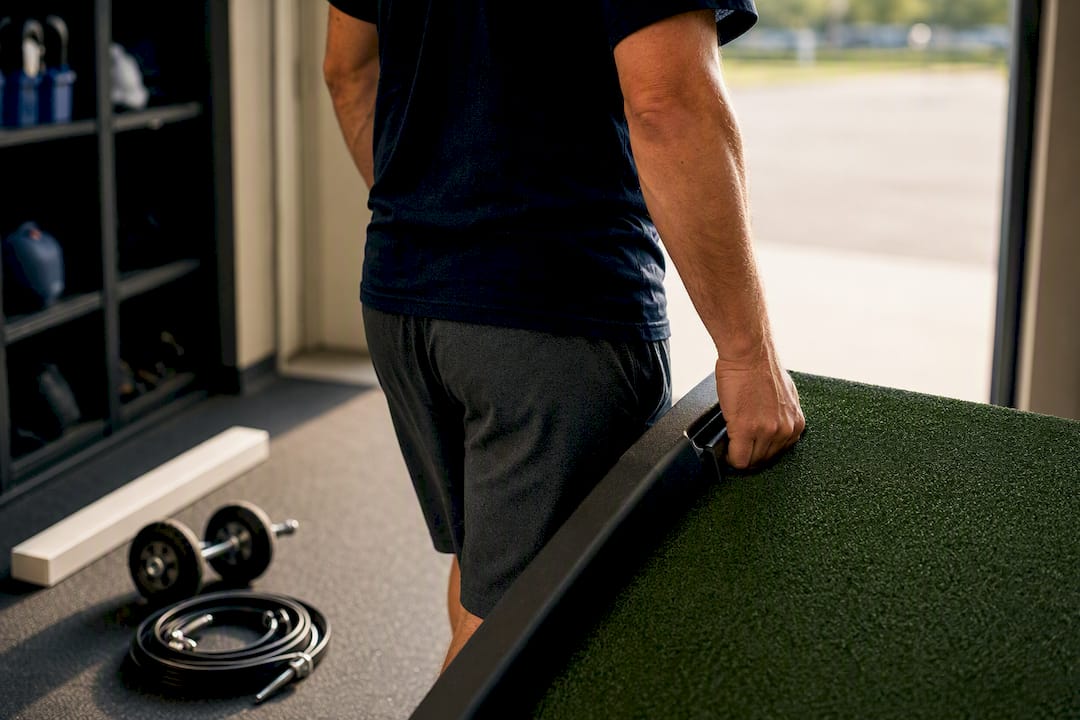
Maintenance is quick but easy to skip. Inspect the pitching rubber for wear before each season, store the mound dry to prevent mold or warping, and keep a spare rubber on hand since worn rubbers are one of the most common annual replacement items. Two-piece mounds with molded handles and wheel kits cut setup time noticeably for volunteer coaches hauling gear between fields.
What Drills Work Best on a Portable Mound?
A mound is only as useful as the drills you run on it. Keep sessions short. Fifteen to twenty minutes of focused work beats an hour of unstructured throwing, especially for younger arms still building durability.
A basic mechanics-focused bullpen looks like this: five minutes of flat-ground stretching, five minutes of balance-point holds off the mound to reinforce a stable landing leg, then ten to fifteen pitches at half speed focused purely on stride length and glove-side direction.
For command work, shift to target-based reps. This is where a pitching target net earns its keep, giving a pitcher a visual zone to hit instead of just throwing at a general area. Run 10 to 15 pitches split between the corners of the zone, tracking makes and misses out loud.
A few drills specifically need the slope to work:
- Stride and landing drills that isolate how the front foot plants on a downhill surface
- Balance holds at the top of the leg lift, checked from the side with a phone camera
- Directional target reps aimed at glove side and arm side corners in alternating sets
Video feedback from a basic phone camera, reviewed right after the bullpen, catches mechanical issues faster than verbal coaching alone. And for youth arms, rest matters as much as reps. Cap bullpen days according to your league’s pitch count rules and never stack two mound sessions back to back without a rest day between them.
Why Consistent Mound Slope Matters for Safety and Skill
League specifications exist for a reason beyond compliance. A mound built to the wrong height or an inconsistent slope changes how a pitcher’s body absorbs force on landing, which affects both performance and injury risk over a season of repeated throws.
Little League’s field specifications spell out mound height and pitching distance by division, and those numbers form the baseline every portable mound should be measured against before it touches a game field.
The consensus among youth training resources lines up: consistent slope geometry supports safer mechanics and keeps competition fair across teams using different mounds. That’s the same principle Pitchtrainingbaseball builds its training content around, whether it’s a distance breakdown for a specific division or a full session plan for backyard reps.
How Pitch Training Baseball Kits Fit a Portable Setup
A mound gets a pitcher on the right slope. What happens on top of it still comes down to the ball, the target, and the reps. That’s the gap Pitchtrainingbaseball fills for families and coaches who already have a mound and need the rest of a real bullpen setup.

The PITCH TRAINING BASEBALL KIT™ is built around hard-pitch balls designed for accuracy and control work, sold as a one-time purchase with no subscription or recurring commitment attached. It suits players and coaches who already have a mound in place and want a structured way to run command drills against a target rather than just throwing into open space.
For younger players or indoor sessions where a regulation ball isn’t practical, the SOFT PITCH TRAINING BASEBALL KIT™ covers the same drill structure with a softer ball better suited to garages, basements, and beginner arms still building confidence. Pair either kit with a pitching target net and you’ve got a complete portable bullpen: mound, ball, and target, all of it storable and ready for the next session. Coaches outfitting a whole roster with mounds and kits might also look at custom team apparel to round out the setup. Browse the full kit lineup and pick the one that matches your player’s stage.
A Coach’s Take on What Actually Matters
Most of the mound-buying advice out there obsesses over brand and turf color. What actually protects a young arm is slope consistency, a height that matches the division, and lifting the thing correctly so nobody throws out their back in the driveway. Get those three right and the rest is preference.
Before every session, run this quick checklist: mound height matches the division, slope feels the same every time you set it up, base is flat and non rocking, and two people lift anything full-size. Skip a step and you’re one bad landing away from a bad habit or a bad back.
— Albert
Sources
- Field specifications | Little League
- The Best Portable Pitching Mounds for Youth Leagues 2026 - Baseball Scouter
- Best Portable Baseball Pitching Mound: Top Picks, Benefits & Buying Guide – Portable Shop
FAQ
How Can I Practice Pitching at Home?
Set up a compact practice mound or flat pitching mat in your backyard or garage with a target net for accuracy work. Fifteen to twenty minute sessions focused on stride, balance, and command beat long, unstructured throwing days, especially for younger arms.
How Do I Make a DIY Portable Pitching Mound?
Most DIY versions use plywood or foam layered to create a gradual slope, roughly 1 inch of rise per foot of run, topped with turf or carpet for grip. Building one takes real time and tools, and it rarely matches the durability or exact league height of a manufactured mound.
How Much Does a Portable Pitching Mound Cost?
Budget practice mounds start under $200, while full-size youth game mounds with turf tops and heavier shells run well past $500, according to Baseball Scouter’s cost breakdown. If you just need balls and a target to pair with a mound you already own, the PITCH TRAINING BASEBALL KIT™ runs $29.99 one time.
How Fast Do 12 Year Old Little League Pitchers Pitch?
Speeds vary widely by player development. Confirm your exact division’s mound height and pitching distance through Little League’s field specifications before assuming a number.
Are Portable Mounds Allowed in Game Play?
Many leagues permit portable mounds as long as they meet height, slope, and footprint requirements, but rules vary by district and tournament. Always confirm with your league before relying on a portable mound for an official game.