


Little League pitching distance is 46 feet for Majors and every division below it, 50 feet for Intermediate (50/70), and 60 feet 6 inches for Junior and Senior League. That measurement runs from the back tip of home plate to the front edge of the pitcher’s rubber, not from the mound’s edge or any painted line.
- 46 ft: Majors, Minors, and below (most players ages 9-12)
- 50 ft: Intermediate (50/70), a transitional division for ages 11-13
- 60 ft 6 in: Junior and Senior League
Quick note: local leagues can shorten regular-season distances to fit their players, but official field specifications apply once tournament play starts. Check your league’s board before setting up a field or a bullpen session.
Key Takeaways
Little League pitching distance scales from 46 feet through Intermediate’s 50 feet up to 60 feet 6 inches, and matching training to the correct distance protects young arms while building real command.
| Point | Details |
|---|---|
| Know the three distances | 46 ft (Majors and below), 50 ft (Intermediate 50/70), 60 ft 6 in (Junior/Senior). |
| Measure it right | Always run the tape from the back tip of home plate to the front edge of the rubber. |
| Confirm with your league | Local boards can shorten regular-season distances, so check before setting up a field. |
| Prioritize mechanics over distance | Command and repeatable delivery matter more than added distance during transitions. |
| Track control, not just velocity | Watch walks and strike rate closely when a pitcher moves up a division. |
Table of Contents
- Little League Pitching Distances by Division, Explained
- How Do You Measure Pitching Distance Correctly?
- Why Little League Scales Pitching Distance by Age
- Coaching Drills for Each Pitching Distance
- Why Coaches Trust Pitchtrainingbaseball for Distance-Specific Training
- What Actually Matters When You’re Setting Up Pitching Distance
- Frequently Asked Questions
- Sources
Little League Pitching Distances by Division, Explained
Every division in Little League scales its field to match the age and strength of the kids playing on it. That’s not an accident. It’s built into the official field specifications, and it’s the reason a 10-year-old pitcher and a 14-year-old pitcher never stand on the same rubber.
Tee Ball sits at the youngest end, with basepaths commonly set at 50 feet and no pitching distance to speak of since kids hit off a tee or a coach toss. Minor League and Major Division both use 60-foot basepaths with a 46-foot pitching distance, which covers the bulk of Little League games played across the country. Intermediate (50/70) bumps basepaths to 70 feet and pitching distance to 50 feet. It’s built specifically for 11 to 13 year-olds making the jump toward a full-sized diamond. Junior and Senior League go all the way to 90-foot basepaths and the 60-foot 6-inch pitching distance used in high school and beyond.
Girls’ softball runs its own scale, and mixing it up with baseball distances is one of the more common mistakes parents make when setting up a backyard practice area.
| Division | Pitching Distance | Basepaths |
|---|---|---|
| Tee Ball | Not applicable | 50 ft |
| Minor League | 46 ft | 60 ft |
| Major Division | 46 ft | 60 ft |
| Intermediate (50/70) | 50 ft | 70 ft |
| Junior/Senior League (baseball) | 60 ft 6 in | 90 ft |
| Minor softball | 35 ft | varies by league |
| Majors softball | 40 ft | varies by league |
| Junior/Senior softball | 43 ft | varies by league |
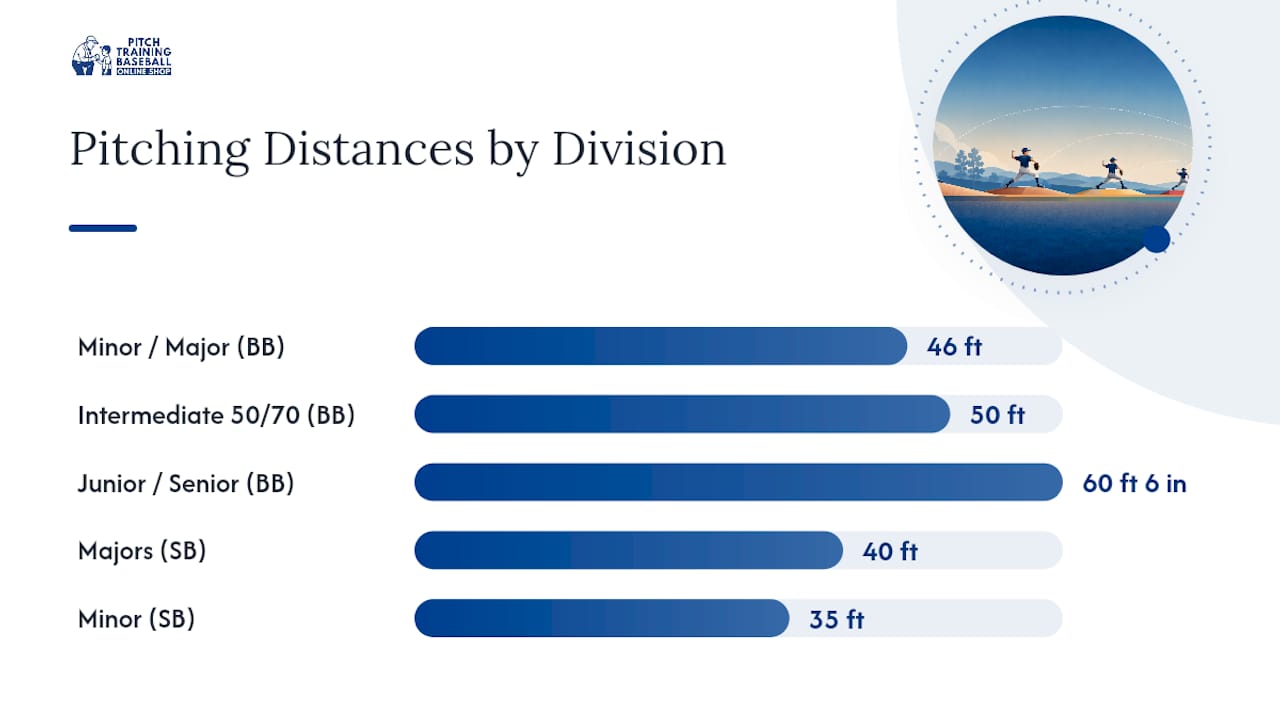
If you’re coaching a co-ed rec league or you’ve got kids in both baseball and softball, keep that softball column handy. A 40-foot softball rubber and a 46-foot baseball rubber look similar enough at a glance to cause a setup error during a rushed field prep before a Saturday doubleheader.
How Do You Measure Pitching Distance Correctly?
Getting the number right on paper doesn’t help if the rubber ends up in the wrong spot. Here’s how to measure it the way Little League’s official field guide specifies:
- Find the back tip of home plate, the point farthest from the batter’s box.
- Run a tape measure or measuring wheel straight toward second base.
- Stop at the required distance for your division: 46 feet, 50 feet, or 60 feet 6 inches.
- Mark that point. That’s the front edge of the pitcher’s rubber, not the center and not the back edge.
- Confirm the rubber itself measures 24 inches by 6 inches and sits centered in an 18-foot mound circle.
Pro Tip: Measure from the back tip of the plate every single time, even on fields you’ve used for years. Sod repairs, plate replacements, and mound rebuilds shift things more than you’d expect, and a rubber that’s even a foot off changes everything about how a kid’s fastball plays.
On temporary or borrowed fields, run the tape twice. Youth tournaments often set up on multipurpose parks where lines get repainted between age groups, and a mound built for 46 feet doesn’t always get moved before an Intermediate game kicks off an hour later.
Why Little League Scales Pitching Distance by Age
The graduated distances exist for one main reason: a young pitcher’s arm, shoulder capsule, and growth plates aren’t built to handle 60-foot-6 mechanics at age 10. Little League’s own field guidance ties the shorter distances directly to physical development and injury prevention, not just tradition.
- Shorter distances reduce the torque and arm speed a young pitcher needs to reach the plate with velocity.
- They keep the game competitive. A 9-year-old throwing 40 mph from 46 feet crosses the plate with roughly the same reaction window a high schooler creates throwing harder from 60 feet 6 inches.
- Local boards frequently shorten regular-season distances even further for younger or less experienced groups, saving the full standard for tournament play.
The bigger risk isn’t the distance itself. It’s what happens during the jump between distances. When a pitcher moves from 46 to 50 feet, or from 50 to 60 feet 6 inches, mechanics that worked fine at the shorter distance often break down under the added throw. Coaches should watch control metrics, walks allowed, strikes thrown, more closely than velocity during that stretch. A sudden spike in walks or a kid rubbing his shoulder between innings matters more than how hard he’s throwing.
Coaching Drills for Each Pitching Distance
Training should match the rubber your pitcher will actually stand on come game day, and incorporating simple at-home toss activities like the Handheld Ball Catch Game – Best Kids Toys can help younger players develop accuracy and hand-eye coordination. Here’s a rough progression that works across a season:
- At 46 feet: Set up short-distance accuracy work using a fixed target, quadrants of the strike zone, and reward strikes over velocity. This is where the Pitching Target Net with Colorful Strike 9-Zone earns its spot in a bag, since it gives pitchers instant visual feedback on location instead of just guessing where the ball landed.
- At 50 feet (Intermediate): Shift toward control-under-pressure drills, live at bats, simulated counts, runners on base, since this distance is where command starts to matter more than raw stuff.
- Preparing for 60 feet 6 inches: Add long-toss and mechanics-focused bullpens that emphasize a repeatable delivery before chasing added distance. Rushing this step is where a lot of arm trouble starts.
Structure the whole progression over several weeks rather than days: accuracy first, then control under game-like pressure, then incremental distance increases in supervised bullpen sessions, never in a live game.
Pro Tip: Track pitch counts every single outing, not just in games. A kid who throws 40 pitches in a bullpen and 60 in a game that same week has thrown 100, and his arm doesn’t know the difference between practice and competition. Pair that habit with the routines in our recommended daily pitching habits guide and our safe pitching tools rundown for warm-up routines that actually reduce soreness.
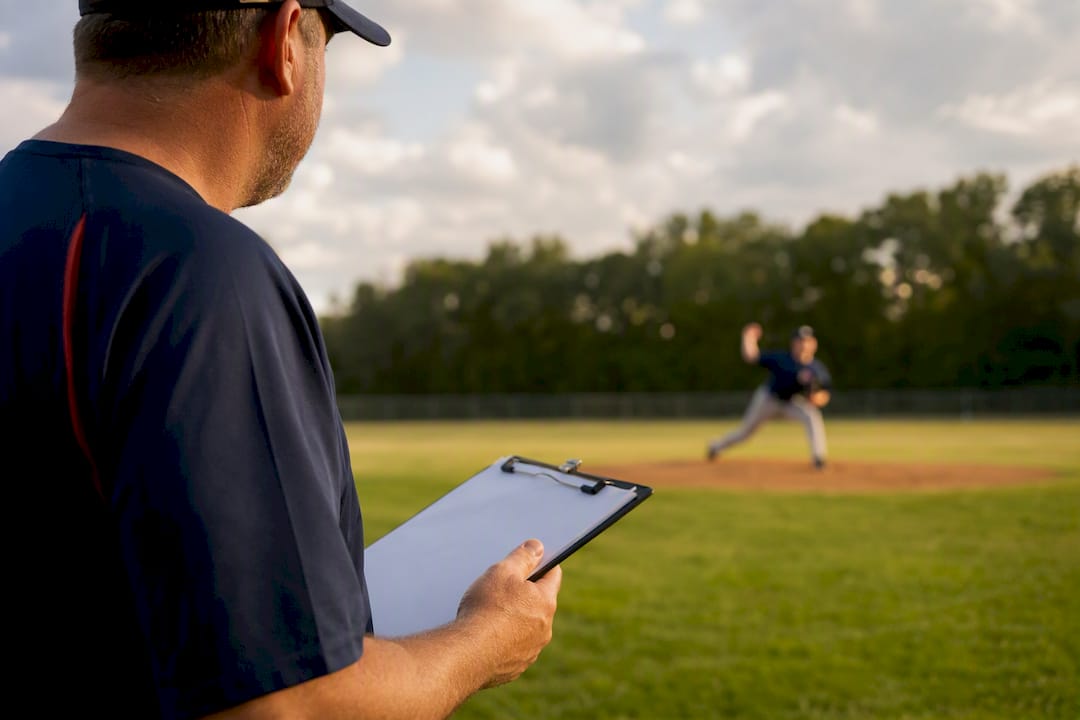
Why Coaches Trust Pitchtrainingbaseball for Distance-Specific Training
Pitchtrainingbaseball built its entire product line around one problem: giving young pitchers accurate, repeatable feedback at whatever distance they’re actually throwing from. That focus shows up in a few concrete ways.
- Strike zone target nets let a pitcher self-correct at 46 feet without a coach standing behind the plate every single rep.
- Soft and hard training balls let families practice grip and control work safely in a backyard or driveway, no full field required.
- Included eBooks on pitching grips help parents coach fastball and changeup mechanics correctly, even without a baseball background.
| Distance | What to Prioritize | Tool That Helps |
|---|---|---|
| 46 ft | Strike zone accuracy | Target net with zone markings |
| 50 ft | Command under pressure | Live-count bullpen work |
| 60 ft 6 in prep | Mechanics before velocity | Long-toss with grip-focused balls |
What Actually Matters When You’re Setting Up Pitching Distance
Most of the confusion around little league pitching distance doesn’t come from the numbers themselves, it comes from treating them as fixed when they’re not. Local flexibility during the regular season is a feature, not a loophole, and coaches who ignore it because “that’s not the real distance” are missing the entire point of a graduated system.
The bigger blind spot is what happens during transitions. Parents obsess over hitting the next distance milestone, 46 to 50, 50 to 60’6", as if crossing that line is the achievement. It isn’t. A pitcher who reaches 60 feet 6 inches with shaky mechanics and no command is worse off than one who stayed at 50 feet another season and built real control. The distance a kid throws from matters far less than whether his delivery holds up once he gets there.
If you take one thing from this: measure correctly, respect the transitional divisions, and never rush a mechanics fix by simply adding distance.
Frequently Asked Questions
What is the little league pitching distance for 12u? Most 12-year-olds play in the Major Division, which uses a 46-foot pitching distance. Some 12-year-olds playing Intermediate (50/70) pitch from 50 feet instead, depending on league assignment.
Is the pitching distance measured to the mound or the rubber? Neither the mound’s edge nor its center. Measurement runs from the back tip of home plate to the front edge of the pitcher’s rubber, per CoverSports’ field guide.
Can a local league change the pitching distance? Yes, for regular-season play. Local boards can shorten distances to fit player development, though official specifications apply during tournament play.
What is the youth baseball pitching distance in Intermediate (50/70)? 50 feet, paired with 70-foot basepaths. It’s a transitional division built for players roughly 11 to 13 years old moving toward a full-sized field.
Are softball and baseball pitching distances the same? No. Softball uses 35 feet in Minors, 40 feet in Majors, and 43 feet in Junior/Senior, all shorter than the equivalent baseball distances.
When should a pitcher move from 46 feet to 50 feet? When league age assignment places them in Intermediate (50/70), typically around ages 11 to 13, and when their mechanics and control are solid enough to handle the added distance without breaking down.
Sources
- Little League Field Dimensions: Official Measurements | CoverSports
- Field specifications - Little League
Recommended
- Why Monitor Pitch Counts: A 2026 Safety Guide – Pitch Training Baseball
- Pitching Trends in 2026: What Coaches Must Know – Pitch Training Baseball
- How to Plan Pitcher Rotations for Youth Baseball – Pitch Training Baseball
- Baseball Pitching Trainers Comparison: 2026 Buyer’s Guide – Pitch Training Baseball