


Which pitching trainers and machines are the best for 2026?
For most players and parents comparing pitching trainers right now, the short answer is this: Jugs and Spinball Sports lead the field for versatility and game-realistic training, Iron Mike earns its place in schools and facilities for sheer durability, and Heater Sports is the pick for competitive players chasing velocity gains. Louisville Slugger and Sports Attack fill real gaps at the youth and beginner end. No single machine is right for every player, and the differences between them matter more than most buyers realize before they spend.
The six brands below cover every major player level and training goal in the US market. Each one has a distinct design philosophy, and matching that philosophy to your player’s actual needs is the whole game.
| Brand | Best For | Training Focus | Key Features | Portability | US Availability |
|---|---|---|---|---|---|
| Heater Sports | Intermediate to advanced | Velocity and precision | Adjustable speed, industrial-grade build | Moderate | Widely available |
| Iron Mike | Entry-level to intermediate | Consistent delivery, mechanics | Mechanical arm design, easy transport | Good | Widely available |
| Jugs | All levels, indoor and outdoor | Accuracy, pitch variety | Adjustable arc and speed, pitch type variety | Good | Widely available |
| Louisville Slugger | Youth and recreational leagues | Fundamentals, user-friendliness | Compact, easy setup, multiple pitch styles | Excellent | Widely available |
| Spinball Sports | Advanced players | Spin variation, game simulation | Programmable drills, curveball/slider/changeup simulation | Moderate | Available online |
| Sports Attack | Beginners and small leagues | Basic skill development | Lightweight, easy speed adjustment, protective housing | Excellent | Widely available |
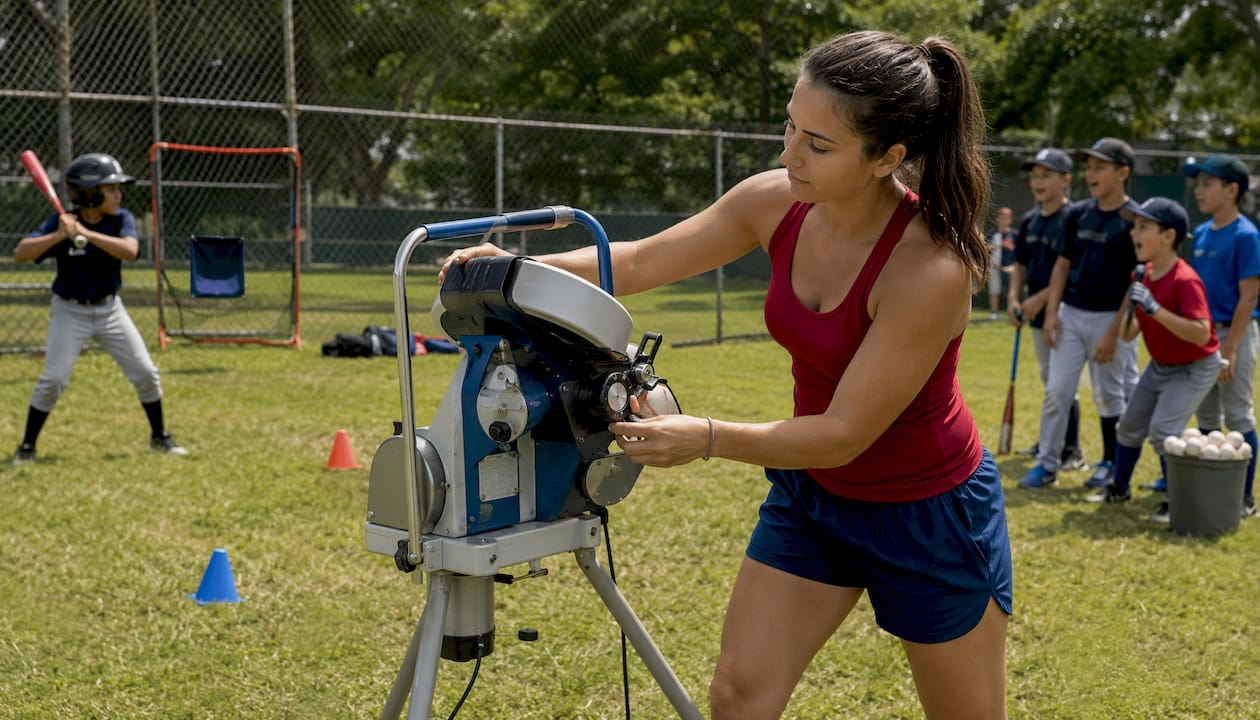
Heater Sports machines run on adjustable speed settings with industrial-grade components built to hold up through heavy use. That durability is what separates them from lighter consumer machines when a competitive pitcher is throwing daily. Iron Mike takes a different approach: a mechanical arm design that replicates a natural pitching motion, which is why you see them in school programs and training facilities where consistency matters more than pitch variety.
Jugs is the brand most coaches reach for when they need one machine to handle everything. The adjustable pitching arcs and speed ranges cover youth developmental work through high school practice, and the machines hold up indoors and out. Louisville Slugger’s compact, easy-setup design makes it the practical choice for recreational leagues and younger players whose parents need something they can actually operate without a manual.
Spinball Sports stands apart from the rest of this list because it does something the others don’t: it simulates real pitch movement. Programmable drills that replicate curveballs, sliders, and changeups give advanced hitters and pitchers a training environment that actually resembles a game. Sports Attack occupies the other end of the spectrum, lightweight and straightforward, built for beginners who need repetitions without complexity.
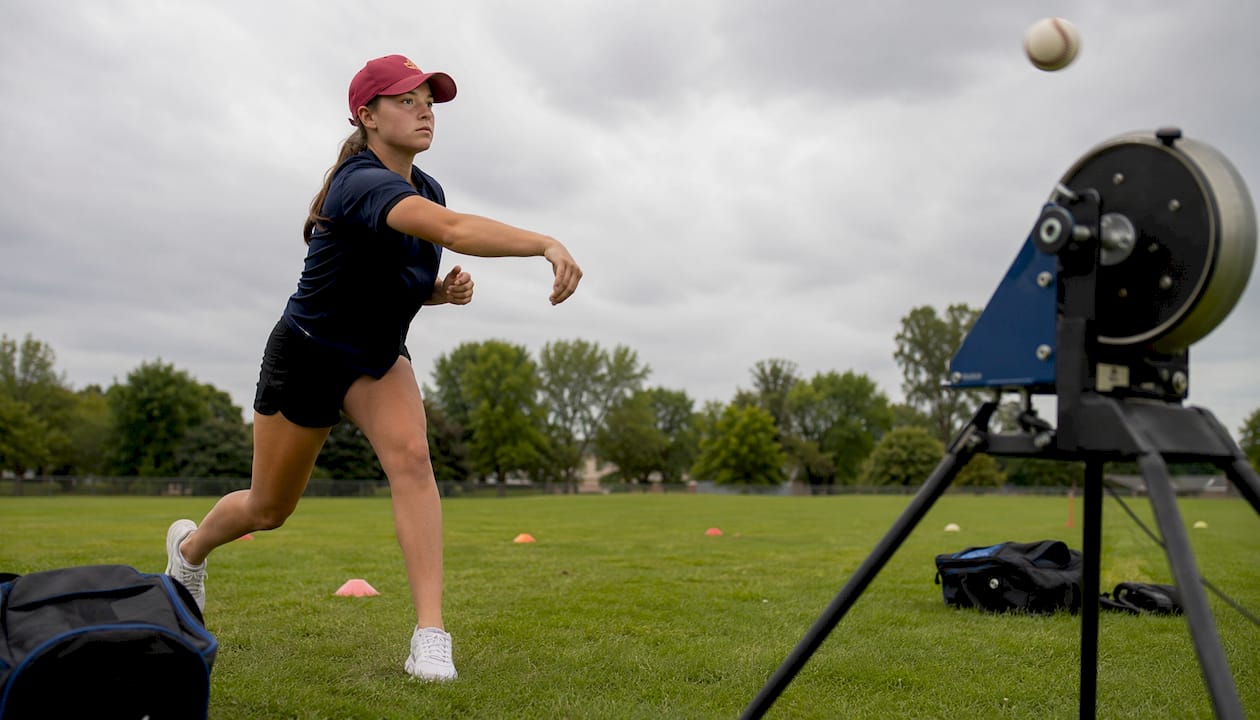
How do the top pitching machine brands actually compare?
The most important thing to understand about this baseball pitching trainers comparison is that price and player level are not the same variable. A $300 machine can be exactly right for a 10-year-old working on strike-throwing fundamentals and completely wrong for a 16-year-old trying to read pitch movement. The brands below differ on mechanics, training philosophy, and durability in ways that price alone won’t tell you.
Heater Sports is built for players who have already developed their mechanics and want to push velocity. The adjustable speed settings let coaches dial in specific pitch speeds for batting practice, and the industrial components mean the machine won’t degrade after a full season of daily use. The trade-off is that Heater Sports machines are less focused on pitch movement and more on replicating raw fastball velocity at consistent intervals.
Iron Mike earns its reputation in institutional settings. Schools and training facilities favor it because the mechanical arm design delivers a repeatable, natural-looking pitch that hitters can time without the machine introducing unpredictable variation. Portability is better than you’d expect for a machine this durable, which is why travel programs use them.
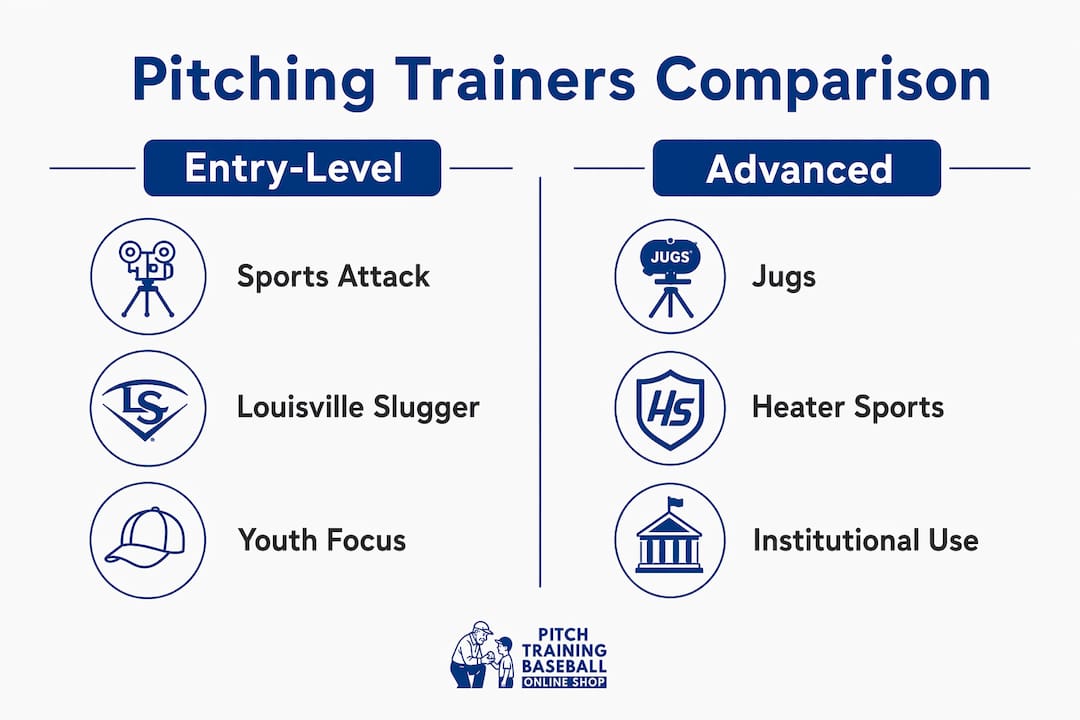
Jugs is the most versatile machine on this list. The combination of adjustable arc, speed range, and pitch type variety means one machine can serve a 9-year-old learning to track the ball and a high school pitcher working on pitch recognition in the same practice session. Jugs machines are also among the most widely stocked at sporting goods retailers, which matters for parts and service.
Louisville Slugger pitching machines are designed with youth players as the primary user. The compact footprint and simple setup mean a parent can get a machine running in a backyard in minutes. Multiple pitch style options give young players exposure to different ball paths without requiring a coach to operate the machine.
Spinball Sports is the most technically advanced option on this list for players who want game-realistic training. The ability to program spin variation, including curveballs, sliders, and changeups, gives advanced hitters something no standard two-wheel machine can replicate. Coaches running serious development programs use Spinball because it closes the gap between machine work and live at-bats.
Sports Attack keeps things simple on purpose. The lightweight build and easy speed adjustments make it accessible for beginners and small leagues that don’t have a dedicated equipment manager. The protective housing is a practical feature for youth settings where safety is a priority.
Pros and cons at a glance:
- Heater Sports: excellent velocity replication, durable build; less suited to pitch movement training
- Iron Mike: consistent mechanical delivery, good portability; limited pitch variety
- Jugs: versatile across all levels, widely available; higher price point for full-featured models
- Louisville Slugger: youth-friendly, easy setup; not designed for advanced development needs
- Spinball Sports: best spin and movement simulation available; higher cost, more complex setup
- Sports Attack: lightweight, beginner-friendly, affordable; limited features for advanced players
Maintenance and durability: Iron Mike and Heater Sports machines are built for institutional use and require minimal maintenance beyond standard cleaning and occasional belt checks. Jugs machines are similarly durable but have more moving parts given their pitch variety features. Louisville Slugger and Sports Attack machines are consumer-grade and will show wear faster under heavy daily use. Spinball Sports machines, given their programmable components, benefit from regular calibration checks to maintain spin accuracy.
Pro Tip: Before buying any pitching machine, confirm whether replacement parts are stocked domestically. Jugs and Iron Mike both have established US service networks; some newer brands require international shipping for components, which can sideline a machine for weeks.
How to choose a baseball pitching coach or trainer effectively
The credential that matters most is not the one printed on a business card. A coach with a USA Baseball coaching certification and five years of youth development experience will almost always outperform a former college player with no formal training background, regardless of how impressive their playing career sounds in a parent meeting.
What to look for in credentials and experience:
- USA Baseball or NFHS coaching certification for youth-level coaches
- Demonstrated experience with your player’s specific age group and skill level
- Specialization in pitching mechanics rather than general baseball coaching
- Familiarity with video analysis tools for diagnosing mechanical issues
- A clear philosophy on arm care and pitch count management
- References from current or former players at a similar development stage
Coaching style matters as much as credentials. Some coaches prioritize mechanical consistency above everything else, drilling the same motion until it becomes automatic. Others focus on feel and adaptability, teaching players to self-correct in real time. Neither approach is universally better, but the mechanical consistency model tends to produce faster results for younger players who are still building their foundational movement patterns.
Selection checklist for parents and players:
- Ask to observe a session before committing to a package
- Confirm the coach tracks pitch counts and follows age-appropriate rest guidelines
- Verify the coach uses objective feedback tools, not just subjective feel assessments
- Check whether the coach integrates arm care into every session, not just as an afterthought
- Ask specifically how the coach handles a player who is struggling or plateauing
Age and skill level alignment is non-negotiable. A coach who specializes in high school velocity development is not the right fit for a 10-year-old working on basic mechanics, even if their credentials look impressive. The best coaches for youth players understand that player development programs require long-term planning, not quick-fix approaches.
Pro Tip: A phone tripod and a free video app give you more diagnostic information than most radar guns. Record your player from the side and from behind the mound. A coach who can’t explain what they see in that footage probably isn’t analyzing mechanics as deeply as they should be.
What does pitching training actually cost?
Private pitching lessons in the US typically run $60–$120 per hour, depending on the coach’s credentials, location, and demand. Semi-private sessions with two or three players sharing a coach drop that per-player cost to roughly $30–$60 per session. Group clinics, which are common through local leagues and academies, can run as low as $15–$25 per player per session.
Equipment costs span a much wider range. Entry-level machines like Sports Attack and Louisville Slugger models start around $200–$400. Mid-range machines from Iron Mike and Jugs typically fall in the $500–$1,500 range depending on features. Heater Sports and Spinball Sports machines at the advanced end can run $1,500–$3,000 or more for fully featured models.
| Training Type | Typical Cost Range | Notes |
|---|---|---|
| Private pitching lesson (1 hour) | $60–$120 | Varies by coach credentials and market |
| Semi-private lesson (per player) | $30–$60 | 2–3 players sharing a coach |
| Group clinic (per player) | $15–$25 | League or academy setting |
| Entry-level pitching machine | $200–$400 | Sports Attack, Louisville Slugger |
| Mid-range pitching machine | $500–$1,500 | Iron Mike, Jugs |
| Advanced pitching machine | $1,500–$3,000+ | Heater Sports, Spinball Sports |
| Basic training aids (bands, targets) | $20–$100 | Resistance bands, strike zone targets |
| Radar gun (consumer grade) | $200–$400 | Bushnell Velocity, Pocket Radar |
Location affects lesson pricing more than most parents expect. Coaches in major metro areas like New York, Los Angeles, and Chicago command rates at the top of those ranges, while coaches in smaller markets often price closer to the floor. Coach credentials push prices up too: a former professional player or a coach with a proven track record of developing college-bound pitchers will charge more, and often deliver more.
One cost that buyers consistently underestimate is the ongoing investment in training aids alongside a machine. A pitching machine alone won’t develop command. Adding a quality strike zone target, resistance bands for arm care, and occasional video analysis sessions rounds out a complete training setup, and those additions typically add $100–$300 to the initial investment.
Where can you find qualified baseball pitching coaches?
Local baseball academies are the most reliable starting point. Established academies vet their coaches, maintain consistent scheduling, and often have multiple specialists on staff, so you can find someone who focuses specifically on pitching mechanics rather than general skills. Many academies also offer trial sessions, which lets you evaluate a coach before committing to a full package.
Practical sources for finding coaches:
- Local travel baseball organizations and club teams
- High school and college baseball programs (many coaches offer private lessons)
- USA Baseball’s coach finder and affiliate programs
- Perfect Game and PBR (Prep Baseball Report) event networks, which connect players with coaches at showcases
- Online platforms like CoachUp and TakeLessons, which list verified coaches by location and specialty
- Baseball academies affiliated with MLB teams’ youth development initiatives
Evaluating a coach’s reputation requires more than reading reviews. Ask for references from current clients at a similar age and skill level to your player. A coach who works primarily with high school pitchers may not have the patience or methodology for a 9-year-old, even if their reviews are excellent. Specialization is the variable most parents overlook when searching for youth pitching coaches.
Verifying credentials and fit:
- Confirm USA Baseball, NFHS, or equivalent coaching certification
- Ask about their approach to pitch count limits and arm care
- Request a sample session plan to see how they structure development
- Check whether they use video analysis or only subjective feedback
- Ask how they communicate progress to parents between sessions
Online coaching has expanded the options considerably. Platforms that offer video review services let players submit footage of their mechanics and receive detailed feedback from coaches who may not be local. This model works well for players in areas with limited access to specialized pitching coaches, and the cost is typically lower than in-person sessions.
Youth baseball pitching training tools and what the experts say
The most common mistake in youth pitching development is buying a tool before building a plan. Experts consistently caution that training aids without structure can lead to injury rather than improvement, particularly when velocity-focused tools get introduced before a player has established sound mechanics.
The right tool depends entirely on what the player needs to fix. Training aids fall into five distinct categories, and confusing them is where most buyers go wrong:
- Accuracy aids: strike zone targets, pocket targets, and nets with marked zones give immediate visual feedback on location
- Mechanics aids: stride mats, connection balls, and resistance bands used for movement prep address posture, direction, and timing
- Velocity-support tools: weighted ball systems and plyometric balls build arm strength and explosive mechanics, but only within a structured program
- Arm care tools: resistance bands and warm-up gear protect the rotator cuff and support recovery between sessions
- Feedback tools: radar devices, video tripods, and phone mounts turn every session into measurable data
Beginners benefit most from accuracy aids and mechanics tools. A simple strike zone target and a stride mat do more for a young pitcher’s development than a weighted ball program, because fundamentals come first before any velocity work makes sense. Advanced players can layer in weighted balls and plyometric tools once their mechanics are consistent enough to handle the added load.
Pro Tip: Pitchers who improve most combine arm care tools with performance tools in the same program. Resistance bands protect the rotator cuff during the recovery phase; weighted balls drive full-body velocity gains during the development phase. Running both simultaneously is not optional for serious development.
The 80/20 rule in youth baseball is worth understanding here: pitching, hitting, and catching drive roughly 80% of game outcomes. That means practice time and training tool investment should weight heavily toward pitching development, not split evenly across every skill. Coaches who apply this principle structure their sessions around the pitcher-batter confrontation, which is where games are actually decided.
On velocity benchmarks: for 13-year-olds, the average fastball sits in the 54–65 mph range, with 70 mph representing elite, high school-caliber output at that age. A pitcher tracking at the 50th percentile at 13 can expect roughly 5–6 mph of annual velocity gain through age 16, after which gains slow to 2–3 mph per year. Those benchmarks matter because they put training tool claims in context. A program promising 10 mph gains in a single offseason is selling something the biology doesn’t support.
Advanced command training benefits from targets with specific quadrant zones rather than generic nets. A large net with no marked zones gives a pitcher no feedback on where the ball actually went, which can reinforce bad habits over time. A target with clear zones forces the pitcher to aim at a specific location on every rep, which is how command actually develops.
Key Takeaways
The strongest pitching programs combine the right machine or training aid with qualified coaching and a structured development plan, not just the most expensive equipment.
| Point | Details |
|---|---|
| Match the machine to the player level | Beginners need Sports Attack or Louisville Slugger; advanced players benefit from Spinball Sports or Heater Sports. |
| Credentials matter in coaching | Look for USA Baseball or NFHS certification and confirmed experience with your player’s specific age group. |
| Velocity benchmarks are a compass | Average fastball for 13-year-olds is 54–65 mph; 70 mph at that age is elite, high school-caliber output. |
| Tools need a plan | Buying velocity aids without a structured program that includes arm care and mechanics work increases injury risk. |
| Pitchtrainingbaseball for youth accuracy | Pitchtrainingbaseball’s strike zone targets and training nets are built for the accuracy and mechanics work youth pitchers need most. |
What most buyers get wrong about pitching training investment
The conventional wisdom says buy the best machine you can afford. That advice is wrong for most players, and it costs families real money every season.
The machine is not the variable that limits development for most youth pitchers. Mechanics are. A player with a flawed arm path and inconsistent release point will not improve meaningfully by throwing into a $2,000 Spinball Sports machine instead of a $400 Sports Attack. What they need is a coach who can diagnose the mechanical issue, a feedback tool like video analysis that makes the problem visible, and enough structured repetitions to build a new movement pattern. The machine just delivers the ball.
The other thing buyers consistently underestimate is arm care. Resistance bands and warm-up protocols are not exciting purchases, but they are among the highest-return investments a pitcher can make. A player who throws hard but skips arm care is borrowing against their future health. The pitchers who stay healthy and develop steadily over multiple seasons are almost always the ones whose programs treat arm care as non-negotiable, not optional.
There’s also a real risk in chasing velocity too early. The career longevity factors that parents control most are not about pushing harder. They’re about building a foundation of mechanical consistency, appropriate workload, and recovery habits before layering in intensity. A 12-year-old who develops clean mechanics and strong arm care habits will outperform a 12-year-old who maxes out velocity training by the time they’re 16, because the first player stays healthy and keeps developing while the second one is managing an overuse injury.
The best training setups are also the simplest ones that actually get used. A $150 strike zone target that a player throws into three times a week beats a $1,500 machine that sits in a garage because setup takes 20 minutes. Consistency is the variable that drives development, and consistency requires tools that are easy to use, easy to transport, and easy to integrate into a daily routine.
Pitchtrainingbaseball’s tools for youth pitching development
If you’re building a youth pitching setup that prioritizes accuracy and mechanics over raw velocity, Pitchtrainingbaseball offers a direct alternative to the machine-heavy approach this guide covers.
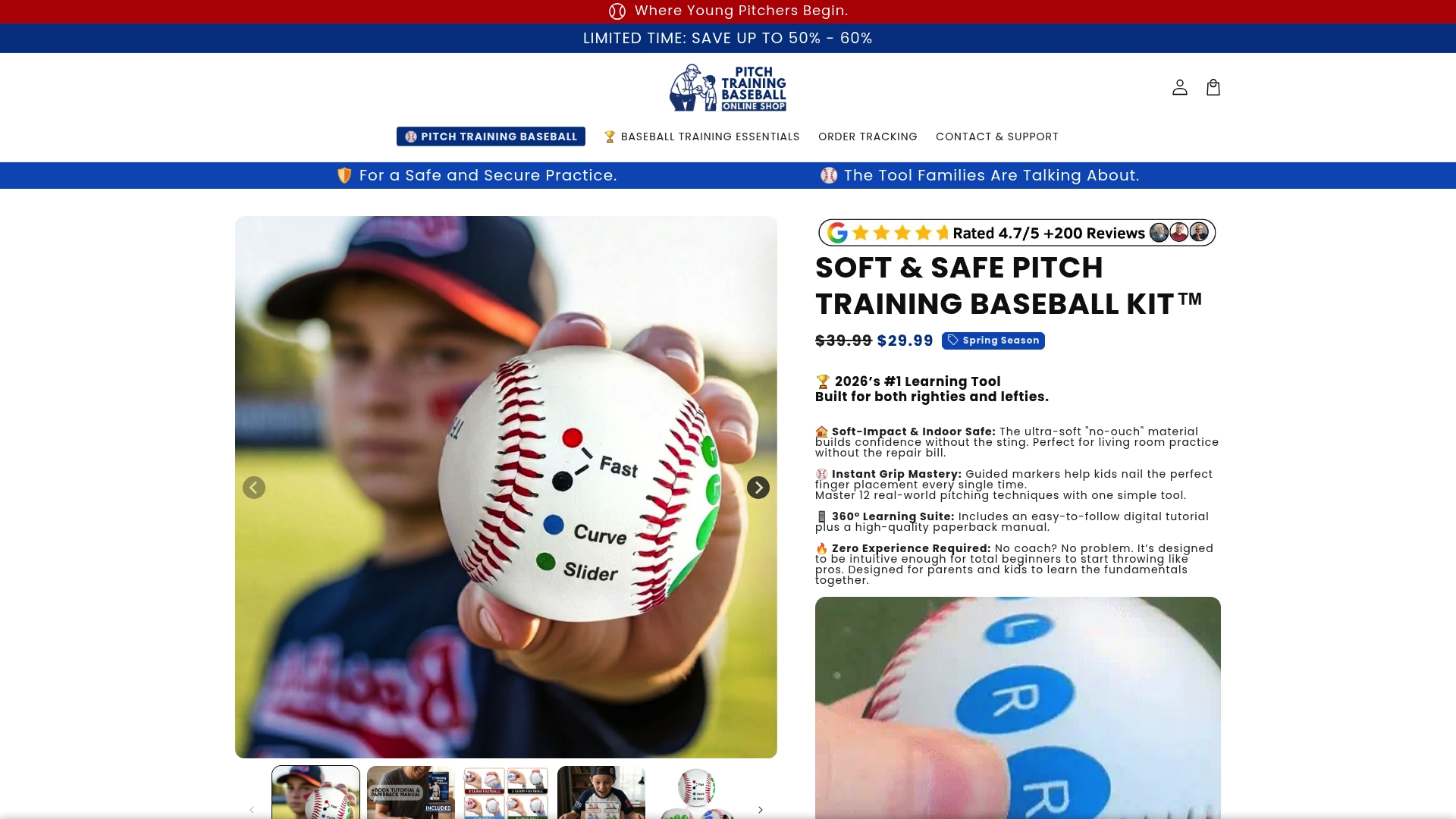
The 9-zone pitching target net gives young pitchers the immediate location feedback that generic nets can’t provide. Every throw lands in a specific zone, which turns flat-ground sessions into real command training rather than just volume throwing. The pitch training baseball is designed for consistent mechanics practice, built to support accuracy and arm health across a full season of use. Both products are portable, easy to set up, and built for the backyard or cage environment where most youth players actually train. For parents and coaches who want tools that support safe youth pitching workouts without the complexity or cost of a full pitching machine, Pitchtrainingbaseball’s lineup covers the accuracy and mechanics work that matters most at the developmental stage.
Useful sources for baseball pitching training and coaching
These resources go deeper on the topics covered in this guide, from velocity benchmarks to coaching methodology to training tool selection.
- 14U Baseball Performance Requirements, Professional Baseball Strength: Detailed velocity and physical benchmarks for 13U and 14U players, including reaction time data and field dimension changes. Useful for setting realistic development targets.
- Chasing Velo: Benchmarks for 13–18 Year Old Competitive Pitchers: Age-specific fastball velocity percentiles derived from scouting event data. The most rigorous publicly available benchmark resource for adolescent pitchers.
- Best Pitching Training Aids for Mechanics and Accuracy, Yankee Life: Practical breakdown of training aid categories, selection criteria, and seasonal maintenance guidance. Covers accuracy, mechanics, velocity, arm care, and feedback tools.
- Top Pitching Training Aids to Improve Velocity and Arm Strength, GoRout: Covers the five main categories of pitching aids and explains how to integrate them into a structured program without increasing injury risk.
- Best Pitching Training Equipment, Japan Baseball Lab: Explains the training philosophy behind Japanese pitching academies and the specific tools they use, with budget-tiered recommendations by player level.
- Using Video Analysis to Prevent Throwing Injuries, Nationwide Children’s: Makes the case for video as a diagnostic tool, with specific guidance on what mechanical patterns to look for and how to use footage to prevent injury.
- The 80/20 Rule for Youth Baseball, Youth Baseball Edge: Explains how pitching, hitting, and catching drive the majority of game outcomes, with a practical framework for restructuring practice time accordingly.
- Arm strength tips for youth players, Pitchtrainingbaseball: Covers safe velocity-building approaches and arm care habits appropriate for youth pitchers at different development stages.
- Recommended daily pitching habits, Pitchtrainingbaseball: Practical daily routine guidance for young pitchers, including warm-up, throwing volume, and recovery habits.