


If you’re putting in the work but your arm still feels weak, underpowered, or prone to fatigue by the third inning, you’re not alone. Learning how to increase arm strength is one of the most common goals for young baseball players and their coaches, yet most training programs miss the mark by focusing on the wrong muscles, skipping recovery, or ignoring sport-specific mechanics. This guide cuts through the noise. You’ll get a clear breakdown of arm anatomy, the best exercises with proper form cues, smart programming built for young athletes, and honest advice on what actually produces results on the mound and in the field.
Table of Contents
- Key takeaways
- How to increase arm strength: start with the right muscles
- What you need before you start training
- Best arm strength exercises with step-by-step instructions
- Programming arm workouts for young athletes
- Recognizing progress and fixing common problems
- My honest take after years working with young players
- Take your arm training further with Pitchtrainingbaseball
- FAQ
Key takeaways
| Point | Details |
|---|---|
| Train all three muscle groups | Target biceps, triceps, and brachialis together for real arm strength, not just biceps curls. |
| Control every rep | A slow 2-3 second lowering phase builds more strength than lifting heavy with sloppy form. |
| Follow a weekly program | Train arms 2-3 times per week with 24-48 hours of rest between sessions for actual growth. |
| Progressive overload matters | Add roughly 1% more weight or reps each session to keep making consistent gains. |
| Recovery drives results | Muscle grows during rest, not during training. Sleep, nutrition, and rest days are non-negotiable. |
How to increase arm strength: start with the right muscles
Most young athletes walk into the gym and head straight for the biceps curl rack. It makes sense visually, but it leaves two-thirds of the arm undertrained. To genuinely build arm muscle and see it translate to the baseball field, you need to understand which muscles you’re actually working.
The major muscles of your arm
Here’s a breakdown of the key players:
- Biceps brachii: The muscle on the front of your upper arm. It flexes the elbow and rotates the forearm, which matters every time you catch, field, or pull through a throw.
- Triceps brachii: The muscle on the back of your upper arm. Triceps make up two-thirds of your arm’s total mass, yet most athletes spend 80% of their arm training on biceps. Strong triceps are critical for the push phase of throwing.
- Brachialis: This muscle sits underneath your biceps and is responsible for pure elbow flexion strength. Training it adds thickness to the arm and improves your grip on every pitch.
- Forearm flexors and extensors: These muscles control grip strength and wrist stability. Weak forearms lead to reduced bat speed, inconsistent release points, and increased injury risk.
- Shoulder stabilizers (rotator cuff and deltoids): Not technically “arm” muscles but directly connected to how much force your arm can safely generate and absorb.
Why this matters for baseball specifically
In baseball, your arm generates force in a highly specific sequence from your legs, through your core, and out through your fingertips. If any link in that chain is weak, performance drops and injury risk goes up. The triceps, in particular, decelerate your arm after ball release. A weak triceps means your shoulder does more braking work than it should, which is one of the leading causes of youth pitching injuries. Balanced training of all these muscles doesn’t just boost pitching power, it protects the arm over an entire season.
What you need before you start training
Setting yourself up correctly before you lift a single rep makes a massive difference in safety and long-term results. You don’t need a fully loaded gym. What you need is the right setup and the right mindset.
Recommended equipment
| Equipment | Training benefit |
|---|---|
| Adjustable dumbbells | Allow progressive overload and single-arm variations for imbalance correction |
| Resistance bands | Great for warm-ups, rotator cuff activation, and low-impact arm endurance work |
| Pull-up bar | Enables compound back and biceps movements without a cable machine |
| Flat bench or chair | Supports triceps dips, kickbacks, and seated curl variations |
| Grip strengthener | Directly targets forearm muscles and grip endurance for batting and throwing |
You don’t need to spend a lot to get started. A solid pair of adjustable dumbbells covers most of what this program requires. For athletes training at home or in a small space, bodyweight alternatives like diamond push-ups, pike push-ups, and resistance band curls can replace nearly every dumbbell movement in a pinch.
Safety and warm-up first
Never start an arm training session cold. Spend 5-10 minutes on general movement: light jogging, arm circles, and band pull-aparts. Then do a warm-up set of each exercise at around 50% of your working weight before you touch anything heavy. A proper warm-up isn’t optional, especially for young athletes whose tendons and ligaments are still developing.
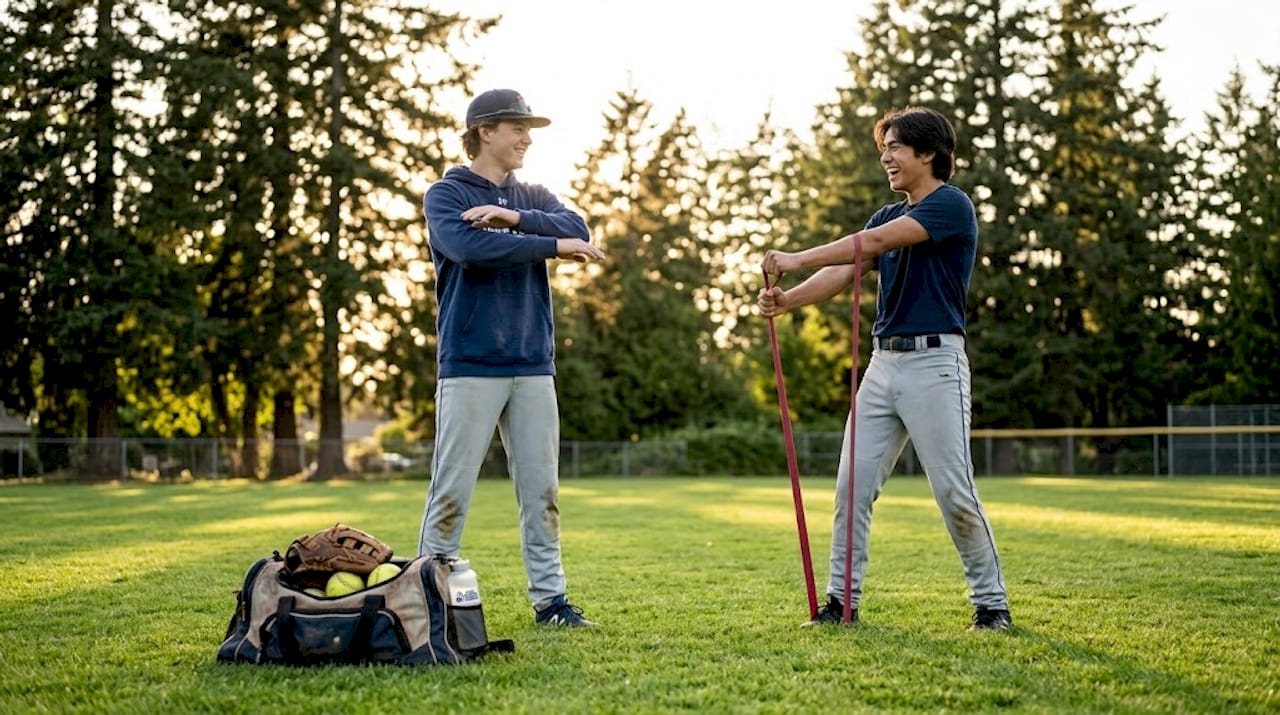
Pro Tip: If you’re a coach setting up a team training session, have athletes pair up and do 2 minutes of gentle band pull-aparts and wrist circles before any weight is touched. It takes under five minutes and cuts injury risk significantly.
Best arm strength exercises with step-by-step instructions
These are the exercises that consistently produce results for young athletes. You don’t need a long list of movements. You need a short list done correctly.
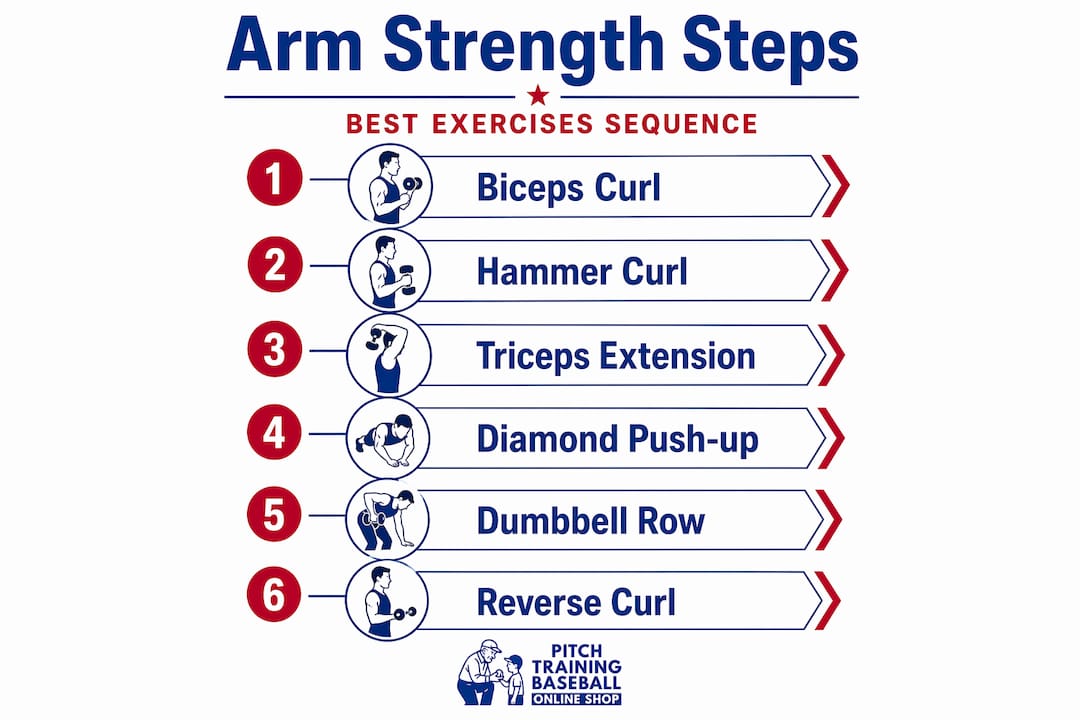
1. Biceps curl
Stand with a dumbbell in each hand, palms facing forward. Keep your elbows tucked at your sides throughout the movement. Curl the weight up to shoulder height, squeeze at the top for one second, then lower it back down over 2-3 seconds. That slow lowering phase is where a significant portion of your strength gains come from. Do 3 sets of 10-12 reps.
2. Hammer curl
Same setup as the biceps curl, but rotate your palms to face each other (like you’re holding a hammer). This variation shifts emphasis to the brachialis, which is the muscle most people leave completely undertrained. Adding thickness to the brachialis makes your arm look bigger from any angle and adds a lot of functional grip strength. Do 3 sets of 10-12 reps.
3. Overhead one-arm dumbbell triceps extension
Sit on a bench with one dumbbell held in one hand directly overhead. Keep your upper arm vertical and close to your ear, then bend at the elbow to lower the weight behind your head. The triceps long head gets placed in a fully stretched position here, which makes this one of the most effective arm strength exercises for baseball players. Press back to the start. Do 3 sets of 10 reps per arm.
4. Diamond push-up
Get into a push-up position and form a diamond shape with your thumbs and index fingers directly under your chest. Lower yourself with control, keeping your elbows pointing back rather than flaring out to the sides. Press back up explosively. This is one of the best arm workouts for athletes who are training without equipment because it loads the triceps at a meaningful bodyweight resistance. Do 3 sets to within 2 reps of failure.
5. Single-arm dumbbell row with pause
This isn’t just a back exercise. Unilateral movements like this one also reveal and correct side-to-side imbalances, which are extremely common in baseball players who throw exclusively with one arm. Place one knee and hand on a bench for support. Row the dumbbell up to your hip, pause for one second, then lower it slowly. Do 3 sets of 10-12 reps per side.
6. Reverse curl
Use an overhand grip (palms facing down) on a barbell or dumbbells and perform a standard curl. This hits the brachioradialis and extensor muscles of the forearm, which directly supports wrist stability during throwing and catching. Forearm strength is frequently the weak link in an otherwise solid training program.
Pro Tip: One of the biggest mistakes young athletes make is using momentum to swing the weight up. If your back is rocking or your elbows are drifting forward during curls, the weight is too heavy. Drop down and use controlled reps instead. You’ll get far more out of a lighter weight done right than a heavy weight done wrong.
You can also use lighter loads with higher reps to build strength. Sets lifted to failure at around 67% of your one-rep max produce muscle adaptations comparable to heavier loading when form is dialed in.
Programming arm workouts for young athletes
Knowing the exercises is only half the equation. How you organize them across a week is what actually produces long-term improvement in arm strength and baseball performance.
Setting up your weekly schedule
- Train arms 2-3 times per week, leaving at least 24-48 hours between sessions. Effective muscle growth requires 2-4 sets of 8-12 reps per exercise done at this frequency.
- Pair triceps with chest on one day and biceps with back on another. This way your arms are already partially warmed up from the compound lift, and you avoid the overlap fatigue that comes from training arms in isolation every day.
- Keep your arm-specific sessions to 30-45 minutes. More volume isn’t always better, especially for younger athletes still developing their recovery capacity.
- Rest periods of 60-90 seconds between sets work well for muscle growth. For endurance-focused sessions, drop rest to 30-45 seconds to build arm endurance alongside strength.
Progressive overload: the non-negotiable
This is the single most important programming concept you need to understand. If you lift the same weight for the same reps every week, your muscles have no reason to adapt. Increasing weight, reps, or sets by about 1% each session is a realistic and effective target. That might mean one extra rep this week or half a pound more next week. Small, consistent progress compounds into real results.
Integrating arm training with baseball practice
Don’t train arms heavily the day before a game or a heavy pitching practice. The fatigue in your elbow flexors and triceps will affect your mechanics and increase the risk of a bad throw leading to an injury. A good rule: do your arm strength work after lighter practice days and give yourself at least one full rest day before you pitch at full intensity. For more safe sport-specific guidance, check out these pitching workouts for youth designed specifically around arm care.
Pro Tip: Track every workout in a simple notebook or phone app. Write down the exercise, sets, reps, and weight used. This makes it easy to spot when you’ve stalled and tells you exactly when to increase the load.
Recognizing progress and fixing common problems
Even when athletes follow a solid program, things don’t always go smoothly. Here’s how to identify what’s going wrong and what to do about it.
Signs you’re on the right track
- Your throwing velocity or arm endurance has improved noticeably over 6-8 weeks
- You can complete your target reps with control on exercises that felt hard two weeks ago
- Your grip strength and forearm endurance are holding up later in games
- Most visible arm changes appear within 6-8 weeks of consistent training with progressive overload
Common problems and how to fix them
- Plateau: You’ve stopped getting stronger. Add one more set, try a new angle on the same movement (like switching from a flat curl to an incline curl), or take a deload week at 60% intensity to let your body reset.
- One arm noticeably weaker: Switch all curls and extensions to single-arm variations for 4-6 weeks until the weaker side catches up. Don’t let the stronger arm compensate.
- Pain during or after training: Sharp pain is a stop signal, not something to push through. Training through significant pain causes stagnation and injury. Dull muscle soreness 24-48 hours after training is normal. Acute pain during movement is not.
- Slow recovery: Look at your nutrition first. Adequate protein and calorie intake is required for muscle growth. If you’re training hard but eating too little, you won’t recover between sessions, and strength gains will stall.
“The muscle you built in the gym shows up on the field only if you gave it time to actually grow. Recovery isn’t laziness. It’s where the gains happen.”
For guidance on keeping your training safe and injury-free throughout the season, Pitchtrainingbaseball has a detailed resource on youth injury prevention worth bookmarking.
My honest take after years working with young players
I’ve worked with dozens of young athletes who came to me frustrated that their arms weren’t getting stronger despite months of training. Almost every single time, the problem wasn’t effort. It was that they were training hard in the wrong direction.
The most consistent pattern I see: kids do biceps curls every day, skip their triceps entirely, never touch their forearms, and wonder why their throw still lacks pop. When we switch to balanced training that splits volume across biceps, triceps, and brachialis, the velocity and arm endurance improvements tend to show up within 4-6 weeks.
The second biggest issue I see is impatience with load. Young athletes want to lift heavy, which I completely understand. But arm strength in a sport like baseball isn’t about moving maximum weight in the gym. It’s about producing force reliably, repeatedly, across a full game or a full season. Controlled tempo, proper range of motion, and consistent volume beat heavy sloppy reps every time in this context.
What I’ve found actually produces long-term results: train arms twice a week with intent, prioritize the slow eccentric phase on every rep, get 7-9 hours of sleep, eat enough protein, and track your progress week to week. It’s genuinely not complicated. The athletes who do these basics consistently are the ones who show up in the spring measurably stronger than they were in the fall.
One more thing I want coaches to hear: rest is not a reward for hard work. It’s part of the training plan. If a kid is sore, stiff, or their mechanics are breaking down in practice, the most productive thing you can do is give them a day off. Building arm strength safely over a full career is the real goal, not maxing out in week two.
— Albert
Take your arm training further with Pitchtrainingbaseball
Ready to turn these strength gains into on-field results? Pitchtrainingbaseball offers training tools built specifically for young baseball and softball players who want to develop arm strength, pitching mechanics, and throwing accuracy together.
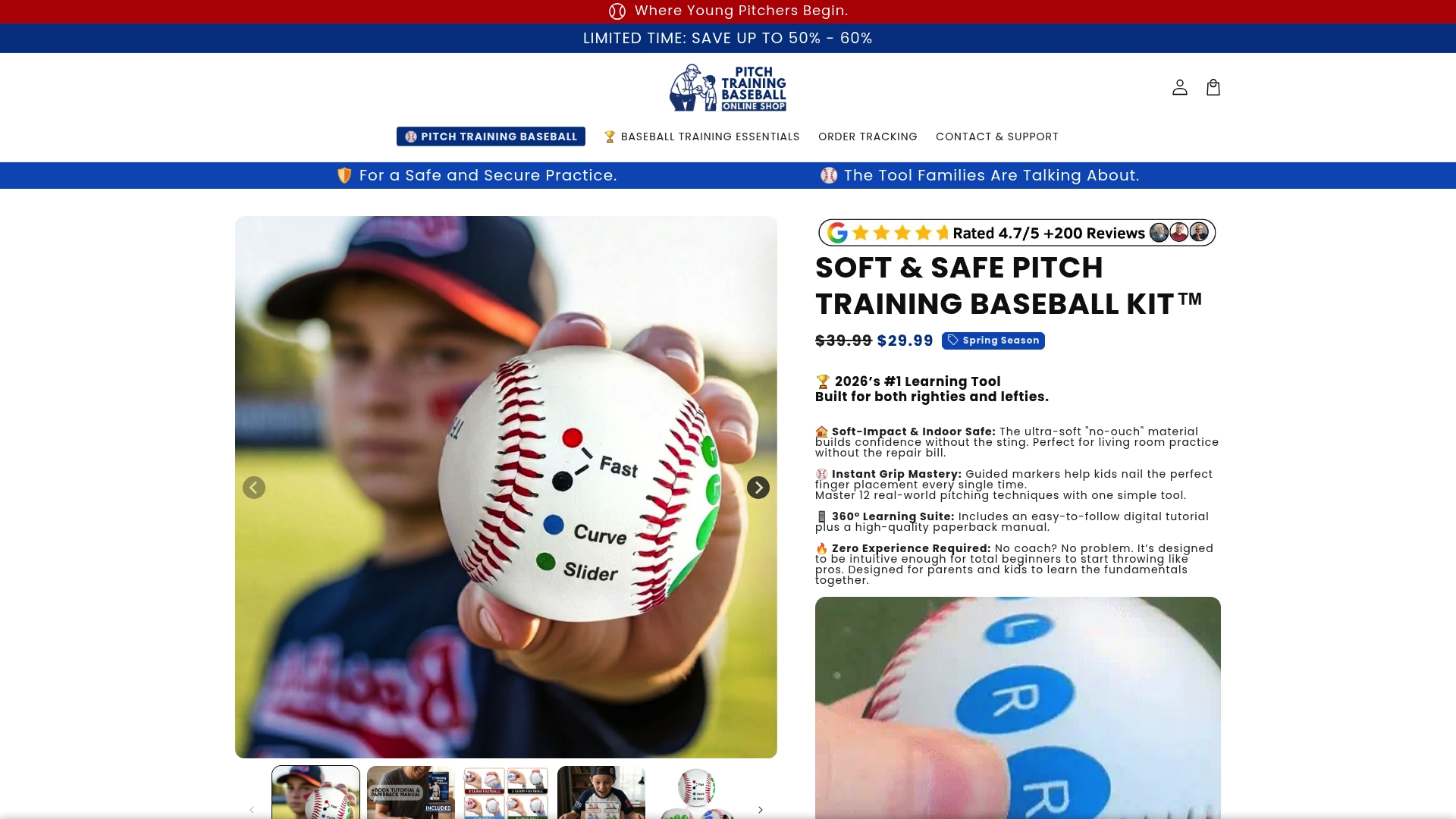
The Pitch Training Baseball program gives athletes a structured, sport-specific way to develop arm strength while reinforcing proper pitching mechanics from the start. For softball players, the Pitch Training Softball kit applies the same principles to softball-specific throwing patterns and arm conditioning. Both tools are portable, coach-approved, and designed to make consistent practice easy and effective for athletes at any level. Whether you’re training in the backyard or at the facility, Pitchtrainingbaseball has the equipment to back up every rep you put in.
FAQ
What is the fastest way to build arm strength for baseball?
Train arms 2-3 times per week using compound and isolation exercises with a slow controlled tempo. Consistent progressive overload combined with adequate rest produces the fastest safe results, with visible improvement typically appearing within 6-8 weeks.
How many reps and sets should young athletes do for arm strength?
Research supports 2-4 sets of 8-12 reps per exercise, two to three times per week. This range builds both size and strength effectively while allowing enough recovery time for young athletes.
Can you increase arm strength without weights?
Yes. Diamond push-ups, resistance band curls, and bodyweight triceps dips are effective arm strength exercises at home that build real strength when performed with controlled tempo and progressive difficulty.
How often should a pitcher do arm strength training?
Pitchers should train arms 2-3 times per week, scheduling sessions after lighter practice days and allowing at least one full rest day before pitching at full intensity to protect arm health and mechanics.
Why is my arm strength not improving despite training?
The most common causes are using too much momentum during exercises, skipping triceps and forearm work, insufficient protein intake, and not applying progressive overload. Fixing form and adding 1% more load per session usually breaks a plateau quickly.