


A backyard pitching net built from lightweight poly usually holds up for several seasons of casual use, while a properly specced facility net can last significantly longer with good maintenance. The gap comes down to four things: material and twine gauge, UV exposure, how often it takes impact, and whether anyone bothers to maintain it. Get the material right for your use case and follow three habits (rotate panels, dry before storage, patch small holes fast) and you’ll outlast nets that cost twice as much.
TL;DR:
- UV treatment is crucial for outdoor nets, with untreated nylon losing up to 20% of its strength in a year, while UV-resistant HDPE can last three to four years.
- Using a higher gauge twine, such as #42 to #60, is necessary for high-impact, frequent practice environments, especially with fast pitches exceeding 75 mph.
- Regular maintenance, including rotating impact panels, patching small holes early, and storing nets dry, can extend net lifespan significantly, often more than upgrading material grade.
- Impact zones should have removable panels to concentrate wear and allow cost-effective repairs, avoiding full-net replacements after localized damage.
- Proper setup, including even tension and solid anchoring, prevents early tearing and prolongs the net’s usable life, especially in high-volume practice settings.
Table of Contents
- What Determines Pitching Net Durability?
- How Long Do Pitching Nets Last in Real Use?
- What Maintenance Routine Actually Extends Net Life?
- How Do You Choose a Durable Pitching Net?
- Setup and Anchoring Practices That Prevent Early Failures
- When Should You Patch, Replace a Panel, or Replace the Net?
- Why We Emphasize Maintenance-First Choices
- A Durable Target Net Built Around the Maintenance Habits That Matter
- Sources
- FAQ
What Determines Pitching Net Durability?
Every pitching net is really a fabric engineering decision disguised as sporting goods. The mesh material, the thickness of the twine, and how the knots are tied all interact to decide whether your net survives one summer or ten.
Nylon is the strongest option on paper. It has the highest breaking strength and best abrasion resistance of any common netting material, which is why it’s the standard in indoor MLB and NCAA training facilities. The catch: untreated nylon left in direct sunlight can lose up to 20% of its breaking strength in a single year. If you’re setting up in a backyard or open field without a coating, that strength advantage evaporates fast.
HDPE, or poly netting, flips that tradeoff. It doesn’t absorb water, resists rot, and with UV inhibitors added during manufacturing, it holds its strength far longer outdoors than nylon does. The compromise is that HDPE often needs a heavier gauge to match nylon’s raw strength, so a poly net built for the same impact load tends to weigh more per square foot.
Polyester and premium fibers like Dyneema sit in between, or above, depending on the product. They offer long UV life and low stretch, which matters if you want a net that holds its shape through hundreds of pitching sessions instead of sagging into a hammock.
Twine gauge is the other half of the equation. Gauge numbers like #21, #36, #42, and #60 describe the thickness of the individual strands:
- #21 gauge suits casual backyard tossing and lighter youth pitches, but it wears out after a few seasons of regular use.
- #36 gauge is the balance point most guides recommend for high-school-level throwing and team practice.
- #42 to #60 gauge is built for machine-fed or commercial-facility use, where the ball never stops coming.
Pro Tip: Match twine gauge to your fastest realistic pitch speed, not your average one. A single 75 mph fastball hits harder than a hundred soft-toss reps, and gauge failures usually start at the point of peak impact, not average wear.
Knotted nets are more repairable in the field, since you can work strand by strand instead of replacing whole panels, which makes them the better choice for a permanent backyard or facility install. Knotless nets look cleaner and resist snagging but are harder to patch piecemeal. For any high-volume setup, a replaceable impact panel is worth the extra cost. It concentrates wear on a single removable section so the main net can go years longer between replacements.
How Long Do Pitching Nets Last in Real Use?
Lifespan ranges swing dramatically depending on where and how often the net gets used. A backyard net that comes out twice a week ages nothing like a facility net that eats 200 pitches a day.
| Use case | Typical lifespan | Primary wear driver |
|---|---|---|
| Backyard recreational | 1 to 3 years | UV exposure, infrequent storage care |
| Youth or team practice | 2 to 5 years | Mixed indoor/outdoor use, moderate volume |
| Machine-heavy facility | 3 to 6 years (mesh); panels sooner | Impact frequency, concentrated wear zones |
| Indoor-only setup | 5 years | Minimal UV exposure, controlled climate |
Indoor nets consistently outlast outdoor ones by a wide margin, and the reason isn’t mysterious. UV degradation, not ball impact, is the leading cause of outdoor net failure over time. A net stored in a garage or gym never fights that battle.
Here’s a timeline that shows the split clearly. An untreated nylon net left outside through spring and summer can show visible fiber weakening within a single year, with real strength loss detectable by year two. A UV-treated HDPE net in the same spot, same sun exposure, same throwing volume, typically holds usable strength through year three or four before panels need attention. By year five, the untreated nylon is usually retired. The treated HDPE might still be the main net, just with a swapped impact panel or two.
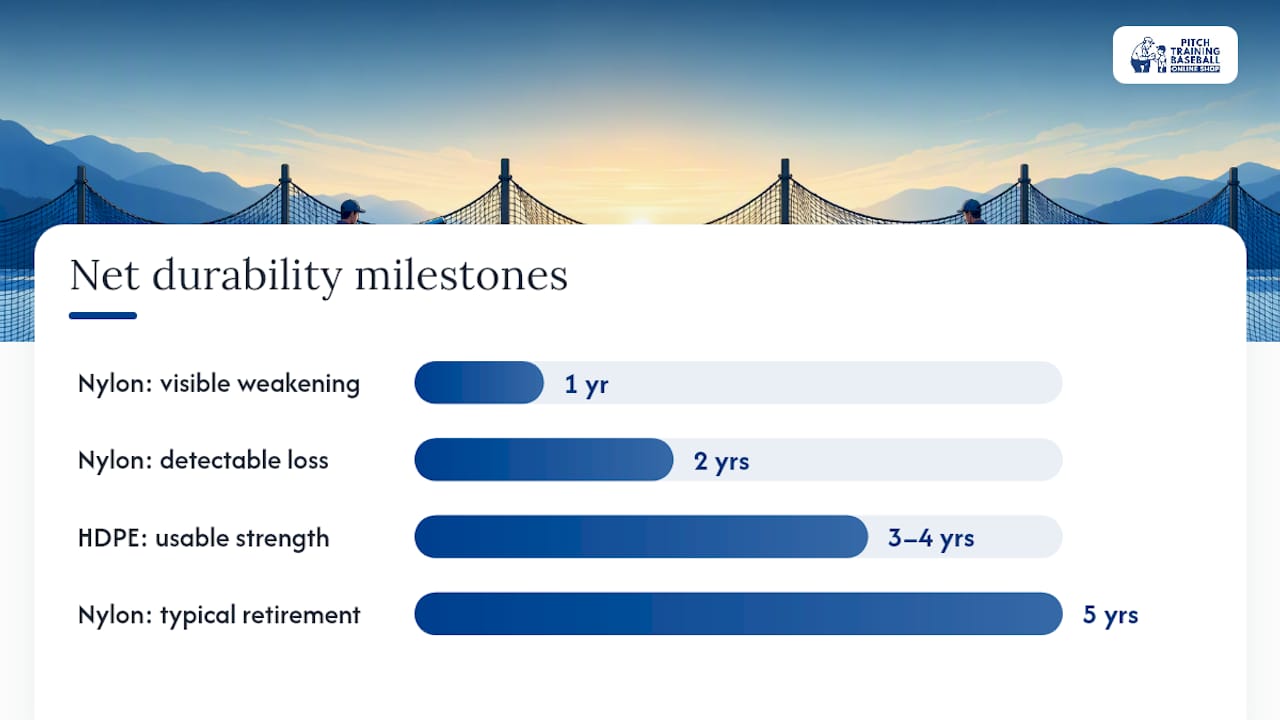
Climate matters too. A net stored in a humid, coastal climate faces mildew risk on top of UV stress. Desert climates accelerate UV breakdown but skip the moisture problem entirely. Either way, daily volume is the multiplier: a net used for 20 minutes of practice three times a week ages far slower than one absorbing back-to-back pitching sessions for a full travel team.
What Maintenance Routine Actually Extends Net Life?
Maintenance is the single biggest lever most people ignore, and it costs almost nothing. Rotating panels, patching small holes early, and storing the net dry explains more lifespan variance than material grade does in a lot of real-world cases.
Here’s the routine that matters most:
- Inspect high-wear zones monthly. Check the strike-zone area and lower panels first. That’s where impact concentrates and where small tears start.
- Flip or rotate panels seasonally. If your net has a removable or reversible impact section, rotate it every few months so wear spreads evenly instead of blowing out one spot.
- Dry the net fully before storing it. Trapped moisture breeds mildew and weakens fiber bonds, especially in nylon.
- Keep netting off the ground. Dirt, grass moisture, and foot traffic degrade the bottom edge faster than any other part of the net.
- Patch small holes immediately with a matched twine kit before they spread into a multi-strand failure.
- Replace frayed border rope or worn carabiners before they fail under tension, since a snapped anchor point often takes a chunk of net with it.
Storage is where a lot of otherwise good nets die early. A cheap breathable cover, a tarp during off-season months, or simply bringing the net indoors between seasons will do more for lifespan than upgrading to a pricier mesh. The insight worth remembering: a mid-grade, UV-treated net that’s cared for consistently typically outlasts an untreated premium net left out in the weather.
How Do You Choose a Durable Pitching Net?
Buying the right net starts with being honest about how you’ll actually use it, not how you imagine using it in a perfect world.
- Match material and gauge to your real pitch speeds and session frequency. A once-a-week backyard thrower doesn’t need #60 gauge; a daily team practice does.
- Confirm UV treatment if the net will spend any real time outdoors. This single spec probably matters more than any other on the list.
- Look for a rope-bordered perimeter and reinforced seams. These are the first points of failure under repeated tension.
- Prioritize a replaceable impact panel if you’re throwing hundreds of pitches a week. It turns a full net replacement into a $20 to $40 panel swap.
- Treat the frame and anchor system as separate from the mesh. A sturdy frame can outlive three or four net replacements if you plan for panels rather than full teardowns.
On budget: a $40 backyard net that lasts one season and gets replaced three times costs more over three years than a $120 to $200 net with better gauge and UV treatment that lasts five. Higher upfront cost is justified almost every time you’re throwing more than twice a week or leaving the net outside for months at a stretch. If your use is genuinely occasional and mostly indoors, a lower-gauge net can be sufficient without overspending on heavier gauge twine.
Setup and Anchoring Practices That Prevent Early Failures
How you hang and tension a net matters almost as much as what it’s made of. A tightly stretched net looks sharp but transfers every bit of impact energy straight into the fibers with nothing to absorb the shock.
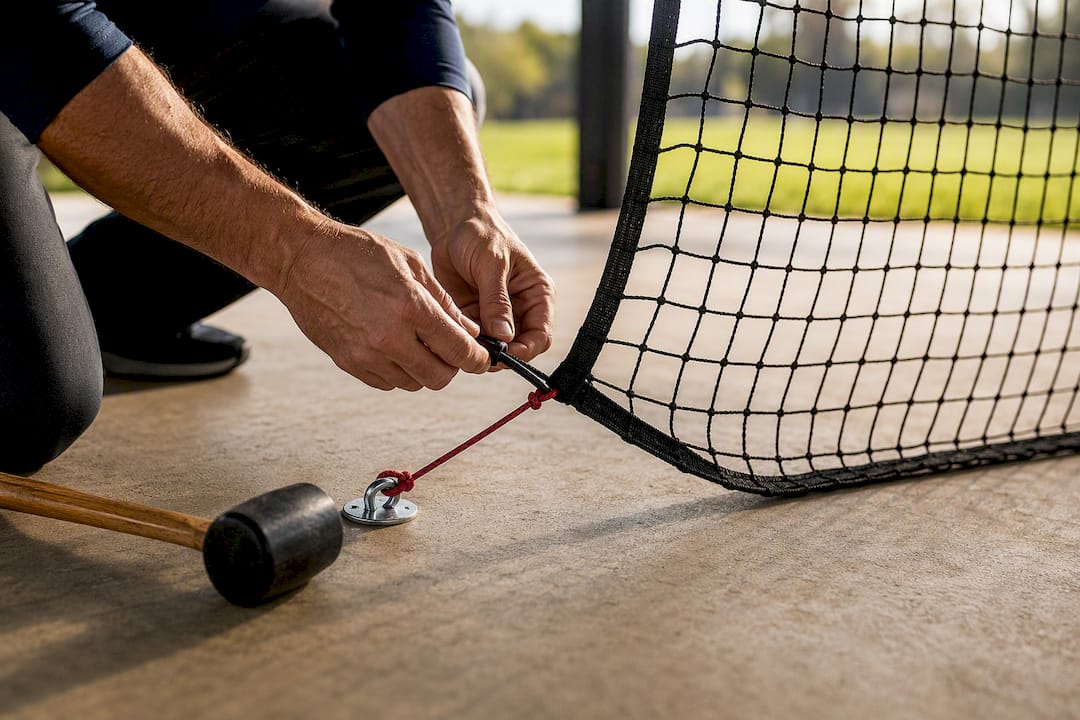
A slight, controlled drape does the opposite. Letting the impact panel hang loose, roughly 6 to 18 inches behind the main wall, gives the ball somewhere to go and spreads that energy out instead of concentrating it on one taut section.
A few setup habits protect the net over the long haul:
- Tension the border rope evenly on all sides rather than pulling one edge tight and leaving the others slack.
- Re-tension periodically, since ropes stretch and settle over weeks of use, and an uneven net starts pocketing in the middle.
- Anchor the base solidly so the frame doesn’t shift or rock during use, which causes rubbing abrasion at every contact point.
- Check metal-to-net contact points during setup and teardown, since frame edges and clips are common sources of small tears that snowball over time.
Coaches setting up for left-handed pitchers should also think through positioning early. A lefty-specific setup at the right distance keeps the strike zone target aligned and avoids repositioning the net constantly, which by itself reduces wear from repeated dragging and re-anchoring.
When Should You Patch, Replace a Panel, or Replace the Net?
Not every hole means a full replacement. Work through repairs in order of least to most invasive:
- Small isolated hole: Patch it with matched-gauge twine immediately. A #36 hole needs a #36 patch, not whatever spare cord is on hand.
- Frayed border rope or a cracked carabiner: Swap the hardware before it fails under tension and takes adjacent mesh with it.
- Concentrated damage in the strike zone or impact area: Replace just that panel if the net has a removable section.
- Multiple adjacent failures or damage spreading across a wide area: Replace the full net. At that point, patching becomes a losing game of whack-a-mole.
Keep a small kit on hand: matched twine in your net’s gauge, a netting needle, spare carabiners, and a tape measure to check hole size before deciding. If you’re patching more than three spots per season, that’s usually a sign the whole panel, not just the holes, needs to go.
Why We Emphasize Maintenance-First Choices
Most durability advice online focuses entirely on material specs and skips the boring part: what you actually do with the net once it’s in your yard or gym. At PitchTrainingBaseball.com, our product design leans hard into replaceable panels and rope-bordered construction because we’ve seen how much longer a net lasts when the wear point is swappable instead of terminal. Setup guidance, like positioning for left-handed pitchers, matters just as much as the mesh itself, since more usable training days per week means more value out of the same net. The honest caveat: even the best net will underperform if nobody’s willing to spend ten minutes a month checking it.
— Albert
A Durable Target Net Built Around the Maintenance Habits That Matter
If you’ve read this far, you already know the formula: the right material, a replaceable wear point, and a little upkeep beat an expensive net left to fend for itself. The Pitching Target Net with Colorful Strike 9-Zone is built around exactly that logic.

It uses reinforced pocket dividers around each strike zone, a rope-bordered perimeter to handle repeated tensioning, and a design that supports the panel-first repair approach covered above instead of forcing a full-net replacement the first time a corner wears thin. For coaches or parents training multiple kids across baseball and softball, Pitch Training Softball offers the same durability-focused build for the softball side of the bag. If your net is currently the weak link in your practice routine, the 9-zone target’s product page has the full specs and sizing so you can see whether it fits your setup before you order.
Sources
- Choosing the Right Baseball Batting Cage Net Material: A 2026 Guide - Baseball Scouter
- Netting Education – Netting World
- Maintenance tips for sports netting — Renconets
- Batting Practice Nets: How to Read Netting Gauge, Ply, and Material - BattingLeadoff
FAQ
What Is the Strongest Type of Sports Netting?
Nylon has the highest breaking strength and best abrasion resistance of common netting materials, which is why it’s standard in indoor training facilities, but it needs UV protection to hold that strength outdoors.
What Is the Best Pitching Net for Durability?
The best choice depends on where you’ll use it: UV-treated HDPE for outdoor setups, higher-gauge nylon for indoor or facility use, and a net with a replaceable impact panel like the Pitching Target Net with Colorful Strike 9-Zone for heavy, repeated use.
What Twine Gauge Should I Buy for Team Practice?
A #36 gauge is generally the balance point for high-school-level throwing and regular team practice, while #42 to #60 gauge suits machine-fed or facility environments.
How Long Do Pitching Nets Last Before Needing Replacement?
Backyard nets typically last one to three years, youth or team practice nets last two to five years, and indoor nets can last five to ten years or more with proper storage and maintenance.
What Is a 9-Hole Pitching Net Used for?
A 9-hole or 9-zone pitching net gives pitchers defined target zones across the strike zone, letting them practice location and control rather than just throwing at a blank net.