


Do this: 3 minutes of controlled active movement, then 5 to 8 minutes of scapular activation and posterior shoulder stretching, then optional prolonged cooling if you have the equipment. That sequence, backed by studies on youth pitcher recovery and rotator cuff strength, beats jogging laps or sitting still. Coaches and parents can run it in under 15 minutes after any outing, no special training required.
TL;DR:
- Short active movement routines of three minutes are more effective than jogging laps for youth pitcher recovery and can be completed in under 15 minutes.
- A full cooldown program including mobility, scapular activation, stretching, and optional cooling can significantly reduce injury risk and preserve shoulder strength over 72 hours.
- Rest periods should be based on pitch count, with at least 72 hours recommended after high-volume outings, and any elbow pain warrants immediate evaluation.
- Inexpensive equipment like light resistance bands, lacrosse balls, and gel packs support effective cooldowns without requiring specialized facilities.
- Assigning a dedicated adult to lead the cooldown every outing improves consistency and adherence to injury prevention routines.
Table of Contents
- Quick 5-Minute Post-Throw Cooldown for Youth Pitchers
- Full 10 to 15 Minute Post-Game Cooldown Routine
- Why This Routine Works: Studies Behind the Sequence
- How Long Should a Youth Pitcher Rest Before Throwing Again?
- What Equipment Actually Helps a Cooldown
- Coach and Parent Checklist for a Consistent Cooldown Routine
- A Coaching Note From Albert: How We Apply This With Real Players
- Recovery Gear for Youth Baseball Training
- Sources
Quick 5-Minute Post-Throw Cooldown for Youth Pitchers
Between innings or right after a bullpen session, you don’t have 15 minutes. You have five, maybe less. This is the routine to run when the clock is tight and the arm still needs attention.
- Minute 1 to 3: Controlled active movement. Walk briskly or shuffle laterally between the dugout and foul line. Skip sprinting drills or long jogging loops. Research comparing recovery methods in youth pitchers found that generic jogging can add unnecessary lower-body fatigue without speeding up arm recovery, and some small-scale comparisons of post-pitching recovery methods actually favor short, individualized movement over standard jogging.
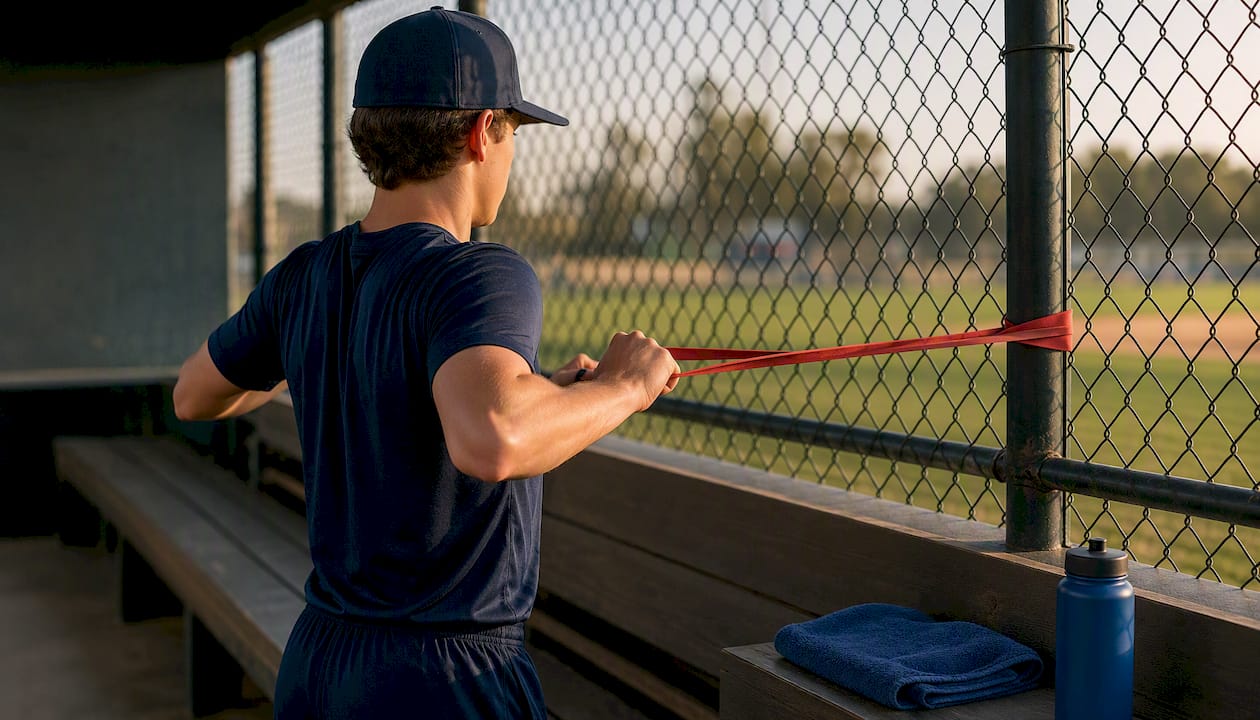
- Minute 3 to 4: Scapular activation. Ten to twelve light band rows or band pull-aparts, done standing with the elbows close to the body. Keep the resistance low. This isn’t strength training, it’s waking up the muscles that stabilize the shoulder blade.
- Minute 4 to 5: Posterior shoulder stretch and elbow mobility. Cross-body shoulder stretch, 20 to 30 seconds per side, plus gentle wrist flexor and forearm stretches held for 15 seconds each.
For pitchers under 10, cut hold times in half and skip the band work entirely; a slow walk and two gentle stretches are plenty. If a player reports sharp pain anywhere in the throwing arm, stop the routine and flag it to a parent or athletic trainer instead of pushing through the sequence.
Pro Tip: Keep a set of light bands looped on the dugout fence. Pitchers are far more likely to do scapular work when the band is already in reach instead of buried in a bag.
Full 10 to 15 Minute Post-Game Cooldown Routine
Once the game ends and there’s no next inning to prep for, this is the version worth running in full. It’s built in four blocks, each with a specific job.
- 5 minutes, active downshift. Walking or light shuffling, not jogging laps. The goal is bringing heart rate down gradually while keeping blood moving through the throwing arm, not burning off leftover adrenaline through distance running.
- 4 to 6 minutes, mobility and posterior shoulder stretching. Cross-body stretch (30 seconds per side), sleeper stretch (20 seconds per side, gentler for players under 12), and forearm/wrist flexor stretches (15 seconds each). Elbow-focused mobility work can be added here for pitchers who throw breaking pitches regularly.
- 4 to 6 minutes, condensed strength and scapular control. A shortened version of the Youth Throwers Ten sequence works well here, done standing rather than lying down so the lower body and core stay engaged. Think band rows, external rotation holds, and full-can raises, 8 to 10 reps each. Standing variations recruit the whole kinetic chain, which supports faster return to stable shoulder function than isolated shoulder-only moves. This maps closely to broader arm strength programming for young pitchers.
- Optional soft tissue and cooling. A lacrosse ball or short foam roller on the upper back and forearm for two minutes. If a phase-change cooling pack is available, 15 to 20 minutes on the shoulder and forearm after a heavy outing is reasonable; see this day-by-day plan for recovery therapies after marathon for additional cooling and rehab strategies.
Pro Tip: Run the strength block before the stretching block on high pitch-count days. A slightly warmer, more activated shoulder tolerates deeper stretching better than a cold one.
Why This Routine Works: Studies Behind the Sequence
The 72-hour number comes up constantly in youth pitching research, and it’s not arbitrary. Youth pitchers averaging about 78 pitches per outing needed a full 72 hours for shoulder structure and range of motion to return to baseline, including tendon changes in the supraspinatus and biceps that show up on ultrasound right after an outing.
Multimodal arm-care programs that combine strength, mobility, and plyometric work, paired with daily posterior shoulder stretching, are associated with a significant reduction in shoulder and elbow injuries among adolescent throwers.
That figure comes from a clinical review of arm-care programs in adolescent baseball players, and it’s the strongest single reason to treat cooldown as more than stretching. A systematic review of injury prevention programs in overhead youth athletes found strength training was the most consistently effective component, ahead of stretching alone.
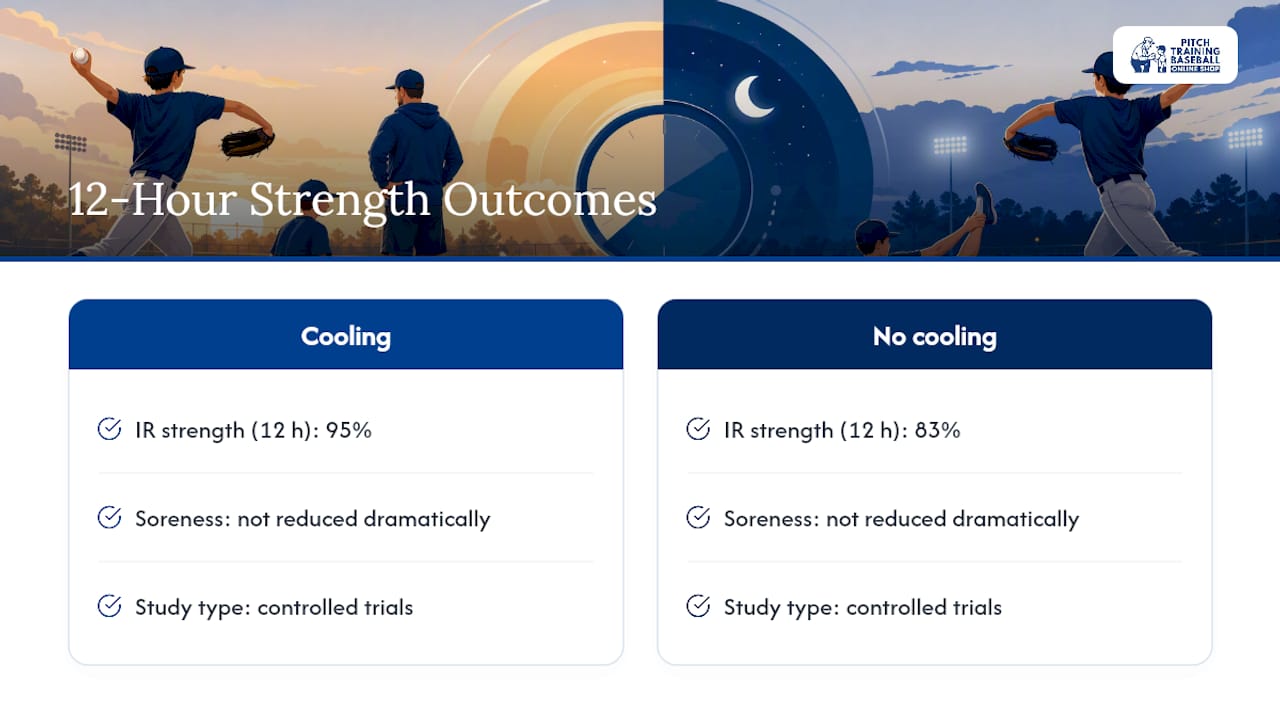
Cooling adds a smaller but real piece. In controlled trials, pitchers using phase-change cooling packs preserved 95% of baseline shoulder internal rotation strength 12 hours after pitching, compared to 83% in pitchers who didn’t cool. It didn’t reduce soreness dramatically, so treat it as a strength-preservation tool, not a pain cure. None of this research covers every age group or throwing volume, so apply it as a general framework and adjust conservatively for younger, less experienced arms.
How Long Should a Youth Pitcher Rest Before Throwing Again?
Seventy-two hours is the baseline recovery window backed by youth pitcher recovery studies, but the actual number shifts with pitch count, age, and how the arm felt during the outing. A light 20-pitch bullpen doesn’t demand the same rest as a 90-pitch start.
- Under 40 pitches: 1 full rest day is often enough for most youth pitchers, provided there’s no reported soreness.
- 40 to 65 pitches: 2 rest days, with light arm-care movement allowed but no throwing.
- Over 65 pitches: Follow the full 72-hour window before any throwing resumes, even light catch.
- Any elbow pain, not just shoulder fatigue: Skip the countdown entirely and get the player evaluated before clearing them to throw again.
A pitch-count-based rest strategy built around these thresholds keeps the guesswork out of a decision that matters. When in doubt, more rest is the safer error, and understanding why recovery matters for young arms makes that easier to enforce with skeptical players.
What Equipment Actually Helps a Cooldown
You don’t need a training room. A few inexpensive items cover almost everything above.
- Light resistance bands (yellow or red tension, generally the lightest two grades most brands sell) for scapular and rotator cuff activation.
- A lacrosse ball for targeted soft tissue work on the upper back, and a short foam roller for broader coverage.
- Reusable gel ice packs as a practical stand-in for phase-change material packs; wrap them, never apply directly to skin, and cap application at 15 to 20 minutes.
Keep all three in a dedicated dugout bag so cooldown never depends on someone remembering to bring gear from home.
Coach and Parent Checklist for a Consistent Cooldown Routine
Cooldowns fall apart when nobody owns them. Assign one adult, an assistant coach or a parent volunteer, to lead the routine every single outing, not just on days someone remembers.
- Before the game: Confirm who leads cooldown and stage the bands, lacrosse ball, and ice packs in the dugout.
- Immediately after a pitcher exits: Start the 5-minute quick routine within 2 to 3 minutes of their last pitch, before the arm cools and stiffens on its own.
- After the final out: Run the full 10 to 15-minute routine for every pitcher who threw more than 20 pitches that day.
- On non-throwing days during the week: Schedule two short 10-minute arm-care sessions, focused on the band and mobility work, to reinforce the fatigue-prevention habits that matter more over a season than any single game.
Pro Tip: Print the checklist and tape it inside the equipment bag. Teams that keep the routine visible run it far more consistently than teams that rely on memory.
A Coaching Note From Albert: How We Apply This With Real Players
After a 70 to 85 pitch outing, the full routine runs exactly as written above, cooling included when a pack is on hand. For pitchers under 10, we cut every hold time roughly in half and drop the strength block if the kid seems checked out mentally, not just physically tired.
Mechanics and pain signals always override the clock. A stiff, guarded throwing motion after a light 30-pitch outing matters more than any timer.
— Albert
Recovery Gear for Youth Baseball Training
Running this routine well comes down to having the right low-load tools within reach, not expensive equipment. Certain product lines are designed as safe, portable gear to support both practice reps that build a pitcher’s arm and the recovery work that protects it afterward.

- Pitch Training Softball gives pitchers a soft, low-impact ball for scapular activation drills and light catch on rest days, without adding joint stress.
- Pitching Target Net with Colorful Strike 9-Zone keeps practice reps focused on accuracy over raw velocity, which means fewer max-effort throws piling up before cooldown even starts.
- 5 Pickeballs work well for daily light-catch arm-care sessions on non-throwing days, the kind this routine recommends twice a week.
Check out the full lineup of Pitch Training Baseball equipment and stock the dugout bag before the next outing, not after.
Sources
- Immediate effects of pitching on shoulder muscle-tendon properties and recovery in youth baseball players
- Prolonged local cryotherapy with phase-change material accelerates recovery of shoulder function after a pitching performance
- Effectiveness of overuse injury prevention programs on upper extremity performance in overhead youth athletes: A systematic review