


Youth pitching frequency comes down to three hard rules: daily pitch caps by age, a rest schedule tied to how many pitches were thrown, and an annual innings ceiling with real time off. Pitch Smart sets daily maximums around 75 pitches for 9 and 10-year-olds and 85 for 11 and 12-year-olds, with rest requirements that scale up as pitch counts climb.
-
1 to 20 pitches: 0 days rest
-
21 to 35 pitches: 1 day rest
-
36 to 50 pitches: 2 days rest
-
51 to 65 pitches: 3 days rest
-
66 or more: 4 days rest
Annual workload matters just as much as any single outing. Ages 9 to 12 should stay under 80 combined innings across all teams in a 12-month span, and every young pitcher needs 3 to 4 months off from competitive throwing each year, including 2 to 3 months in a row.
Two rules override everything else: never pitch three consecutive days, and once a pitcher is removed from the mound in a game, he does not go back out to pitch, no matter how many pitches he had left in the tank.
Key Takeaways
Safe youth pitching frequency depends on matching daily pitch counts to age-based limits, enforcing the matching rest days, and capping annual innings with real months off.
| Point | Details |
|---|---|
| Daily limits by age | Cap pitches at 75 for ages 9 to 10 and 85 for ages 11 to 12 per Pitch Smart. |
| Rest scales with pitch count | 66 or more pitches requires 4 days of rest before the next outing. |
| Annual cap and months off | Stay under 80 combined innings for ages 9 to 12 and take 3 to 4 months off yearly. |
| Two non-negotiables | No pitching three straight days, and no return to the mound after removal. |
| Track across every team | Log pitches from all teams and lessons in one running tally, owned by a parent. |
Table of Contents
Youth Pitching Frequency: Pitch Counts And Rest By Age
Reading a pitch-count table only works if you know which numbers actually apply to your kid, and that depends on league age, not the age printed on his birth certificate. Most youth leagues define league age as whatever age the player turns by a fixed cutoff date, often April 30 or August 31 depending on the organization, so a 12-year-old playing up in an older bracket follows that bracket’s limits, not his own age group’s. Check your league’s rulebook before assuming.
Here’s how the daily limits and rest requirements break down across the common youth brackets, based on Pitch Smart and Little League guidelines:
St. Louis Children’s Hospital notes pitchers under 12 often see game maximums closer to the 50 to 85 range depending on exact age, and recommends two full days off after any outing near the top of that range, even if the official chart technically allows less.
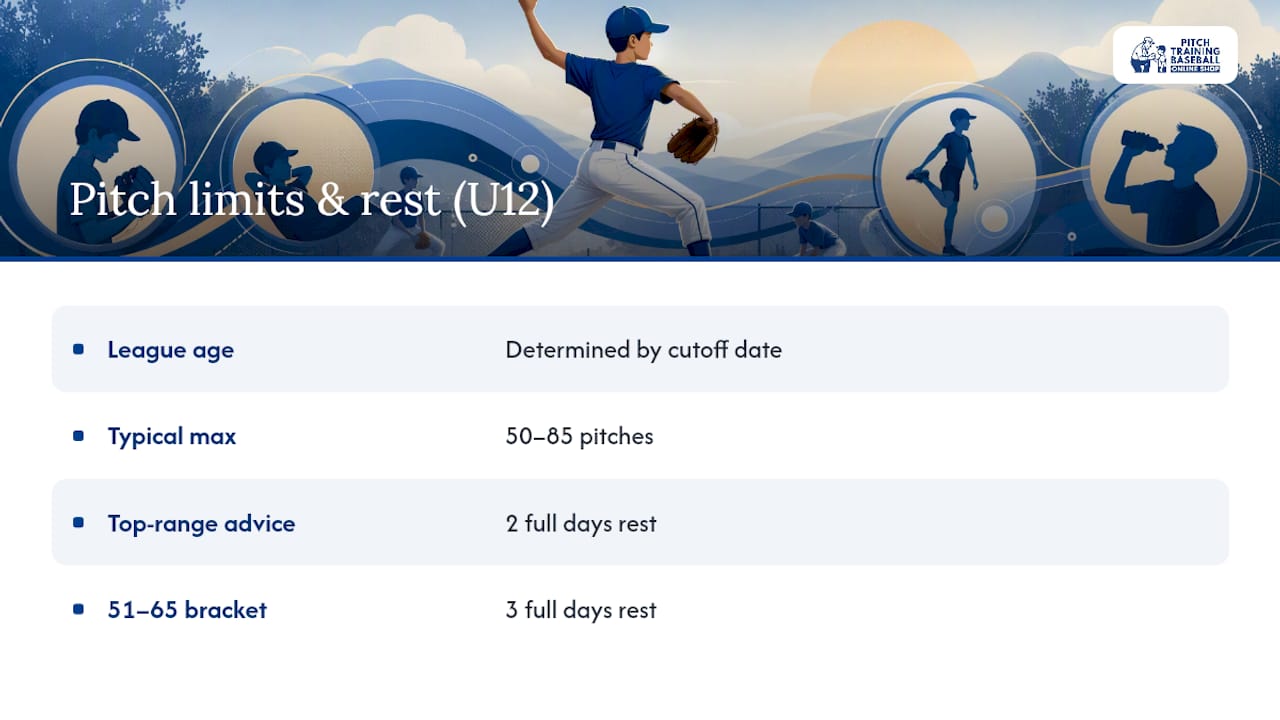
Here’s how it plays out in a real box score: your 11-year-old throws 58 pitches in Saturday’s game. That lands him in the 51 to 65 bracket, which means three full days of rest before he can pitch again, not just sit out the mound and play catcher on Sunday. If his team has a Wednesday game, he’s eligible. A Tuesday game is off the table no matter how good he says his arm feels.
Annual Workload, Innings Caps, And Time Off
A single high-pitch-count outing rarely causes the injuries that end seasons or careers. Cumulative workload does. That’s the finding behind Pitch Smart’s annual caps, which recommend no more than 80 combined innings across all teams in 12 months for ages 9 to 12, with higher but still capped totals for older pitchers.
-
Track innings across every team, not just the primary one.
-
Build in at least 3 to 4 months of no competitive pitching each year.
-
Make 2 to 3 of those months continuous, not scattered weekends here and there.
-
Recount at the season’s midpoint, not just at the end.
The easiest way to stay honest about combined innings: add up outings from the travel team, the school team, and any showcase or lesson-based bullpen work into one running tally, checked monthly.
Pro Tip: Keep the innings tally in a phone notes app or shared spreadsheet you update the same night as the game, while the pitch count is still fresh in your head. Waiting until Sunday to reconstruct Tuesday’s outing is how totals get lost.
Game-Day Rules Every Coach And Parent Should Enforce
Two rules have zero exceptions, regardless of what the scoreboard says or how the tournament bracket looks. A pitcher cannot throw on three consecutive days, period. And once he’s pulled from the mound mid-game, he cannot return to pitch later in that same game, even in extra innings.
-
After pitching, move him to first base or second base if he stays in the lineup.
-
Avoid putting a pitcher behind the plate to catch on days he’s thrown, since the throws back to the mound add real workload.
-
In tournament and doubleheader formats, map every pitcher’s rest requirement before the bracket starts, not after game one.
-
Rotate arms deliberately across a weekend rather than leaning on one or two kids because they’re “the best options.”
Tournament directors rarely track this for you. That job falls to whoever’s keeping score for your kid.
Warning Signs Of Overload And What To Do Next
Cumulative overload, not one hard outing, drives most youth pitching injuries, according to HSS and other children’s sports medicine programs. Watch for these red flags rather than waiting for a complaint of pain:
-
Sharp pain in the elbow or shoulder during or right after throwing.
-
Soreness that lingers more than 48 hours after an outing.
-
A sudden drop in velocity or command with no obvious mechanical cause.
-
Visible changes in arm slot, stride, or follow-through mid-game.
If any of these show up, stop throwing immediately. Ice the area for roughly 20 minutes if there’s swelling, hold him out of throwing drills, and tell the coach so nobody schedules him for the next outing by mistake. Pain that persists beyond a few days needs a medical evaluation, not a “let’s see how it feels Saturday” approach.
Tracking Pitch Counts Across Multiple Teams
Workload stacks up fast once a kid plays travel ball, a school team, and takes private lessons in the same month. Each coach sees only his own slice of the workload, which is exactly why caregiver awareness research found that parents who kept their own tracking log had far better adherence to safe limits than families relying on coaches to communicate across programs.
-
Log every outing the same day: date, opponent, pitch count, and how many days rest preceded it.
-
Total those entries weekly to catch anything approaching the rest thresholds.
-
Roll weekly totals into a monthly tally to spot a pattern before it becomes a problem.
-
Keep a running annual innings tracker that pulls from all teams and showcase appearances, checked against the season cap.
Pro Tip: Parents, not coaches, should own this log. A coach sees one team’s schedule. You see all of them, including the private lesson that added 40 throws nobody logged anywhere else.
Set a simple enforcement rule at home: if the weekly total from team one already puts your son near his rest threshold, he sits out pitching for team two that week, even if that coach doesn’t know the number. Our recommended rest strategies guide walks through how to set those household rules without creating conflict with a second coach.
When To Introduce Breaking Pitches Safely
Fastball command comes first, then the changeup, and only after both are genuinely under control does it make sense to add anything else. Cedars-Sinai recommends delaying curveball instruction until around age 14 and holding off on sliders until roughly 16, since the wrist and forearm mechanics of breaking pitches place different stress on a still-developing elbow.
-
Master fastball location before adding any secondary pitch.
-
Add the changeup next. It’s the lowest-stress pitch to layer in and teaches deception without extra arm strain.
-
Hold curveballs until around 14 and sliders until around 16, under qualified instruction.
-
Skip max-effort bullpens for pitchers under 13. Command and mechanics matter more than raw velocity at that age.
Velocity gains at this age come from strength and athleticism, not from throwing more pitches. A kid who lifts, sprints, and builds general coordination almost always adds more mph over two years than one who just throws bullpen after bullpen.
Recovery And Building Arm Health In The Offseason
What happens in the 48 hours after an outing shapes whether a pitcher bounces back clean or starts stacking soreness week over week.
-
Monitor for soreness the day after pitching. Mild fatigue is normal; sharp pain is not.
-
Ice for about 20 minutes if there’s any swelling, and skip catching or throwing-heavy positions that same day.
-
If soreness lasts beyond 48 hours, hold him out of throwing drills entirely until it resolves.
-
When returning from rest, restart with short-distance, pain-free tosses and add distance and effort gradually, advancing only when he has full range of motion and no discomfort.
-
Use the offseason months off to cross-train, build general strength, and ramp back into throwing gradually before the season starts rather than jumping straight into full bullpens.
Our recovery guide for young arms breaks this staged return down day by day if you’re working back from a longer layoff.
Where This Guidance Comes From
This article’s framework is built on the same guidelines Pitch Smart, Little League, and children’s sports medicine programs including HSS, Nationwide Children’s, St. Louis Children’s Hospital, and Cedars-Sinai already publish and recommend to parents and coaches.
-
Albert, a contributing coach at Pitch Training Baseball, put this framework together for practical use on the field.
-
Every pitch-count and rest threshold above traces back to a named clinical or governing-body source, not a rule of thumb.
-
For tools that support the control and command work these guidelines call for, our pitching target net and daily pitching habits guide both support building accuracy without adding unnecessary max-effort throws.
Better command means fewer wasted pitches per outing, which is one of the simplest ways to keep a kid under his rest threshold on a given day.
Build Command Without Adding Arm Stress
A pitcher who hits his spots throws fewer pitches per inning, which means fewer trips into the higher rest-day brackets over a season. That’s the real value of dedicated accuracy work between outings: it protects the arm indirectly by cutting down on the walks, deep counts, and extra warm-up throws that pad a pitch count without adding development value.
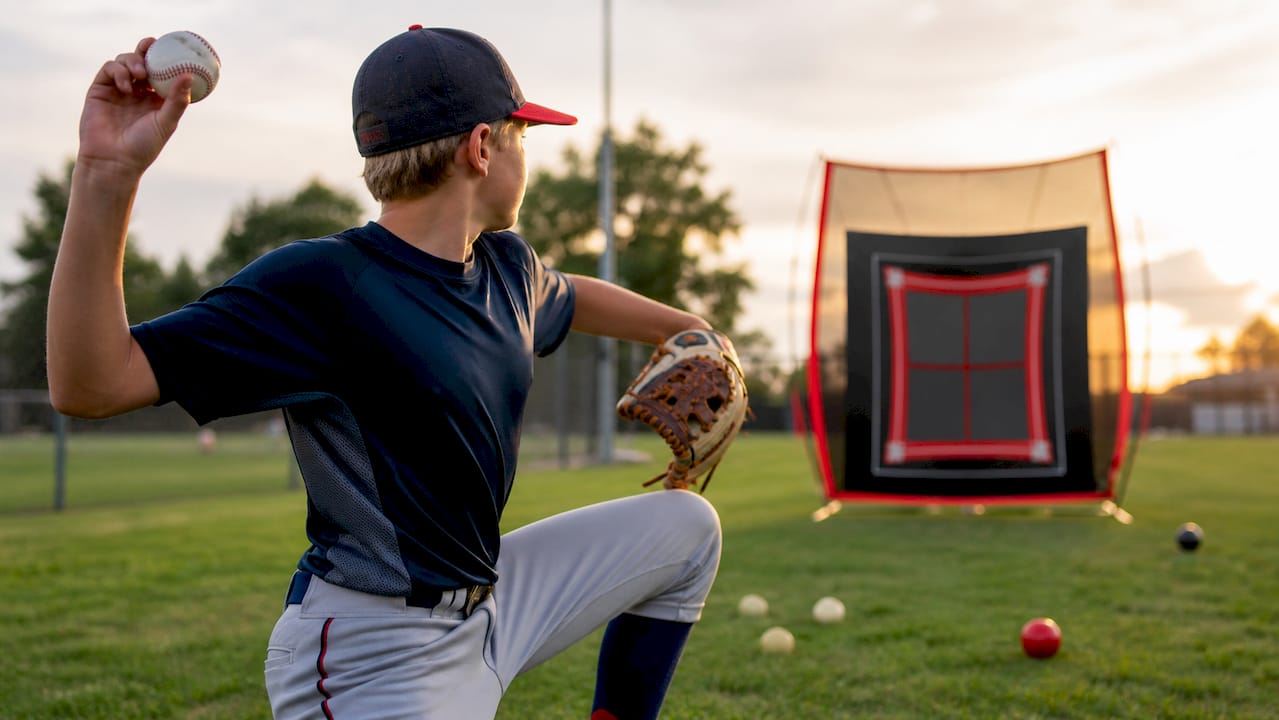
Pitch Training Baseball’s strike zone target net gives young pitchers a fixed target for command drills at home or on the field, so practice reps build accuracy instead of just adding raw throw volume. For lower-impact reps during return-to-throwing progressions or short at-home sessions, a soft training ball set lets a pitcher work on mechanics without the full-effort stress of a hard ball. Teams organizing their season gear can also check Capra Sports youth uniform packages if standardized gear is part of your season planning.
What The Guidelines Get Right, And Where They Fall Short
The medical guidance on youth pitching frequency is solid. The enforcement of it is where things fall apart. Pitch Smart and Little League publish clear numbers, but those numbers only protect a kid if someone actually adds up his throws across every team he plays for, and most families don’t do that consistently.
The conventional advice treats pitch counts as a single-team problem. It isn’t. A kid pitching for a travel team, a school team, and taking weekly lessons can blow past his weekly rest threshold without any one coach seeing the full picture. That’s the gap parents need to close, not the coach.
My honest take: prioritize the tracking log before you prioritize anything else on this list. The age-based charts matter, but they’re useless without a system that catches the stacked workload across programs. Start there, then layer in the mechanics work and the delayed breaking pitches. Getting the accounting right protects an arm more reliably than any single rule on the chart.
— Albert
Sources
Recommended
-
Recommended Daily Pitching Habits for Youth Players – Pitch Training Baseball
-
Recommended Pitching Rest Strategies for Youth Players – Pitch Training Baseball
-
How to Plan Pitcher Rotations for Youth Baseball – Pitch Training Baseball
-
Youth Baseball Pitching Myths Coaches Must Stop Believing – Pitch Training Baseball