


Expect to pay roughly $40 to $150 for a basic backyard pitching net, $150 to $500 for a durable mid-range target or rebounder, and $500 or more for pro-grade systems built for daily use. Most youth pitchers do best with a 9-pocket target net or a mid-range rebounder in that middle bracket. Start there, then adjust up or down based on your yard space and how often your kid actually throws.
TL;DR:
- Most families should target mid-range nets costing $150 to $500, which balance durability, target feedback, and cost-effectiveness for regular use.
- Netting material, frame quality, size, and features significantly influence a net’s longevity and price, with knotless netting offering better durability despite higher upfront cost.
- Rebounders are ideal for solo fielding practice and higher repetitions, while target nets improve pitching accuracy and command.
- Always measure pitch distance and test setup indoors before purchase to ensure proper fit and usability in your space, avoiding common sizing mistakes.
- Longer warranty coverage and availability of replacement parts can justify higher initial costs, as they extend the net’s usable life and prevent additional expenses.
Table of Contents
- Pitching Net Price Ranges: What You Get At Each Budget
- What Drives Pitching Net Price?
- Which Pitching Net Fits Your Player’s Age, Space, and Goals?
- What Real Pitching Nets Cost: A Quick Snapshot
- Why Pitchtrainingbaseball Recommends These Choices
- What Do Replacement Parts and Accessories Cost?
- How Warranty Coverage Affects Pitching Net Price
- A Coach’s Note on Common Buyer Mistakes
- Get a Pitching Net Built for Real Practice, Not Just Backyard Tosses
- Sources
Pitching Net Price Ranges: What You Get At Each Budget
Pitching net price scales almost entirely with three things: frame quality, netting durability, and how much feedback the target gives you. Here’s how that plays out at each level.
Budget nets, typically $40 to $150, are usually lightweight folding frames with basic polyester netting and minimal or no target graphics. They work fine for occasional backyard tosses but tend to sag or tear under daily bullpen sessions. Mid-range options, running $150 to $500, are where most families end up. This band includes larger 9-pocket target nets, entry-level rebounders, and stronger tube-steel frames that hold their shape after repeated setup and teardown.
Above $500, you’re paying for heavier-duty rebound systems and semi-permanent installations, often used by travel programs or facilities rather than backyard hitters. That’s the same price logic that applies once families start comparing full batting cages, where budget portable setups run $500 to $2,500 and mid-range cages climb to $3,000 to $8,000.
- Budget ($40-$150): light frame, basic netting, no rebound feature
- Mid-range ($150-$500): 9-pocket targets, entry rebounders, sturdier frames
- Premium ($500+): commercial-grade netting, reinforced frames, daily-use durability
Retailers often provide discounts on portable nets in late winter and early spring ahead of youth seasons, making early-year purchases potentially more economical than later in the year.
What Drives Pitching Net Price?
Four factors decide where a net lands on the price spectrum, and understanding them keeps you from overpaying for the wrong feature or underpaying for one you’ll regret skipping.
Netting material matters more than most buyers realize. Knotless netting costs 10 to 15% more upfront than knotted netting, but it resists fraying at the intersections and often lasts long enough to lower your actual cost per year of use. Higher-denier, UV-treated netting also holds up better against sun exposure if the net lives outside year-round.
Frame material is the second lever. Galvanized or powder-coated steel resists rust and holds shape under wind, while aluminum frames are lighter and easier to move but can flex or bend under repeated impact. Composite frames split the difference on weight and price.
Size and features round out the equation:
- Larger nets require more material and stronger framing, which generally increases their cost.
- Strike-zone graphics and multiple pockets typically add a noticeable premium over plain nets of the same size.
- Features enhancing portability, such as wheels or quick-fold mechanisms, usually increase the price somewhat.
Pro Tip: Calculate cost per usable year, not just sticker price. When considering longevity, a higher-cost knotless net that lasts multiple seasons can prove more cost-effective annually than a lower-cost knotted net requiring yearly replacement.
Which Pitching Net Fits Your Player’s Age, Space, and Goals?
Different net types solve different training problems, and picking the wrong one wastes money regardless of price.
- 9-pocket or 9-square target nets give pitchers direct feedback on location by showing which quadrant a pitch would have crossed, which speeds up coaching corrections compared to throwing at a blank net.
- Rebounders bounce the ball back to the thrower, letting a solo player get fielding reps and more throws per session without a partner shagging balls.
- Containment or portable nets are the cheapest way to get repetition in a small yard. They don’t teach location, but they stop balls from rolling into the street.
- Pocket trainers and small wall targets work well in garages, basements, or tight apartments where a full-size net won’t fit.
If the goal is sharpening command and hitting spots, a pitching net beats a rebounder for that specific job, while rebounders win on versatility and solo rep pace. For a side-by-side breakdown of how these categories stack up on drills and durability, see this pitching trainers comparison.
What Real Pitching Nets Cost: A Quick Snapshot
Here’s how typical SKUs line up against the price bands above, based on common category listings for portable and mid-range nets.
Most direct-to-consumer sellers offer free or flat-rate shipping on folded nets since they ship compact, and return windows of 30 days are common for unused, unassembled units. Watch for bundle discounts around back-to-school and pre-season sales, when sellers often knock 10 to 20% off target nets to clear inventory.
Why Pitchtrainingbaseball Recommends These Choices
Coaches and parents come to us because they’ve already burned money on a flimsy net that ripped after one summer. That’s exactly why we build toward the mid-range bracket: strong enough frame, netting rated for daily outdoor use, and a target that actually gives location feedback instead of just catching the ball.
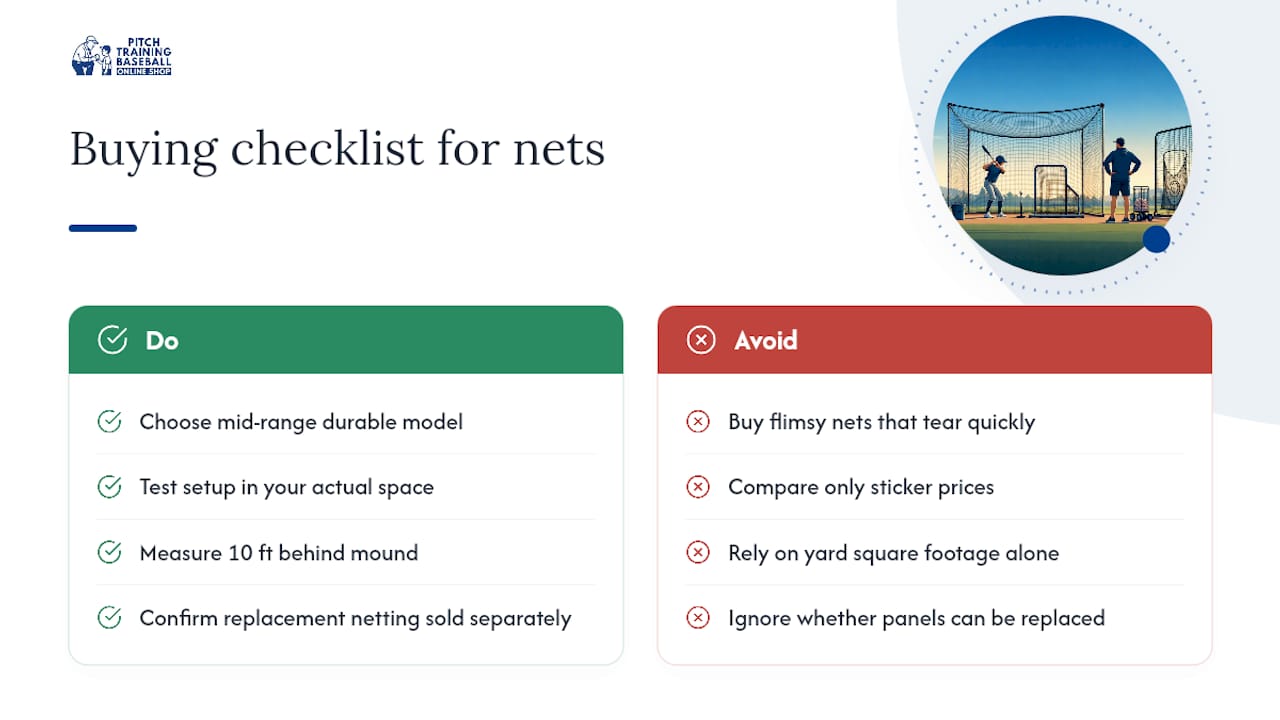
Before buying, test the setup in your actual space, not just the yard’s total square footage. Measure ten feet behind the mound for a proper drop zone, and check whether the seller sells replacement netting separately in case a panel wears out. Pro Tip: Divide the net’s price by how many seasons you realistically expect to use it, then compare that number across models instead of comparing sticker prices alone.
What Do Replacement Parts and Accessories Cost?
The net itself is only part of the budget. Ground anchors or stakes typically run $10 to $30 for a basic four-pack and matter more than most buyers expect, since a net that shifts in wind stretches unevenly and tears faster at the seams. Sandbags or weighted base kits, used where staking isn’t possible (decks, garages, turf you don’t want punctured), usually cost $20 to $50.
Replacement netting availability is important, with costs varying by size and type; smaller panels tend to be less expensive than full 9-pocket replacement nets. If a seller doesn’t list replacement netting separately, that’s worth asking about before you buy, especially if the net will live outside through summer heat and winter storage swings.
Frame replacement parts, like a snapped fiberglass pole or a cracked joint connector, run $10 to $40 per piece when sold individually, though not every manufacturer sells them. That gap is exactly why frame material matters at purchase time: a $150 net with no available replacement parts can become a $150 net you throw away after one broken pole, while a slightly pricier model with stocked parts keeps paying off year after year. Budget an extra $30 to $50 at purchase for anchors and a spare net panel if you’re buying for outdoor, multi-season use.
How Warranty Coverage Affects Pitching Net Price
Warranty length is one of the clearest signals of build quality, and it usually tracks price directly. Budget nets under $100 often carry short coverage windows, sometimes 30 to 90 days, covering manufacturing defects but not wear from regular use. That’s a reasonable trade-off for occasional backyard tossing, but it means you’re on your own if the netting frays by August.
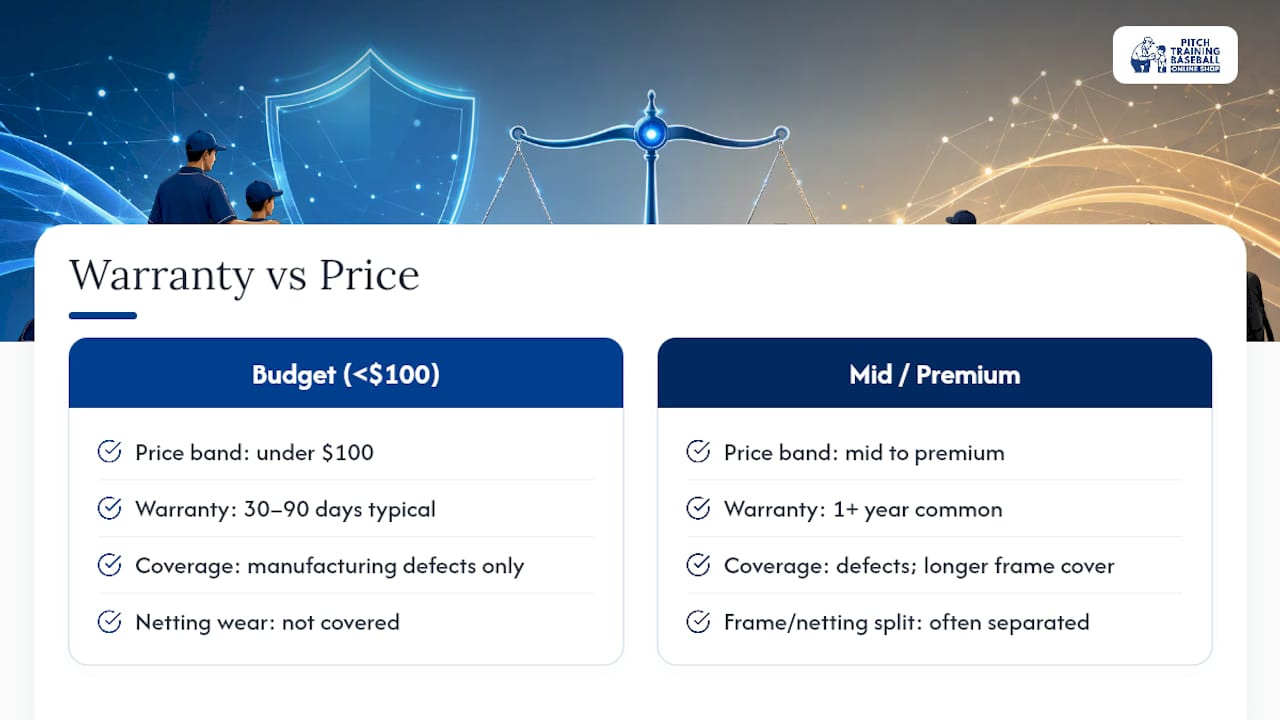
Mid-range and premium nets typically carry longer coverage, often one year or more, and some sellers separate frame warranty from netting warranty since the two wear at different rates. A frame might carry a multi-year guarantee against bending or rust while the netting itself is only covered for defects, not general wear, which is standard since netting is a consumable part regardless of price point.
Before buying, check whether the warranty requires you to register the product or keep a receipt, and whether return shipping falls on you or the seller if a defect shows up. A slightly higher price from a seller offering a full year of coverage and easy replacement-part ordering often beats a cheaper net with a 30-day window and no parts support. That gap in service policy explains a meaningful chunk of the price spread between two nets that look nearly identical on a spec sheet.
A Coach’s Note on Common Buyer Mistakes
Watching a parent buy a net two sizes too small for their kid’s growth spurt taught me the real lesson: measure the pitcher’s actual throwing distance and stride length before ordering, not just the box dimensions. Buyers also skip testing the setup indoors before committing, then discover it won’t fit the space they had in mind.
The two biggest errors: buying strictly on lowest price without checking if replacement netting exists, and skipping a trial setup before the return window closes…
— Albert
Get a Pitching Net Built for Real Practice, Not Just Backyard Tosses
If you’ve read this far, you already know the mid-range bracket is where most families should land, and that’s exactly where the Pitching Target Net with Colorful Strike 9-Zone sits.
It ships with a nine-zone strike graphic for real location feedback, a frame built to hold up to daily bullpen use, and a coaching eBook covering pitching grips so you’re not just throwing at a target blindly. It fits pitchers working on command, whether that’s a ten-year-old learning to hit corners or a travel-ball kid grinding through winter bullpens. Families building out a full practice kit often add the America Sliding Mitt for base-running drills, and coaches running small-group sessions can pair net work with structured drills like these youth mini-game coaching ideas to keep practice varied. Check the product page for current sizing and pricing, and order now if you want it set up before your next bullpen session.
Sources
- The Complete Batting Cage Quality Guide: Budget vs Mid-Range vs Premium (2026) | CageList
- Material Cost Analysis: Knotless Vs. Knotted & Total Value
- Pitching Targets & Nets (2026) / Blog | Diamond Sports Equipment
- Pitching Net vs Rebounder vs Pocket Trainer