


Arm strength in young baseball players is defined as the combined capacity of muscle power, joint stability, and throwing mechanics that produces safe, effective throwing performance. Understanding what is arm strength in young players goes far beyond how hard a kid can throw. It involves the rotator cuff, scapular stabilizers, the kinetic chain from legs to fingertips, and the recovery habits that keep all of it working. 46% of healthy youth baseball players report arm pain during throwing, which means most coaches and parents are already dealing with the consequences of underdeveloped or overworked arms. This guide gives you the framework to develop arm strength the right way.
What is arm strength in young players, exactly?
Arm strength in young players is not a single muscle or a single skill. It is the coordinated output of several physical systems working together during a throw.
The major muscle groups involved are the rotator cuff (supraspinatus, infraspinatus, teres minor, and subscapularis), the scapular stabilizers (serratus anterior, lower trapezius, and rhomboids), and the forearm flexors and extensors. Each group plays a specific role. The rotator cuff controls the shoulder through the throwing arc. The scapular stabilizers position the shoulder blade so the rotator cuff can work efficiently. The forearm muscles transfer force through the wrist and into the ball.
Joint stability is equally important. Ligaments and tendons around the elbow and shoulder absorb and redirect force on every throw. A young athlete with strong muscles but poor joint stability will still break down under a heavy workload. This is why arm strength training for young players must address both power and stability, not just one.
The kinetic chain is the piece most coaches and parents overlook. Throwing velocity comes primarily from the legs and core, not the arm. The arm is the final segment of a force sequence that starts at the ground, travels through the hips and trunk, and exits through the shoulder and elbow. A weak core or poor hip rotation forces the arm to compensate, which increases stress on the elbow and shoulder.
- Rotator cuff: Controls shoulder rotation and deceleration after release
- Scapular stabilizers: Position the shoulder blade for efficient arm movement
- Core and hips: Generate the majority of throwing force through rotation
- Forearm muscles: Transfer energy through the wrist and into the ball
- Ligaments and tendons: Absorb stress and protect joints on every throw
Pro Tip: Ask your player to throw a ball while sitting on a bench with no leg drive. The dramatic drop in velocity shows exactly how much power comes from the lower body, not the arm.
Why does proper arm strength development matter for young athletes?
Poor arm conditioning is the leading cause of overuse injuries in youth baseball. The connection between underdeveloped arm strength and injury is direct and well documented.
Elbow injuries like Little Leaguer’s Elbow and UCL sprains are caused primarily by overuse, poor mechanics, and insufficient rest. These injuries are not random. They follow predictable patterns in athletes who throw too much, too soon, without the muscular support to handle the workload. A young pitcher with a weak rotator cuff places the entire burden of deceleration on the UCL, which is a ligament, not a muscle. Ligaments do not recover the same way muscles do.
The injury statistics for youth baseball are alarming. 46% of healthy youth players experience arm pain during throwing. That number represents kids who are already in the sport and considered healthy. It shows how common arm stress is even before a formal diagnosis occurs.
“Arm care differs from arm strengthening. Effective programs combine muscle building with high-repetition, low-intensity joint stability exercises. Band rotations and scapular stability drills protect the shoulder complex in ways that heavy lifting cannot.”
The benefits of developing arm strength correctly go beyond injury prevention. A player with a strong, stable arm throws with better velocity and more consistent control. The shoulder stays in proper position through the entire throwing arc, which improves accuracy. Recovery between outings is faster because the muscles can handle the workload without breaking down. Understanding the importance of arm strength at a young age sets the foundation for a longer, healthier playing career.
Year-round competitive throwing without adequate rest is the single biggest risk factor for arm injury in youth baseball. The body needs time to repair micro-damage in tendons and ligaments. Without that repair time, small injuries accumulate into serious ones.
How to safely improve arm strength in youth baseball players
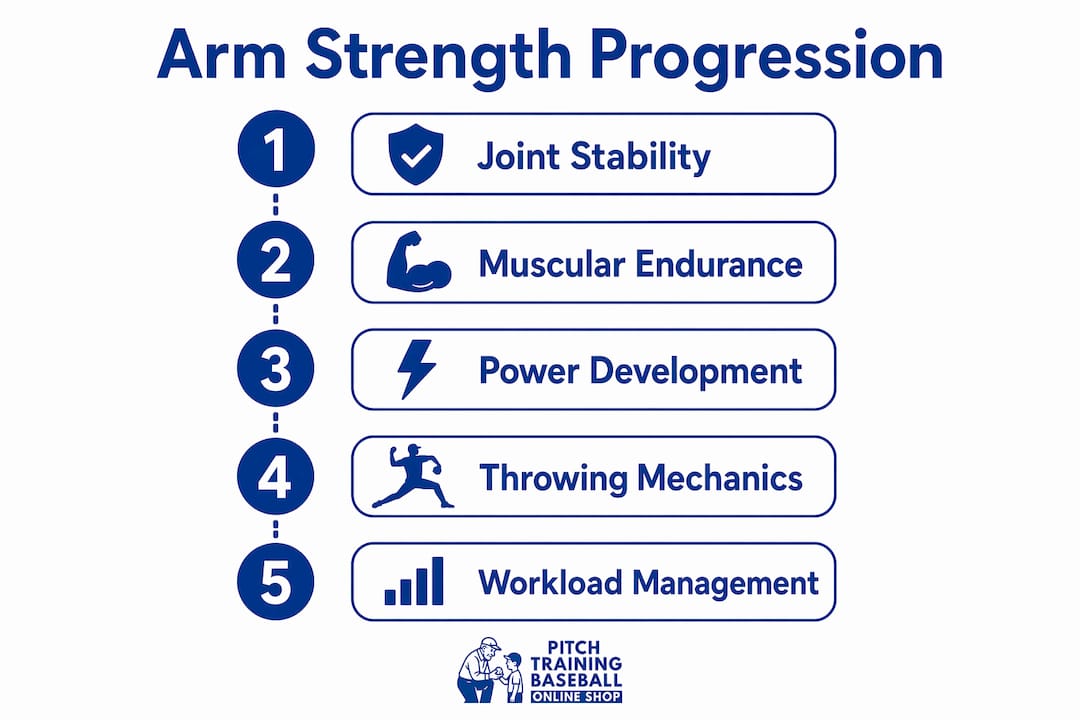
Safe arm strength development follows a progression from joint stability to muscular endurance to power. Skipping steps in that progression is how young athletes get hurt.
Start with resistance bands and bodyweight
Resistance bands are the best starting point for young players because they build joint stability without overloading tendons. External rotations with a band target the infraspinatus and teres minor, the two muscles most responsible for decelerating the arm after a throw. Y-T-W raises with a band or light weight activate the lower trapezius and serratus anterior, which stabilize the scapula. These exercises are not glamorous, but they build the foundation that makes every other training safe.
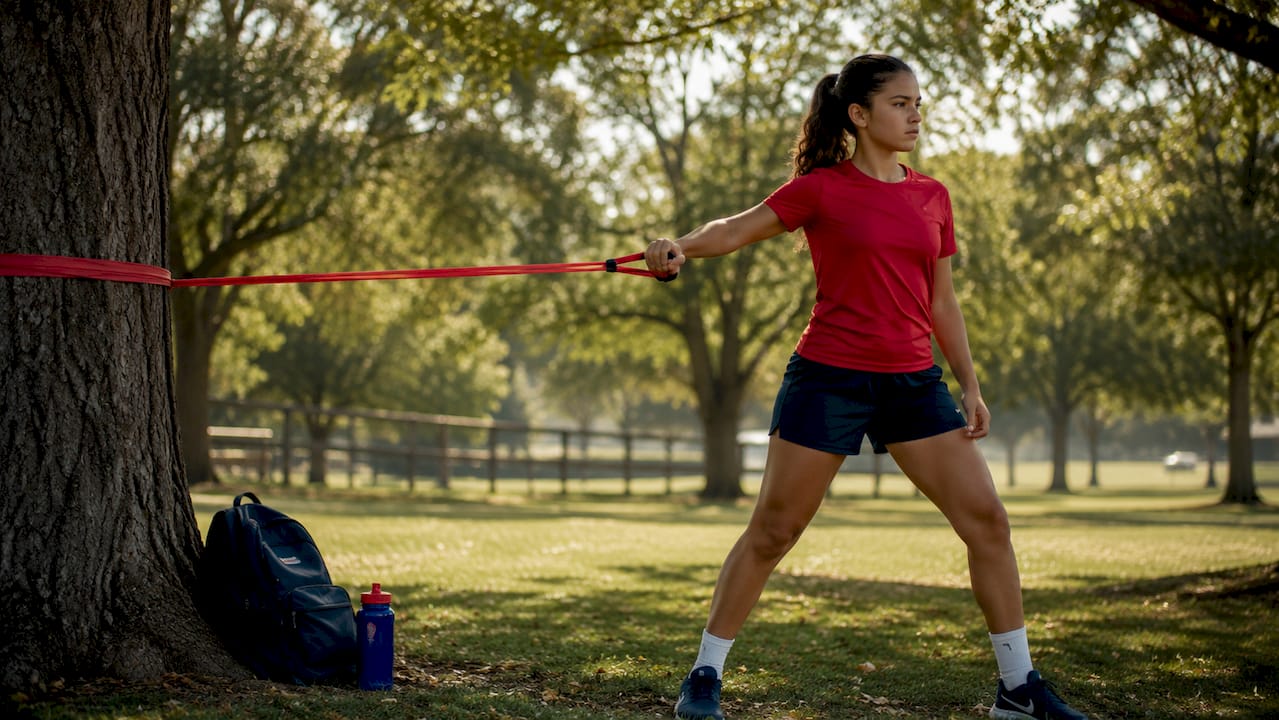
Arm care programs combine muscle building with high-repetition, low-intensity stability work. That means sets of 15–20 reps with light resistance, not heavy sets of 5. The goal at this stage is endurance and coordination, not maximum strength.
Progress to total-body and core exercises
Once joint stability is established, total-body exercises build the power that actually drives throwing velocity. Medicine ball rotational throws train the hip-to-shoulder sequence that generates force in a real throw. Planks, pallof presses, and rotational cable exercises strengthen the core without putting stress on the arm. Push-up variations build shoulder and chest strength in a natural range of motion.
Follow a structured throwing progression
Throwing itself is the best arm strength exercise, when done correctly. A structured long-toss program builds arm strength gradually by increasing distance over weeks, not days. The key is that mechanics must stay clean at every distance. Throwing harder with poor mechanics does not build strength. It builds injury risk.
| Training phase | Exercise examples | Sets and reps |
|---|---|---|
| Joint stability | Band external rotations, Y-T-W raises | 3 sets of 15–20 reps |
| Muscular endurance | Push-ups, planks, medicine ball throws | 3 sets of 12–15 reps |
| Power development | Rotational med ball slams, long-toss progression | 2–3 sets of 8–10 reps |
| Arm care maintenance | Band rotations, scapular retractions | Daily, 2 sets of 20 reps |
Pro Tip: A dynamic warm-up before every throwing session reduces injury risk significantly. Arm circles, hip rotations, leg swings, and light band work activate the muscles and prepare the joints before any ball is thrown. Never let a young player throw cold.
Avoid heavy barbell exercises like bench press or overhead press for players under 14. The growth plates in young arms are vulnerable to compressive loads. Bodyweight and band-based arm strength exercises build the same qualities without the risk.
What are the signs of arm overuse, and how should coaches manage throwing workload?
Recognizing overuse early is the most practical thing a coach or parent can do to protect a young player’s arm. The signs are consistent and recognizable when you know what to look for.
Signs of arm overuse in young players:
- Persistent soreness or pain in the elbow or shoulder that lasts more than 24 hours after throwing
- Decreased throwing velocity without an obvious mechanical cause
- Complaints of fatigue or “dead arm” feeling during or after practice
- Changes in throwing mechanics, such as dropping the elbow or shortening the follow-through
- Swelling, tenderness to the touch, or reduced range of motion in the elbow or shoulder
Any of these signs means the player needs rest, not more throwing. Pushing through arm pain in a young athlete is how minor overuse becomes a structural injury.
Pitch count guidelines and rest periods
Pitch count is the most predictive factor for arm injury in youth baseball. Exceeding pitch count guidelines dramatically increases injury risk, regardless of how strong or experienced the player is. Most youth baseball organizations publish age-specific pitch count limits and mandatory rest periods. Coaches must follow these guidelines without exception.
A minimum of four months of zero competitive overhead throwing annually is recommended by the American Sports Medicine Institute. That shutdown period allows soft tissues to recover and adapt. Players who skip the annual rest period accumulate damage that compounds over multiple seasons.
A player should never pitch and catch in the same game or on the same day. Both positions place maximum stress on the throwing arm. Combining them doubles the workload without doubling the recovery time.
| Workload factor | Recommended practice |
|---|---|
| Annual throwing shutdown | Minimum 4 months off competitive overhead throwing |
| Same-day pitching and catching | Never permitted |
| Pitch counts | Follow age-specific league guidelines strictly |
| Rest between outings | Mandatory rest days based on pitch count totals |
Technology and monitoring tools
Wearable inertial measurement units (IMUs) track arm workload at the joint level, providing data that pitch counts alone cannot capture. These devices measure arm speed, elbow stress, and fatigue patterns across a full practice or game. They give coaches and parents objective data to make rest decisions before pain appears.
Communication between coaches, parents, and athletes is the most underused tool in overuse injury prevention. A player who feels arm fatigue but stays quiet because they fear losing playing time is a player headed for injury. Building a culture where athletes report discomfort without consequences is as important as any training program.
Key Takeaways
Arm strength in young players is built through joint stability, muscular endurance, proper mechanics, and disciplined workload management, not by throwing harder or lifting heavier.
| Point | Details |
|---|---|
| Arm strength is a system | It combines rotator cuff strength, scapular stability, core power, and throwing mechanics. |
| Injury risk is high without care | 46% of healthy youth players report arm pain, making structured arm care non-negotiable. |
| Training must match age | Use resistance bands and bodyweight exercises before progressing to power-based training. |
| Rest is part of the program | A 4-month annual throwing shutdown protects long-term joint health in young athletes. |
| Pitch counts save careers | Exceeding pitch count guidelines is the most predictive factor for youth arm injuries. |
What I’ve learned coaching young arms that most guides won’t tell you
After years of working with youth baseball players, the pattern I see most often is not a training problem. It is a perception problem. Parents and coaches believe that a harder-throwing kid has a stronger arm. That belief drives decisions that hurt young athletes.
The kids I’ve seen develop the most durable, effective arms are not the ones who threw the most. They are the ones whose parents understood that rest is training. A four-month shutdown is not lost development time. It is the period when the body consolidates the gains from the previous season and prepares for the next one. The players who skipped that rest consistently showed up to spring training with tighter, more fatigued arms than the ones who took the full break.
The other mistake I see constantly is isolating arm training from the rest of the body. Coaches run band exercises at the end of practice as an afterthought. The kinetic chain work, the hip mobility, the core rotation, those get skipped because they do not look like baseball training. But a player with a weak core will always put excess stress on the elbow, no matter how many band rotations they do. Total-body conditioning is arm care.
The most honest advice I can give you: if your player’s arm is the most developed part of their athletic profile, something is out of balance. The arm strength training that lasts is built on top of strong legs, a stable core, and a disciplined rest schedule. Build the base first. The velocity follows.
— Albert
How Pitchtrainingbaseball supports safe arm development
Developing arm strength the right way requires the right tools, not just the right information. Pitchtrainingbaseball designs training equipment specifically for young athletes and the coaches and parents who guide them.
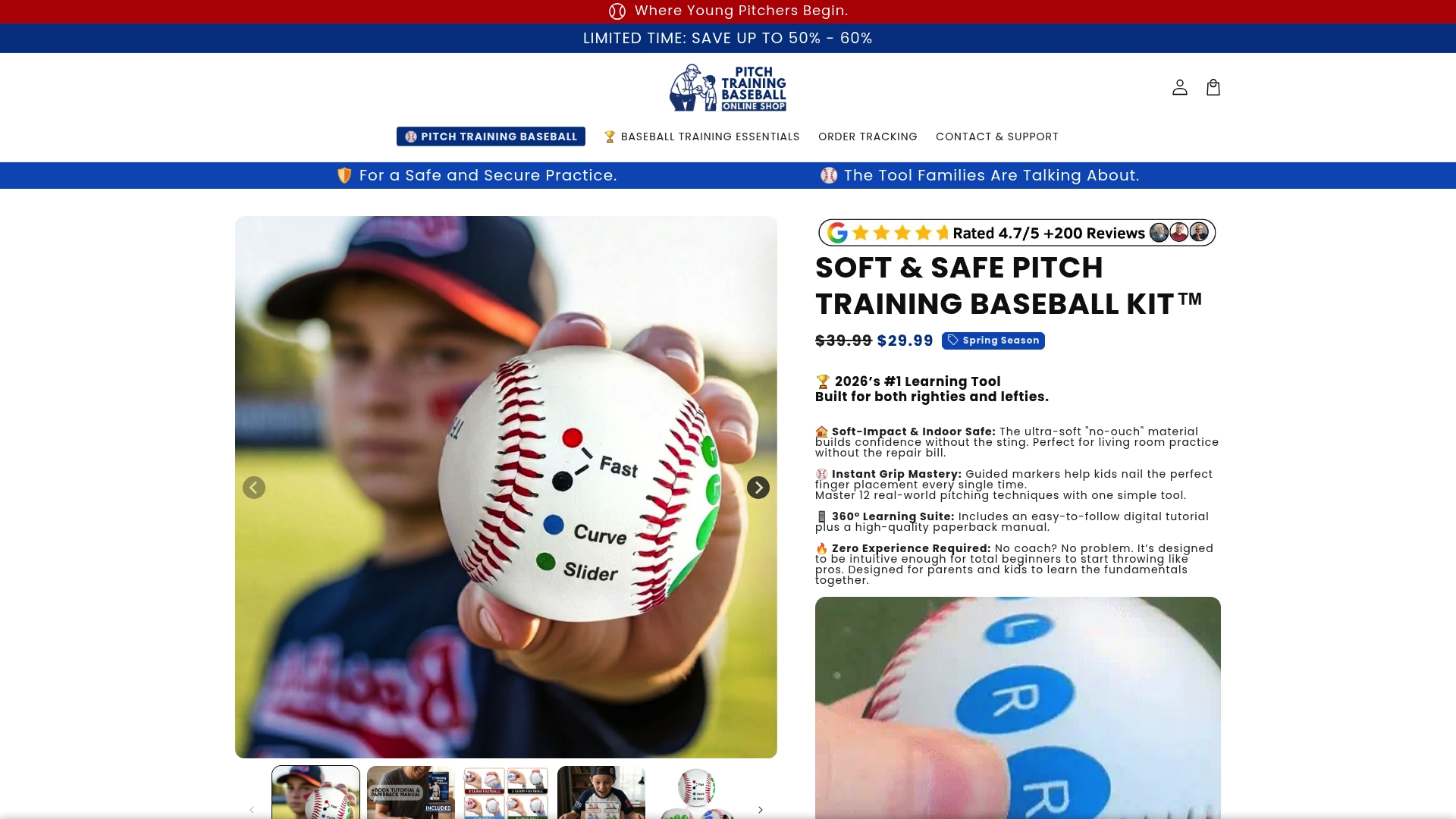
The Pitch Training Baseball kit gives players a structured way to practice throwing mechanics with feedback built into every rep. Paired with the Pitching Target Net with Strike 9-Zone, players develop accuracy and arm endurance together, which mirrors exactly what a well-structured arm strength program demands. Both tools are portable, adjustable, and designed to work alongside the exercise progressions and throwing programs described in this guide. Pitchtrainingbaseball makes it easier to build consistent, safe practice habits at home or at the field.
FAQ
What is arm strength in young baseball players?
Arm strength in young players is the combined output of rotator cuff muscles, scapular stabilizers, core power, and throwing mechanics that produces safe and effective throwing. It is not simply how hard a player can throw.
At what age should youth players start arm strength training?
Players as young as 8–10 can begin resistance band and bodyweight exercises focused on joint stability. Power-based training should wait until the mid-teen years when growth plates are more developed.
How many months should a young pitcher rest each year?
The American Sports Medicine Institute recommends a minimum of four months of zero competitive overhead throwing annually to protect long-term joint health.
What are the best arm strength exercises for young players?
Band external rotations, Y-T-W raises, medicine ball rotational throws, and push-up variations are the most effective starting exercises. They build joint stability and muscular endurance without stressing growth plates.
How do pitch counts protect young arms?
Pitch count guidelines limit the total throws per outing and require mandatory rest days based on volume. Exceeding these limits is the single most predictive factor for arm injury in youth baseball.
Recommended
- Arm Strength Tips for Baseball: Youth Player Guide – Pitch Training Baseball
- The Role of Parents in Baseball Training: A 2026 Guide – Pitch Training Baseball
- Arm Strength Training for Young Baseball Pitchers – Pitch Training Baseball
- How to Increase Arm Strength for Baseball Athletes – Pitch Training Baseball