


Most kids need a soft safety ball for tee ball (ages 4 to 7), a soft or entry-level youth ball for coach-pitch (7 to 9), a real youth regulation ball once they hit Little League play (9 to 12), and a full-size regulation ball by 13 and up. That said, every league sets its own rules, so double-check your division’s cutoff and equipment list before you buy anything.
TL;DR:
- Children ages 4 to 7 should use soft foam or low-impact safety balls, which are less likely to cause injury during early skill development.
- Youth regulation baseballs for ages 9 to 12 feature raised seams, a synthetic or leather cover, and are nearly identical in size to adult balls.
- Full-size regulation balls, about 9 inches in circumference and weighing roughly 5 ounces, become standard for players aged 13 and above.
- Raised seams improve grip and control for young pitchers, but foam or flat-seam balls are better for beginners or during early training.
- Always verify league-specific rules and certifications before purchasing equipment, as compliance standards can vary across organizations.
Table of Contents
- Baseball Size by Age: The Division-by-Division Breakdown
- What Are the Official Baseball Size and Weight Standards?
- Raised Seam vs Flat Seam: Which Baseball Type Should You Buy?
- How to Choose the Right Baseball: A Step-by-Step Checklist
- Why League Age and Field Size Change Your Equipment Choice
- A Coach’s Perspective on Testing and Progressing Ball Types
- Practice Smarter With Safe Training Balls and a Pitching Target
- Sources
Baseball Size by Age: The Division-by-Division Breakdown
The right ball changes fast as kids move through youth baseball, and picking the wrong one either slows down skill development or puts a young player at unnecessary risk. Here’s what to grab at each stage, based on how Little League structures its divisions.
- Tee ball (ages 4 to 7): Use a soft foam or low-compression safety ball. At this age, reaction time and glove skills are still developing, and a regulation-weight ball hitting a four-year-old’s forearm is a bad first impression on the sport. Look for labels that say “safety ball,” “low impact,” or “reduced injury factor” (RIF) on the packaging.
- Coach-pitch (ages 7 to 9): Step up to a transitional or entry-level youth ball, often a slightly softer core wrapped in a synthetic cover. Kids are starting to track pitched balls and swing with more force, so you want something forgiving but closer to game feel.
- Little League Minor/Major (ages 9 to 12): Move to a genuine youth regulation baseball, usually a synthetic or full-grain leather cover with raised seams. This is the first stage where the ball needs to match what’s used in actual league games.
- Intermediate and Junior divisions (ages 11 to 14): Kids transition to full-size regulation baseballs as fields expand toward adult dimensions. According to Little League’s division guide, Intermediate and Junior play bridges the gap between small-field baseball and the 90-foot diamond.
- 13 and up (Senior division and high school): Full-size, full-weight regulation baseballs become standard. By now, most players have the strength and mechanics to handle true game specs.
A coach’s rule of thumb: if a kid is still flinching at a coach-pitch ball, keep them on the softer option a season longer. Confidence at the plate matters more than rushing to “the real ball.” Retail guides from major sporting goods chains group products the same way. DICK’S Sporting Goods’ buying guide separates tee/safety balls, youth regulation balls, and full-size regulation balls into distinct categories for exactly this reason.
What Are the Official Baseball Size and Weight Standards?
A regulation baseball measures approximately 9 inches in circumference and weighs roughly 5 ounces, based on typical MLB standards cited in Net World Sports’ baseball buying guide. That’s the standard MLB and most Little League Major Division and older balls are built to.
Youth balls marketed for Minor Division or coach-pitch play often stay close to that circumference but use a softer core, so the size feels similar in the hand even though the impact is gentler. The differences that actually matter for compliance are certification marks, not just dimensions. USA Baseball’s equipment standards explain that certification categories determine which balls and bats are legal at a given level, and USSSA publishes its own division-specific equipment rules that can differ from Little League’s.
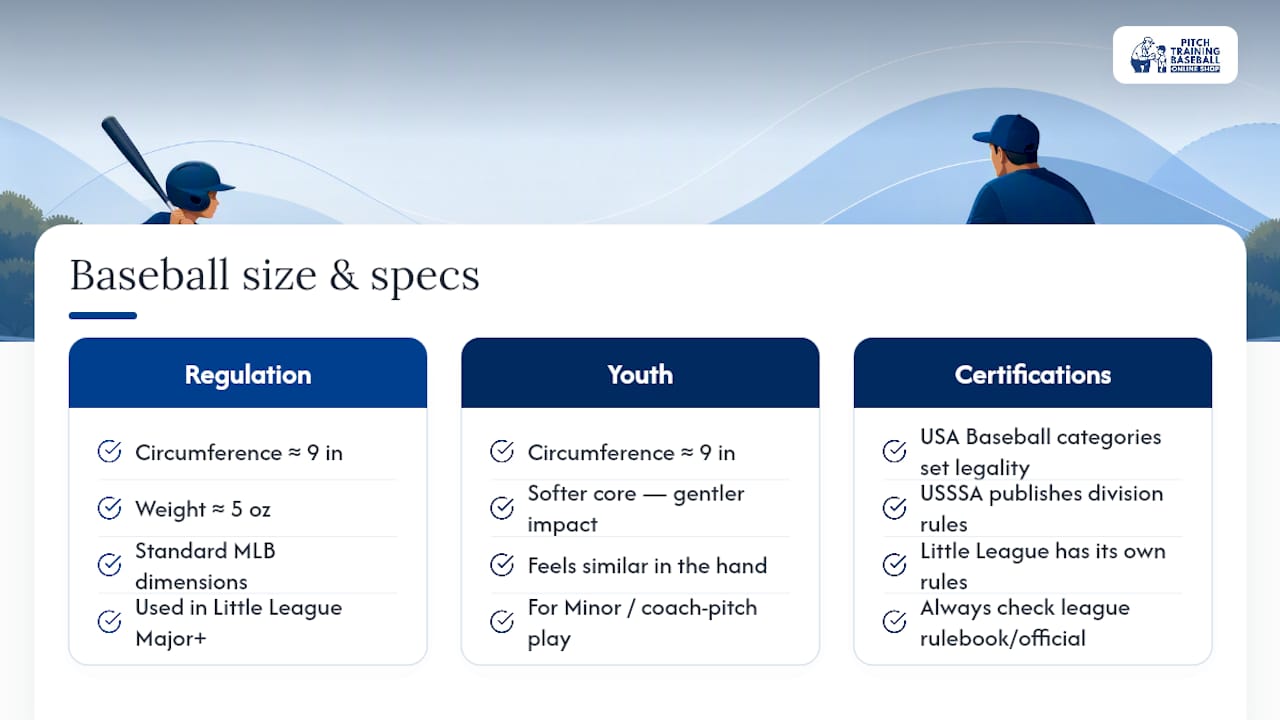
Never assume a ball is tournament legal just because it looks right. Check your league’s rulebook or ask your league official before showing up to a sanctioned game with the wrong stamp on your equipment bag.
Raised Seam vs Flat Seam: Which Baseball Type Should You Buy?
Cover material and seam height affect grip, spin, and how forgiving a ball is on impact.
- Leather covers hold up better over seasons of outdoor use and grip well in dry weather, but cost more and can get slick when wet.
- Synthetic covers cost less, tolerate rain and mud, and are common in youth regulation balls.
- Raised seams give young pitchers something to grip for spin and control, which is why most training and youth regulation balls use them.
- Flat seams show up more in some practice balls and are smoother, with less grip feedback for developing pitchers.
- Foam and low-compression safety balls trade all of that for pure impact reduction, ideal for tee ball and early skill work.
Pro Tip: If a young pitcher struggles to grip a ball consistently, switch to one with pronounced raised seams before assuming it’s a mechanics problem. Sometimes the equipment is fighting the kid, not the other way around.
How to Choose the Right Baseball: A Step-by-Step Checklist
- Check league rules first. Confirm your league’s age cutoff date, since Little League uses August 31 while other organizations use May 1 or January 1.
- Confirm the division. Match your child’s league-assigned age, not calendar age, to the correct division and its ball requirements.
- Pick material and hardness for skill level. Newer players and younger kids benefit from softer cores; established pitchers benefit from raised-seam regulation balls.
- Buy two balls if you can. One certified game ball, one softer training ball for backyard reps.
| Age Band | Division | Recommended Ball | Key Trait |
|---|---|---|---|
| 4 to 7 | Tee Ball | Soft foam/safety ball | Low impact |
| 7 to 9 | Coach-Pitch/Minor | Entry-level youth ball | Softer core |
| 9 to 12 | Little League Major | Youth regulation ball | Raised seams |
| 13+ | Intermediate/Junior/Senior | Full-size regulation ball | approximately 9 inches, roughly 5 ounces |
Why League Age and Field Size Change Your Equipment Choice
Field dimensions and pitching distance aren’t just trivia. They determine how much reaction time a hitter has and how hard a pitch can safely travel before it reaches the plate.
- Little League’s own field specifications set pitching distance around 46 feet for Major Division and below, which is shorter than the standard 60 feet 6 inches used in high school and beyond as noted in Little League field specifications.
- Shorter distances mean less time to react, which is part of why younger divisions pair shorter mounds with softer balls.
- As players move into Intermediate and Junior divisions, both the field and the ball scale up together, not separately.
For a full breakdown of how pitching distance shifts by division, our pitching distance guide walks through the specifics league by league. Always confirm your local league’s exact field setup before finalizing gear.
A Coach’s Perspective on Testing and Progressing Ball Types
Squeeze the ball with your thumb before handing it to a young pitcher. If it gives noticeably, it belongs in the tee-ball or early coach-pitch bucket, not a Little League game bag. The safest progression moves from soft training balls, to raised-seam youth balls, to full regulation, letting arm strength and mechanics catch up at each stage rather than rushing size. Pair that progression with a pitching target net and soft practice balls at home, since low-stakes reps build accuracy faster than game situations ever will.
— Albert
Practice Smarter With Safe Training Balls and a Pitching Target
Pitchtrainingbaseball gives you a lower-risk way to build arm strength and control between practices, without needing a full field or a second coach standing behind the plate. Our soft training balls and target net let a young pitcher get real reps in the backyard, the garage, or the driveway, at a fraction of what a private lesson costs.

For the youngest players working on grip and confidence, the Pitch Training Softball and the 5 Pickeballs bundle offer a low-impact way to log swings and throws without the sting of a hard ball. Pair either with our pitching target net to turn open backyard space into a real strike-zone workout, especially useful during off-season months when field time is scarce. Head to the product page, pick the bundle that matches your player’s age band, and get a set delivered before your next practice window opens.