


Pitch selection is defined as the strategic decision of which pitch type to throw and where to locate it, based on the batter’s tendencies, the game situation, and what the pitcher can reliably execute. It is the central act of pitching intelligence, sitting above mechanics and velocity in terms of long-term impact on outcomes. Every pitch thrown in a game is the result of a structured decision workflow that moves from reading the game context to choosing a pitch to adapting based on batter reactions. For parents, coaches, and young pitchers, understanding this process is the difference between throwing hard and pitching smart. The industry term for the broader practice is pitch calling, and pitch selection is the individual decision within each at-bat that makes pitch calling work.
What is pitch selection and why does it matter in baseball?
Pitch selection is not a single choice. It is a dynamic feedback loop that adjusts inning by inning, batter by batter, and pitch by pitch. A pitcher who treats it as a static menu, picking from a list of their best pitches without reading the situation, will consistently underperform against hitters who have seen them before.
The importance of pitch selection becomes clear when you consider what it actually controls. It determines whether a batter sees something they expect or something that disrupts their timing. It shapes whether a pitcher conserves energy by getting early-count outs or burns through pitches chasing strikeouts. It also determines whether a pitcher’s best stuff gets used at the right moment or wasted on the wrong batter in the wrong count.
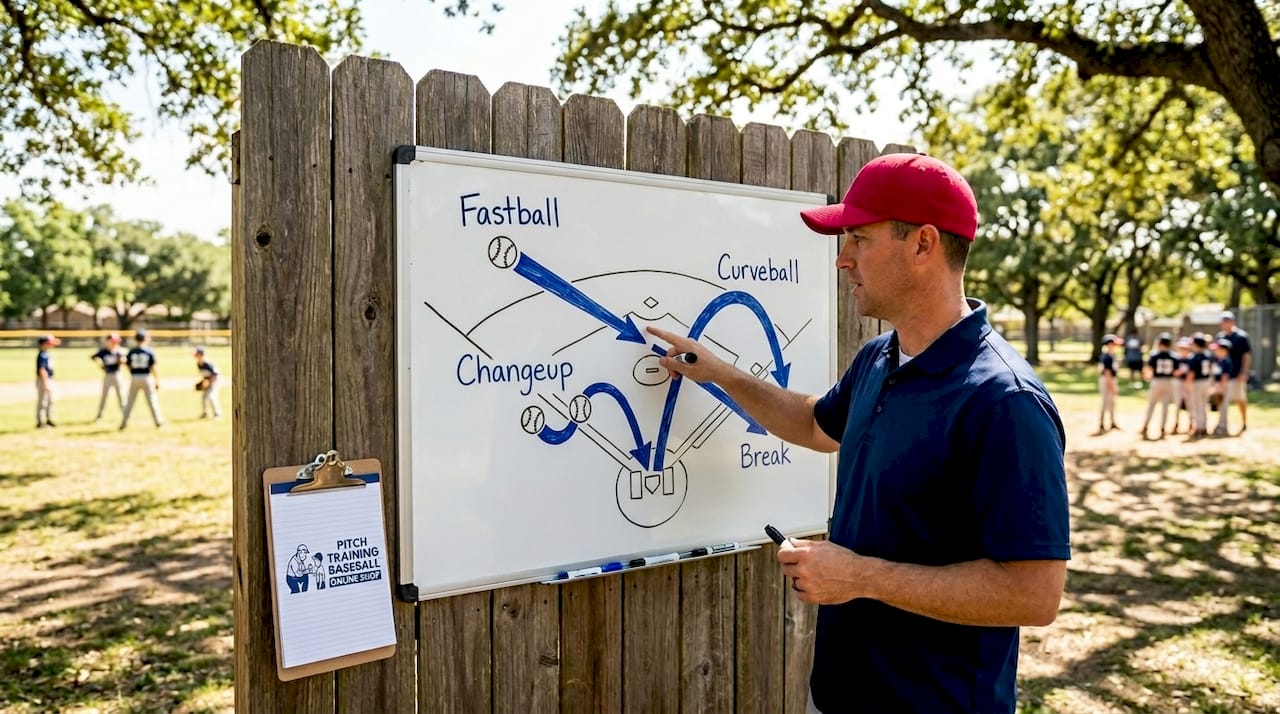
Three factors drive every pitch selection decision: the batter’s profile, the game situation, and the pitcher’s current command. A pitcher who cannot locate their curveball on a given day should not be throwing it in a 3-2 count with runners on base. That is not a mechanical failure. That is a pitch selection failure. Understanding the distinction is the first step toward coaching it effectively.
How do game situations and batter profiles shape pitch strategy?
The game situation changes the risk-reward calculation on every pitch. With no runners on base and a 1-0 lead, a pitcher can work the edges of the zone and accept a walk. With runners on second and third and one out, the calculus shifts entirely. The pitcher needs a ground ball or a strikeout, and situational pitch decisions must reflect that urgency.
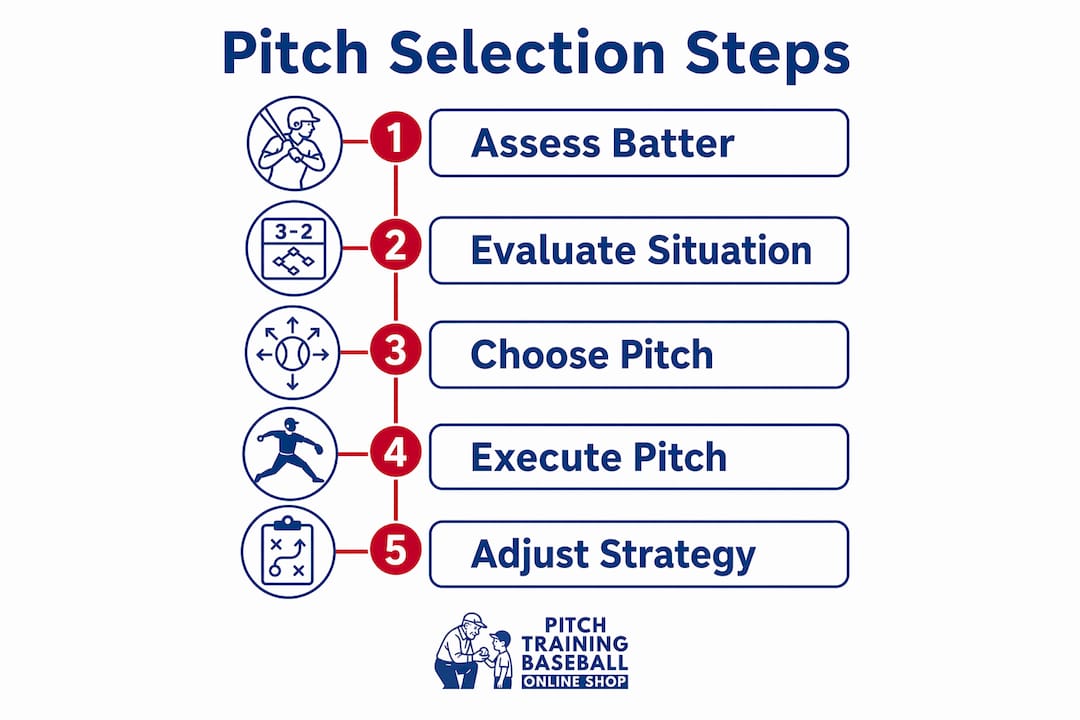
Batter scouting shapes which pitches to throw and where. A hitter who chases high fastballs gets a steady diet of elevated heaters early in the count. A pull-heavy hitter gets worked away. A batter who struggles with breaking balls gets a curveball in a hitter’s count to see if the scouting holds. At the youth level, formal scouting reports do not exist, but coaches and catchers can observe tendencies within a single at-bat and adjust immediately.
Here is what changes based on game context:
- Early innings: Establish the fastball, test the batter’s weaknesses, and gather information for later at-bats.
- Middle innings with runners on: Prioritize contact management. Induce weak contact over chasing strikeouts.
- Late innings, close game: Go to the pitcher’s most reliable pitch, not their most impressive one.
- Full count, pressure situation: Throw the pitch the pitcher can locate, not the one that looks best on paper.
Pro Tip: Keep a simple mental log during the game. If a batter fouls off a fastball inside twice, they are timing it. Move the next fastball outside or drop in a changeup. Adjustment is the skill.
What is pitch sequencing and how does it connect to pitch selection?
Pitch sequencing is the arrangement of pitches across an at-bat or across multiple at-bats to set up future outcomes. Where pitch selection answers “what do I throw right now,” sequencing answers “what am I setting up for the next pitch or the next time this batter steps in.” The two concepts are inseparable in practice.
“Pitching is more chess than brute force; sequencing sets up hitters psychologically and strategically rather than just relying on best pitches.” — Full Count Perspective
The most effective sequencing strategies use contrast. A fastball-changeup speed delta of 8 to 12 mph is the standard rule of thumb for disrupting a batter’s timing. When a hitter gears up for a 85 mph fastball and gets a 73 mph changeup in the same arm slot, their swing starts too early. That is not luck. That is sequencing doing its job.
Here are five sequencing principles that apply at every level of baseball:
- Establish the fastball first. Batters must respect the heater before off-speed pitches become effective.
- Use location before movement. Change the quadrant of the zone before changing pitch type to compound confusion.
- Set up your best pitch. If your curveball is your out pitch, throw two fastballs that make the batter lean toward the plate, then break the curve away.
- Repeat to deceive. Throwing the same pitch twice in a row is not predictable if the location changes. Batters who expect variation get caught by repetition.
- Use pitch tunneling. Pitches that look identical out of the hand but break differently at the plate create the highest deception. This is the concept behind spin mirroring, where two pitches share early flight paths before diverging.
At the youth level, sequencing does not need to be complex. Two pitches thrown with intention and contrast, a fastball in and a changeup away, are enough to keep most young hitters off balance. The goal is not to have a deep arsenal. The goal is to use what you have with purpose.
Why does pitch accuracy matter more than speed or pitch type?
Pitch accuracy is the single most predictive variable in batter outcomes. Research published in The Sport Journal shows that accurate pitches are over three times more likely to produce favorable outcomes than pitch speed or type alone. That finding reframes how coaches should think about youth development. A 12-year-old who can hit the outside corner with a fastball consistently is more dangerous than one who throws 10 mph harder but misses his spots.
Accuracy means hitting the intended location, not just throwing strikes. A fastball aimed at the low outside corner that lands belt-high over the middle is not an accurate pitch. It is a batting practice pitch with extra velocity. The difference between those two outcomes is what separates effective pitchers from hard throwers.
| Pitch quality factor | Impact on batter outcomes |
|---|---|
| Pitch accuracy (hitting the spot) | Over 3x more likely to produce favorable outcomes |
| Pitch speed (velocity) | Significant but secondary to location accuracy |
| Pitch type (fastball vs. breaking ball) | Effective only when paired with accurate execution |
| Pitch sequencing | Multiplies the effect of accuracy across an at-bat |
This data carries a direct coaching implication. Prioritize pitches that a young pitcher can accurately command today over theoretically superior pitch types they cannot yet locate. A reliable two-seam fastball to both sides of the plate beats an inconsistent slider every time. Building youth pitching mechanics around repeatable delivery is the foundation that makes accuracy teachable.
What role does the catcher play in pitch selection?
The catcher is the architect of pitch selection in real time. While the pitcher executes, the catcher reads the batter’s stance, tracks pitch effectiveness across innings, monitors the pitcher’s fatigue and command, and calls the pitch that fits all of those variables simultaneously. It is one of the most cognitively demanding positions in team sports.
Catchers use several methods to communicate pitch calls:
- Traditional hand signals: One finger for fastball, two for curveball, three for changeup. Simple and universal at the youth level.
- PitchCom: An electronic wristband system used in MLB that transmits pitch calls directly to the pitcher’s ear, eliminating sign-stealing risk.
- Dugout relay systems: Real-time pitch calling from coaches to catchers, observed in minor league and MLB experiments, allows pitching coaches to transmit pitch types and locations electronically.
- Wristband playbooks: Used increasingly at the college baseball level to relay pitch calls with coded numbers, reducing miscommunication under pressure.
The catcher-pitcher relationship is built on trust. A pitcher who shakes off every call loses confidence in the system and slows the game. A catcher who ignores pitcher feedback misses critical information about what is working. Building psychological safety between the two players, where both feel heard and respected, directly improves pitch selection quality.
Pro Tip: At the youth level, keep the signal system to three pitches maximum. Complexity creates hesitation, and hesitation kills rhythm. A simple system executed confidently beats a sophisticated one executed poorly.
How can youth pitchers improve pitch selection with drills and practice?
Improving pitch selection is a skill that requires constraint-based training focused on decision-making under pressure, not just mechanical repetition. Applied Vision Baseball’s research confirms that isolating decision moments in drills produces faster skill transfer than purely mechanics-focused sessions.
The most effective approach for youth pitchers follows a progression:
- Start with a two-pitch arsenal. Fastball and changeup. Master location and contrast before adding a breaking ball. This mirrors the youth pitch selection guidance that emphasizes avoiding overcomplication at early skill levels.
- Run situation-based bullpen sessions. Instead of throwing 30 pitches to no one, set up scenarios. Bases loaded, one out, 2-2 count. The pitcher must choose and execute. This is game-like pitching practice that builds real decision-making speed.
- Log pitch outcomes after every session. Track which pitches worked, which missed, and in what counts. Patterns emerge quickly. A pitcher who consistently misses their changeup low and away in 3-2 counts knows exactly what to work on.
- Practice the shake-off. Catchers should occasionally call a pitch the pitcher disagrees with. The pitcher shakes off and calls an alternative. This builds communication confidence and teaches pitchers to advocate for their own command.
- Introduce a third pitch only when the first two are reliable. Adding a curveball before a pitcher can locate their fastball to both sides of the plate is a common mistake. Complexity added too early creates confusion, not growth.
| Training approach | Best for | What it develops |
|---|---|---|
| Two-pitch constraint drill | Beginners (ages 8 to 12) | Command, contrast, and sequencing basics |
| Situation-based bullpen | Intermediate (ages 12 to 15) | Decision-making under pressure |
| Pitch outcome logging | All levels | Self-awareness and in-game adaptation |
| Shake-off communication drill | All levels | Pitcher-catcher trust and signal clarity |
Assessing youth pitching performance regularly gives coaches the data they need to know when a pitcher is ready to expand their pitch menu. Without that assessment, adding complexity is guesswork.
Key takeaways
Effective pitch selection combines accurate execution, situational awareness, and clear pitcher-catcher communication to consistently outperform hitters regardless of velocity.
| Point | Details |
|---|---|
| Accuracy beats velocity | Pitches hitting the intended spot are over 3x more likely to produce favorable outcomes than faster, less accurate throws. |
| Sequencing multiplies effectiveness | Arranging pitches with speed and location contrast disrupts timing and sets up out pitches across an at-bat. |
| Game situation drives pitch choice | Score, inning, base runners, and batter tendencies must all shape which pitch gets thrown and where. |
| Simple systems work best for youth | A two-pitch arsenal with a clear three-signal system outperforms complex approaches at early skill levels. |
| Communication is a trainable skill | Pitcher-catcher trust and clear signal systems are developed through deliberate practice, not assumed to exist. |
Why I think most youth coaches get pitch selection backwards
From where I stand, the biggest mistake in youth pitching development is treating pitch selection as something that comes after mechanics are “fixed.” Coaches spend months on arm angle and stride length, then hand a kid a game and expect them to make smart pitch decisions with zero training in that skill. That is not how learning works.
Pitch selection is a cognitive skill. It needs reps under pressure, just like a curveball grip needs reps in the bullpen. The coaches I have seen develop the sharpest young pitchers do one thing differently: they make every bullpen session a decision session. The pitcher does not just throw. They read a scenario, choose a pitch, and execute. Then they get feedback. That loop, repeated over months, builds the kind of in-game intelligence that no amount of mechanical drilling can replicate.
The other thing I would push back on is the obsession with pitch variety at young ages. A 10-year-old with a reliable fastball to both sides of the plate and a changeup that drops out of the zone is already ahead of 80% of their peers. Adding a curveball before those two pitches are locked in is not development. It is distraction. Simplicity, executed with accuracy and intention, wins more games and builds better pitchers.
The catcher side of this equation gets even less attention. Most youth teams treat the catcher as a receiver, not a strategist. Investing 15 minutes per practice in pitcher-catcher communication drills, running through signals, discussing pitch choices for different counts, and building a shared vocabulary pays off faster than almost any other training investment.
— Albert
Build pitch command with the right training tools
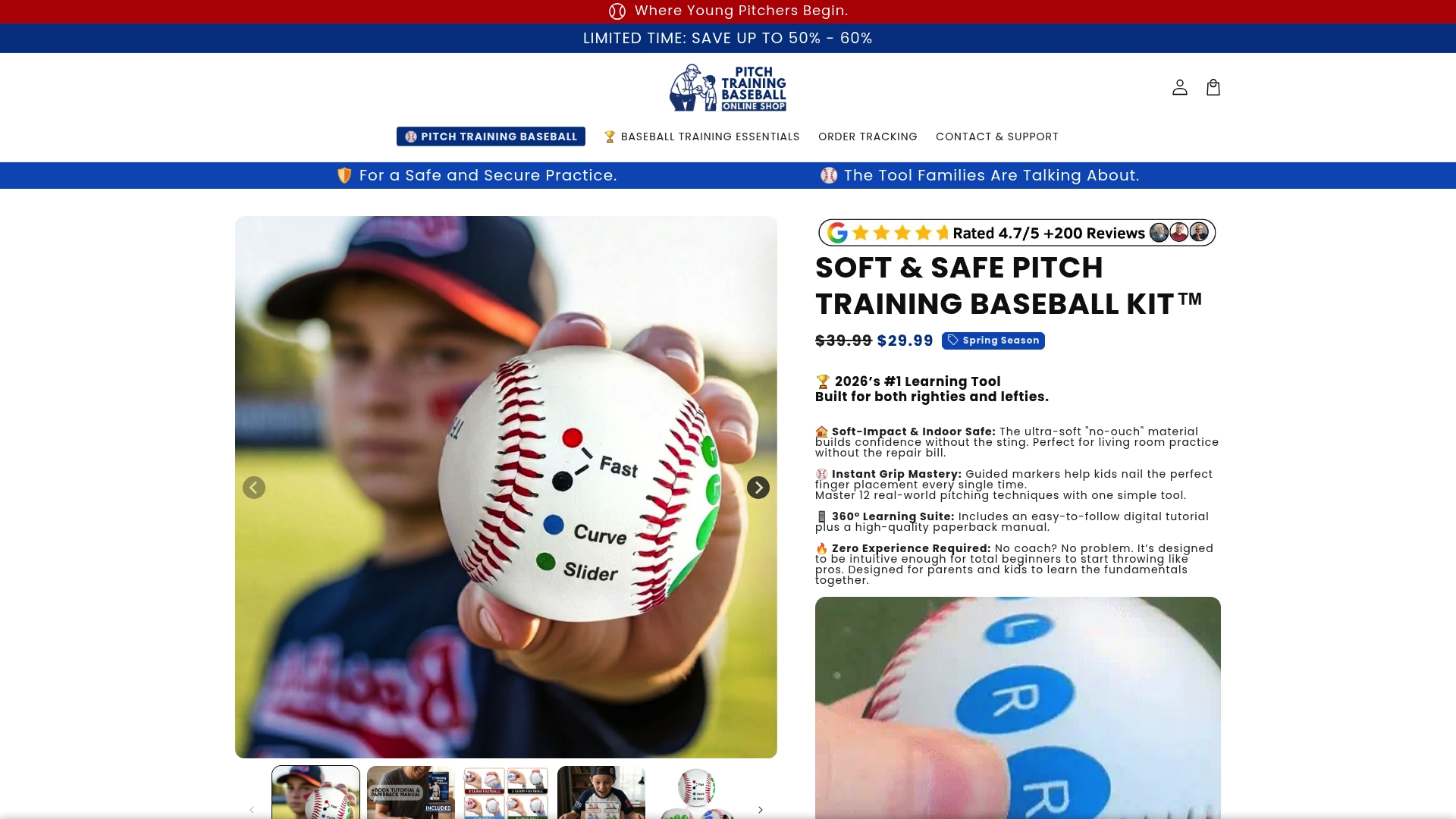
Understanding pitch selection strategy is the first step. The second step is building the command to execute it. At Pitchtrainingbaseball, the training tools are designed specifically for youth pitchers who need to develop accuracy, control, and confidence through focused repetition. The Pitching Target Net with Strike 9-Zone gives pitchers a visual, zone-specific target that makes every bullpen session a pitch selection drill. Pair it with specialty training balls to build feel and command across pitch types. These tools turn the concepts in this article into physical practice reps that stick.
FAQ
What is pitch selection in simple terms?
Pitch selection is the decision of which pitch type to throw and where to locate it, based on the batter, the count, and the game situation. It is the core strategic act of pitching, distinct from mechanics or velocity.
How does pitch sequencing differ from pitch selection?
Pitch selection is the individual pitch decision. Pitch sequencing is the arrangement of multiple pitches across an at-bat to set up future outcomes, using speed and movement contrast to disrupt a batter’s timing.
Why is accuracy more important than pitch speed?
Research shows that accurate pitches are over three times more likely to produce favorable outcomes than faster or more varied pitches that miss their intended location. Hitting the spot consistently is the highest-leverage skill a pitcher can develop.
What pitch selection drills work best for youth players?
Situation-based bullpen sessions and two-pitch constraint drills are the most effective approaches. Applied Vision Baseball’s research confirms that decision-focused drills transfer faster to in-game performance than mechanics-only practice.
How should a youth catcher call pitches?
A youth catcher should use a simple three-signal system, one finger for fastball, two for changeup, three for breaking ball, and base calls on the batter’s stance, the count, and what the pitcher has been locating well that day. Simplicity and consistency matter more than sophistication at early levels.