


For youth pitchers and the coaches developing them, the three categories worth buying first are a strike-zone target net, a portable rebounder or pocket trainer, and a measured practice ball set. Pitchtrainingbaseball’s Pitching Target Net with Colorful Strike 9-Zone, the 5 Pickeballs set, and the Ice Cream Sliding Mitt cover those bases at a price point that makes sense for families and programs alike. Pair any of these with Pitch Smart age-based pitch counts and the kinetic-chain guidance from HSS and Cedars-Sinai, and you have a framework that builds skill without burning out young arms.
Caution on weighted balls: A prospective study published in the International Journal of Sports Physical Therapy found a 24% injury rate among high school pitchers in a weighted-ball program. That number alone should set the dosing bar high before any youth athlete touches a ball heavier than regulation.
Pro Tip: Start every new aid with a two-week “feel-out” block at reduced intensity before adding it to a full session. Mechanics first, load second.
Table of Contents
- What are the best baseball pitching aids for each training goal?
- How do you pick the right pitching aid for your player?
- What does each type of pitching aid actually train?
- Safety first: how do you use pitching aids without raising injury risk?
- What does a sample weekly routine with three aids look like?
- Pitchtrainingbaseball products that match these drills
- Key Takeaways
- A coaching perspective on what actually moves the needle
- Useful sources and further reading
What are the best baseball pitching aids for each training goal?
Matching the tool to the goal cuts wasted reps and money. Here is a quick shortlist organized by what you are actually trying to fix.
- Command/location: 9-zone strike-zone target net — gives immediate quadrant feedback; best solo drill tool on the market for youth pitchers working on location.
- Mechanics/arm path: Connection device (band or rope trainer) — keeps the elbow in the right slot through the delivery; requires a coach present for feedback.
- Velocity (with caution): Measured underload/overload ball set — modest gains possible for some athletes, but only with careful dosing and off-season timing. Not recommended for skeletally immature players without medical clearance.
- Warmup/feel: Pitch Training Softball or soft practice balls — low-stress reps that build feel without taxing the arm; ideal for pre-bullpen activation.
- Versatile solo training: Rebounder net — returns the ball for pitcher fielding practice (PFP) and quick-reaction drills, so one piece of equipment does double duty.
- Compact technique work: Pocket trainer — most portable option; great for hotel rooms, small gyms, or pre-game warmup tunnels.
- Glove work/transfer: Ice Cream Sliding Mitt — trains proper glove-side mechanics and transfer speed; underused by youth programs.
- High-rep practice: 5 Pickeballs set — durable, lightweight practice balls that let a pitcher throw more reps without arm fatigue from heavy balls.
Pro Tip: Coaches running academies or travel programs: buy the 9-zone net and the Pickeballs set first. Those two tools alone cover 80% of what a solo bullpen session needs.
How do you pick the right pitching aid for your player?
The wrong tool does not just waste money. It can reinforce bad habits or, in the case of weighted balls, create real injury risk. Run through this checklist before any purchase.
Decision framework
| Factor | Question to ask |
|---|---|
| Training goal | Velocity, command, mechanics, or warmup? Pick one primary goal per tool. |
| Player age and skill | Is the athlete skeletally mature? Avoid heavy overload balls entirely for skeletally immature youth. |
| Weekly workload | Does this tool count toward throw totals? Weighted balls and high-rep nets both add stress. |
| Practice space | Backyard, gym, or full field? Pocket trainers and soft balls work indoors; full nets need 40+ feet. |
| Budget | Single item or bundle? Bundles from Pitchtrainingbaseball reduce per-item cost for coaches buying for a group. |
| Coach access | Mechanical aids (connection devices, leg-drive sleds) require a coach present to give feedback. |
Red flags to avoid
- Any program that promises a specific velocity gain in a fixed number of weeks without mentioning injury risk.
- Weighted-ball protocols that do not specify ball weight, throw count, or rest requirements. As experts note, aids must supplement Pitch Smart guidelines, not replace them.
- “One-size-fits-all” programs that use the same ball weights for a 12-year-old and a 17-year-old.
- Vendors with no return policy, no instructional materials, and no coach-reviewed drill guidance.
For a deeper look at safe pitching tools for youth athletes, Pitchtrainingbaseball’s resource library is a practical starting point.
What does each type of pitching aid actually train?
Strike-zone target nets (9-zone)
Primary target: Location and pitch command. 9-hole targets give immediate quadrant feedback that accelerates location training versus unmarked nets. Two drills: (1) “Zone ladder” — throw five pitches to each zone top-to-bottom in sequence; (2) “Miss-and-correct” — after any miss, repeat the same zone until two consecutive hits before moving on. Main risk is overuse; cap solo net sessions at the same throw count you would use in a bullpen.
Rebounders
Primary target: Versatility. A rebounder returns the ball, enabling PFP and quick-reaction drills without reconfiguration. Two drills: (1) Rapid-fire comebackers at 60% intensity; (2) Fielding-position work where the pitcher fields the rebound and simulates a throw to first. Compared to a standard net, a rebounder is the better buy when a pitcher trains alone regularly.
Pocket trainers
Primary target: Compact mechanics work. A pocket trainer is the most portable option and the best choice for technical arm-path drills in tight spaces. Two drills: (1) Wall-facing arm circles into the pocket; (2) Mirror drill where the pitcher watches their elbow position in real time. No ball flight means no location feedback, so pair it with a net session when possible.
Weighted and underload balls
Primary target: Arm speed and velocity. The evidence is mixed and the risk is real. Use only in the off-season, only with athletes who are physically mature, and only with a physician’s clearance for youth players. Start with submaximal intensity and low volume, monitor shoulder range of motion weekly, and stop at any pain signal.
Connection devices (bands and rope trainers)
Primary target: Arm path and kinetic-chain sequencing. These tools keep the elbow in the correct slot and force the body to rotate before the arm fires. They require a coach present because the feedback is proprioceptive, not visual. Two drills: (1) Slow-motion delivery with band resistance; (2) Mirror-check at arm-cocking position.
Leg-drive trainers and sleds
Primary target: Lower-half power and drive-leg push. Best for high school and college athletes who have already cleaned up upper-body mechanics. Youth players often lack the strength base to benefit and may compensate with the upper body, making mechanics worse.
Sliding mitts and glove trainers
Primary target: Glove-side mechanics and transfer speed. The Ice Cream Sliding Mitt from Pitchtrainingbaseball trains the glove arm to stay firm through release, which directly affects command and arm health. Two drills: (1) Glove-tuck drill with a partner checking elbow position; (2) Transfer-speed drill timing the catch-to-throw sequence.
Practice balls (soft and standard)
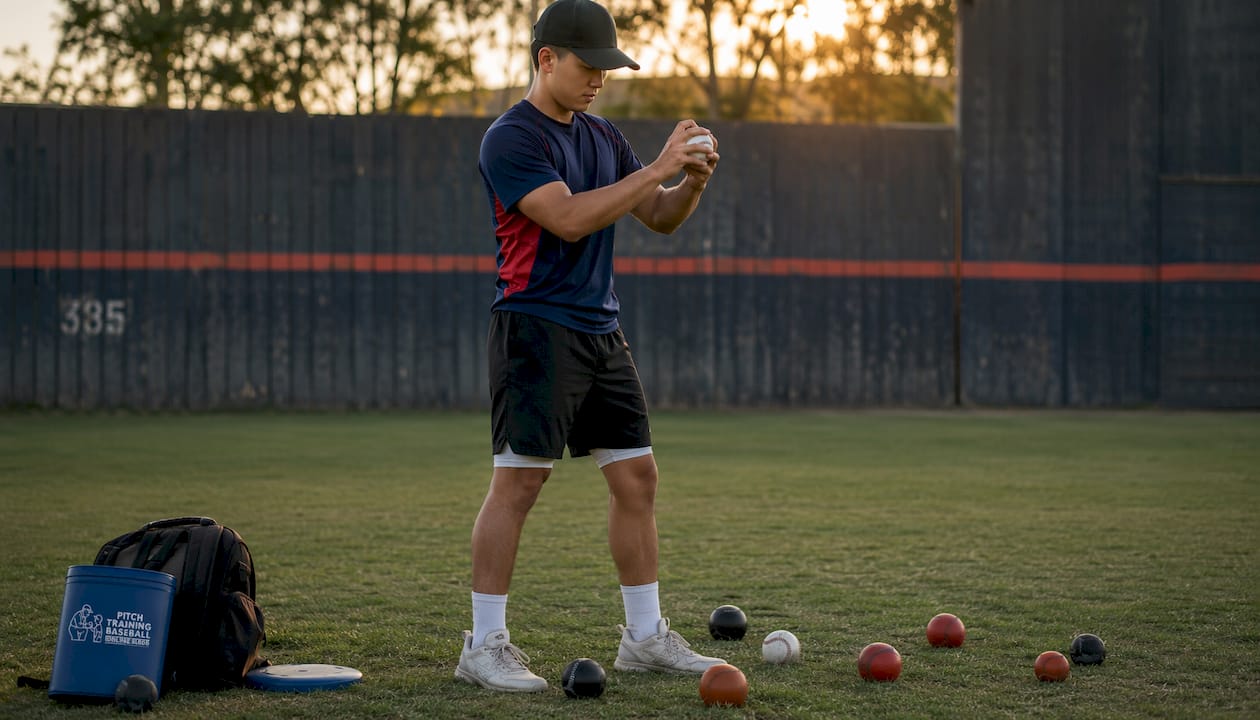
Primary target: High-rep feel work with low arm stress. The Pickeballs set is built for this. Soft balls are ideal for pre-bullpen activation and for younger players building grip and release patterns without loading the arm.
| Aid type | Best for | Recommended age | Portability | Relative injury risk |
|---|---|---|---|---|
| 9-zone target net | Command | All ages | Medium | Low |
| Rebounder | Versatility/PFP | All ages | Medium | Low |
| Pocket trainer | Mechanics | All ages | High | Low |
| Weighted balls | Velocity | Mature athletes only | High | High without proper dosing |
| Connection device | Arm path | 12+ with coach | Medium | Low with coach |
| Leg-drive sled | Lower-half power | High school+ | Low | Low with proper load |
| Sliding mitt | Glove mechanics | All ages | High | Low |
| Practice balls | Feel/high-rep | All ages | High | Low |
Pro Tip: Prioritize tools that give unambiguous feedback, a visible pocket hit or a consistent rebound, over tools that require constant repositioning. Repetition quality matters more than repetition count for youth motor learning.
Safety first: how do you use pitching aids without raising injury risk?
HSS and Cedars-Sinai both emphasize kinetic-chain strengthening as the primary injury-prevention strategy for young throwers. That means hips, glutes, and core work belongs in every training week alongside any mechanical aid. No device replaces that foundation.
Cedars-Sinai recommends at least one full rest day per week and three to four months off from competitive throwing per year. Those rules apply whether a pitcher is throwing off a mound or into a target net. Total throw count across practices, games, and weighted-ball drills must be tracked the same way pitch counts are tracked.
Weighted-ball caution: In the IJSPT Reinold study, just 27 submaximal throws with 16–32 oz balls produced an 8-degree increase in passive shoulder external rotation. Youth pitchers typically gain only 5 degrees over an entire 8-month season. That abrupt shift is a known injury risk factor.
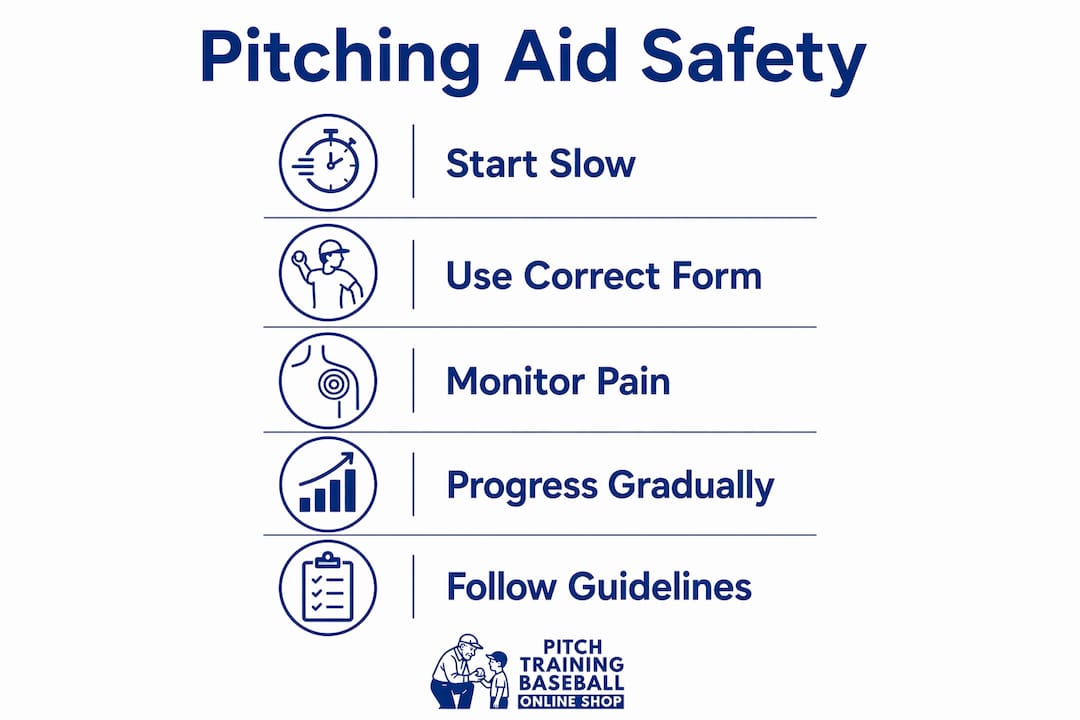
Session safety checklist
- Warm up with light jogging and dynamic stretching before any throws.
- Cap total throws per session at the Pitch Smart limit for the player’s age group.
- Stop immediately at any elbow or shoulder pain. No “throw through it” exceptions.
- Log RPE (rate of perceived exertion), velocity if measured, and any pain after each session.
- Schedule at least one full rest day between high-intensity bullpen sessions.
- No weighted-ball work in-season for youth athletes.
For daily pitching habits that build these safety rules into a routine, Pitchtrainingbaseball’s blog covers the specifics in detail.
Four-to-eight week introduction progression
Weeks 1–2: Introduce the new aid at 50–60% intensity, low volume. Weeks 3–4: Increase to 70–75% with standard session volume. Weeks 5–6: Full integration at normal intensity. Weeks 7–8: Assess velocity, command metrics, and pain log before deciding whether to continue or adjust.
What does a sample weekly routine with three aids look like?
| Week | Session type | Duration | Throws/drills | Intensity | Recovery |
|---|---|---|---|---|---|
| 1–2 | 9-zone net solo | 20 min | 30 throws | 60% | Full rest next day |
| 1–2 | Pocket trainer mechanics | 15 min | Drill reps only | Low | Same day as net OK |
| 3–4 | Net + rebounder combo | 25 min | 40 throws | 70% | Rest day after |
| 3–4 | Arm care + soft balls | 15 min | 20 soft-ball throws | Low | Any day |
| 5–6 | Full bullpen with net | 30 min | 45 throws | 80% | Full rest next day |
| 5–6 | Glove/mitt drill | 10 min | Partner reps | Low | Any day |
| 7–8 | Assess and adjust | — | Log velocity, RPE, pain | — | Mandatory off day |
Four-week sample schedule (one week repeated as template)
- Monday: 9-zone net solo session (20–25 min, 30 throws at 60–70%). Log zone accuracy.
- Tuesday: Kinetic-chain strength work (core, hips, glutes). No throwing.
- Wednesday: Pocket trainer mechanics drill (15 min) plus soft-ball feel work (15 throws).
- Thursday: Rest or light catch only.
- Friday: Partner bullpen with rebounder (25–30 min, 35–40 throws). Coach observes.
- Saturday: Glove/mitt transfer drill (10 min). Optional light arm care.
- Sunday: Full rest.
Log three numbers after every session: velocity (if measured), RPE on a 1–10 scale, and any pain location. If pain appears twice in a row, pull back volume immediately. For a full youth pitching workout template that maps to this structure, Pitchtrainingbaseball’s training guides go deeper on progression.
Pitchtrainingbaseball products that match these drills
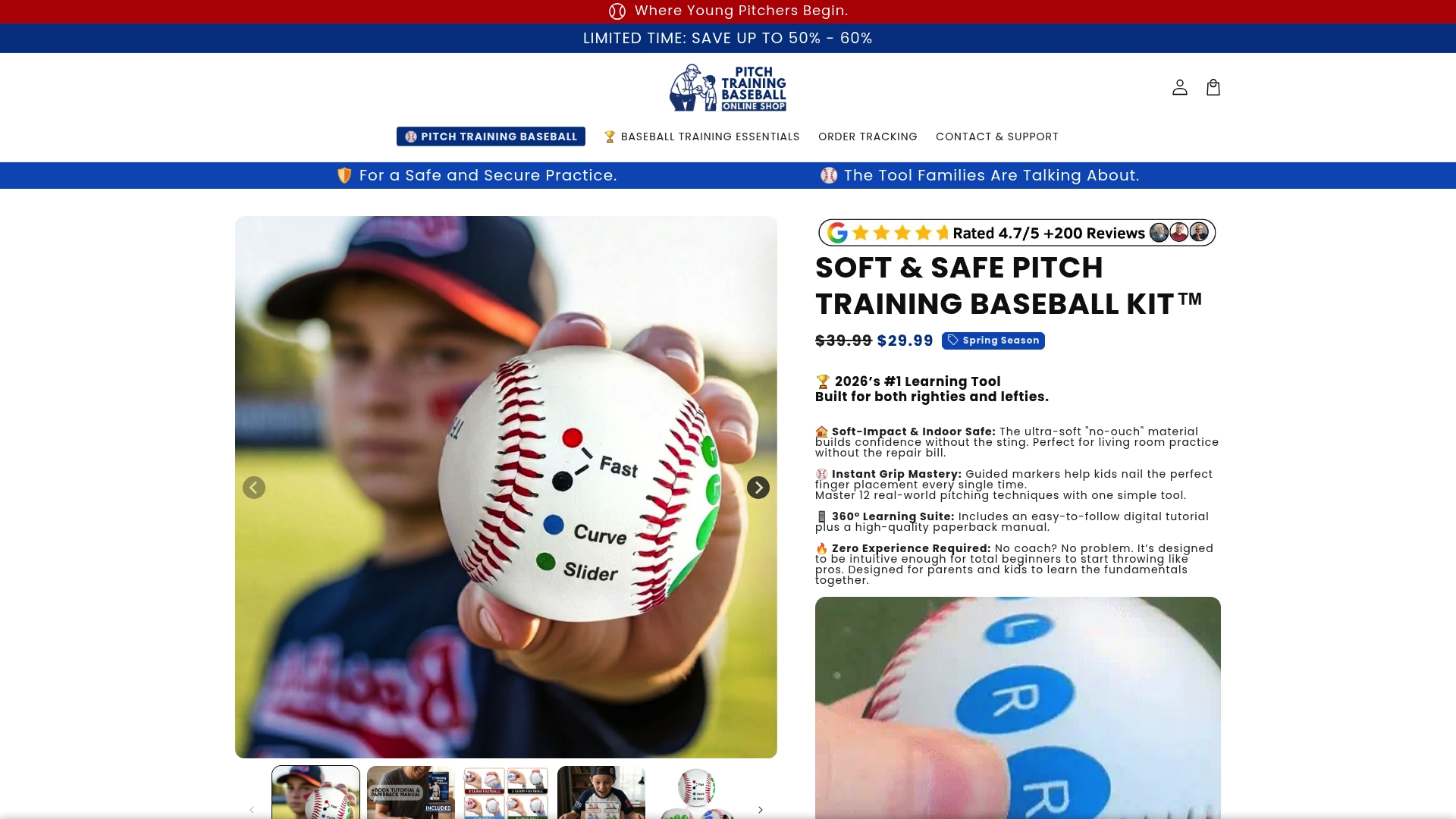
Pitchtrainingbaseball builds its product line specifically for youth development, which means every item maps directly to a training goal covered above. The Pitching Target Net with Colorful Strike 9-Zone is the command tool in the sample routine. It sets up in minutes, requires no repositioning mid-session, and gives the immediate zone feedback that accelerates location learning. The 5 Pickeballs set handles all the high-rep feel work and soft-ball activation sessions. The Ice Cream Sliding Mitt covers glove-side mechanics, and the Pitch Training Softball bundle works as a low-stress starter kit for younger players or warmup-focused sessions.
Coaches buying for a team or academy should look at the bundle options, which reduce per-item cost and include instructional materials. If your program is working on a budget, youth team fundraising ideas can help offset equipment costs without door-to-door selling. Pitchtrainingbaseball’s products ship with a return policy and drill guidance included. Browse the full product catalog to match your program’s specific needs and get started today.
Key Takeaways
The most effective approach to youth pitching development pairs feedback-rich, low-risk tools with Pitch Smart workload limits and kinetic-chain strength work.
| Point | Details |
|---|---|
| Start with command tools | A 9-zone target net gives immediate location feedback and works for all ages and skill levels. |
| Weighted balls carry real risk | The IJSPT Reinold study found a 24% injury rate; use only with mature athletes, off-season, and low volume. |
| Follow Pitch Smart limits | Track total throws across all sessions, including net work and practice balls, not just game pitches. |
| Kinetic chain first | HSS and Cedars-Sinai both prioritize hip, glute, and core strength as the primary injury-prevention strategy. |
| Pitchtrainingbaseball bundles | The 9-Zone Net, Pickeballs, Sliding Mitt, and Softball bundle cover command, feel, and glove work in one starter kit. |
A coaching perspective on what actually moves the needle
Most coaches who come to pitching aids are chasing velocity. That is understandable, but it is usually the wrong starting point for youth players. The tools that consistently produce the biggest long-term gains are the boring ones: a fixed target, a consistent setup, and enough reps to build a repeatable delivery. A 12-year-old who can throw 60% of his pitches to the lower half of the zone is more valuable to a team than one who throws 3 mph harder with no idea where it is going.
The weighted-ball conversation is where I see the most damage done. Parents read about velocity programs and want results fast. But the research is clear that the injury rate without careful dosing is significant, and the velocity gains are inconsistent even in studies with controlled protocols. For youth athletes still growing, the risk-reward math simply does not work. Kinetic-chain strength work, a quality target net, and consistent mechanics practice will get a young pitcher further than any overload program.
One habit that separates good youth programs from great ones: they log three numbers after every session. Velocity if they have a radar gun, RPE, and pain. That is it. Three numbers, every session. When something spikes, you catch it early. When something improves, you know what caused it. No gadget replaces that discipline.
Useful sources and further reading
- Tips for Young Baseball Pitchers to Avoid Injury — HSS: Kinetic-chain guidance and Pitch Smart pitch-count standards.
- How To Avoid Injuries in Youth Baseball — Cedars-Sinai: Rest recommendations, growth-plate protection, and seasonal break guidance.
- The Safety and Efficacy of Weighted Baseballs — IJSPT (Reinold et al.): Prospective study on velocity gains and injury rates in high school pitchers.
- Youth Baseball Injuries and Pitch Smart Commentary — Stat News: Expert commentary on why aids must supplement, not replace, evidence-based safety guidelines.
- Pitching Targets and Nets (2026) — Diamond Sports Equipment: Category breakdown of 9-zone nets, rebounders, and pocket trainers with use-case analysis.
- Pitching Net vs. Rebounder vs. Pocket Trainer — Baseballs.site: Practical comparison of the three most common solo training tools.
- Recommended Daily Pitching Habits for Youth Players — Pitchtrainingbaseball: Daily routine and rest guidelines for youth pitchers.
- Safe Pitching Tools for Youth Baseball Players — Pitchtrainingbaseball: Guide to choosing age-appropriate, coach-reviewed training aids.
- Top Pitching Workouts for Youth Baseball — Pitchtrainingbaseball: Workout templates that pair with the aids and progression plan above.