


Most coaches assume their players understand what went wrong after a bad rep. They rarely do. The role of feedback in baseball training is far more specific than a post-pitch nod or a “nice try” from the dugout. Today’s most effective youth programs combine real-time technology with deliberate coaching communication to give young players the kind of information their brains can actually use to improve. If you’re a coach or parent who wants to stop guessing and start developing athletes with intention, this guide covers exactly how to do that.
Table of Contents
- Key takeaways
- The role of feedback in baseball training: types and tools
- How real-time feedback accelerates skill development
- Best practices for delivering feedback to young players
- Integrating modern feedback tech into youth programs
- Applying feedback to daily training routines
- My honest take on feedback in youth baseball
- Train smarter with the right feedback tools
- FAQ
Key takeaways
| Point | Details |
|---|---|
| Feedback types vary in power | Verbal, visual, and technology-driven feedback each serve distinct roles in accelerating skill development. |
| Timing changes everything | Immediate feedback after each rep closes the correction gap faster than delayed review or vague commentary. |
| Wise feedback builds trust | Affirming a player’s ability before giving corrections prevents defensiveness and keeps motivation high. |
| Data guides human coaching | Use objective metrics first to pinpoint what needs work, then apply targeted verbal coaching for better results. |
| Consistency compounds growth | Daily feedback-driven drills, tracked over time, produce measurable, repeatable improvement in young pitchers and hitters. |
The role of feedback in baseball training: types and tools
Not all feedback is created equal. A coach yelling “throw strikes” and a bat sensor showing a 15-degree attack angle are both technically feedback. But one gives a player something they can act on immediately. Understanding the categories of feedback available to you is the first step in building smarter training sessions.
Verbal feedback
Verbal feedback is the most common and the most misused form of coaching communication. At its best, it’s precise, calm, and specific. “Your front shoulder flew open on that swing” is useful. “Be better” is noise. Technical cues, encouragement that names what the athlete did well, and correction that focuses on the next rep rather than the last mistake are the three pillars of effective verbal coaching.
Visual feedback
Video analysis has dropped in cost dramatically over the past decade, which means even local youth programs can now show players what their mechanics actually look like. Side-by-side comparisons of a player’s swing versus a corrected model give the brain a target to replicate. Live demonstrations from a coach or a senior player add a layer of real-time modeling. Both are far more effective than description alone because the player builds a mental picture they can rehearse.
Technology-driven and data-driven feedback
This is where youth baseball training has shifted most dramatically. Bat sensors and VR simulators now provide instant, objective data on metrics like swing speed, attack angle, bat path, and pitch recognition speed. Decisions at the plate happen within 25 milliseconds, which means the feedback loop needs to be tight. When a player can see their numbers after each rep, progress stops being a feeling and becomes a measurable fact.
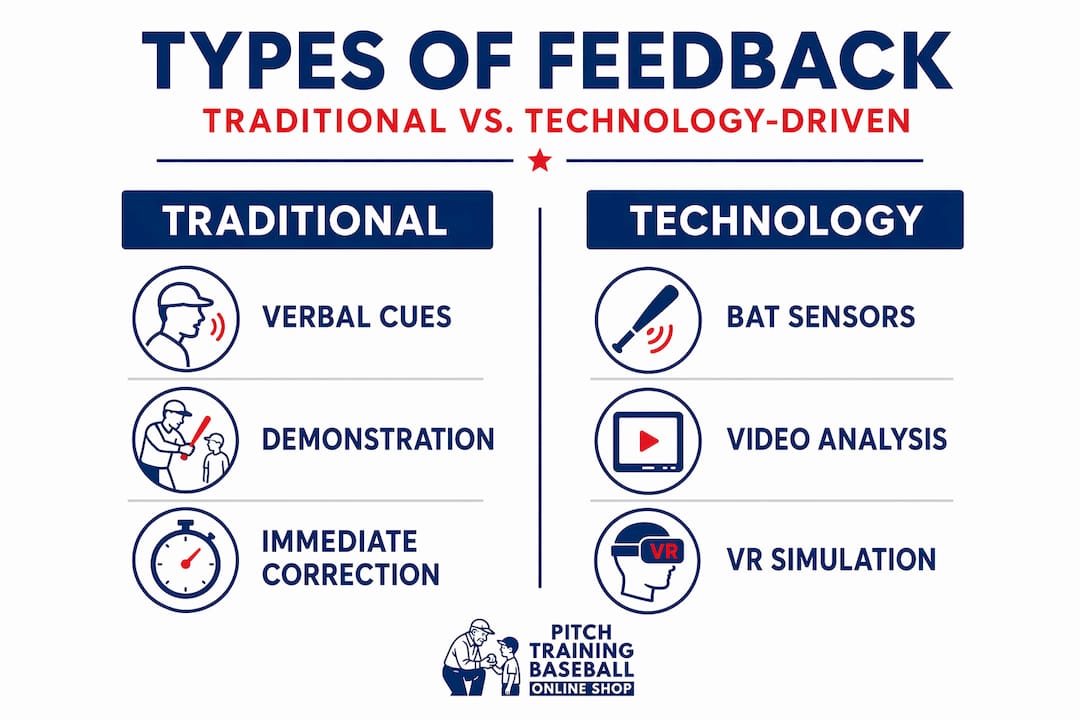
Here is a quick comparison of the three main feedback types:
| Feedback type | Best use case | Limitations |
|---|---|---|
| Verbal | Real-time cues, motivation, confidence building | Can be vague; relies on coach’s precision |
| Visual (video) | Mechanics correction, model comparison | Requires playback time; harder to use mid-drill |
| Technology/data | Tracking trends, benchmarking progress, instant metrics | Cost of some tools; requires interpretation |
The strongest programs do not pick one. They layer all three together so the player is never operating on guesswork.
How real-time feedback accelerates skill development
Speed of correction is everything in motor learning. When a young pitcher throws a pitch, the window for their brain to connect that action to a specific outcome is brief. The longer the gap between the action and the correction, the harder it is for the nervous system to form the right pattern. Real-time feedback closes that gap.
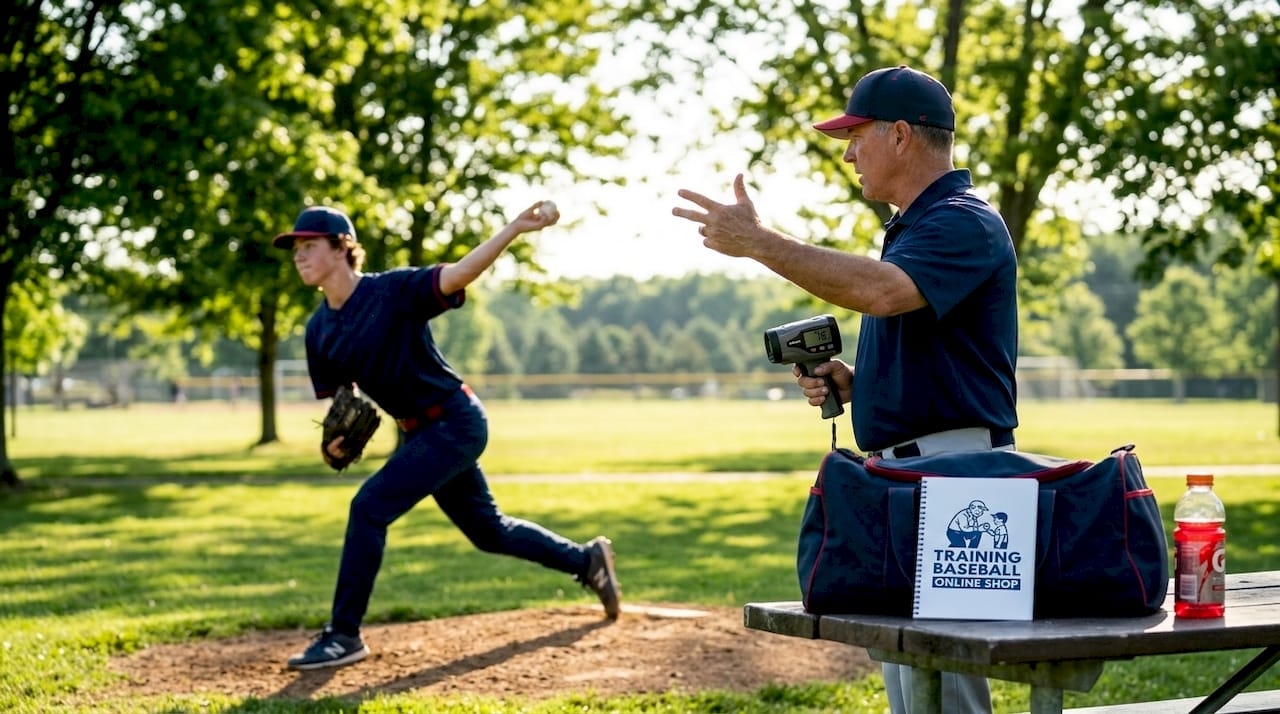
The ABS technology example
The Automated Ball-Strike (ABS) system is one of the clearest examples of technology changing how pitchers and catchers train. ABS-based drills shorten the learning curve significantly by showing the exact strike box call after each pitch. Catchers no longer have to guess whether a borderline pitch was “good enough.” They see it scored immediately. For youth players learning to frame pitches or command the zone, this kind of objective, rep-by-rep clarity accelerates learning in ways that a coach’s verbal judgment simply cannot match at scale.
VR pitch recognition and bat sensors
Bat speed training with blast sensors allows young hitters to benchmark their metrics against age-appropriate performance standards and track progress with each session. VR platforms that simulate live at-bats train pitch recognition at realistic speeds, giving players hundreds of decisions per session that would take years to accumulate in game situations. The athlete’s brain processes feedback faster when it arrives right after the action. That neurological reality is the scientific case for building technology into your training.
Pro Tip: Combine technology feedback with human coaching by letting the data speak first. Show the athlete their metrics before you say a word. Then your verbal coaching lands as explanation rather than opinion, and the player is far more open to it.
This sequence, data first then coaching conversation, is supported by the finding that technology feedback with narrative coaching consistently outperforms either method used alone. The data identifies the gap. The coach explains why it matters and how to fix it. That combination is hard to beat.
Best practices for delivering feedback to young players
Knowing what type of feedback to give is only half the job. How you deliver it determines whether a young player absorbs it, resists it, or shuts down entirely. Young athletes are not small professionals. Their psychological response to criticism directly affects how much of your coaching actually sticks.
Use wise feedback
The most research-supported technique for coaching youth athletes is called wise feedback. The concept is straightforward: affirming a player’s ability before offering corrective instruction prevents the feedback from landing as a personal attack. Instead of leading with “your mechanics are off,” you say “you’ve got the athleticism to make this adjustment” and then address the specific issue. The player receives the critique inside a container of belief, which dramatically reduces defensiveness.
A feed-forward framing of feedback takes this further. Rather than pointing to what went wrong in the last rep, you orient the player toward what to do in the next one. “On your next pitch, keep your elbow at shoulder height through release” is more useful than “you dropped your elbow again.” Feed-forward feedback focuses on strategy for future success rather than cataloging past mistakes. That shift in framing keeps energy and attention pointed forward.
Create an environment where feedback is welcome
The coach’s identity and how they connect with their players directly affects whether feedback gets received. Research shows that relatable coaches who create inclusive environments produce greater player openness to feedback and faster development overall. A training space described as a “no-drama zone” removes social fear from the equation. When a young player isn’t worried about embarrassment, they process technical instruction rather than managing anxiety.
Here are the practical steps for creating that environment:
- Name what the player did right before addressing the correction. Be specific, not generic.
- Use the player’s name during feedback to signal that this is personal, not a public critique.
- Separate feedback from emotion. Calm delivery carries more authority than frustration.
- Ask questions rather than always making statements. “What did that feel like?” puts the player in the role of evaluator.
- Time your feedback deliberately. During a rep is for brief cues. After a rep is for observation. After a block of reps is for pattern-level conversation.
Pro Tip: Avoid vague feedback like “good job” or “that’s not right.” Vague praise teaches nothing and vague criticism discourages without directing. Every piece of feedback you give should tell the player specifically what to keep, stop, or change.
Integrating modern feedback tech into youth programs
Professional-level feedback technology is no longer reserved for pro organizations. Many youth programs and even home training setups now use tools that would have been considered elite a decade ago. The shift is meaningful. It means that youth programs can deliver professional-style training with direct coaching and instant feedback loops that used to require major resources.
Structured training sessions with over 200 participants rotating through skill stations with immediate instructor feedback are now a documented reality in youth baseball development programs. That model works because the feedback density is high. Players are not waiting for input. They are receiving it constantly throughout the session.
The table below compares common technology tools available to youth programs:
| Tool | Key metric provided | Best for | Accessibility |
|---|---|---|---|
| Blast bat sensor | Swing speed, attack angle, bat path | Hitters tracking mechanical trends | High (affordable, portable) |
| Video analysis app | Visual mechanics breakdown | All positions, mechanics review | High (smartphone-based) |
| VR pitch recognition | Decision speed, pitch type recognition | Hitters building plate approach | Medium (requires hardware) |
| ABS strike zone tech | Framing accuracy, pitch location | Pitchers and catchers | Low (mostly professional facilities) |
| Pitching target nets | Accuracy, zone placement | Pitchers at all levels | High (home and practice field use) |
For coaches and parents working with limited budgets, the right approach is to start with the high-accessibility tools. A pitching target net combined with video from a smartphone gives a pitcher immediate visual and accuracy feedback every single session. That combination covers two of the three major feedback types at very low cost.
The key principle behind any technology integration is that the tool should serve the athlete, not impress the parent. If a young pitcher cannot read or understand the feedback being generated, the technology is just noise. Start simple, make the metrics visible and meaningful, then layer in complexity as the athlete matures.
Applying feedback to daily training routines
Understanding feedback theory only helps if you convert it into daily practice habits. The most developed youth athletes are not the ones with the best natural talent. They are the ones with the most consistent feedback loops built into their training week.
Follow this sequence to build a feedback-driven training routine:
- Set a measurable baseline. Before any new training cycle, assess where the athlete currently stands. Assessing youth pitching performance gives you a starting point so improvement is trackable rather than assumed.
- Choose one or two metrics to focus on per session. Trying to improve everything at once dilutes the feedback signal. Pick accuracy this week. Pick arm path next week.
- Record feedback after each session. Write down or log what the data showed and what the verbal coaching identified. Patterns become visible over two to three weeks of records.
- Review with the athlete weekly. Show them their own trend lines. Athletes who see their progress in objective terms develop internal motivation that is far more durable than external praise.
- Adjust the training focus monthly. If the data shows a plateau in one area, shift attention to the next constraint. Feedback trends tell you exactly where to look.
- Incorporate multiple feedback sources. Coach observation, video review, and sensor data each catch different things. Using all three across a training week gives the most complete picture.
- Build self-assessment skills. Encourage athletes to evaluate their own reps before the coach speaks. Athletes who self-identify errors have deeply internalized the training objective. That is the ultimate goal of any feedback-driven program. When the player becomes their own most reliable coach, development accelerates dramatically.
Consistent game-like pitching practice combined with structured feedback review sessions is the daily routine that separates the athletes who plateau from the ones who keep climbing.
My honest take on feedback in youth baseball
I’ve watched a lot of coaches hand a kid a bat sensor after poor batting practice and expect the numbers to fix the problem. They don’t. What I’ve learned from watching hundreds of training sessions is that technology without context is just data with no story attached to it.
The coaches I’ve seen produce the best athletes are the ones who use data as a launching point for conversation, not a verdict. They sit with a kid, pull up the swing metrics, and ask what the player thinks happened. More often than not, the athlete already knows. They just needed permission to say it out loud. That moment of self-recognition, where the player identifies the mistake before the coach names it, is exactly what earned coaching feedback looks like in practice.
The wise feedback research rings true in my experience too. I’ve seen kids shut down completely under coaches who lead with critique. And I’ve seen the same corrections delivered inside a framework of genuine belief in the player land completely differently. The technical content of the feedback was identical. The reception was night and day. That tells you the relationship carries as much weight as the information.
My take on the current state of youth baseball coaching is this: the technology is genuinely useful and getting better every year. But the coaches who will produce the best young players over the next decade are the ones who use the data to have better conversations, not to skip them. Screens don’t build trust. Coaches do. The combination of both is where real development lives.
— Albert
Train smarter with the right feedback tools
Everything you’ve read here depends on one practical reality: your players need the right equipment to generate the feedback worth analyzing. At Pitchtrainingbaseball, the training gear is designed specifically to give young pitchers immediate, visual feedback on every throw.
The strike zone pitching target breaks the zone into nine visible sections, so a pitcher knows not just whether a pitch was a strike, but exactly where it landed. That specificity is what turns a practice session into a feedback loop. Pair it with the rest of the baseball training essentials available on the site, and you have a home or field training setup that reinforces every coaching cue you deliver. The equipment does not replace the coach. It gives the coach’s words something concrete to land on.
FAQ
What is the role of feedback in baseball training?
Feedback tells an athlete specifically what they did, how it measured against the target, and what to adjust on the next rep. Without it, practice builds bad habits as easily as good ones.
Why is pitching feedback so important for young players?
Young pitchers are still forming mechanical habits. Immediate, specific feedback during the habit-formation window corrects errors before they become ingrained, saving months of retraining later.
What types of feedback work best for youth baseball?
A combination of verbal cues, video review, and data from tools like bat sensors or pitching targets covers the most ground. Each type catches different aspects of performance that the others miss.
How should coaches deliver feedback without discouraging young athletes?
Use wise feedback by affirming the athlete’s ability before offering corrections. Frame feedback as direction for the next rep rather than a critique of the last one to keep motivation intact.
How often should feedback be given during practice?
Brief, specific cues can be given after each rep. Deeper pattern-level feedback works best after a block of reps or at the end of a session, when the athlete can absorb it without interrupting flow.
Recommended
- Game-like pitching practice: Raise youth baseball skills fast – Pitch Training Baseball
- The Real Role of Adjustable Pitching Trainers – Pitch Training Baseball
- How training nets elevate youth baseball pitching skills – Pitch Training Baseball
- How to throw a baseball: proven youth coaching tips – Pitch Training Baseball