


Off-speed pitching is the practice of throwing pitches slower than a fastball to disrupt a batter’s timing and force weak contact or swings and misses. These pitches include breaking balls like curveballs and sliders, as well as changeups, and they form the backbone of effective pitching strategy at every level of baseball. Understanding what is off speed pitching means understanding deception. A pitcher who can only throw hard gives hitters a single timing target. A pitcher who mixes speeds forces hitters to make split-second recalculations on every pitch. That difference separates good pitchers from great ones.
What is off speed pitching and why does it matter?
Off-speed pitching is defined as any pitch thrown at a velocity meaningfully lower than a pitcher’s fastball, with the specific goal of disrupting the hitter’s timing mechanism. The term “off-speed” is the common informal label used by coaches and players, while pitch analysts and scouts often use the broader category of “secondary pitches” to describe the same group. Both terms refer to the same core concept: pitches designed to make a fastball more effective by contrast.
The strategic logic is straightforward. A hitter’s swing takes roughly 150 milliseconds to complete. When a fastball arrives at 92 mph and a changeup arrives at 82 mph, that 10 mph difference translates to the ball arriving several feet later in the hitting zone. The hitter who commits early is either fooled completely or makes poor contact. This is why off-speed pitches are not just a complement to the fastball. They are what make the fastball dangerous in the first place.
At the youth level, off-speed pitching for beginners starts with the changeup, since it requires no wrist snap and carries lower injury risk than breaking balls. Coaches at organizations like Little League Baseball and USA Baseball recommend introducing the changeup before curveballs or sliders, typically around ages 13 to 14. Getting the grip and arm speed right early builds the foundation for a full pitch arsenal later.
What are the main types of off speed pitches?
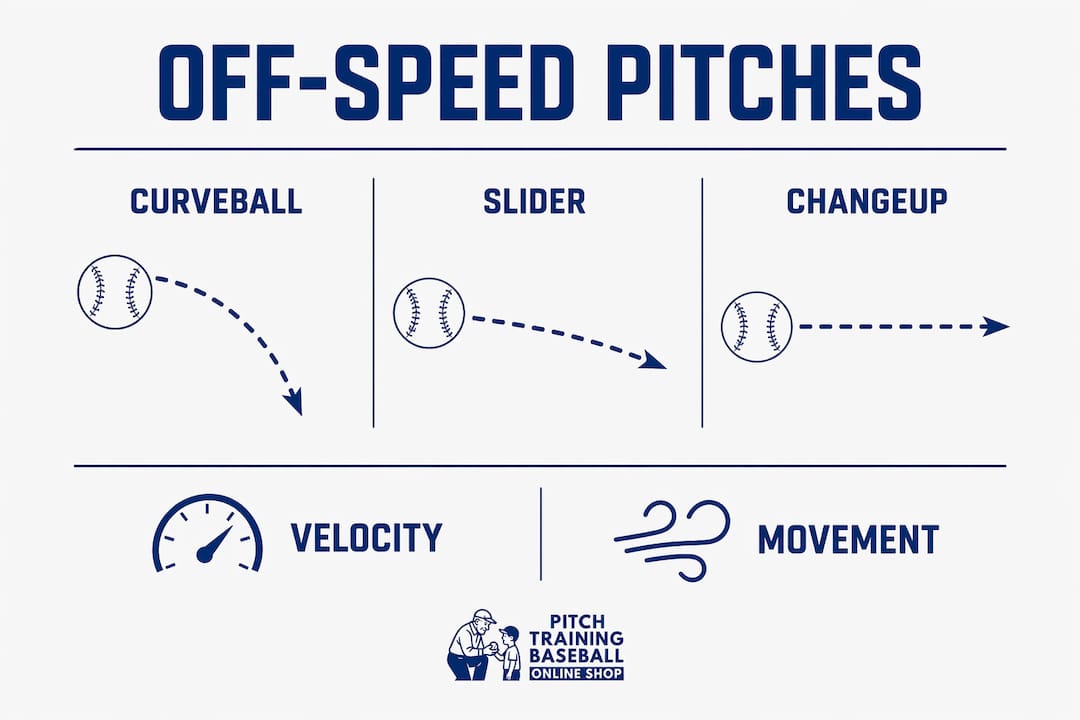
The three primary categories of off-speed pitches are curveballs, sliders, and changeups. Each works differently, moves differently, and targets a different weakness in a hitter’s approach.
Curveball
The curveball is the slowest of the three main off-speed pitch types. It generates topspin through a downward wrist snap at release, producing a sharp downward break that drops out of the strike zone. Velocity classification places breaking pitches under 79 to 80 mph in the curveball category. This threshold matters because pitch-tracking systems like Statcast and TrackMan use it to auto-classify pitches, which affects how coaches and scouts evaluate a pitcher’s repertoire. A “loopy” 12-to-6 curveball drops nearly straight down, while a sharper “knuckle curve” breaks both down and laterally.
Slider
The slider sits above the curveball in velocity, typically ranging from 80 to 90 mph. It breaks laterally and slightly downward, making it harder for hitters to read out of the hand. Breaking pitches above 80 mph are classified as sliders, which is why a pitcher’s “hard curve” often gets labeled a slider by tracking systems. The slider is the most common strikeout pitch in Major League Baseball because its late, sharp break gives hitters almost no time to adjust.
Changeup
The changeup is thrown with fastball arm speed but a grip that bleeds velocity, typically arriving 8 to 12 mph slower than the pitcher’s fastball. The circle changeup and the palmball are two common grips. Because the arm action mirrors the fastball, hitters read “fastball” out of the hand and commit early, arriving at the plate before the ball does.
Here is a quick comparison of the three main off-speed pitch types:
| Pitch type | Typical velocity range | Primary movement | Key deception factor |
|---|---|---|---|
| Curveball | 65 to 79 mph | Downward (topspin) | Dramatic drop out of zone |
| Slider | 80 to 90 mph | Lateral and down | Late break, hard to read |
| Changeup | 78 to 88 mph | Arm-side fade | Fastball arm speed, slower ball |
Pro Tip: When teaching a young pitcher the changeup, have them throw it with the same arm speed as their fastball. If the arm slows down, the hitter picks it up immediately. The grip does the work, not the arm.
How effective are off speed pitches compared to fastballs?
The data on off-speed effectiveness is not subtle. 96% of the top 50 pitches by whiff percentage are off-speed or breaking pitches, with only 2 of the top 50 being four-seam fastballs. This means that when pitchers generate swings and misses at the highest rates, they are almost always doing it with secondary pitches. The fastball generates velocity-based whiffs, but off-speed pitches generate timing-based whiffs, and timing-based whiffs are far more repeatable.
“Pitchers now view off-speed pitches not as secondary weapons but as foundational offerings that disrupt hitters trained to attack velocity.” — MLB.com
The strategic shift at the MLB level confirms this. The hardest throwers in baseball are using fewer fastballs than a decade ago, leaning on off-speed pitches even when they can throw 98 mph. This is not a concession. It is a recognition that velocity alone no longer wins at-bats. Hitters have adapted to pure heat through better data, video preparation, and launch-angle training. Off-speed pitches break that preparation.
Here is a summary of pitch effectiveness trends based on current data:
| Pitch category | Share of top-50 whiff pitches | Strategic trend |
|---|---|---|
| Off-speed and breaking | 96% (48 of 50) | Increasing usage at all levels |
| Four-seam fastball | 4% (2 of 50) | Declining as primary strikeout tool |
| Changeup | High whiff rate vs. RHH | Growing as primary off-speed weapon |
Fastball velocity remains critical but is no longer enough on its own. Pitchers who combine a 95 mph fastball with a sharp slider or a deceptive changeup are far more effective than those who rely on velocity alone. The fastball sets up the off-speed pitch, and the off-speed pitch makes the fastball look faster than it is.
Pro Tip: Sequence matters as much as pitch quality. Throw a fastball up and in, then follow with a changeup down and away. The contrast in speed and location is what generates the swing and miss, not either pitch in isolation.
How do hitters adjust to off speed pitches?
Hitters trained on fastballs face a fundamental problem against off-speed pitching. Their default mode is reactive and velocity-based. They time their load and stride to a fastball, and when a slower pitch arrives, they have already committed. Successful off-speed hitting requires a shift away from the reactive fastball mindset toward early pitch recognition and deliberate timing adjustment.
The adjustment starts before the pitch leaves the pitcher’s hand. Experienced hitters watch the pitcher’s grip, arm slot, and release point for early clues about pitch type. A changeup thrown with the same arm action as a fastball is hard to identify early, which is exactly why it works. Hitters who can pick up spin direction off the hand gain a fraction of a second that changes the entire at-bat.
Mechanically, handling off-speed pitches requires a quieter load and a longer wait before committing the hips. Hitters who lunge or fire their hips early are the most vulnerable to off-speed pitches because their weight has already shifted forward. Early pitch recognition and timing adjustment are the two mechanical pillars that separate hitters who handle off-speed pitches from those who do not.
Common techniques hitters use to counter off-speed pitches include:
- Staying back: Keeping weight on the back leg longer to avoid committing to a pitch before it arrives.
- Shortening the stride: A shorter stride reduces the window of commitment and keeps the hitter in a better position to adjust.
- Looking for spin: Training the eyes to identify curveball spin or changeup tumble out of the hand.
- Sitting on off-speed: In certain counts, hitters will look specifically for a breaking ball or changeup and adjust to a fastball if it comes instead.
- Two-strike adjustments: With two strikes, hitters widen their stance and shorten their swing to make contact on pitches they cannot fully read.
Understanding the hitter’s challenge also makes you a better pitcher. When you know that hitters are vulnerable to off-speed pitches after seeing fastballs, you can sequence more deliberately and attack those vulnerabilities with purpose.
What are the mechanics and injury prevention tips for off speed pitches?
Throwing off-speed pitches correctly is not just about grip and spin. The mechanics of delivery determine both how effective the pitch is and how much stress it places on the arm. Pitching mechanics impact UCL stress more than pitch velocity alone, with high arm slots and excessive torso tilt increasing elbow ligament load regardless of how hard or soft the pitcher throws.
This finding matters enormously for coaches working with young pitchers. The instinct is to focus on grip and spin when teaching a curveball or slider. But if the delivery mechanics are flawed, the pitch creates elbow stress that compounds over time. Biomechanical models show that two pitchers throwing at the same velocity can experience vastly different UCL stress based on arm slot and torso posture. The pitcher with better mechanics protects the elbow even while throwing harder.
Pitchers can maintain high velocity with controlled, upright mechanics that reduce elbow stress without sacrificing speed. This applies directly to off-speed pitches, where the temptation to “muscle” the pitch or alter arm speed creates the exact mechanical breakdowns that lead to injury.
Practical coaching tips for developing proper off-speed pitch mechanics include:
- Keep arm speed consistent: The arm should move at the same speed for fastballs and changeups. Slowing the arm telegraphs the pitch and increases stress on the elbow.
- Maintain a consistent arm slot: Dropping the arm to create more break on a curveball increases lateral elbow stress. Teach pitchers to generate spin through wrist action, not arm angle changes.
- Prioritize hip-to-shoulder separation: Proper sequencing of the lower half before the arm fires reduces the load the elbow must absorb.
- Monitor pitch counts for breaking balls: Young pitchers should limit curveball and slider volume in practice and games. USA Baseball’s Pitch Smart guidelines provide age-specific pitch count limits.
- Use video review: Reviewing delivery on video helps coaches catch arm slot drift and torso lean before they become injury risks.
Pro Tip: When teaching a young pitcher the curveball, have them practice the wrist snap motion separately before attaching it to a full delivery. This builds the feel for spin without putting the elbow under full pitching stress.
Learning proper pitching technique early is the single most effective way to protect a young pitcher’s arm while building a complete pitch arsenal.
Key takeaways
Off-speed pitching is the most reliable way to generate swings and misses, with 96% of the top whiff-rate pitches being off-speed or breaking pitches rather than fastballs.
| Point | Details |
|---|---|
| Definition of off-speed pitching | Any pitch thrown slower than a fastball to disrupt timing, including curveballs, sliders, and changeups. |
| Pitch classification by velocity | Breaking pitches under 80 mph are curveballs; above 80 mph are sliders, per Statcast tracking standards. |
| Effectiveness vs. fastballs | 96% of top-50 whiff-rate pitches are off-speed or breaking, making them the dominant strikeout tool. |
| Hitter adjustment requirement | Hitters must shift from a reactive fastball mindset to early pitch recognition and deliberate timing control. |
| Mechanics protect the arm | Arm slot and torso posture affect UCL stress more than velocity, making proper mechanics non-negotiable. |
Why off-speed pitching is the most undervalued skill in youth baseball
I have watched hundreds of youth pitchers over the years, and the pattern is almost always the same. Coaches celebrate the kid who throws hard. Parents talk about radar gun readings. The pitcher with a 70 mph fastball at 12 years old gets the attention, while the kid with a 60 mph changeup that makes hitters look silly gets overlooked. That is a mistake, and the data backs me up.
The shift happening at the MLB level, where even the hardest throwers are moving away from fastball-heavy approaches, is not a trend that starts at the professional level. It starts in youth baseball, where pitchers who develop off-speed pitches early build habits and feel that compound over years. A 14-year-old who can throw a reliable changeup with consistent arm speed is learning the most transferable pitching skill in the game.
The hitter-pitcher battle is fundamentally a battle over timing. Pitchers who understand this stop thinking about velocity as the goal and start thinking about deception as the goal. Velocity is a tool. Deception is the strategy. The best pitchers I have seen at every level are not the ones who throw the hardest. They are the ones who make hitters uncomfortable on every pitch, regardless of speed.
Mechanics matter more than most youth coaches realize. I have seen talented young arms get hurt not because they threw too hard, but because they threw with poor mechanics that compounded stress over hundreds of pitches. Teaching off-speed pitches without teaching mechanics is like handing someone a sharp tool without showing them how to hold it. The grip and the delivery are inseparable.
If you are a coach, invest time in game-like pitching practice that puts pitchers in real sequencing situations. Throwing a changeup in isolation is not the same as throwing it after two fastballs with a runner on second. Context builds the skill that matters.
— Albert
Build your off-speed arsenal with Pitchtrainingbaseball
Knowing the theory behind off-speed pitching is only half the work. The other half is repetition with the right tools.
Pitchtrainingbaseball offers baseball pitch training products designed specifically to develop the accuracy, control, and arm mechanics that off-speed pitches demand. From adjustable pitching targets that force location discipline to training balls that give instant feedback on spin and grip, the tools are built for youth players and the coaches who work with them. Whether you are developing a changeup from scratch or sharpening a slider’s break, consistent targeted practice with quality equipment is what turns a concept into a weapon. Explore the full product line and find the training aid that fits your current development stage.
FAQ
What is the difference between off-speed and breaking pitches?
Off-speed pitches is the broad category that includes any pitch slower than a fastball, while breaking pitches specifically refers to pitches with significant lateral or downward movement, like curveballs and sliders. Changeups are off-speed but not breaking pitches.
At what age should young pitchers start throwing off-speed pitches?
USA Baseball’s Pitch Smart guidelines recommend introducing the changeup around age 13 to 14, with curveballs and sliders added later as arm strength and mechanics develop. Starting with the changeup reduces injury risk because it requires no wrist snap.
Why do off-speed pitches generate more strikeouts than fastballs?
96% of the highest whiff-rate pitches in baseball are off-speed or breaking pitches because they exploit timing rather than velocity. Hitters can train to handle speed, but disrupting timing with deception is far harder to prepare for.
How do I throw a changeup without tipping the pitch?
Keep your arm speed identical to your fastball delivery and let the grip reduce velocity. Any slowdown in arm speed signals the pitch to the hitter before it leaves your hand.
Does throwing a curveball hurt a young pitcher’s arm?
Poor mechanics cause more UCL stress than the curveball itself. Arm slot and torso posture affect elbow ligament load more than pitch type, which is why teaching proper mechanics before introducing breaking balls is the correct sequence.
Recommended
- Defining Youth Pitching Mechanics: A Coach’s Guide – Pitch Training Baseball
- Game-like pitching practice: Raise youth baseball skills fast – Pitch Training Baseball
- Pitching zone knowledge: Boost your young player’s skills – Pitch Training Baseball
- Why Focus on Repetition in Pitching: a Coach’s Guide – Pitch Training Baseball