


A slide-step is a shortened, quicker delivery from the stretch that trims the pitcher’s leg lift and stride timing while keeping balance and arm path intact. Coaches should teach it once a young pitcher has runners to hold and can already repeat a normal stretch delivery with consistent command. If speeding up the motion costs the pitcher his balance or his strike zone, he isn’t ready for it yet, no matter how fast the runner is.
TL;DR:
- Shortening the slide-step compresses the first phase of delivery without lowering the knee lift, which must stay consistent for proper energy transfer.
- Building slide-step proficiency requires layering drills that focus on balance, control, and decision-making under game-like conditions, not rushing into full-speed reps.
- Evaluating mechanics with video from multiple angles helps identify issues like stride direction and front-side stability, preventing rushed motions and injuries.
- Slide-step reps count as pitches and must adhere to league-specific rules and workload limits to prevent overuse and fatigue-related injuries.
- Using simple tools like a strike-zone target net and soft baseballs improves command feedback and reduces arm stress during foundational slide-step training.
Table of Contents
- What Happens Biomechanically During a Slide-Step
- How Do You Teach a Youth Pitcher the Slide-Step?
- What Should You Watch for on Video or in Practice?
- Safety, Workload, and League Rules You Need to Check
- Video Angles and Low-Cost Tools That Actually Help
- Why the Slide-Step Pays Off Beyond Holding Runners
- Slide-Step vs. Traditional Windup: What’s Actually Different
- Drills That Build Sliding Skill Without Overloading the Arm
- Field Conditions and Gear That Change How Well This Works
- Common Sliding-Related Injuries and How to Prevent Them
- Why I Teach the Slide-Step This Way
- Building Your Slide-Step Practice Setup
- Sources
- FAQ
What Happens Biomechanically During a Slide-Step
Shortening the delivery mainly compresses the first phase of the motion, the leg lift, rather than shrinking it. Research on pitchers trained specifically to speed up their slide-step found that Phase 1 timing dropped while knee lift height stayed roughly the same. That distinction matters for how you cue it: tell a kid to lift faster, not lower.
The drive leg and the stride leg do different jobs. The drive leg pushes energy up into the pelvis and trunk, and the stride leg brakes on landing to redirect that energy toward the throwing arm. Ground reaction force data from youth pitchers shows this energy transfer depends on a stable front-side landing, whether the delivery is full speed or shortened. Cut the stride short and let the front leg collapse, and the arm inherits work it wasn’t built to absorb.
None of this means a slide-step is inherently safer than a full stretch delivery. Shoulder kinematics shift when you compress the motion, and comparisons of slide-step mechanics don’t support treating it as a lower-risk default. The real question is whether the pitcher can repeat it without pain or losing command, not whether it looks faster on a stopwatch.
How Do You Teach a Youth Pitcher the Slide-Step?
Rushing this progression is the single most common mistake coaches make. Build it in layers, and don’t skip one just because a kid looks athletic.
- Reinforce the stretch position first. Have the pitcher get comfortable holding the set position and reading the sign without any added speed. If he’s antsy or off-balance here, everything downstream gets worse.
- Shrink the leg lift, not the stride. Introduce a smaller, controlled knee lift or lower hand separation at reduced effort. The goal is a quicker, compact motion, not a shorter throw toward home.
- Add moderate effort and a target. Once the compact motion feels natural, have him throw at moderate intensity with a stationary runner or a coach calling the cue, so decision timing enters the picture without full-speed chaos.
- Move to live hold-and-deliver reps. Only now should he practice full command decisions with a real runner threat, layering realistic game pressure onto a motion he’s already grooved.
Advance to the next stage only when three things show up consistently: the pitcher lands balanced without stumbling, his arm path looks the same as his regular delivery, and his command hasn’t dropped off. If any one of those slips, go back a stage. This layered approach, moving from no runner to a stationary cue to live decisions, isolates whether a problem is mechanical, a decision-making lag, or fatigue, based on training progressions built around Pitch Smart’s guidance. Our guide on defining youth pitching mechanics covers the underlying stretch fundamentals in more depth.
Pro Tip: If a pitcher’s command falls apart the moment you add a stationary runner, the issue usually isn’t the slide-step itself. It’s that he skipped straight to decision pressure before the compact motion became automatic.
What Should You Watch for on Video or in Practice?
A short checklist beats a vague feeling of “that didn’t look right.” Run through these four points every time you evaluate a slide-step rep:
- Head and posture stay level through the delivery, without a dip or a lean.
- The stride lands aimed at home plate, not drifting across the body or falling open.
- The front side controls the landing instead of collapsing or bracing stiffly.
- The arm path and finish match what you see in his full stretch delivery.
The most common failure isn’t a slow motion. It’s a rushed one. Hurried hands and shoulders that open early make the ball arrive sooner, but they degrade command in the process, a pattern that shows up clearly when you compare full-motion video frames side by side. A pitcher can look “quicker” and actually be worse.
Statistic Callout: Training aimed at shortening slide-step delivery time reduced Phase 1 duration while leg lift height held steady in the pitchers studied. That’s the target: faster timing, same lift.
Film two angles if you can manage it: straight-on from the side, and an open-side view from roughly first or third base depending on handedness. Freeze the frame at foot strike and compare it to a still from his normal windup. If the stride direction, front-side stability, and arm slot all line up, the slide-step is doing its job. If they don’t, you’ve found your next coaching focus.
Safety, Workload, and League Rules You Need to Check
Slide-step reps count as pitches. That sounds obvious, but coaches sometimes treat drill work as “free” volume outside the pitch count, and that’s exactly the kind of thinking that leads to overuse. Pitch Smart’s age-based guidelines set daily pitch limits and required rest days by age, and slide-step practice needs to live inside those limits, not on top of them.
Before you build baserunner-control drills into practice, confirm your league’s rules on stops and quick pitches. Little League’s own rules treat this differently by division: Major and below generally don’t enforce balks the way older divisions do, while Intermediate and up apply stricter stop requirements and illegal-pitch enforcement. Teaching an 11-year-old a technique built around big-league balk rules can create confusion, or worse, a rule violation nobody saw coming.
A short safety checklist for practice sessions:
- Cap high-effort slide-step reps within the same daily count as regular pitches.
- Watch for fatigue signs like dropping arm slot or shortened stride length.
- Stop the session if the pitcher reports pain or his command falls apart mid-rep.
- Recheck division-specific rules with your league before game-speed drills.
Our breakdown of recommended rest strategies for youth pitchers goes deeper into how rest days interact with total workload across a season.
Video Angles and Low-Cost Tools That Actually Help
You don’t need a biomechanics lab to coach this well. A phone, a target, and a plan get you most of the way there.
- Film from directly to the side and from the open side (glove-side angle) to catch both stride direction and shoulder timing.
- Use your phone’s slow-motion setting if it has one; anything above standard frame rate makes foot strike easier to freeze and study.
- A strike-zone target net gives instant visual feedback on command without needing a catcher standing in.
- Soft training baseballs let a pitcher run more reps at game-like effort without adding stress to a live arm on every throw, useful when you’re layering in a stationary runner or coach cue. For filming setups specifically, this rundown of filming youth sports covers angle and lighting basics worth applying here.
- A simple stopwatch or frame-count comparison between full delivery and slide-step reps helps track whether timing is actually improving, not just feeling faster.
The point of all this gear isn’t volume. It’s better feedback per rep, so you’re not guessing whether a change stuck.
Why the Slide-Step Pays Off Beyond Holding Runners
The most obvious benefit of a solid slide-step is fewer stolen bases against a pitcher who can control the running game. But the development payoff runs deeper than that. A pitcher who masters a compact, repeatable motion from the stretch is also building the kind of movement efficiency that protects his arm long-term, since energy transfer research shows a stable landing and directed stride matter regardless of delivery speed.
There’s a coordination benefit too. Youth pitchers who only ever throw from a full windup often struggle the first time they’re asked to pitch from the stretch in a game, because the movement pattern feels foreign under pressure. Practicing the slide-step regularly, even in bullpen work with no runner on base, builds a second delivery option into muscle memory rather than leaving it as an emergency improvisation.
Because youth kinematics shift with age and growth, this is also a good age to build adaptable coordination rather than locking in one rigid model. A pitcher who learns to adjust his lift height, stride length, and timing while preserving his arm path is developing a skill that transfers well past Little League, into travel ball, high school, and beyond. The slide-step, taught correctly, becomes less a trick for holding runners and more a rehearsal in disciplined, efficient movement.
Slide-Step vs. Traditional Windup: What’s Actually Different
The two deliveries aren’t opposites. A slide-step is a variation on the stretch position, not a separate pitching philosophy, and the biomechanical research treats it that way. The main differences show up in timing and lift, not in arm mechanics, assuming the pitcher is coached well.
A full windup gives a pitcher more time to build momentum and set his rhythm, which can make it easier for beginners to find consistent balance. The slide-step compresses that same window, asking the pitcher to generate similar balance and direction in less time. That’s a harder skill, not a different one, and it’s why coaches should introduce it after the stretch delivery is already solid, not as a shortcut around learning the stretch in the first place.
One comparison youth coaches sometimes get wrong is assuming a shorter motion automatically means a safer motion. As covered earlier, the research doesn’t back that up. Shoulder kinematics shift with a compressed delivery, and a rushed slide-step can load the arm differently than a smooth, well-paced windup. The deciding factor isn’t which delivery looks more advanced. It’s which one this specific pitcher can repeat, pitch after pitch, without his mechanics falling apart under game pressure.
Drills That Build Sliding Skill Without Overloading the Arm
Good slide-step drills share one trait: they isolate a single variable at a time instead of asking a young pitcher to fix everything at once.
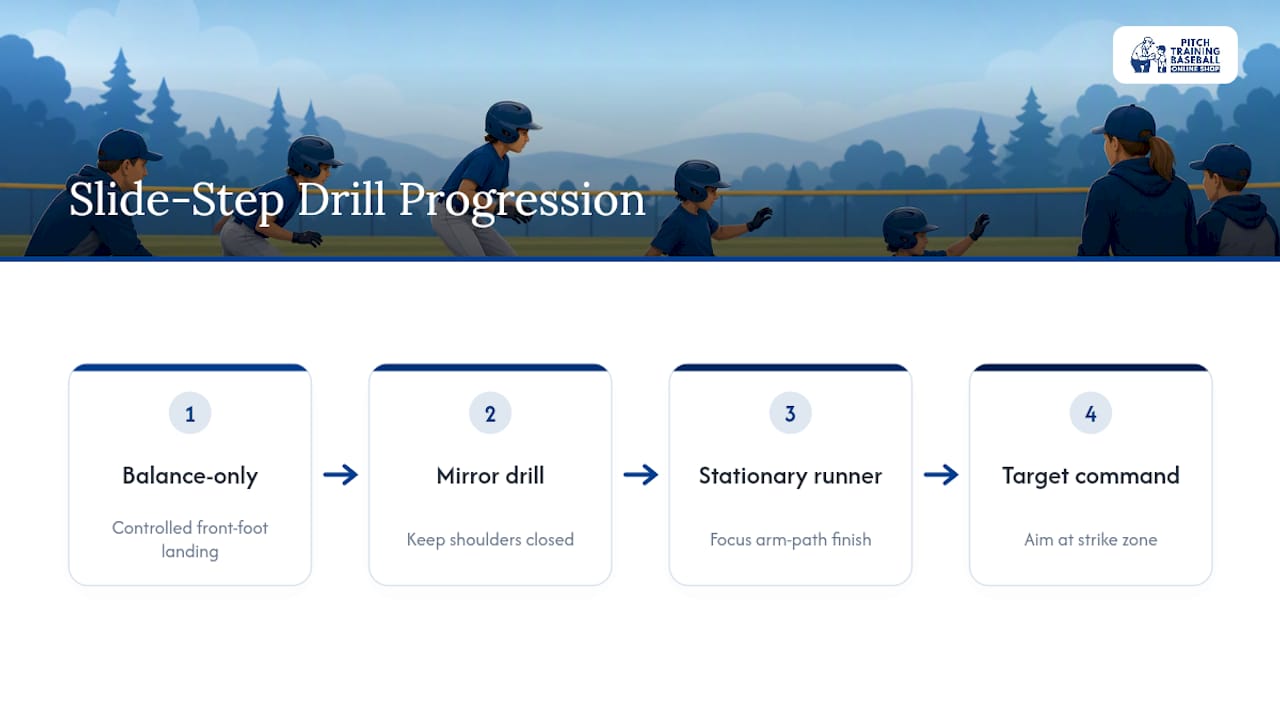
Start with a balance-only drill: no ball, just the set position into the leg lift and landing, checking that the front foot lands under control every single time. Add a ball only once that balance looks automatic.
A mirror or wall drill helps catch early shoulder rotation, one of the most common slide-step errors. Have the pitcher go through the motion facing a mirror or a coach standing where a catcher would be, watching specifically for the shoulders staying closed until the stride foot lands.
The stationary runner drill described in the coaching progression above deserves a repeat mention here in a different context: it’s also a great isolation tool for arm path. Since the pitcher isn’t making a real decision about the runner, you can focus his attention entirely on whether his finish matches his full windup.
Finally, a target-based command drill using a strike-zone net keeps every rep purposeful. Random tossing teaches nothing; a pitcher aiming at a specific zone while executing the slide-step gets instant feedback on whether the shortened motion is helping or hurting his accuracy.
Field Conditions and Gear That Change How Well This Works
Mound condition matters more for a slide-step than most coaches expect. A soft, chewed-up landing area right where the stride foot lands can turn a small timing adjustment into a genuine ankle or knee risk, since the pitcher is already compressing his normal balance window. Check that landing spot before every practice session, not just before games.
Cleats matter too, particularly on wet grass or clay mounds. A pitcher sliding even a few inches on foot strike will compensate somewhere else in the chain, usually the front knee or the throwing shoulder, to make up for the lost stability.
On equipment, a strike-zone target net gives a pitcher a fixed aim point, which matters more during slide-step work than regular bullpens because the shortened timing leaves less room to self-correct mid-delivery. Soft training baseballs reduce the physical toll of high-rep drill sessions, letting a young arm log more repetitions at a given effort level without the same cumulative stress as a full-weight ball on every throw. Neither replaces a proper mound or clear space to throw, but both make the feedback loop tighter, which is really what separates productive slide-step practice from just throwing fast for the sake of it.
Common Sliding-Related Injuries and How to Prevent Them
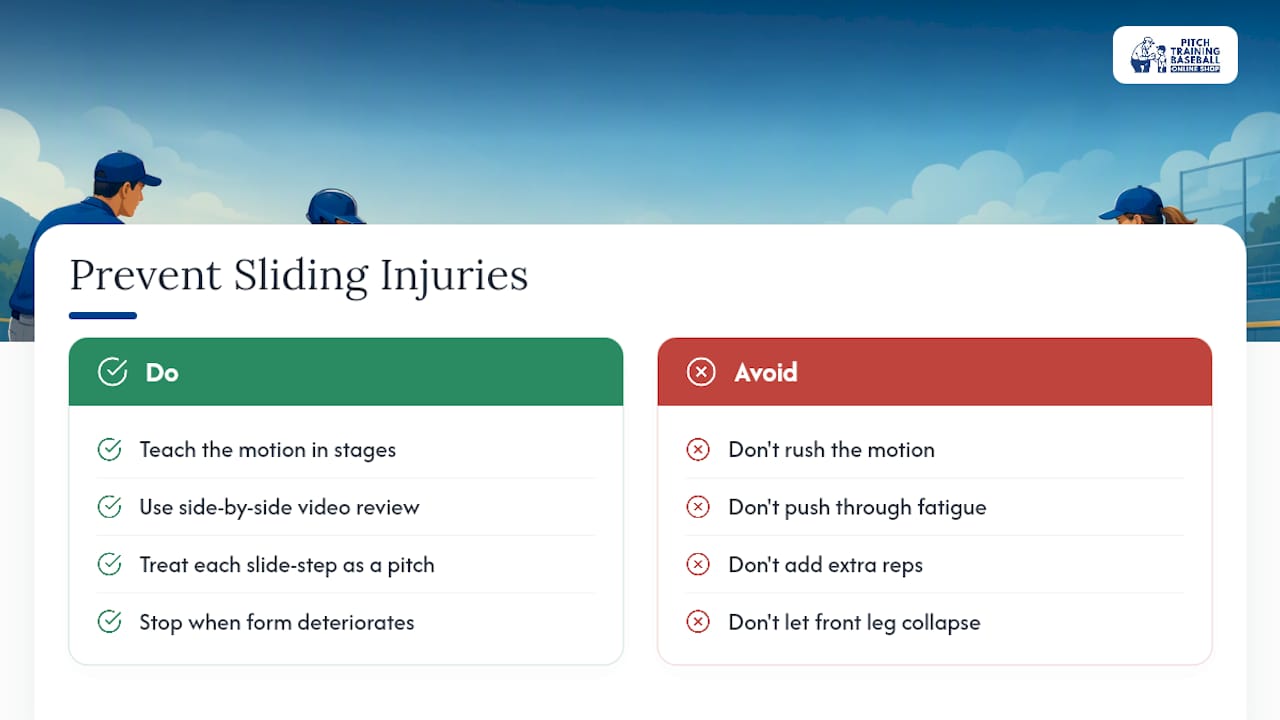
Most injuries tied to a poorly executed slide-step trace back to one of two root causes: rushing the motion before it’s grooved, or letting fatigue erode form late in a long practice or outing.
Shoulder strain shows up most often when a pitcher opens his shoulders early to compensate for a rushed stride, a pattern that’s easy to miss live but obvious on side-by-side video comparison. Catching this early, before it becomes habitual, is the single best prevention tool available to a coach with nothing more than a smartphone.
Elbow stress tends to follow when the front leg collapses on landing instead of bracing, forcing the arm to absorb energy the lower body should have handled. This ties directly back to the drive-leg and stride-leg roles covered earlier: when that chain breaks down, the arm pays for it.
Overuse injuries aren’t really about the slide-step at all, they’re about volume. A pitcher who throws his normal bullpen count and then adds “just a few” slide-step reps on top has quietly exceeded his daily limit. Treat every slide-step rep as a full pitch against the Pitch Smart count for his age group, no exceptions.
The prevention formula is straightforward even if it’s not exciting: teach the motion in stages, watch for fatigue signs like a dropping arm slot, and stop the moment command or form deteriorates rather than pushing through “just a few more.”
Why I Teach the Slide-Step This Way
Most youth coaching content treats the slide-step as a trick, something you bolt onto a pitcher’s repertoire the week before a big game because a scout or a rival coach mentioned it. That’s backwards. The research on drive-leg and stride-leg roles makes clear that a shortened delivery still depends on the same fundamentals as a full windup: balance, direction, and a repeatable arm path. Skip the fundamentals, and you’re just teaching a kid to rush.
What I’ve come to trust more than any single drill is the layering approach: no runner, then a stationary cue, then live decisions. It exposes exactly where a pitcher’s problem lives, whether that’s mechanics, decision-making, or plain fatigue, instead of throwing every variable at him at once. Training aids that give instant visual feedback, like a fixed target or a soft ball that lets a pitcher log more reps safely, speed that process up considerably when they’re used inside Pitch Smart limits rather than as an excuse to add volume.
— Albert
Building Your Slide-Step Practice Setup
Every drill in this progression works better with the right gear on hand. The Pitch Training Baseball Kit pairs a strike-zone target net with soft training baseballs and instructional materials, giving a pitcher instant feedback on command during slide-step reps without the wear and tear of a full-weight ball on every throw.

That combination matters most in the early stages of the progression outlined above, where a coach needs to see immediately whether a compact leg lift is holding up under moderate effort, and where a young arm benefits from logging reps that don’t carry the same cumulative load as a hard ball. The target net turns vague “aim for the plate” cues into a measurable outcome, and the soft ball keeps volume from quietly creeping past safe limits. Browse the full Pitch Training Baseball Kit collection to find the setup that matches your pitcher’s current stage, and get a kit on order before your next practice.
Sources
This article draws on slide-step biomechanics research, energy-transfer findings from Marquette University, the Penn State longitudinal youth pitching study, Pitch Smart workload guidelines, and Little League’s balk and rule guidance.
- The purpose of this research was to evaluate the motion and time change by training aiming at shortening the slide step delivery time of baseball pitchers. ISBS conference paper.
- Peak horizontal ground reaction forces and impulse correlate with segmental energy flow in youth baseball pitchers. Marquette University.
- What is a balk? - Little League
- MLB-USA Baseball supplement: Pitch Smart guidelines for 2021 season.
FAQ
What Age Should a Pitcher Learn the Slide-Step?
There’s no fixed age in the research, but most coaches introduce it once a pitcher has a reliable full-windup and stretch delivery, since the slide-step is a variation on the stretch position rather than a beginner move. Focus on movement quality first, based on findings from the Penn State longitudinal study showing youth mechanics shift as kids mature.
Does the Slide-Step Increase Injury Risk?
Not automatically, but it’s not automatically safer either. Research comparing slide-step mechanics shows shoulder kinematics shift with a compressed delivery, so the real risk factor is whether the pitcher can repeat the motion without rushing his arm or losing balance on landing.
Do Slide-Step Reps Count Against My Pitcher’s Daily Pitch Count?
Yes. Every slide-step rep is a full pitch and should count within the Pitch Smart age-based limits for that player, not as extra volume layered on top of a normal bullpen.
What Equipment Helps Teach the Slide-Step Safely?
A strike-zone target net and soft training baseballs are the two most useful tools, since they give instant command feedback while reducing arm stress across high-rep sessions. The Pitch Training Baseball Kit is priced at $29.99 and bundles both along with instructional materials for this exact purpose.
Do Little League Rules Treat the Slide-Step Differently by Age Group?
The slide-step itself isn’t restricted, but the baserunner-control rules around it change by division. Little League’s balk guidance notes that Major and below enforce stop and illegal-pitch rules differently than Intermediate and up, so confirm your specific division before building game strategy around it.