


Youth-sports safety exists to prevent overuse and traumatic injuries by applying evidence-based workload limits, clinical screening, and clear accountability for coaches and parents. The most reliable framework for young pitchers combines MLB/USA Baseball Pitch Smart pitch-count rules with preparticipation physicals and age-appropriate training gear from Pitchtrainingbaseball.
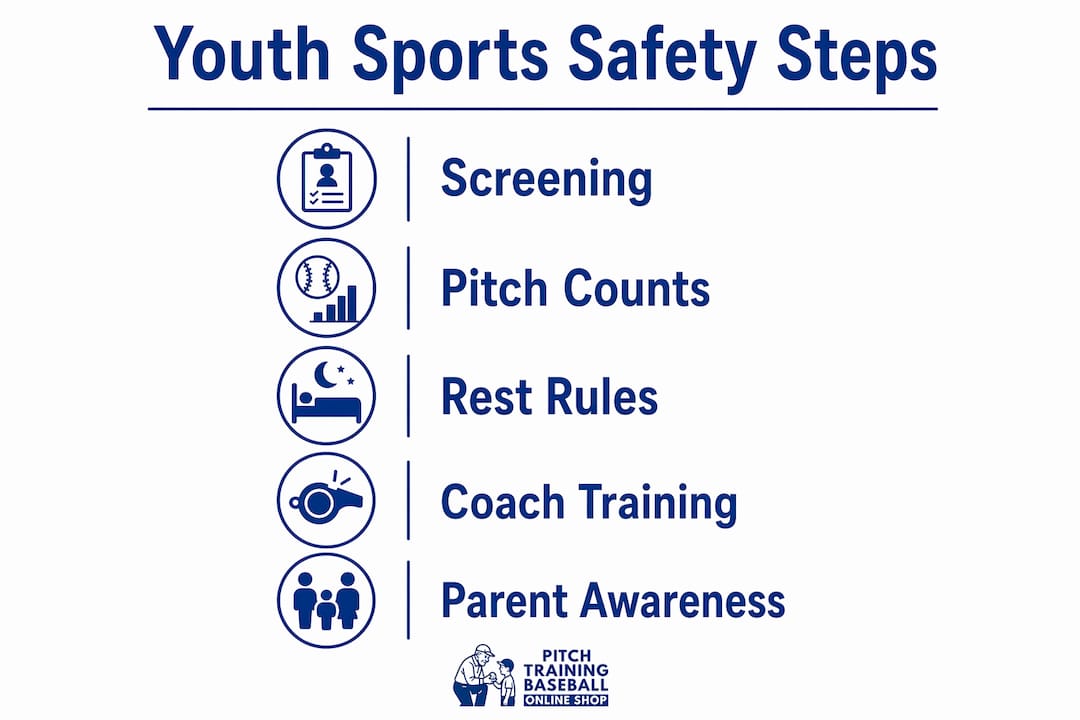
The core safety components every parent and coach must act on:
- Workload limits: Follow Pitch Smart daily pitch-count maximums and mandatory rest days by age group
- Movement quality: Prioritize mechanics over volume; poor form raises injury risk even within legal pitch counts
- Medical screening: Schedule a preparticipation physical (PPE) at least six weeks before the season
- Organizational accountability: Leagues and coaches must enforce safety policies consistently, not selectively
Check your pitcher’s pitch count today and book a PPE before the next season starts.
Table of Contents
- Why does youth sports safety matter so much?
- What are the Pitch Smart pitch-count limits and rest rules?
- How coaches act as the primary safety managers
- What parents should do to protect young pitchers
- How to design a safe pitching practice
- How to choose pitching training aids safely
- How do you recognize overuse and when should you act?
- Quick-reference checklist for safe pitching practice
- Key Takeaways
- Why safety is the foundation, not the footnote
- Safe training gear that supports everything in this guide
- Sources and further reading
Why does youth sports safety matter so much?
Safety preserves long-term participation. When young athletes get hurt, they don’t just miss games; they lose development time, social connection, and sometimes their love of the sport entirely.
About 50% of youth sports injuries are overuse-related, according to the American Academy of Pediatrics. That means roughly half of all injuries in youth baseball are preventable with smarter scheduling and load management. Research published in PMC confirms that tens of millions of youth participate in organized sports annually, yet a low percentage of volunteer coaches have formal safety training, revealing the need for injury prevention habits for tactical athletes that transfer to youth sports.
The psychosocial toll is just as real. Burnout, anxiety, and early dropout are direct consequences of environments where winning overrides wellbeing. Safety measures in youth sports aren’t just about preventing a torn UCL; they protect a kid’s relationship with the game.
What are the Pitch Smart pitch-count limits and rest rules?
Pitch counts and mandatory rest are the most reliable workload controls available to coaches and parents. The MLB/USA Baseball Pitch Smart guidelines set age-based daily maximums and required rest intervals that reduce fatigue-related injury risk.
| Age Group | Daily Max Pitches | Rest Required (days) |
|---|---|---|
| 7–8 | 50 | 1 day after 20+ pitches |
| 9–10 | 75 | 1 day after 25+ pitches |
| 11–12 | 85 | 1 day after 25+ pitches |
| 13–14 | 95 | 1 day after 35+ pitches |
Practical application rules:
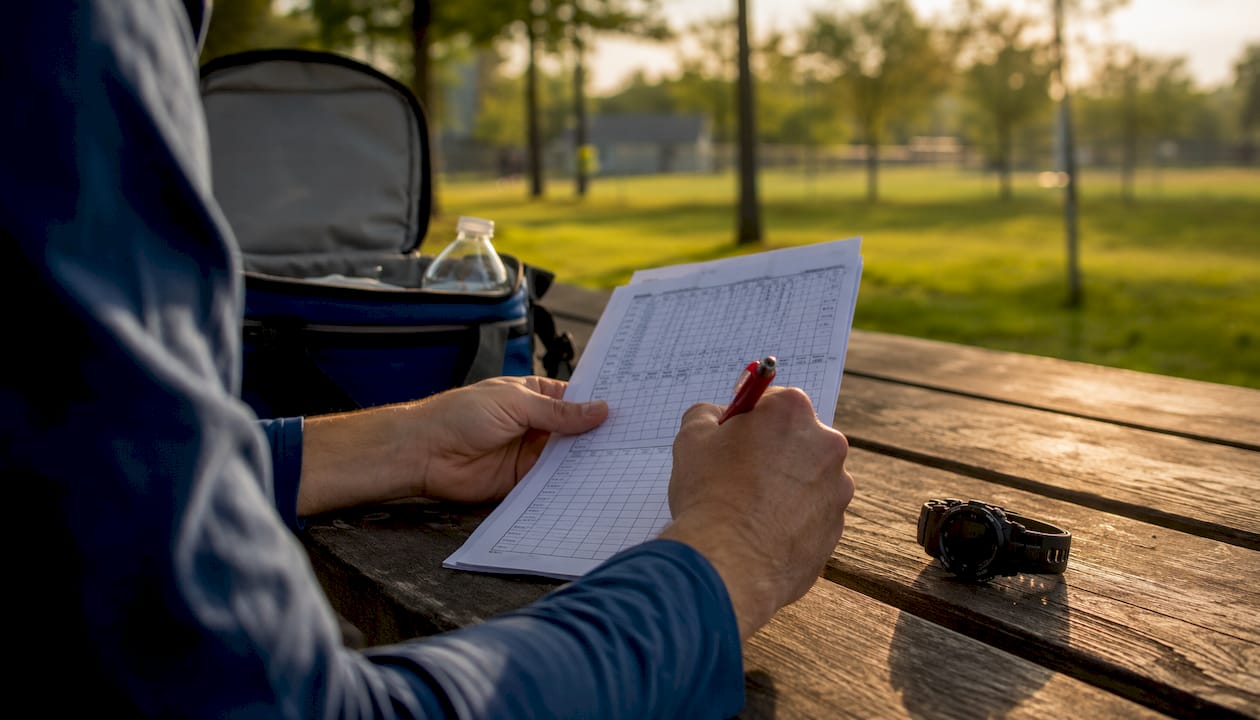
- Count pitches across every team and league, not just one roster
- No pitcher may appear in a game for three consecutive days
- Avoid playing catcher on days when also pitching
- For ages 9–12, avoid throwing breaking pitches until the arm and mechanics are mature enough to handle the stress
Pro Tip: Keep a single shared log (a simple spreadsheet works) that tracks pitches from travel ball, rec league, and school games combined. Cumulative weekly workload is what injures arms, not any single outing.
How coaches act as the primary safety managers
Coaches are the first line of defense for young pitchers, not just instructors. Their daily decisions about technique, workload, and practice structure directly determine injury risk. Research shows that fewer than 20% of community youth coaches have formal safety training, which means most are making consequential calls without a reliable framework.
What a safety-conscious coach does every practice:
- Teaches proper mechanics before adding velocity or volume
- Enforces pitch counts and rest rules without exception, even in playoff situations
- Monitors pitchers for early fatigue signs: dropping elbow, shortened stride, loss of command
- Follows concussion and heat-illness protocols and has an emergency action plan on file
- Communicates with parents about cumulative workloads across teams
Organizational accountability matters too. Leagues should require documented coach training and make safety policy compliance a condition of participation. When coach behavior strongly affects injury risk and safety culture, leaving it to individual judgment is a structural problem, not just a personal one.
Pro Tip: Use low-intensity mechanics reps with training aids, like target nets and light training balls, to build repetitions without adding arm stress. High-rep bullpen sessions are where overuse accumulates fastest. See baseball coaching methods for drill examples.
What parents should do to protect young pitchers
Parents are the safety advocates who enforce limits when coaches don’t, arrange medical checks, and manage the multi-team scheduling that often drives overuse.
Parent action checklist:
- Schedule a preparticipation physical at least six weeks before the season
- Track pitch counts across every team your child plays for
- Insist on rest days and cross-training weeks, especially after tournaments
- Monitor sleep and nutrition, both affect recovery and injury resistance
- Talk openly about pain versus normal muscle soreness so your child reports symptoms early
Johns Hopkins clinician guidance recommends treating the PPE as a genuine screening tool, not a checkbox. A thorough physical can identify shoulder weakness, prior growth-plate stress, or mobility deficits before they become season-ending problems. Parents who understand that purpose become better advocates when a coach or league pushes back on modifications.
Cedars-Sinai guidance also warns against year-round single-sport pressure. A practical scheduling rule: a child’s weekly hours of organized sport should not exceed their age in years. A 10-year-old pitcher should average no more than 10 hours of organized sport per week. For more on overuse injury in baseball, Pitchtrainingbaseball has a parent-focused resource worth bookmarking.
Pro Tip: When talking to a coach about safety, frame it around Pitch Smart and Johns Hopkins guidance rather than personal preference. Evidence-based language shifts the conversation from opinion to policy.
How to design a safe pitching practice
Safe practices prioritize movement quality and gradual load progression over high-count, high-intensity throwing. The goal is building command and mechanics without accumulating the stress that leads to overuse.
A sample safe practice progression:
- Dynamic warm-up (10 min): Arm circles, hip openers, band work, light jogging
- Mechanics focus (15 min): Slow-motion or partial-effort reps with a target net, no full velocity
- Progressive throwing (15 min): Start at 45 feet, move back gradually, cap effort at 75%
- Live reps (10 min max): Full-effort pitches to a target or catcher, strictly capped by age limits
- Cool-down and mobility (10 min): Shoulder stretches, forearm work, recovery talk
Cross-training days matter as much as throwing days. Swimming, running, and non-throwing strength work keep athletes fit without adding arm stress. The age-to-hours rule from Cedars-Sinai applies here too: total organized sport hours per week should stay at or below the athlete’s age.
Pro Tip: Use pitching workouts that emphasize target-based mechanics reps with light balls rather than full-effort bullpen sessions. You build command without the cumulative stress.
How to choose pitching training aids safely
Choose training aids that reduce high-load throwing and emphasize mechanics and command. The best gear for young pitchers makes it easier to get quality repetitions at low intensity.
Selection criteria:
- Size and weight appropriate for the athlete’s age and strength
- Target-feedback design that rewards accuracy, not velocity
- Clear instructions for recommended reps and intensity levels
- Durable enough for outdoor use but portable for backyard practice
Red flags to avoid:
- Devices marketed for “arm strengthening” with no load guidance
- Equipment that encourages maximum-effort throws for young ages
- Products with no usage guidelines or rep limits
Useful training aid categories include strike-zone target nets, colored strike-zone overlays, and lightweight training balls for mechanics work. A pitching target net with a 9-zone strike overlay lets a pitcher get 50 high-quality mechanics reps without throwing a single full-effort pitch. That’s the kind of volume that builds command without building injury risk.
Movement quality is a critical safety factor: adhering to pitch counts alone does not remove injury risk when mechanics are poor. Gear that supports technique work at low intensity fills that gap.
How do you recognize overuse and when should you act?
Sharp, joint-focused pain or a sudden loss of command and velocity are red flags that require immediate activity reduction and likely medical review. Normal post-practice soreness fades within 24–48 hours. Pain that lingers, sharpens during throwing, or localizes to the elbow or shoulder joint is different.
Decision flow:
- Rest: Diffuse muscle fatigue, mild soreness, no joint involvement
- Modify: Reduced velocity, loss of command, fatigue that persists beyond one day
- Refer: Sharp or localized joint pain, swelling, numbness, or any symptom that doesn’t resolve with 48–72 hours of rest
Emergency preparedness covers more than arm injuries. Coaches must have protocols for heat illness (remove from activity, cool immediately, call 911 if unresponsive), allergic reactions (epinephrine if available, call 911), and concussion (remove from play, no same-day return). Concussion incidence in youth sports is significant enough that every coach and parent should complete a recognized concussion awareness course before the season.
Pro Tip: Teach your pitcher the phrase “sharp or joint” as the trigger to stop and tell an adult. It’s simple enough for a 9-year-old to remember and specific enough to mean something.
Quick-reference checklist for safe pitching practice
| Age | Daily Max Pitches | Min. Rest After Threshold |
|---|---|---|
| 7–8 | 50 | 1 day |
| 9–10 | 75 | 1 day |
| 11–12 | 85 | 1 day |
| 13–14 | 95 | 1 day |
Before every practice or game:
- PPE completed and on file for the season
- Sleep and nutrition checked (fatigue increases injury risk)
- Dynamic warm-up completed before any throwing
- Pitch-count tracker open and ready
- Intensity cap set for the session
- Emergency action plan reviewed and accessible
Pro Tip: A shared digital log, even a basic Google Sheet, lets parents and coaches see cumulative pitch counts across all teams in real time. Paper works too. The format matters less than the habit of monitoring pitch counts consistently.
Key Takeaways
Preventing overuse injuries in young pitchers requires pitch-count enforcement, clinical screening, and movement-quality coaching working together, not any single measure alone.
| Point | Details |
|---|---|
| Follow Pitch Smart limits | Use MLB/USA Baseball age-based daily maximums and rest rules across every team your pitcher plays for. |
| Schedule a PPE early | Book a preparticipation physical at least six weeks before the season to catch issues before they become injuries. |
| Prioritize mechanics over volume | Poor movement quality raises injury risk even within legal pitch counts; use low-intensity reps to build command. |
| Apply the age-to-hours rule | Weekly organized sport hours should not exceed the athlete’s age in years to reduce overuse and burnout. |
| Pitchtrainingbaseball supports safe training | Pitchtrainingbaseball offers target nets and training balls designed for low-intensity mechanics work aligned with Pitch Smart principles. |
Why safety is the foundation, not the footnote
Most youth baseball content treats safety as a disclaimer at the end. After years of watching how overuse injuries derail young careers, the more honest framing is this: safety is the practice plan. Every pitch-count rule, every rest day, every mechanics drill at reduced intensity is the training. The arm that stays healthy through age 14 is the arm that gets to develop through age 18.
What gets underestimated is how much parents and coaches can accomplish without medical expertise. You don’t need a sports medicine degree to track pitch counts, schedule a PPE, or swap a high-intensity bullpen session for target-net reps. The Pitch Smart framework and clinician guidance from Johns Hopkins and Cedars-Sinai have already done the hard work. The gap is almost always implementation, not information.
Pitchtrainingbaseball’s educational content and training gear exist to close that implementation gap, giving coaches and parents practical tools that support the safety practices described in this guide, not replace clinical judgment.
Safe training gear that supports everything in this guide
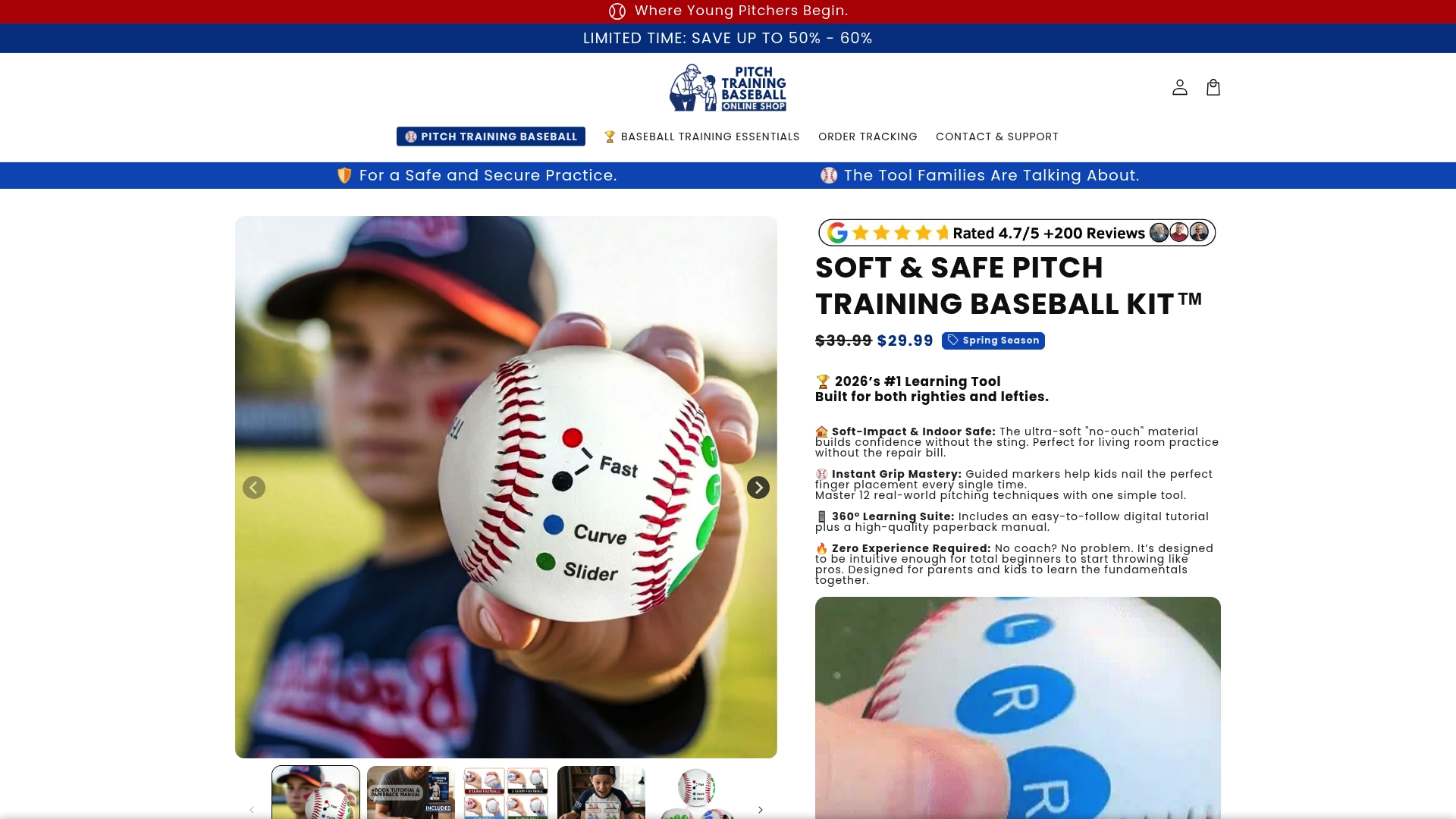
Pitchtrainingbaseball offers training equipment built specifically for the kind of low-intensity, mechanics-focused repetition that Pitch Smart and sports medicine clinicians recommend. The difference from general sporting goods: every product is designed with young pitchers in mind, with clear usage guidance and rep structures that keep workloads safe.
Three categories worth considering for any parent or coach putting this guide into practice:
- Strike-zone target nets: The Pitching Target Net with 9-Zone Strike overlay gives pitchers immediate visual feedback on location without requiring full-effort throws.
- Lightweight training balls: Light training balls reduce arm stress during high-rep mechanics sessions, ideal for the progressive throwing phase of a safe practice.
- Softball training variants: The Pitch Training Softball suits mixed baseball/softball households and coaches working with both sports.
These are training aids, not medical treatments. For any pain, swelling, or suspected injury, consult a sports medicine clinician before returning to throwing. Browse the full range at Pitchtrainingbaseball and pair the gear with the practice plan in this guide.
Sources and further reading
Trusted references used throughout this guide:
- MLB/USA Baseball Pitch Smart Guidelines: Age-based pitch-count limits and rest rules; the primary workload framework for youth pitchers.
- Pitch Smart Ages 9–12: Specific behavioral guidance for the most common youth pitching age group.
- AAP/HealthyChildren: Preventing Overuse Injuries: Evidence on overuse injury prevalence and load-management recommendations.
- Cedars-Sinai: How to Prevent Sports Injuries in Young Athletes: Dr. Zaslow’s clinician guidance on year-round pressure, burnout, and the age-to-hours rule.
- Johns Hopkins: 10 Tips for Preventing Sports Injuries in Kids and Teens: Dr. Lee’s guidance on PPEs and recognizing injury signs.
- PMC: Implementing Injury Prevention in Community Youth Football: Research on coach training rates and organizational accountability in youth sports safety.
- PMC: Youth Sport — Positive and Negative Impact on Young Athletes: Academic review of participation scale and the need for adult oversight.
- PMC: Concussion Incidence in Children and Adolescents: Systematic review of sport-related concussion rates in youth sports.
Recommended
- Why Invest in Youth Sports Equipment: A Parent’s Guide – Pitch Training Baseball
- Training Aids in Youth Sports: A 2026 Parent and Coach Guide – Pitch Training Baseball
- Top safe baseball training practices to prevent youth injuries – Pitch Training Baseball
- The Role of Parents in Baseball Training: A 2026 Guide – Pitch Training Baseball