


Training aids in youth sports are defined as specialized tools, devices, and equipment used to accelerate skill development, improve physical performance, and reduce injury risk in young athletes. The role of training aids in youth sports goes far beyond simply giving kids something to practice with. Research from 2026 confirms that the right equipment, paired with the right coaching approach, produces measurable gains in speed, strength, coordination, and motivation. This guide explains which tools work, why they work, and how parents and coaches can use them to get real results.
What is the role of training aids in youth sports?
Training aids serve as the bridge between raw athletic potential and developed skill. They give young athletes a structured way to practice specific movements, build physical habits, and receive immediate feedback on their performance. Without them, practice often defaults to unstructured repetition that builds bad habits as easily as good ones.
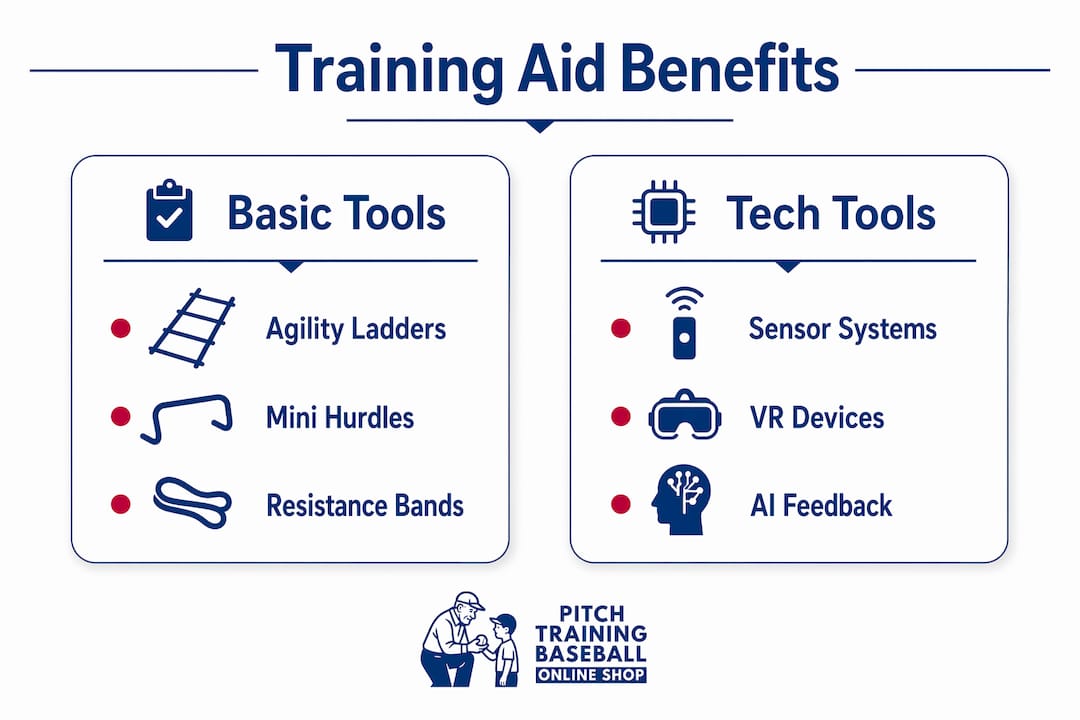
The category covers a wide range of tools. Basic aids include agility ladders, mini-hurdles, resistance bands, and weighted training balls. Advanced tools include sensor-based reaction systems, video analysis platforms, and VR-assisted training devices. Each type targets a different layer of athletic development, from raw speed and strength to visual processing and decision-making.
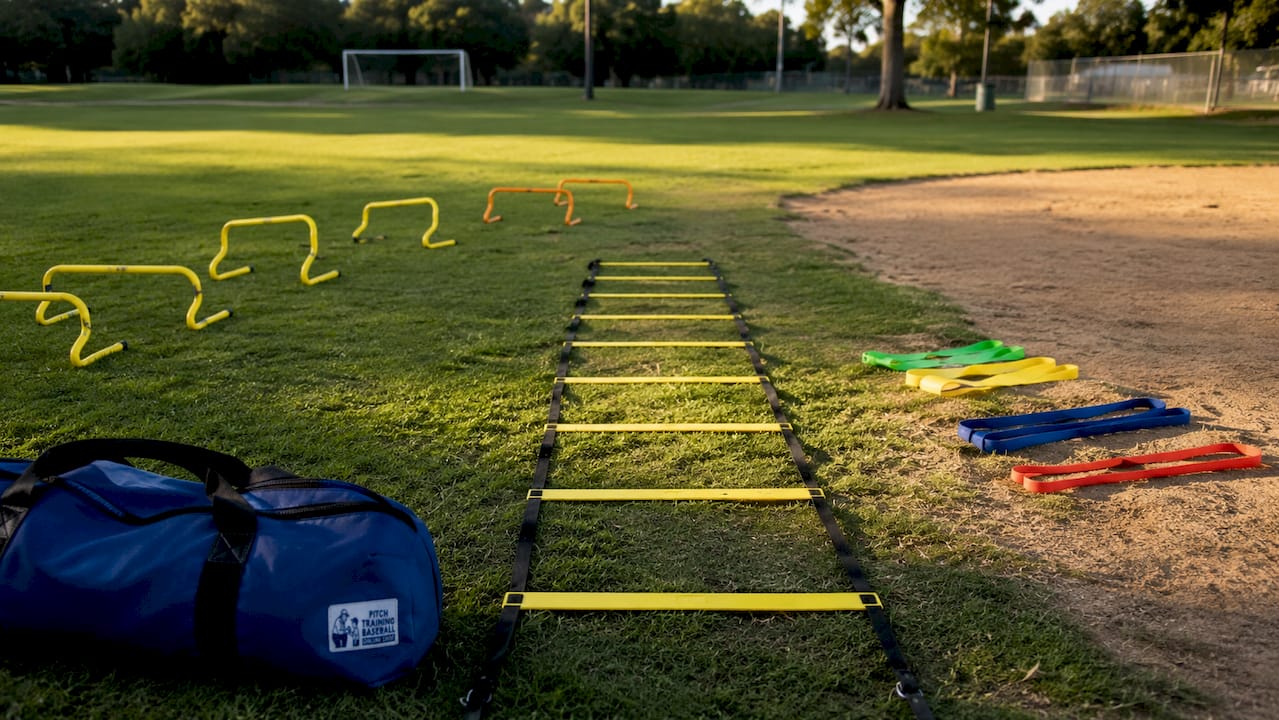
The importance of training equipment becomes clear when you look at what structured programs actually produce. Integrated 8-week programs using agility ladders, mini-hurdles, and resisted-speed devices improve sprint times by 3.9% and hamstring strength by roughly 20–36% in youth athletes. Those gains are 3–4 times larger than what control groups achieve through unstructured practice alone.
Training aids also support injury prevention by teaching proper movement mechanics before bad patterns become ingrained. A young pitcher who practices with a pitching target net learns release point and arm path through repetition with feedback, not through guesswork that strains the elbow and shoulder.
What types of training aids are used in youth sports?
Basic movement and strength tools
Agility ladders, mini-hurdles, and resistance bands form the foundation of most youth training programs. They are inexpensive, portable, and effective across nearly every sport. These tools develop footwork, acceleration, and lower-body strength through high-repetition, low-complexity drills that young athletes can execute correctly from day one.
Plyometric training over 12 weeks reliably improves 20-meter sprint times and broad jump performance in youth soccer players across all maturation stages. That consistency matters because it means coaches can count on these tools to deliver results regardless of where a player is in their physical development.
Sensor-based and technology-driven tools
Sensor systems and VR-assisted devices represent the next tier of training aids. They target the perceptual and cognitive dimensions of athletic performance, not just the physical ones. A 6-session program using sensor-based reaction systems and VR-assisted stimuli measurably improves visual-motor reaction speed in youth handball players after roughly 90 minutes of total training time.
That speed of improvement is significant. It means technology-driven tools can produce results in a fraction of the time that traditional drills require, particularly for skills like reaction time and spatial awareness.
Pro Tip: Pair a sensor-based reaction tool with a game-like drill rather than isolated repetitions. The game context forces decision-making alongside the physical response, which accelerates skill transfer to real competition.
Training aid comparison by type and benefit
| Training aid type | Primary benefit | Best application |
|---|---|---|
| Agility ladders and hurdles | Sprint speed, footwork | Pre-practice warm-up drills |
| Resistance bands and sleds | Strength, acceleration | Strength-focused sessions |
| Training balls and targets | Accuracy, arm mechanics | Sport-specific skill work |
| Sensor-based reaction systems | Visual-motor speed | Cognitive and perceptual training |
| VR-assisted devices | Decision-making, reaction | Advanced skill simulation |
The benefits of training aids multiply when coaches match the tool to the specific developmental gap they are trying to close. A young pitcher struggling with accuracy needs a target-based tool. A wide receiver struggling with reaction time needs a sensor system, not more cone drills.
How do training aids improve motor skills and motivation?
Training aids improve motor skills through a process called perceptual-motor integration. This means the athlete is not just repeating a physical movement. They are learning to read environmental cues, process information, and respond with the right movement at the right time. Perceptual-motor training aids develop what researchers call “physical intelligence,” which is the ability to adapt movement to changing conditions rather than just execute a memorized pattern.
This distinction matters enormously for youth athletes. A player who has only drilled a skill in isolation often freezes when the game situation changes. A player who has trained with perceptual-motor tools adapts in real time because their nervous system has learned to process and respond, not just repeat. Understanding how to reprogram athletic responses at the neurological level explains why these tools outperform rote repetition.
The motivational dimension
Training aids also change how young athletes feel about practice. Equipment that provides immediate feedback, like a pitching target that lights up when you hit the zone, creates a loop of effort and reward that keeps kids engaged. Game-centered pedagogical frameworks that balance motor skill acquisition with motivational climate produce motor proficiency effect sizes of d=0.41–0.92, which outperforms direct instruction by a significant margin.
That effect size range means the best-designed training environments produce results nearly twice as strong as traditional coaching methods. The key variable is not the equipment itself. It is whether the equipment is embedded in a motivating, game-like context.
Key factors that drive motivational benefits from training aids:
- Immediate visual or auditory feedback that confirms correct execution
- Progressive difficulty that keeps the challenge just ahead of current ability
- Game-like formats that make practice feel competitive rather than mechanical
- Athlete choice in drill selection, which builds autonomous engagement
- Clear, measurable goals tied to specific equipment use
AI-powered coaching tools take this further by making performance improvements measurable and personalized. Research shows increased motivation and persistence in athletes aged 16–18 who train with AI-based programs. The measurability itself becomes a motivator because young athletes can see their progress in real numbers.
Pro Tip: Track one specific metric per training aid, such as strike zone accuracy percentage for a pitching target. Visible progress on a single number keeps young athletes more engaged than general “good job” feedback.
What coaching approaches maximize training aid effectiveness?
The effectiveness of any training aid depends almost entirely on how a coach deploys it. Mechanical repetition without game-based context hinders skill transfer, even when the equipment itself is excellent. A young athlete who runs agility ladders in isolation for 20 minutes learns to run agility ladders. A young athlete who runs the same ladder as part of a competitive drill that simulates a game situation learns to move athletically under pressure.
Coaches who get the best results from training aids follow a clear pedagogical sequence:
- Introduce the tool with a clear purpose. Tell the athlete exactly what physical or cognitive skill the tool targets. Vague instruction produces vague results.
- Start with isolated skill work. Give athletes enough repetitions to understand the movement pattern before adding complexity.
- Embed the tool in a game-like task. Create a drill that uses the equipment within a competitive or decision-making context.
- Provide specific, immediate feedback. General praise does not build skill. Tell the athlete what they did correctly and what to adjust.
- Progress the difficulty systematically. Apply progressive overload principles by increasing speed, resistance, or complexity as the athlete improves.
Adapting tools to maturation status
Maturation affects how athletes respond to different training aids. Prepubertal athletes gain the most from varied resistance tools and movement-based equipment because their nervous systems are highly adaptable. Postpubertal athletes often hit performance plateaus and need more targeted equipment to break through.
This means a 10-year-old and a 16-year-old should not be using the same training program, even if they play the same position. Coaches who ignore maturation status and apply a one-size approach leave significant development on the table.
Over-reliance on a single training aid also increases injury risk. Coaches should vary movement environments and encourage participation in multiple sports, a concept researchers call “donor sports.” Cross-sport movement patterns build the physical diversity that prevents overuse injuries and keeps young athletes developing broadly.
Pro Tip: Rotate three to four different training aids across a four-week block rather than using the same tool every session. Variety prevents adaptation plateaus and keeps practice mentally fresh for young athletes.
How can parents and coaches implement training aids effectively?
Selecting and using training aids well does not require a large budget or a professional facility. It requires matching the right tool to the right athlete at the right developmental stage.
Selecting the right training aid
Use this checklist before purchasing or introducing any training aid:
- Age and maturation match. Does the tool suit the athlete’s current physical development, not just their age on paper?
- Sport specificity. Does the tool target a skill that directly transfers to game performance in your athlete’s sport?
- Safety design. Is the equipment built for youth use, with appropriate weight, size, and material for the athlete’s body?
- Feedback mechanism. Does the tool provide clear, immediate feedback that the athlete can understand and act on?
- Portability and convenience. Can the tool be used at home or in a backyard, not just at a facility? Portable training equipment dramatically increases practice frequency because it removes the barrier of needing a field or gym.
Building effective short sessions
Short, focused sessions outperform long, unfocused ones for youth athletes. A 20-minute session with a clear goal and the right tool produces more skill development than an hour of unstructured repetition. Structure sessions around a single skill, use the training aid for 10–15 minutes of focused work, then finish with a game-like drill that applies the skill under light pressure.
Safe training practices matter as much as skill development. Always warm up before using resistance or speed tools. Teach proper mechanics before adding load or speed. Stop a session if an athlete shows signs of fatigue-related form breakdown.
Psychological safety within the training environment also affects how well young athletes respond to equipment-based practice. Athletes who feel safe making mistakes try harder, experiment more, and develop faster. Create a practice culture where errors are treated as information, not failure.
Combine training aids with consistent coaching feedback to close the loop between what the tool measures and what the athlete learns. Equipment provides the data. The coach provides the meaning.
Key Takeaways
Training aids accelerate youth athletic development only when matched to the athlete’s maturation stage and embedded in game-like, feedback-rich coaching environments.
| Point | Details |
|---|---|
| Equipment alone is not enough | Training aids produce the best results when paired with game-centered coaching frameworks, not isolated repetition. |
| Maturation determines tool selection | Prepubertal athletes benefit most from varied resistance tools; postpubertal athletes need targeted equipment to break plateaus. |
| Short sessions outperform long ones | A focused 20-minute session with one training aid and clear feedback beats an hour of unstructured practice. |
| Variety prevents injury and plateaus | Rotating multiple training aids and encouraging multi-sport participation reduces overuse injury risk and sustains development. |
| Motivation is a measurable outcome | Game-centered training environments produce motor proficiency effect sizes of d=0.41–0.92, outperforming direct instruction. |
What I have learned after years of watching youth athletes train
The most common mistake I see parents and coaches make is buying excellent equipment and then using it badly. A high-quality pitching target sitting in a gym while a coach runs the same flat-ground throwing drill for 45 minutes is not a training program. It is a missed opportunity.
The research on game-centered learning has shifted how I think about every piece of equipment I recommend. The tool is not the point. The context is the point. A simple agility ladder used inside a competitive drill that simulates a game situation will outperform an expensive sensor system used in mindless isolation. I have watched this play out repeatedly, and the pattern never changes.
What excites me about where youth sports training is heading is the convergence of AI-driven personalization and accessible equipment. We are moving toward a world where a 12-year-old pitcher can get the kind of individualized feedback that used to require a professional coaching staff. Pitchtrainingbaseball is already building in that direction with tools designed specifically for young athletes who need real feedback, not just more reps.
My honest warning is this: do not let technology replace the human relationship between coach and athlete. The best training aid in the world cannot replace a coach who knows when a kid is frustrated, when to push harder, and when to back off. Use the tools. Trust the research. But stay present.
— Albert
Pitchtrainingbaseball training tools for young athletes
Young athletes develop faster when their training equipment is built specifically for their sport, their size, and their stage of development. Pitchtrainingbaseball designs its tools with exactly that in mind.
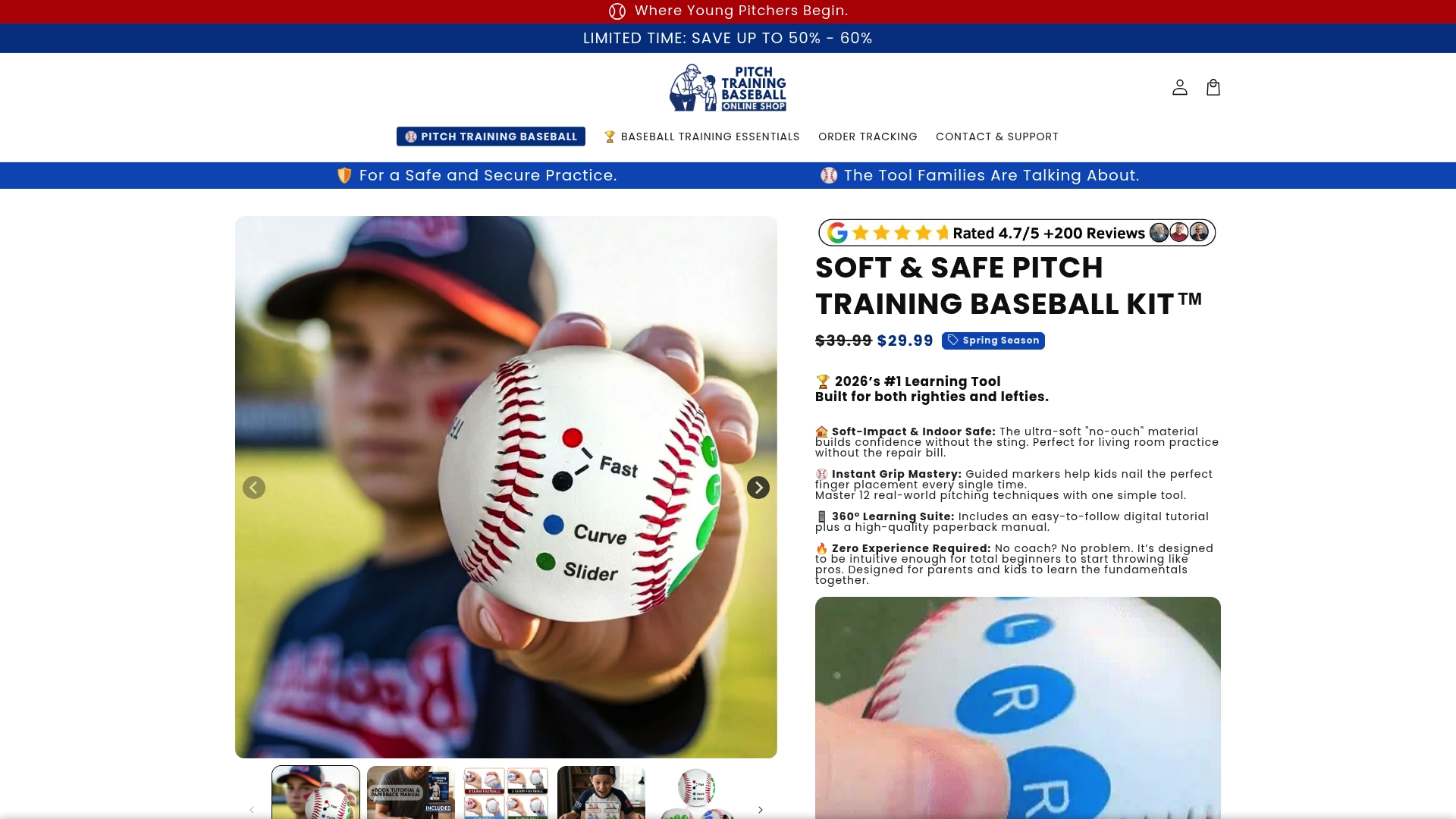
The Pitching Target Net with 9-Zone Strike gives young pitchers immediate visual feedback on every throw, which is the single most effective way to build accuracy and arm mechanics. For coaches and parents who want a complete training solution, the Pitch Training Baseball collection covers the full range of skill development from beginner to advanced. Every product is portable, adjustable, and designed to make consistent practice possible anywhere.
FAQ
What are training aids in youth sports?
Training aids in youth sports are specialized tools and equipment used to develop specific athletic skills, improve physical performance, and reduce injury risk in young athletes. They range from basic tools like agility ladders to advanced sensor-based systems.
How do training aids improve performance in young athletes?
Training aids improve performance by providing structured repetition, immediate feedback, and perceptual-motor challenges that accelerate skill acquisition. Research shows integrated 8-week programs using agility ladders and resisted-speed devices improve sprint times by 3.9% and hamstring strength by up to 36%.
What is the best way for coaches to use training aids?
Coaches get the best results by embedding training aids in game-like, decision-making tasks rather than isolated repetition. Mechanical repetition without game-based context hinders skill transfer, even with high-quality equipment.
Should training aids differ based on an athlete’s age?
Training aid selection should be based on maturation status, not age alone. Prepubertal athletes respond best to varied resistance and movement tools, while postpubertal athletes need more targeted equipment to overcome performance plateaus.
Can parents use training aids at home effectively?
Parents can use training aids effectively at home by choosing portable, sport-specific tools with clear feedback mechanisms and running short, focused sessions of 15–20 minutes with a single skill goal per session.
Recommended
- The Role of Parents in Baseball Training: A 2026 Guide – Pitch Training Baseball
- Top safe baseball training practices to prevent youth injuries – Pitch Training Baseball
- Baseball parents: safety, support, and pitching success – Pitch Training Baseball
- Progressive Overload Baseball: A Youth Coach’s Guide – Pitch Training Baseball