


Progressive overload in baseball is the practice of systematically increasing training demands over time so a player’s muscles, arm, and mechanics adapt and grow stronger. The American College of Sports Medicine defines this as the foundation of any effective resistance training program. For youth baseball players, it means more than just throwing harder or lifting heavier. It means building arm strength, bat speed, and pitching velocity through deliberate, measured increases in training stress. This guide explains what progressive overload baseball training actually looks like, what the science says about weighted balls and bats, and how coaches and parents can apply it safely with developing athletes.
What is progressive overload in baseball training?
Progressive overload is defined as the gradual increase of training load or other stressors so muscles adapt over time. The Cleveland Clinic identifies multiple overload variables including increasing weight, reps, workout duration, or decreasing rest intervals. In baseball, this principle translates directly to throwing programs, bat training, and strength work.
The baseball-specific version of progressive overload differs from general gym training in one critical way: the throwing arm is a precision instrument under enormous mechanical stress. A pitcher’s elbow and shoulder absorb forces that rival Olympic weightlifting movements on every single throw. That context makes the “gradual” part of progressive overload non-negotiable.
Here is how coaches typically apply progressive overload in baseball:
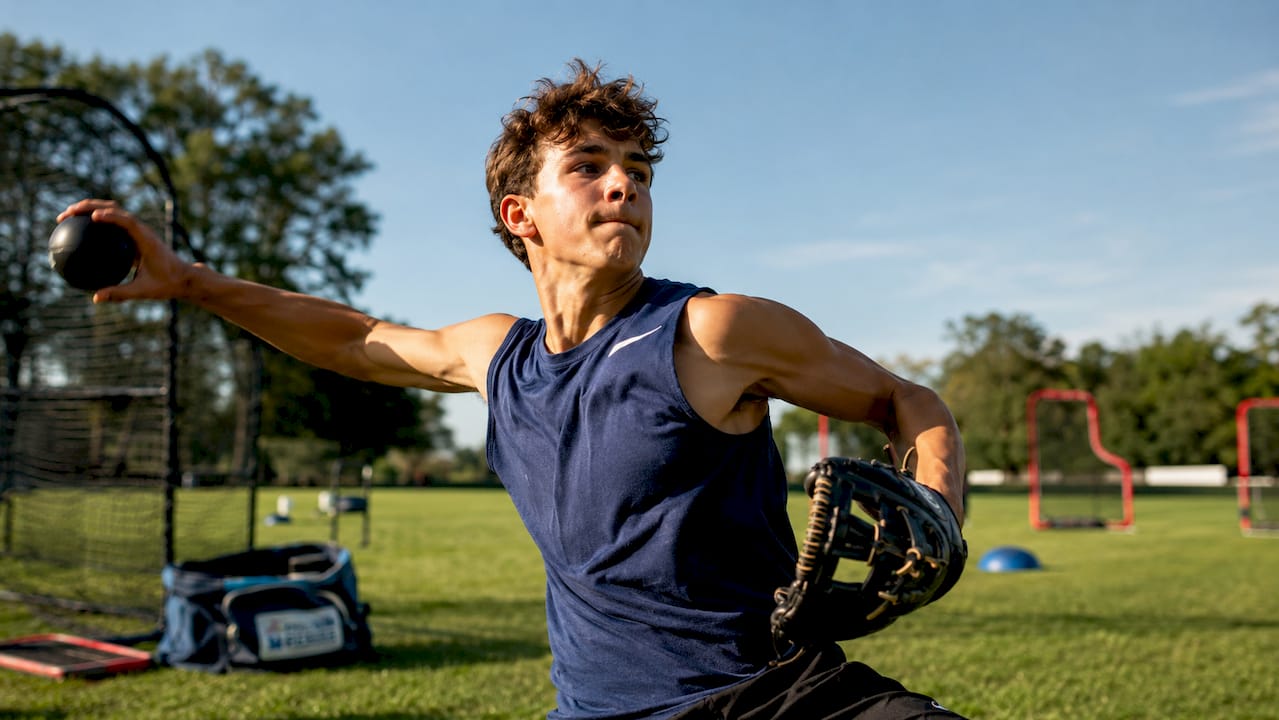
- Weighted balls: Throwing with balls heavier than a regulation 5-ounce baseball to increase resistance on the arm
- Underweighted balls: Throwing lighter balls to train arm speed and fast-twitch muscle recruitment
- Increased throwing volume: Adding more throws per session or per week over a training cycle
- Reduced rest intervals: Shortening recovery time between sets to build arm endurance
- Bat overload: Swinging heavier bats to build force and torque in the swing
The biomechanical rationale is straightforward. When you increase resistance, the body recruits more fast-twitch muscle fibers to handle the load. Over time, those fibers grow stronger and fire faster. That translates to higher pitching velocity and greater bat speed when the player returns to regulation equipment.
Pro Tip: Never increase more than one variable at a time. If you add weighted ball throws this week, keep volume and rest intervals the same. Changing two variables at once makes it impossible to know what is working and what is causing soreness.
Does weighted ball and bat training actually work?
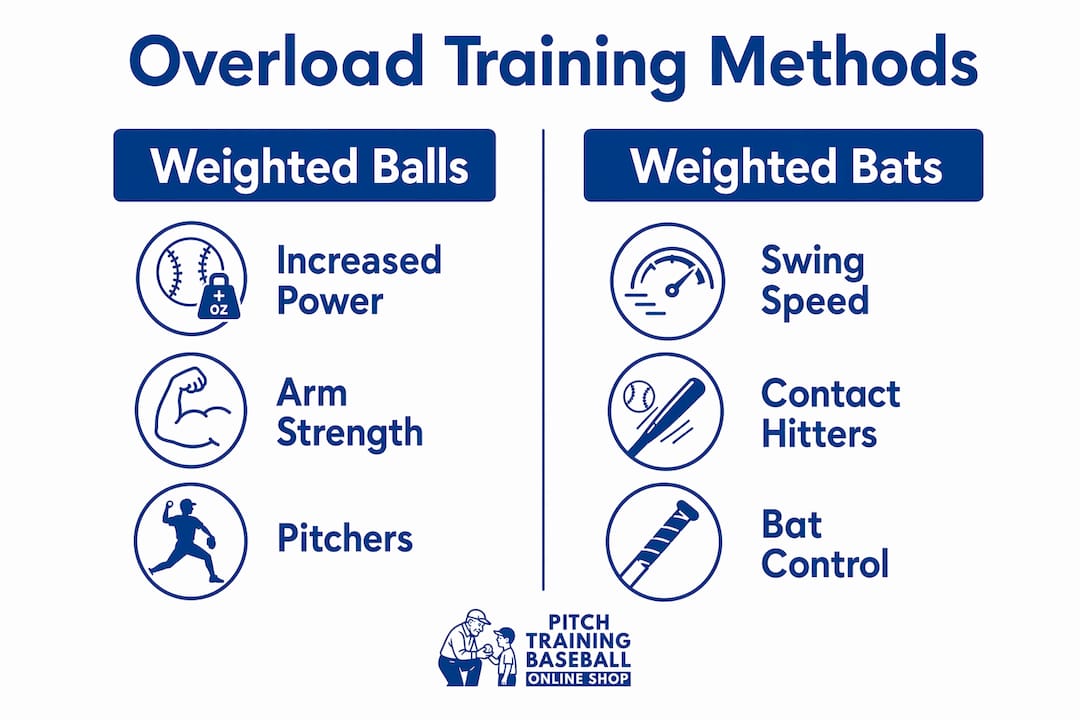
The evidence on weighted implements in baseball is real but more nuanced than most coaches expect. A 2025 biomechanics study found that reduced bat mass increases swing speed by 7–13%, while increased inertial properties increase peak force by 4–8% and torque by 9–20%. Those are measurable, meaningful gains for players at any level.
The force and torque numbers matter most for power hitters. The swing speed numbers matter most for contact hitters and pitchers working on arm speed. This distinction is important because it tells coaches which implement to use based on the specific training goal.
| Training Tool | Primary Effect | Measured Gain | Best For |
|---|---|---|---|
| Heavier bat (overload) | Increased force and torque | 4–8% force, 9–20% torque | Power development |
| Lighter bat (underload) | Increased swing speed | 7–13% speed gain | Bat quickness, contact |
| Weighted baseball | Arm strength and resistance | Velocity gains vary | Pitching arm strength |
| Underweighted baseball | Arm speed and fast-twitch | Arm speed improvement | Velocity training |
| Volume increase | Endurance and consistency | Cumulative adaptation | All-around arm conditioning |
For pitching, the picture is more complicated. A 2025 critical review found that weighted ball programs show inconsistent velocity gains in youth athletes and carry elevated injury incidence. Some players see real velocity improvements. Others see shoulder and elbow stress without the performance payoff. The difference almost always comes down to programming quality and athlete maturity.
A 2025 review from Velo University confirms that periodized programming with volume control makes weighted ball and bat training both safe and effective. The key phrase is “with volume control.” Without it, overload becomes overuse.
What are the injury risks for youth baseball players?
Youth athletes face a specific set of risks with progressive overload that adult players do not. Growth plates in the elbow and shoulder are still open in players under 16, making them vulnerable to stress injuries that can cause permanent damage. This is not a reason to avoid overload training entirely. It is a reason to apply it with far more caution than you would with a college or professional player.
The most documented risk involves shoulder external rotation. Weighted ball programs increase shoulder external rotation in throwing athletes, and athletes who show rapid increases in rotation have elevated injury incidence. More external rotation sounds like a good thing because it creates a longer arm path and more velocity. But in a young athlete whose joint capsule is still developing, it can lead to instability.
Here are the key safety rules every coach and parent should follow:
- Limit weighted ball sessions to twice per week at most, with full rest days between sessions
- Always warm up thoroughly before any overload work, including light throwing and dynamic stretching
- Monitor soreness closely after every session and stop immediately if a player reports elbow or shoulder pain
- Never use weighted balls with players under 14 without direct supervision from a qualified pitching coach or sports medicine professional
- Prioritize mechanics first before adding any resistance. A player with poor arm action under normal load will develop worse mechanics under overload
Pro Tip: Track your player’s soreness on a simple 1–10 scale after every weighted ball session. If they report anything above a 4 two days after training, reduce volume before the next session. Arm tolerance builds slowly, and the goal is months of consistent training, not one big week.
The Cleveland Clinic advises alternating overload variables rather than always chasing heavier implements. For youth baseball, this is especially sound advice. Increasing reps or shortening rest carries far less injury risk than jumping to a heavier ball.
How to apply progressive overload in a youth baseball program
Practical application starts with choosing one training variable to progress and tracking it consistently. The American College of Sports Medicine’s 2026 umbrella review, covering more than 30,000 participants, concludes that individualized resistance training prescription produces better strength gains than fixed-increment programs. That finding applies directly to youth baseball. No two 13-year-olds have the same arm tolerance, mechanics, or training history.
Here is a step-by-step framework for coaches and parents:
- Establish a baseline. Time your player’s pitching velocity and track their current throwing volume per week. You cannot measure progress without a starting point.
- Choose one variable to progress. Start with volume, not weight. Add five throws per session per week for three weeks before introducing any weighted implements.
- Introduce weighted implements gradually. Begin with a ball only slightly heavier than regulation, such as a 6-ounce ball, before moving to 7 or 8 ounces. Never start a youth player on a 10-ounce ball.
- Use a periodized schedule. A basic cycle looks like this: three weeks of progressive loading followed by one week of reduced volume for recovery. This is called a deload week, and it is where most of the adaptation actually happens.
- Combine overload with mechanics work. Strength without proper arm action produces faster bad habits. Every overload session should include a mechanics review, either with video analysis or a qualified coach’s eye.
- Reassess every four weeks. Measure velocity, check mechanics, and ask the player how their arm feels. Adjust the program based on what you find, not on a fixed schedule.
Pro Tip: Use a pitching net and target during weighted ball sessions so the player focuses on hitting a specific zone rather than just throwing hard. Accuracy under load is a skill that transfers directly to game performance. Pitchtrainingbaseball recommends pairing overload work with a quality pitching target to keep mechanics honest.
For bat training, the same periodization logic applies. Alternate between overload bats and underload bats across a training week rather than using only one type. The overload and overspeed combination produces better swing development than either method alone because it trains both force production and bat speed in the same cycle.
Comparing overload methods: which one fits your player?
Not every overload method suits every player. Age, position, training history, and physical maturity all affect which approach produces results safely. The table below compares the most common methods used in youth baseball programs.
| Method | Effectiveness | Injury Risk | Age Suitability | Ease of Use |
|---|---|---|---|---|
| Weighted baseballs | Moderate, variable | High without supervision | 14 and older, with coaching | Requires qualified oversight |
| Underweighted baseballs | Good for arm speed | Low to moderate | 12 and older | Easier to self-manage |
| Overload bats | Good for force and torque | Moderate | 13 and older | Moderate, needs instruction |
| Underload bats | Good for swing speed | Low | 12 and older | Easy to implement |
| Volume increase | Consistent, cumulative | Low if managed well | All ages | Easiest to control |
| Reduced rest intervals | Good for endurance | Low to moderate | All ages | Easy to track |
Volume progression is the safest starting point for any youth player. It requires no special equipment, carries the lowest injury risk, and still produces real adaptation. Weighted balls and overload bats are powerful tools, but they belong later in a player’s development, not at the beginning.
The research from Velo University is clear that safe overload programming requires warm-up and cool-down protocols, soreness monitoring, and professional supervision. For parents coaching their own kids at home, volume and rest-interval progression are the methods you can manage confidently without a sports medicine team on call.
For players 14 and older with solid mechanics and a coach who understands arm care, weighted balls and overload bats become genuinely useful tools. The role of training balls in youth pitching development is real, but the implementation details determine whether they help or hurt.
Key takeaways
Progressive overload in youth baseball works best when coaches increase one training variable at a time, prioritize mechanics, and treat arm care as the foundation of every program.
| Point | Details |
|---|---|
| Define overload clearly | Progressive overload means increasing one training variable at a time, not just throwing harder or lifting more. |
| Volume before weight | Start with more throws per session before introducing weighted balls or heavier bats. |
| Youth athletes need extra caution | Open growth plates and developing joints make rapid overload increases dangerous for players under 16. |
| Periodize every program | Three weeks of progressive loading followed by one deload week produces better adaptation and fewer injuries. |
| Match method to goal | Use overload bats for force development and underload bats for swing speed, based on what the player needs most. |
What i’ve learned watching coaches rush the process
I’ve watched a lot of well-meaning coaches hand a 12-year-old a 10-ounce weighted ball because they read that it builds velocity. Six weeks later, that kid is sitting out with elbow soreness. The problem is not progressive overload itself. The problem is that the word “progressive” gets ignored the moment a coach or parent gets excited about results.
The biggest mistake I see is treating overload training as a shortcut rather than a long-term investment. A player who spends two years building arm tolerance through volume progression and solid mechanics will outperform a player who jumped straight to heavy weighted balls every single time. The second player might show a velocity spike early, but the injury risk catches up.
The other mistake is separating strength work from mechanics. I’ve seen players add three miles per hour to their fastball through overload training and lose two miles per hour because their arm action fell apart under the new load. Strength without mechanics is just faster bad habits. Every overload session needs a mechanics check, whether that is video review, a coach watching live, or even a parent who has learned what proper arm path looks like.
My honest recommendation for any parent or coach reading this: start with the arm strength basics before you touch a weighted ball. Build the foundation first. The overload tools will work far better on a player whose mechanics are already sound.
— Albert
Build the foundation with the right training tools
Progressive overload only works when a player has consistent, quality reps to build on. That means practicing with equipment that reinforces proper mechanics on every throw.
Pitchtrainingbaseball designs training tools specifically for youth players and the coaches who work with them. The Pitching Target Net with Strike 9-Zone gives players a specific target to hit on every throw, which keeps mechanics honest even when fatigue or overload starts to creep in. Pair it with Pitchtrainingbaseball’s training baseballs to build accuracy and arm strength together. When overload training is backed by quality reps with the right equipment, the gains are real and the arm stays healthy.
FAQ
What is progressive overload in baseball?
Progressive overload in baseball is the systematic increase of training demands, such as throwing volume, weighted implements, or reduced rest, so the arm and muscles adapt and grow stronger over time.
Are weighted balls safe for youth baseball players?
Weighted balls carry real injury risk for youth athletes, particularly for players under 14 with open growth plates. They are safest when used twice per week maximum, with proper warm-up, mechanics supervision, and soreness monitoring.
How do i start progressive overload training for my player?
Start by increasing throwing volume by a small amount each week before introducing any weighted implements. Establish a baseline velocity, track soreness, and add resistance only after three to four weeks of volume-based progression.
What is the difference between overload and overspeed training?
Overload training uses heavier implements to build force and torque, while overspeed training uses lighter implements to increase movement speed. Research shows that combining both methods in a training cycle produces better overall swing and arm development than using either alone.
How often should a youth player do progressive overload training?
Most qualified programs recommend two overload sessions per week with full rest days between them. A three-week loading cycle followed by one deload week gives the arm time to adapt and reduces cumulative injury risk.
Recommended
- Baseball Coaching Methods: Examples for Youth Coaches – Pitch Training Baseball
- How to throw a baseball: proven youth coaching tips – Pitch Training Baseball
- Defining Youth Pitching Mechanics: A Coach’s Guide – Pitch Training Baseball
- Arm Strength Tips for Baseball: Youth Player Guide – Pitch Training Baseball