


Baseball pitching visualization techniques are structured mental rehearsal methods that train young pitchers to simulate perfect execution before they ever step on the rubber. Sports psychology research confirms that mental imagery activates the same neural pathways as physical practice, making it a legitimate performance tool rather than a motivational gimmick. The most effective approaches combine pre-pitch routines, multi-sensory imagery, reset gestures, and video review into a repeatable system. This article covers the specific methods that work for youth pitchers from U8 through high school, with guidance for coaches and parents on how to build these habits early.
1. What are baseball pitching visualization techniques?
Baseball pitching visualization, known in sports psychology as motor imagery, is the deliberate mental simulation of pitching mechanics, pitch trajectory, and game scenarios without physical movement. The pitcher mentally rehearses the grip, wind-up, release, and the ball’s path into the catcher’s mitt. This is not daydreaming. It is a structured cognitive skill that, when practiced consistently, builds the same neural patterns as physical repetition.
The mental training for pitchers field distinguishes between two main imagery perspectives: internal (seeing the pitch through your own eyes) and external (watching yourself pitch from the outside). Both have value. Internal imagery strengthens the feel of mechanics, while external imagery helps pitchers spot and correct body language and posture. Youth coaches at programs like USA Baseball and ASMI recommend introducing both perspectives by age 12.
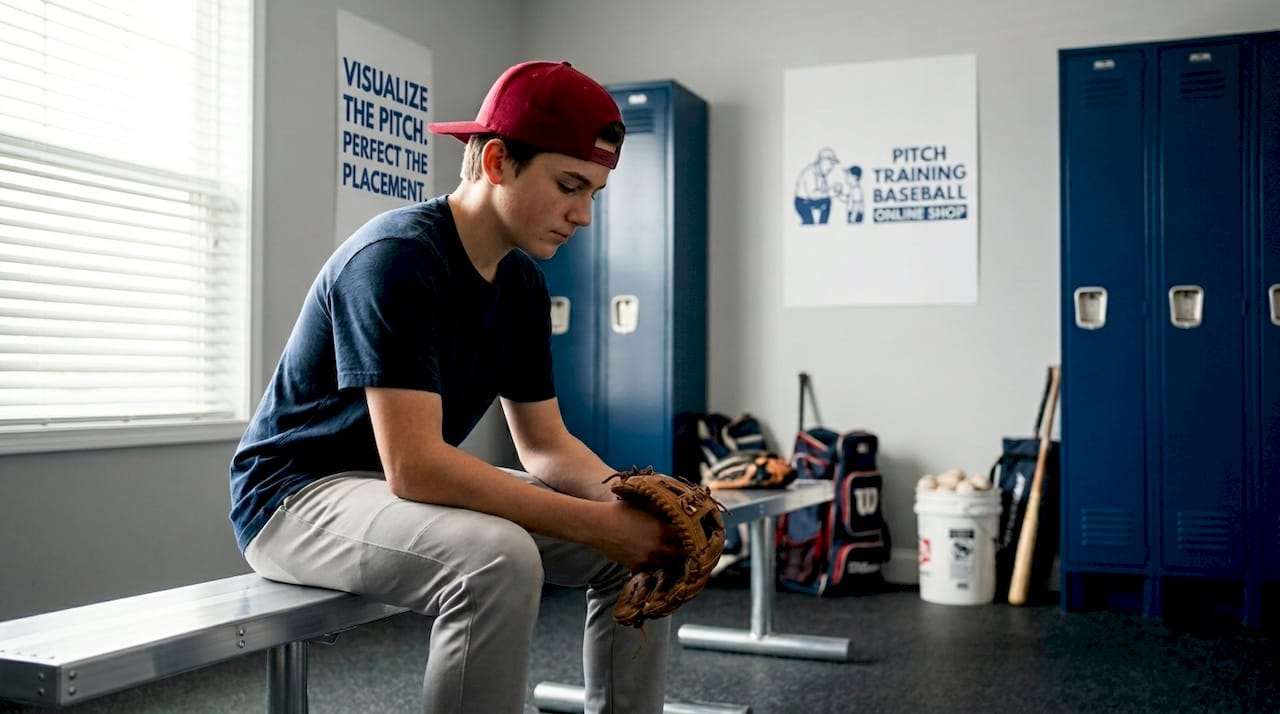
For younger players in the U8 to U10 range, keep the mental picture simple. One clear image, such as the ball hitting the center of the catcher’s mitt, is more useful than a complex multi-step sequence. As players mature, the imagery can grow to include crowd noise, game pressure, and recovery from mistakes.
2. Pre-pitch visualization routines that build consistency
A pre-pitch routine is the foundation of every effective pitching visualization program. Consistent pre-pitch routines anchored by physical gestures improve mental focus and reduce performance anxiety at every youth age level. The routine signals to the brain that it is time to execute, not time to worry.
A well-structured pre-pitch routine for a youth pitcher includes these steps:
- Step onto the rubber with the same foot every time. This physical action serves as the mental trigger to begin the imagery sequence.
- Take one controlled breath. Exhale slowly. This lowers heart rate and narrows attention.
- See the target clearly. Visualize the catcher’s mitt, not just the general strike zone. Pick a specific spot.
- Feel the grip. Run through the grip mentally and physically. Confirm the seam placement.
- Run the pitch in your mind. See the full delivery and the ball landing exactly where you aimed.
- Go. Execute without second-guessing.
For U12 and older players, coaches can add a focus word or phrase to the routine. Words like “smooth,” “low,” or “chest” give the brain a single target and reduce overthinking. This technique is used by mental performance coaches at programs like Athletes Untapped and in collegiate pitching programs across the country.
Pro Tip: Write your focus word on the inside of your glove or wristband. Glancing at it before stepping on the rubber reinforces the cue without breaking your routine.
The age-appropriate adjustment matters. A U8 pitcher needs only two steps: look at the mitt and throw. A U14 pitcher can handle the full six-step sequence. Overloading young players with mental checklists creates anxiety instead of reducing it.
3. How memory reset gestures help pitchers recover after mistakes
A memory reset gesture is a brief, deliberate physical action a pitcher uses immediately after a bad pitch to signal that the moment is over. Reset gestures like tapping a glove act as micro-rituals that break emotional carryover from past pitches and restore present-moment focus. Willpower alone does not accomplish this. The brain needs a behavioral boundary.
Common and effective reset gestures used in youth baseball include:
- Glove tap. The pitcher taps the back of the glove twice, then looks down at the dirt for one second before refocusing on the target.
- Controlled exhale. A slow, deliberate breath out physically releases tension and resets the nervous system.
- Step back off the rubber. Physically leaving the pitching position signals a mental break before re-engaging.
- Dirt kick. A small, deliberate scuff of the dirt with the foot. Simple and invisible to opponents.
The key is that the gesture must be consistent and practiced. A reset gesture used only in games will not work reliably. It needs to be rehearsed during every bullpen session so it becomes automatic under pressure. Coaches running bullpen routines for youth pitchers should build the reset gesture into every session, not just when a pitcher struggles.
Pro Tip: Teach the reset gesture before the season starts. Practice it after every pitch in the bullpen, not just after bad ones. This removes the stigma of using it and makes it a normal part of the routine.
The “next pitch” concept is the mental partner to the physical gesture. After the gesture, the pitcher’s internal dialogue shifts to the next pitch only. No analysis, no frustration. Just the next target. This combination of physical reset and mental redirect is the most reliable tool for maintaining mound presence in youth baseball.
4. What role does video review play in pitching visualization?
Video review transforms visualization from a purely internal exercise into a concrete, observable skill. Youth pitchers aged 12 and older benefit significantly from reviewing footage of their deliveries because it reveals body language, routine consistency, and mental state in ways that live coaching cannot capture. Seeing yourself on video creates a clearer external mental image to draw from during future visualization sessions.
| Video review focus area | What to look for | Mental skill it develops |
|---|---|---|
| Pre-pitch routine | Is the routine the same every pitch? | Routine consistency and focus |
| Body language after mistakes | Do you show frustration visibly? | Reset gesture effectiveness |
| Delivery mechanics | Does the motion match your mental image? | Accuracy of internal imagery |
| Mound presence | Do you look confident between pitches? | Self-image and composure |
| Pitch location patterns | Where do misses cluster? | Target visualization precision |
Coaches should schedule video review sessions separately from physical practice. Watching footage immediately after a game, while emotions are still high, often leads to negative self-criticism rather than productive analysis. A 24-hour gap allows the pitcher to watch with a more analytical mindset. During the review, the coach points out successful sequences first, then identifies one or two patterns to address.
For coaches integrating video into pitching assessments, the goal is not to find every flaw. The goal is to build a clearer, more accurate mental picture of what good execution looks like for that specific pitcher. That image becomes the raw material for visualization sessions.
5. Why managing negative imagery matters, especially for the yips
Positive visualization alone is not enough for every pitcher. A 2023 PLOS ONE study found that pitchers prone to the yips experience significantly heightened vividness of failure imagery, and positive mental pictures do not override those negative ones under competitive pressure. This finding changes how coaches should approach mental training for struggling pitchers.
| Approach | What it involves | When it works best |
|---|---|---|
| Positive visualization only | Imagining successful pitches exclusively | Low-pressure practice, building baseline confidence |
| Guided rescripting | Imagining a failure scenario, then actively rewriting the outcome | Pitchers with recurring negative imagery or yips symptoms |
| Contrast-based imagery | Alternating between failure and success images to regain mental control | Moderate pressure situations, experienced pitchers |
| Approach-oriented coaching | Using language focused on desired execution (“hit the chest”) | All age groups, especially during games |
Guided rescripting and contrast-based imagery are the two most effective techniques for managing vivid negative imagery. Rescripting asks the pitcher to mentally replay a bad pitch, then deliberately rewrite what happens next. The ball finds the mitt. The pitcher stays composed. The inning continues. This rewires the emotional association with that scenario.
Coaching language plays a direct role in this process. Approach-oriented instructions like “hit the catcher’s chest” are more effective than avoidant commands like “don’t miss high.” The brain simulates what it hears. Telling a pitcher what not to do creates a mental image of exactly that mistake. Coaches who understand this shift their language and see faster improvement in pitchers who struggle with confidence.
For parents watching from the stands, the same principle applies. Encouragement focused on process (“good routine,” “nice reset”) reinforces the mental skills being built. Outcome-focused comments (“you need to throw strikes”) increase cognitive load at exactly the wrong moment.
6. Multi-sensory visualization methods that build muscle memory
Multi-sensory imagery is the most powerful form of mental rehearsal available to youth pitchers. Imagining grip feel, the sound of release, and the emotions involved creates vivid practice effects with real competitive benefits. The more senses engaged during visualization, the stronger the neural pathway reinforced.
Here is a step-by-step method for a complete multi-sensory visualization session:
- Find a quiet space. Sit or lie down with no distractions. Close your eyes. Take three slow breaths.
- Set a clear goal for the session. Choose one pitch type or one game scenario. Do not try to visualize everything at once.
- Start with physical sensations. Feel the seams of the ball against your fingertips. Feel your feet on the rubber. Feel the weight shift in your wind-up.
- Add sound. Hear the crowd, the catcher’s signal, the pop of the mitt when the pitch lands perfectly.
- Add emotion. Feel the confidence of a clean delivery. Feel the focus that comes with a good routine.
- Run the full sequence. From the sign to the release to the result. See it succeed.
- Repeat 3 to 5 times. Each repetition deepens the neural pattern.
Youth-focused guidance recommends keeping these sessions to 5 to 10 minutes before practice or games. Longer sessions lose focus and become counterproductive. Consistency matters more than duration. A pitcher who visualizes for 7 minutes every day builds stronger mental habits than one who does a 30-minute session once a week.
A 2026 systematic review in Frontiers in Psychology found that imagery interventions produce inconsistent results when implemented without structure. The review confirms that timing, dosage, and content alignment with actual skill demands determine whether mental rehearsal transfers to performance. This means a pitcher visualizing a curveball they have not yet learned physically will see limited benefit. Visualization works best when it mirrors what the pitcher already does well and is extending.
Key takeaways
Effective baseball pitching visualization techniques combine structured routines, multi-sensory imagery, reset gestures, and video review to build mental toughness and consistent performance in youth pitchers.
| Point | Details |
|---|---|
| Pre-pitch routines anchor focus | A consistent 5-6 step routine before each pitch reduces anxiety and primes execution. |
| Reset gestures beat willpower | Physical micro-rituals like glove taps break emotional carryover more reliably than mental effort alone. |
| Video review sharpens imagery | Watching your own footage at age 12+ builds accurate external mental images for future visualization. |
| Negative imagery needs direct attention | Guided rescripting and contrast-based training address yips-related failure imagery that positive thinking cannot override. |
| Multi-sensory sessions drive results | Daily 5-10 minute sessions engaging sight, sound, and feel produce stronger neural reinforcement than longer, unfocused practice. |
What I’ve learned about visualization and young pitchers
I have watched a lot of youth pitchers try to “think their way” through a rough inning, and it almost never works without a physical anchor. The mental game does not live in the abstract. It lives in the glove tap, the exhale, the step back off the rubber. Those small, repeatable actions are what separate a pitcher who recovers from a walk and one who unravels.
The mistake most coaches make is treating visualization as a pep talk. They tell a kid to “picture success” before a big game and consider the mental work done. That is not a technique. That is a wish. Real mental training for pitchers looks like a game-like practice environment where the reset gesture gets practiced after every pitch, the pre-pitch routine is non-negotiable, and video review happens weekly.
The research on negative imagery also changed how I think about struggling pitchers. A kid who keeps bouncing pitches in the dirt is not lazy or unfocused. He may be vividly imagining the ball hitting the dirt before he even releases it. Telling him to “just visualize success” does not fix that. Guided rescripting does. Approach-oriented language does. Patience and a structured plan do.
My honest recommendation for parents: stop coaching outcomes from the stands. “Throw strikes” is not helpful. “Good routine” is. Your pitcher is building a mental skill that will serve them long after the season ends. Give them the space to practice it.
— Albert
Build the mental and physical game together
Visualization works best when it is paired with physical practice that reinforces the same mechanics. At Pitchtrainingbaseball, the training tools are designed to make that connection concrete. The Pitching Target Net with Strike 9-Zone gives pitchers a specific visual target to lock onto during both physical reps and pre-pitch imagery sessions. When a pitcher can visualize hitting a precise zone and then immediately practice hitting it, the mental rehearsal transfers faster. Explore the full range of youth pitching training tools at Pitchtrainingbaseball and build a practice routine that trains both the arm and the mind.
FAQ
What are baseball pitching visualization techniques?
Baseball pitching visualization techniques are structured mental rehearsal methods where pitchers mentally simulate their grip, delivery, and pitch trajectory before and during games. They build confidence, improve focus, and reinforce the same neural pathways used in physical pitching.
How long should a youth pitcher visualize each day?
Youth-focused mental training guidance recommends 5 to 10 minutes of visualization before practice or games. Short, consistent daily sessions produce better results than infrequent longer ones.
Can visualization help a pitcher who has the yips?
Positive visualization alone is not sufficient for yips-affected pitchers. A 2023 PLOS ONE study found that guided rescripting and contrast-based imagery training are more effective because they directly address the vivid failure imagery driving the condition.
At what age should youth pitchers start using visualization?
Simple visualization, such as picturing the ball hitting the catcher’s mitt, is appropriate from U8 onward. More structured multi-sensory routines and video-assisted review are recommended starting at age 12, when players have the cognitive capacity to sustain focused mental rehearsal.
What is a memory reset gesture and why does it work?
A memory reset gesture is a brief physical action, like a glove tap or controlled exhale, used immediately after a bad pitch to signal that the moment is over. These micro-rituals break emotional carryover more effectively than willpower because they create a clear behavioral boundary between pitches.
Recommended
- How to assess youth pitching performance step by step – Pitch Training Baseball
- Game-like pitching practice: Raise youth baseball skills fast – Pitch Training Baseball
- Top pitching workouts for youth baseball: build skill safely – Pitch Training Baseball
- How to throw a baseball: proven youth coaching tips – Pitch Training Baseball