


A baseball slider is a breaking pitch that combines fastball arm speed with a late, glove-side break — designed to generate weak contact or swing-and-miss. At the pro level, traditional sliders sit 80–90 mph with roughly 6 inches of horizontal break, while the sweeper variant averages about 15 inches of horizontal break and is generally thrown a little slower, typically in the 80–86 mph range. Both versions rely on the same mechanical principle: a tight, gyro-like spin that produces lateral movement instead of the topspin drop you get from a curveball.

One number every coach and parent should know: a peer-reviewed youth cohort study found slider use was associated with an 86% increased risk of elbow pain in pitchers ages 9–14. That finding alone shapes everything below — from grip instruction to drill progressions to when a young arm is actually ready for this pitch.
Table of Contents
- How do you grip and throw a baseball slider?
- What makes a slider move? Spin, axis, and Statcast metrics
- How do slider variants differ, and which one fits your arm?
- When should you throw a slider in a game?
- Common mistakes that cause hangers, and the injury risks for young pitchers
- What drills build a reliable slider without overloading the arm?
- Which MLB pitchers should you study to understand the slider?
- Key Takeaways
- The slider deserves more patience than most coaches give it
- Build your slider practice with the right tools
- Useful sources
How do you grip and throw a baseball slider?
The slider grip starts with a subtle shift off-center. Place your index and middle fingers across the horseshoe seam — but slide them slightly toward the outer third of the ball rather than centering them as you would on a four-seam fastball. Your middle finger carries most of the pressure; the index finger rides along as a guide. Thumb sits underneath, roughly opposite the middle finger, providing a stable base without squeezing.
Here is the full sequence from set position to finish:
- Set your grip in the glove. Fingers slightly off-center on the horseshoe seam, middle finger applying firm pressure on the seam itself.
- Match your fastball arm path. The arm action should look identical to your fastball from the batter’s perspective. Any early tipping — a slower arm, a dropped elbow — kills deception before the ball leaves your hand.
- Keep the wrist firm, not rigid. You are not snapping the wrist violently. Think of the wrist as a stable platform, not a whip.
- At release, drive through with the middle finger. The ball rolls off the outside of your middle finger, creating the tight bullet spin. A useful coaching cue: think “karate chop” — the hand finishes on the outside of the ball, not underneath it.
- Pronate slightly through the finish. A small, natural pronation after release reinforces the spin axis without stressing the elbow. The arm continues down and across the body as it would on a fastball.
For left-handers, the mechanics mirror exactly — the break runs toward a right-handed batter’s back foot, which is why lefty sliders can be especially disruptive against right-handed hitters.
Common grip variants worth knowing:
- Two-seam oriented: fingers run along the seams rather than across; produces a slightly different spin axis and can add more depth to the break
- Off-center with tucked index finger: some pitchers tuck the index finger to reduce its influence and let the middle finger dominate entirely
- Thumb position adjustment: moving the thumb slightly toward the first-base side (for righties) can sharpen the lateral break
Pro Tip: Film your release from behind the mound at 60% effort. If your hand finishes under the ball rather than outside it, you are throwing a hanging curveball, not a slider. Fix the finish before adding velocity.
Grip mastery is the foundation — and proper pitching grip technique is worth studying in detail before moving to full-effort reps.
What makes a slider move? Spin, axis, and Statcast metrics
The slider’s movement comes from its spin axis, not from speed alone. A fastball spins with backspin on a roughly 12-to-6 axis; a curveball spins with topspin that pulls the ball downward. A slider sits in between — the spin axis tilts toward the 10-to-4 range (for a right-hander), producing a gyroscopic or “bullet” spin that generates lateral force as the ball travels through the air.
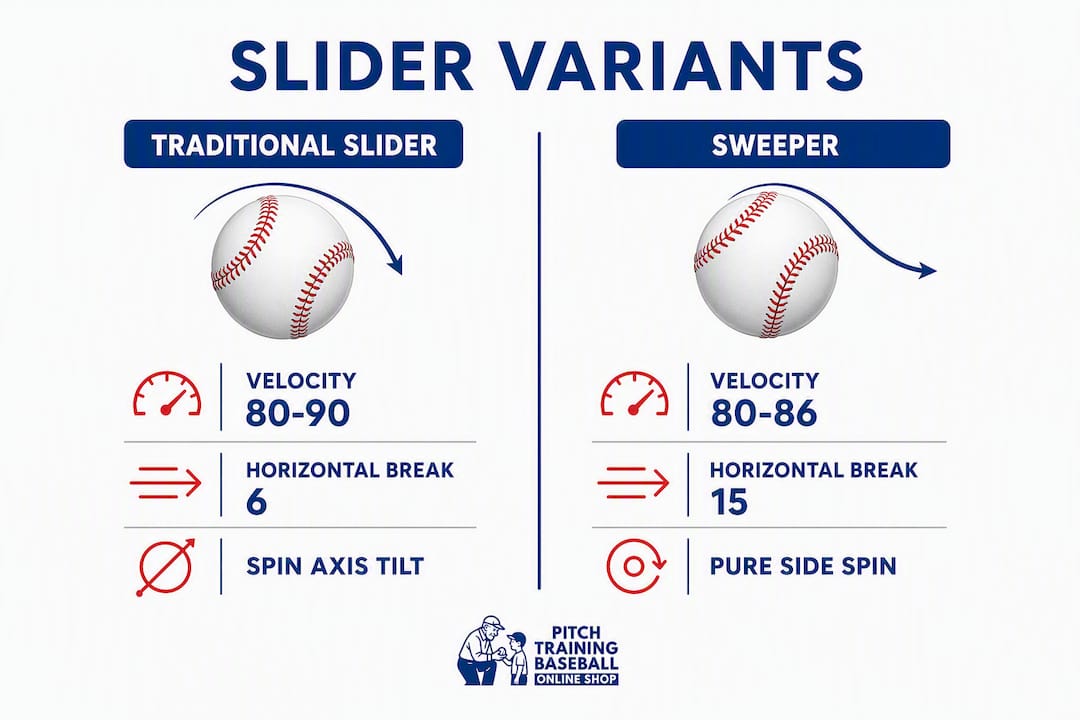
That gyro spin is the key distinction. Unlike a curveball’s topspin, which creates Magnus force pulling the ball down, the slider’s tilted axis creates force pushing the ball toward the glove side. The break arrives late — typically in the last 10–15 feet of flight — which is what makes it so difficult to read out of the hand.
| Metric | Traditional Slider | Sweeper |
|---|---|---|
| Velocity | 80–90 mph | 80–86 mph |
| Horizontal break | ~6 inches | ~15 inches |
| Spin axis | ~10-to-4 (tilted gyro) | More tilted toward 9-to-3 |
| Primary outcome | Swing-and-miss, weak contact | Weak contact, pop-ups |
Statcast and Hawk-Eye track these numbers in real time, and movement charts on Baseball Savant plot horizontal vs. vertical break for every pitch. When you pull up a pitcher’s slider on those charts, you are looking at the result of spin axis and spin efficiency working together. A slider with high spin rate but poor axis alignment will not break as advertised — the axis matters more than raw spin rate for this pitch.
How do slider variants differ, and which one fits your arm?
The Statcast-era tracking system now officially separates sliders into distinct pitch types, with the sweeper earning its own classification after 2020. That distinction matters practically, not just statistically.
Traditional slider: The pitch most coaches teach first. Moderate horizontal break (~6 inches), higher velocity (80–90 mph), and a spin axis that produces both lateral and some downward movement. Effective against same-handed hitters and useful as a two-strike chase pitch.
Sweeper: More horizontal break (~15 inches), slightly lower velocity (80–86 mph), and a spin axis closer to pure side-spin. The sweeper accelerated in MLB usage after Hawk-Eye improvements made the movement measurable and replicable. Rather than generating pure swing-and-miss, sweepers tend to produce weak contact and pop-ups — a different but equally valuable outcome.
Slurve: A hybrid between a slider and a curveball. More depth than a traditional slider, less than a full curve. Pitchers with naturally high arm slots often throw this shape without realizing it. The slurve can be harder to command consistently, but it offers a different look to hitters who have seen a lot of traditional sliders.
Trade-offs at a glance:
- Traditional slider: higher velocity, easier to command, better swing-and-miss rate against same-handed hitters
- Sweeper: more horizontal movement, better platoon neutralization, more weak contact than strikeouts
- Slurve: more depth, harder to command, useful against opposite-handed hitters when located down and away
The practical guidance from coaches who work with this data: fit the variant to your arm slot, not the other way around. A pitcher with a low three-quarter slot will generate natural horizontal break; pushing that toward a sweeper is a small mechanical adjustment. A pitcher with a high arm slot trying to force 15 inches of horizontal break is fighting their own mechanics and risking their primary pitches in the process.
When should you throw a slider in a game?
The slider works best as a pitch the batter cannot sit on. That means sequencing it off your fastball — not throwing it in isolation.
Against a same-handed hitter (righty vs. righty, lefty vs. lefty), the slider breaks away from the batter’s barrel. A fastball up-and-in followed by a slider down-and-away is one of the most reliable two-pitch sequences in baseball. The hitter’s eyes track the fastball’s plane, and the slider exits the zone before the swing catches up.
Against opposite-handed hitters, the slider breaks into the batter’s wheelhouse. Use it sparingly and only when you have established the fastball on the outer third. A slider that catches too much of the plate against an opposite-handed hitter is a mistake pitch.
Count-by-count guidance:
- 0-0 and 1-0: Use the slider to get ahead against same-handed hitters; avoid it as a first-pitch offering against opposite-handed hitters
- 0-2 and 1-2: The slider is a premier chase pitch — throw it off the plate, glove side, and let the hitter expand the zone
- 2-0 and 3-1: Stay with your fastball; a hanging slider in a hitter’s count is one of the most punished pitches in baseball
- Full count: Only throw the slider if you have thrown it for strikes earlier in the at-bat; never introduce it as a surprise on 3-2
Pro Tip: Hide your slider by keeping your glove closed until the last possible moment and maintaining identical arm speed to your fastball. If your arm slows down even slightly, a disciplined hitter will lay off.
Common mistakes that cause hangers, and the injury risks for young pitchers
A hanging slider — one that drifts into the middle of the zone with no break — almost always traces back to one of four mechanical errors.
The four most common faults:
- Opening the hips too early: When the front hip flies open before the arm catches up, the release point shifts and the spin axis flattens. The ball comes out with backspin instead of the tilted gyro spin, and it floats.
- Dropping the arm slot: A lower-than-normal arm slot changes the spin axis direction. The break goes down instead of laterally, producing a pitch that looks like a slow curveball.
- Violent wrist snap: Trying to “create” break by snapping the wrist actually reduces spin efficiency and increases elbow stress. The break comes from finger pressure and spin axis, not wrist action.
- Reduced arm speed: Slowing the arm to “guide” the slider is the most common beginner mistake. It telegraphs the pitch and reduces the Magnus effect that produces late movement.
On the injury side, the evidence for youth pitchers is direct. The peer-reviewed study on youth elbow and shoulder pain found an 86% increased risk of elbow pain associated with slider use in the 9–14 age group. Boston Children’s Hospital’s sports injury guidance recommends deferring sliders until at least age 16, with curveballs introduced no earlier than 14.
Pitch Smart reinforces that the primary risk factors are improper mechanics and cumulative overuse — not the pitch type in isolation. That means a 16-year-old with sound mechanics and monitored pitch counts faces meaningfully less risk than a 13-year-old throwing sliders with a violent wrist snap and no pitch-count tracking.
Safety rules that apply regardless of age:
- Never throw sliders when fatigued; arm fatigue is the single biggest predictor of poor mechanics
- Track pitch counts every outing and follow recommended rest guidelines between appearances
- Prioritize fastball and change-up command before introducing any breaking pitch
- Stop immediately if a pitcher reports elbow pain on the medial (inner) side
What drills build a reliable slider without overloading the arm?
The safest path to a durable slider is a progression that builds the movement pattern before adding effort. Skipping steps is where young arms get hurt.

Stage-by-stage progression:
| Stage | Focus | Recommended Age/Level | Volume |
|---|---|---|---|
| 1. Fastball command | Four-seam location, arm speed | Any age | Full pitch-count budget |
| 2. Change-up | Arm speed deception, grip variation | 12+ with coach approval | 15–20% of pitches |
| 3. Soft-toss slider shape | Grip and spin axis at 50–60% effort | 14–16 with mature mechanics | 10–15 reps, 2x/week |
| 4. Bullpen slider reps | Full mechanics, location targets | 16+ | 10–15% of bullpen pitches |
| 5. Game slider | Sequencing, count-specific use | 16+ with consistent bullpen results | As needed, pitch-count tracked |
Three drills to run in 10–15 minutes:
Wrist-pressure drill (no throw): Hold the ball in slider grip and practice rolling it off the middle finger into your glove. Feel the ball exit from the outside of the finger, not the bottom. Do 20 reps before any throwing session.
Seam-orientation toss (30 feet, 50% effort): Throw the slider to a partner at 30 feet, focusing only on the spin. Watch for a tight bullet spin with a red dot visible on the ball’s side. If the ball tumbles or shows backspin, the grip or release is off.
Target-net location work: Set up a 9-zone strike zone target net and aim every slider at the bottom-away quadrant. This trains the location habit before game pressure enters the equation. Ten reps per session is enough — quality over volume.
Practice volume should stay within your overall pitch-count monitoring plan. Slider reps count the same as fastball reps toward cumulative load.
Pro Tip: Use a training ball for grip and spin drills indoors. Soft training balls let younger pitchers develop the feel of the release without the arm stress of a full-effort throw on a regulation baseball.
Which MLB pitchers should you study to understand the slider?
Watching pro sliders with a specific mechanical question in mind is far more useful than watching for general inspiration.
Randy Johnson threw one of the most feared sliders in baseball history — a pitch that started at a right-handed batter’s hip and finished off the outside corner. The trait to study: how his extreme over-the-top arm slot created a nearly vertical spin axis that produced both depth and late lateral bite. His release point was remarkably consistent across thousands of pitches.
Mariano Rivera is the canonical cutter example, but his pitch blurred the line between a cut fastball and a slider — worth studying specifically to understand how a pitch with less than 4 inches of break can still be dominant when located precisely and thrown with fastball velocity. The lesson: movement volume is not the only variable.
For the modern sweeper, study pitchers whose Statcast pages show horizontal break above 12 inches. Pull up their movement charts on Baseball Savant and compare the spin axis to a traditional slider from the same season. The axis difference is visible in the data even if it is subtle to the naked eye.
This is the core caution from coaches who have watched pitchers disrupt their entire repertoire chasing a sweeper shape that does not match their natural arm slot. Study the principle, not the surface.
For young fans who want to connect their love of the game to the players they study, baseball card collecting is a natural extension — many sets feature pitching legends whose mechanics are worth studying frame by frame.
Key Takeaways
A slider’s effectiveness comes from spin axis and arm speed deception, not from wrist snap or raw velocity — and youth pitchers should not attempt it before age 16 with sound fastball mechanics already in place.
| Point | Details |
|---|---|
| Grip and spin axis | Place fingers off-center, apply middle-finger pressure, and finish outside the ball — the gyro spin creates lateral break. |
| Velocity and movement | Traditional sliders run 80–90 mph with ~6" of horizontal break; sweepers average ~15" of horizontal break and are generally thrown at 80–86 mph. |
| Youth safety threshold | An increased elbow-pain risk in young pitchers means sliders belong after fastball and change-up command are established, at 16+. |
| Sequencing rule | The slider works off the fastball — same-handed hitters, two-strike counts, and chase situations are its best contexts. |
| Pitchtrainingbaseball drills | Target nets, training balls, and monitored pitch counts are the core tools for building a safe, repeatable slider in practice. |
The slider deserves more patience than most coaches give it
The conventional wisdom says: teach the slider early so a pitcher has more time to develop it. That logic sounds reasonable until you look at the injury data. An 86% increased elbow-pain risk in the 9–14 age group is not a small signal to weigh against competitive development timelines. It is a clear argument for patience.
What I find coaches underestimate is how much the fastball and change-up already do. A pitcher who can locate a four-seam fastball to both sides of the plate and throw a change-up that looks identical out of the hand is already difficult to hit. Adding a slider to that arsenal at 16 or 17 — when the arm is physically ready — produces a more durable pitcher, not a slower developer.
The other thing worth saying plainly: the sweeper trend in MLB has created real confusion at the youth level. Parents and coaches see a 22-year-old throwing 15 inches of horizontal break and want their 14-year-old to replicate it. The mechanics that produce a sweeper at the pro level are built on years of fastball command and physical maturity. Chasing that shape prematurely does not accelerate development — it disrupts the primary pitches a young arm already has.
Teach the grip. Build the spin. Monitor the load. The slider will come.
Build your slider practice with the right tools
Developing a reliable slider takes structured repetition — and the right equipment makes every rep count. Pitchtrainingbaseball offers the training tools that map directly to the drills in this article.
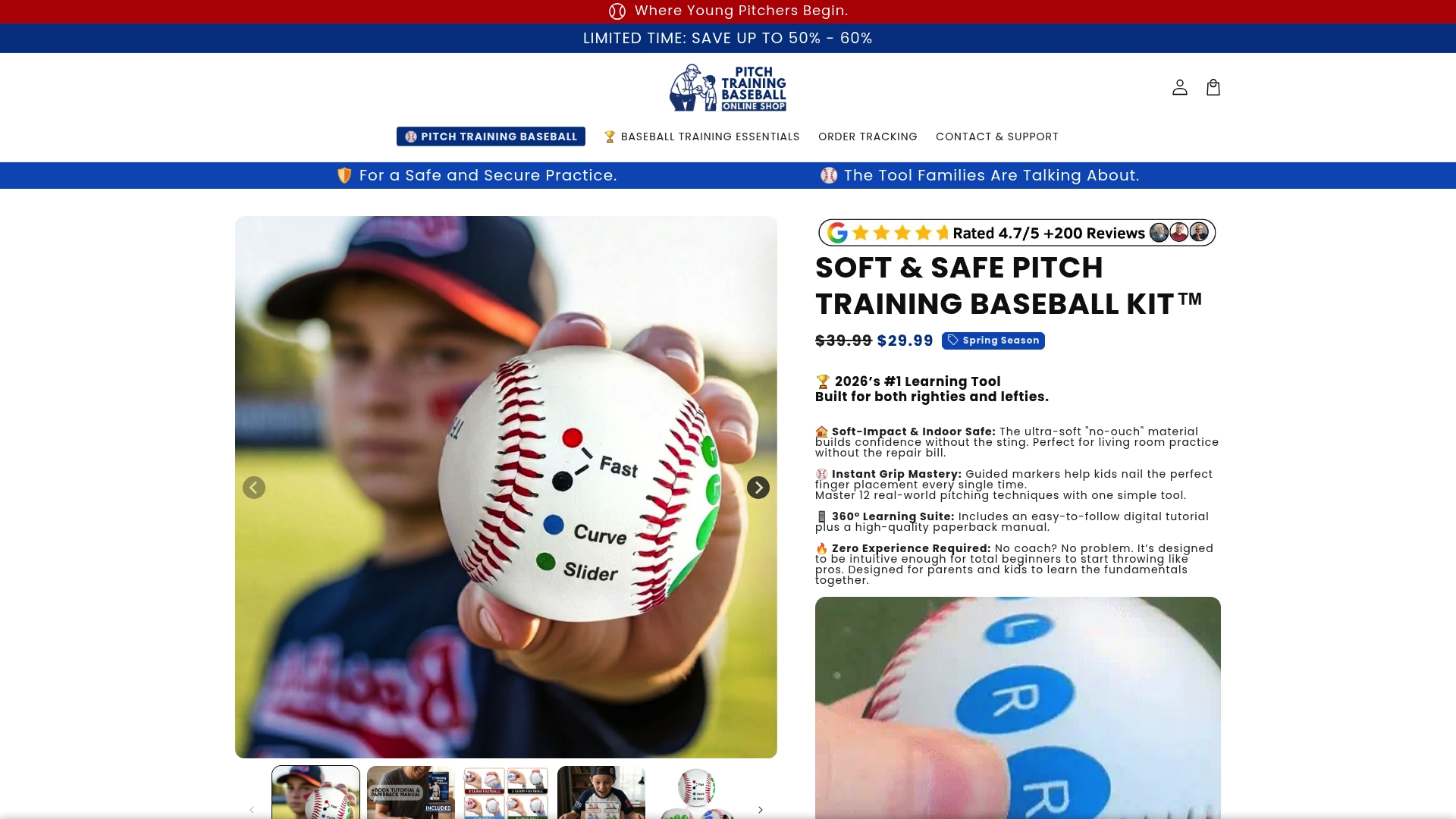
The 9-zone pitching target net is the centerpiece for location work: aim every slider rep at the bottom-away zone and get immediate visual feedback on whether the pitch finished where you intended. Pair it with training baseballs for grip and spin drills at reduced effort, or training softballs for younger pitchers building the feel of the release indoors. The 5-pack of pickeballs gives coaches a safe option for high-repetition seam-orientation work without the arm stress of a regulation ball.
Every product is designed for safe, measurable repetition — the kind that builds a durable slider without overloading a young arm. Browse the full lineup at Pitchtrainingbaseball and build a practice setup that matches your pitcher’s current stage in the progression.
Useful sources
Authoritative references for further study on slider mechanics, youth safety, and Statcast metrics:
- Slider (pitch) — Wikipedia): A solid overview of the pitch’s history, grip variations, and how it compares to other breaking balls — useful as a starting reference.
- Sweeper (ST) | Glossary | MLB.com: The official MLB definition of the sweeper, including the movement thresholds that separate it from a traditional slider in Statcast data.
- Explaining the sweeper | MLB.com: Covers the post-2020 trend toward more horizontal movement and what the data shows about sweeper outcomes vs. traditional sliders.
- Pitch Smart risk factors | MLB: The primary resource for pitch-count limits, rest requirements, and age-appropriate pitch development — required reading for any youth coach.
- Effect of Pitch Type, Pitch Count, and Pitching Mechanics on Risk of Elbow and Shoulder Pain (peer-reviewed): The original youth cohort study behind the 86% elbow-pain finding; read the methodology section to understand the study’s scope and limitations.
- MLB summary of the youth injury study: A coach-accessible summary of the peer-reviewed findings with applied recommendations.
- Sports Injury Prevention: Baseball | Boston Children’s Hospital: Clinical guidance on mechanics, age thresholds, and warning signs — written for parents and coaches, not just physicians.
- Is it Safe to Throw a Breaking Ball? — PMC: A sports medicine editorial that reviews the existing literature on breaking-ball safety and addresses the ongoing debate about curveballs and sliders in youth pitchers.
- Nickel and dime pitches | SABR: A deeper analytical look at pitch mechanics and grip principles from the Society for American Baseball Research.
- How to Introduce Breaking Balls Safely to Young Pitchers | Pitchtrainingbaseball: Practical, age-appropriate guidance on when and how to add breaking pitches to a youth pitcher’s development plan.