


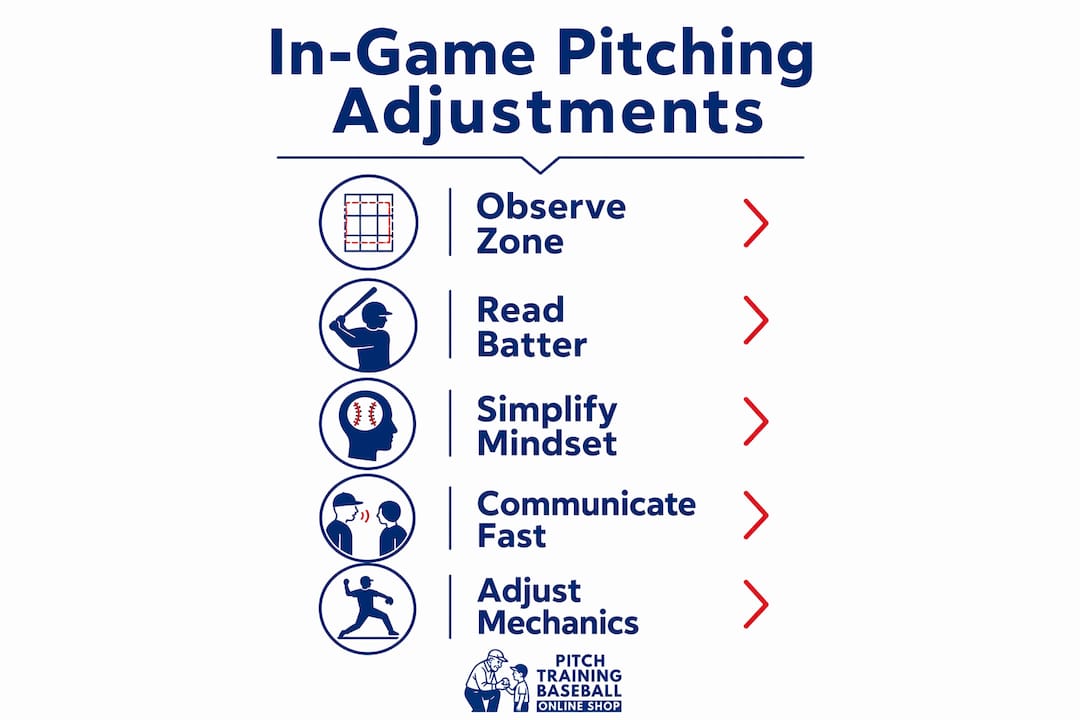
The in-game pitching adjustment process is the real-time practice of reading what a game is telling you and changing your approach before the hitter figures you out first. It covers everything from shifting pitch location based on the umpire’s zone, to breaking a predictable sequence, to resetting your mechanics after command falls apart. The best pitchers treat each at-bat as new information.
Key elements of the process include:
- Reading and adapting to the umpire’s strike zone as it evolves
- Tracking batter tendencies through swings, foul balls, and eye levels
- Adjusting pitch selection and sequencing to stay unpredictable
- Managing fatigue and its effect on mechanics and decision-making
- Communicating clearly with your catcher and coaching staff
- Using a simplified mental framework to avoid overthinking under pressure
Table of Contents
- How the in-game pitching adjustment process starts with the umpire’s zone
- How to read batter tendencies and counter them throughout the game
- Why mental simplicity is your best tool in high-pressure moments
- How communication and trust speed up your in-game adjustments
- Physical mechanics adjustments during the game
- Pitchtrainingbaseball gives you the reps that make adjustments automatic
- Key Takeaways
How the in-game pitching adjustment process starts with the umpire’s zone
The strike zone varies from game to game, and no pre-game chart fully captures what a specific umpire will call on a given day. The first two innings are your data-collection window. Watch which borderline pitches get called strikes and which ones draw ball calls, then adjust your attack accordingly.
When a zone is expanded, attack the edges early in counts. When it runs tight, work the heart of the plate with movement rather than trying to paint corners that won’t get called.
Practical adjustments based on umpire tendencies:
- Move your fastball up or down in the zone based on what the umpire is rewarding
- Use the catcher’s framing to test borderline locations in the first inning
- If the umpire is squeezing you inside, work away and use the outer half as your primary target
- Avoid arguing calls mentally. Accept the zone you have and pitch to it
Pro Tip: Keep a mental note after every borderline pitch. By the third inning, you will have a reliable read on the zone without ever asking your catcher.
How to read batter tendencies and counter them throughout the game
Expert coaches consistently emphasize reading batter swings over pre-game scouting when deciding real-time adjustments. A hitter’s live reactions tell you more than a spray chart. Watch for late swings on fastballs, early swings on off-speed pitches, and foul balls that reveal where a hitter is sitting.

Research on pitch mix changes shows that pitchers who significantly alter their pitch distribution between the first and third times facing a hitter maintain effectiveness longer. The pitchers who barely change their mix get hit harder as the game progresses.
Traditional power statistics like home runs also shape pitch location decisions. A study analyzing MLB pitch-level data from 2002 to 2024 found that home run totals influenced out-of-zone pitching behavior more than advanced metrics like WAR or wRC+. Under pressure, pitchers rely on vivid, memorable cues.
Key adjustments based on batter behavior:
- If a hitter is fouling off your fastball consistently, he is on it. Go off-speed next time through.
- If a hitter is taking your breaking ball for a ball, start throwing it for strikes earlier in counts
- Vary eye levels. A hitter locked in on a low pitch is vulnerable up in the zone
- Use pitch selection principles to build sequences that disrupt timing rather than repeat patterns
The matching law applied to baseball shows that pitchers naturally allocate pitches in proportion to past success. That habit creates predictability. Breaking the pattern consciously, even when a pitch has been working, keeps hitters from locking in.
Pro Tip: After each at-bat, ask yourself one question: what did that hitter show me? One observation per at-bat compounds into a clear picture by the fifth inning.
Why mental simplicity is your best tool in high-pressure moments
Adrenaline limits how much your brain can process during a high-leverage situation. Coaches who work with pitchers at the competitive level consistently point to mental simplification as the difference between a pitcher who resets quickly and one who spirals.
Limit yourself to one or two reliable cues when command breaks down. Trying to fix three things at once mid-inning almost always makes it worse. A single mechanical feel, like staying tall through release or trusting your grip, gives your body something concrete to execute.
Practical mental habits for high-pressure situations:
- Use a reset phrase between pitches to clear the previous outcome
- Avoid negative framing. Your brain processes “don’t throw a ball” as “throw a ball”
- Return to your most trusted pitch when confidence drops, not your most complex one
- Journal mental cues during practice so they are automatic when games get tight
For more on building this mental foundation before game day, the mental preparation guide from Pitchtrainingbaseball covers pre-game routines that carry directly into live-game execution.
How communication and trust speed up your in-game adjustments
Shared signals and established rapport between pitcher and catcher reduce errors and increase how fast adjustments actually happen. When a pitcher and catcher have rehearsed their signs and talked through tendencies before the game, they spend less time second-guessing each other between pitches.
Trust is built in the bullpen, not on the mound during a jam. Pitchers who regularly communicate with their catchers about what pitches feel sharp that day give their battery partner the information needed to call the right sequence at the right moment.
Communication habits that improve in-game adjustments:
- Agree on a primary sign system and a backup before the first pitch
- After each inning, share one observation about the hitters with your catcher
- When a coach visits the mound, listen first and speak second. The outside view often catches what you cannot see from the rubber
- Never shake off a sign without a reason. If you disagree, establish a counter-sign system in advance
Physical mechanics adjustments during the game
Command problems during a game rarely require a full mechanical overhaul. They usually trace back to one thing: rushing, dropping the arm slot, or losing hip-to-shoulder separation. Identify the single most likely cause and address it with one physical cue, not a checklist.

When command falters, the most effective reset is often switching pitch types rather than forcing the same pitch harder. Breaking balls and changeups are grip-based, which gives your arm a different feel and often restores rhythm without any mechanical change at all.
Experienced pitchers also protect their best pitches by using get-me-over variants early in counts. Saving your highest-movement, highest-velocity version of a pitch for two-strike situations keeps hitters from timing it across multiple at-bats.
Common in-game mechanics adjustments by pitch type:
- Fastball missing arm side: focus on staying closed longer through the hip turn
- Fastball missing glove side: drive toward the target rather than pulling off early
- Breaking ball spinning flat: check grip pressure and slow the wrist at release
- Changeup losing depth: trust the grip and avoid squeezing. Firm wrist kills the movement
Fatigue compounds every mechanical flaw. As pitch count climbs, the body compensates by shortening the arm path or over-rotating the trunk. Recognizing these patterns early, usually around the 70-pitch range for younger pitchers, lets you make a small adjustment before the flaw becomes a pattern. Game-situation pitching guides can help coaches and players identify which adjustments fit which game contexts.
Pitchtrainingbaseball gives you the reps that make adjustments automatic
Knowing what adjustment to make is only half the equation. The other half is having enough repetitions under your belt that the adjustment happens without hesitation.

Pitchtrainingbaseball builds that repetition base with training tools designed specifically for youth pitchers: a 9-zone pitching target net that trains location awareness across the full strike zone, and a hard pitch training baseball kit that reinforces grip and release consistency across pitch types. Both tools support the game-like practice that transfers directly to live-game decision-making. When your mechanics and pitch selection are trained under realistic conditions, the in-game adjustment process stops being a mental exercise and starts being a reflex. Browse the full training lineup at Pitchtrainingbaseball and build the reps that hold up when the game is on the line.
Key Takeaways
The most effective in-game pitching adjustment process combines real-time observation, a simplified mental framework, and physical cues rehearsed enough in practice to execute under pressure.
| Point | Details |
|---|---|
| Read the umpire early | Use the first two innings to map the zone and adjust pitch location before counts get critical. |
| Break pitch patterns deliberately | Pitchers who significantly change their mix between encounters with the same hitter stay effective longer. |
| Limit adjustments to one or two cues | Adrenaline narrows cognitive capacity; one physical or mental cue outperforms a multi-point checklist under pressure. |
| Build trust before the game | Pitcher-catcher rapport established in the bullpen speeds every in-game decision at the mound. |
| Pitchtrainingbaseball trains the reps | The 9-zone target net and training baseball kit build the location and grip consistency that make live adjustments automatic. |
Recommended
- Step by Step Pitch Selection: Youth Baseball Guide – Pitch Training Baseball
- The Real Role of Adjustable Pitching Trainers – Pitch Training Baseball
- Game-like pitching practice: Raise youth baseball skills fast – Pitch Training Baseball
- What Is Pitch Selection? A Youth Baseball Guide – Pitch Training Baseball