


The best rainy day baseball drills combine tee work, one live hitting feed, one fielding or pitching block, and a short athletic finish, all inside 30 minutes. Run tee work in three positions, soft toss or front toss for timing, wall ball for hands, and the towel drill for arm mechanics. Check ceiling clearance and use limited-flight balls before anyone swings a bat indoors.
TL;DR:
- Indoor training should rely on limited-flight balls, soft toss, and tee work in three positions to maximize space and safety.
- A 30-minute routine includes warm-up, hitting, fielding or pitching, and an athletic finish, focusing on quality over quantity.
- Short drills with specific focus, like wall ball, towel drills, and target work, effectively develop skills without needing a full field or mound.
- Keeping drills varied and allowing players some ownership maintains engagement during repeated indoor sessions.
- Safety precautions, such as ceiling clearance checks and limiting cues, are essential to prevent injuries and reinforce proper mechanics indoors.
Table of Contents
- Equipment and Space Setup for Indoor Baseball Training
- Warm-Up and Arm Care Before Indoor Reps
- Hitting Drills for Indoor Batting Practice
- Fielding and Catcher Drills That Fit a Hallway
- Pitching and Arm-Care Drills Without a Mound
- Agility and Athletic Drills for Small Spaces
- The 30-Minute Rainy Day Practice Plan
- Why Albert Trusts a Focused Indoor Routine
- How to Track Progress During Indoor Sessions
- When Space Is Extremely Limited
- Keeping Kids Engaged Through Repeated Indoor Sessions
- A Coach’s Honest Take on Indoor Practice Priorities
- Set Up a Safe Indoor Station With the Right Gear
- Sources
Equipment and Space Setup for Indoor Baseball Training
Before any indoor baseball training session starts, the space itself needs a once-over. A garage, basement, or spare room can work fine, but it has to earn that role first.
You do not need a batting cage to get real work done. A tee, a 7x7 net, and limited-flight balls form a starter kit that covers most hitting and pitching drills for well under $300, and it fits a two-car garage with room to spare.
Minimum kit checklist:
- A batting tee (adjustable height for players from age 6 to 14)
- A 7x7 hitting net or rebounder net
- Limited-flight, foam, or wiffle balls (never a real baseball indoors near drywall or windows)
- A portable L-screen or a hung moving blanket for extra protection behind the pitcher
- Field tape or cones for marking footwork lanes and throwing lines
Measure your ceiling before you commit to a hitting station. Youth players taking a full swing need adequate clearance of around 7 to 8 feet from the tee to the ceiling, more if a coach is standing to demonstrate. Clear breakables from a 10-foot radius around any hitting or throwing zone, and mark a single throwing lane with tape so kids know exactly where to stand and where not to wander.
Only one batter swings at a time. That rule sounds obvious until three siblings are all trying to hit off the same tee in a basement, and someone takes a bat to the shoulder. Foam and wiffle balls belong indoors near finished walls; limited-flight balls (the dimpled kind that die quickly) work better in a garage or unfinished space where a stray line drive off a light fixture is a lesser concern. Gloves stay on for every fielding rep, and helmets go on for anything involving live pitching, even soft toss.
Pro Tip: Sweep the floor before you start. A stray ball rolling under someone’s cleat during a fielding drill causes more indoor injuries than anything hit off the bat.
Warm-Up and Arm Care Before Indoor Reps
Skipping the warm-up to save time is the single most common mistake in a short indoor session, and it is the one that costs you the most in the long run.
Give players five minutes of dynamic movement before a single ball gets thrown. This isn’t optional padding. It’s the difference between a session that builds arm health and one that quietly erodes it.
- Band external and internal shoulder rotations, 10 reps each direction
- Band pull-aparts, 15 reps, focusing on squeezing the shoulder blades
- Hip openers and leg swings, 10 per side, to loosen the lower half
- Bodyweight squats, 10 reps, to get the legs firing before any swinging or throwing
After the dynamic warm-up, progress the arm gradually rather than jumping straight into hard throws. If space is tight, use a towel-based progression: dry arm circles first, then 10 to 15 short towel snaps to groove the arm path, then light tosses into a net from short distance. Only after that sequence should a ball go anywhere near a bat or a target.
Age matters here. A 7-year-old needs less volume and shorter throwing distance than a 13-year-old, and both need to stop the moment you see a dropped elbow, a grimace, or a complaint of shoulder tightness. Soreness that shows up mid-session is your cue to switch that player to a non-throwing drill for the rest of practice, not push through it.
Hitting Drills for Indoor Batting Practice
Hitting is where most rainy day baseball drills earn their keep, mainly because tee work and soft toss translate almost directly to live at-bats once the weather clears.
Tee work in three locations. Set the tee in front of the plate, then move it to the inside third, then the outside third. Run 8 to 15 swings per location and give the hitter exactly one coaching cue per round, load, contact point, or finish, never all three at once. Structuring cage time by age group and opening every session with tee work accelerates mechanical fixes far faster than jumping straight to live pitching.
Soft toss and front toss. A coach kneels to the side (never in front) and feeds balls at a slight upward angle into the hitting zone. Vary the cadence: paced feeds for younger hitters working on timing, rapid-fire feeds for older players working on hand speed and recognition. An L-screen or hanging net in front of the feeder is not optional when live pitching is involved, even at half speed.
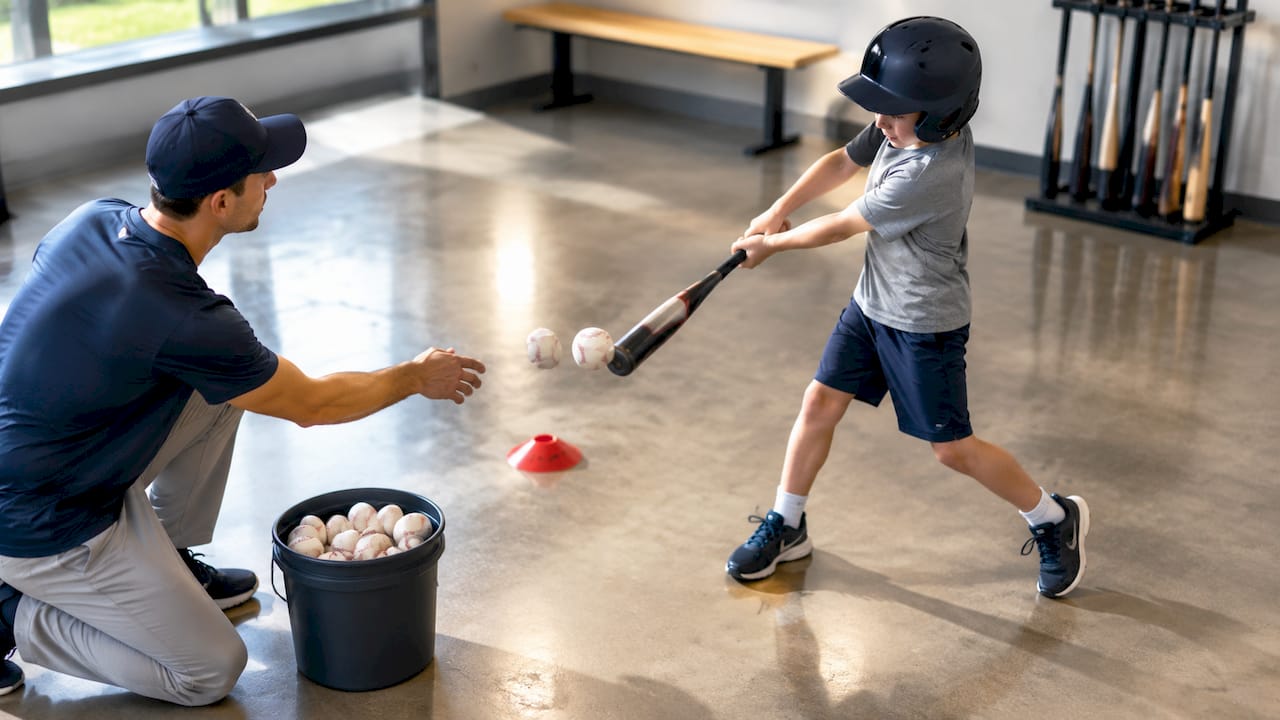
Dry swings and mirror work. For a single player with limited space, mirror swings and phone-recorded dry cuts do real work. Film three checkpoints: hip rotation at contact, hand position through the zone, and balance at finish. Play it back in slow motion and let the player see what a coach would otherwise have to describe in words. Video review consistently speeds up hitting development because kids correct faster when they can see the flaw themselves.
PVC drill and one-hand swings. A short PVC pipe or a cut-down bat teaches bat path without the risk of a mis-hit ball. One-hand swings (top hand or bottom hand isolated) build bat speed and separation. Save overload or underload bats for players 10 and older, and only after mechanics are consistent, since a heavier bat exaggerates any existing flaw.
Pro Tip: One coaching cue per swing round beats three. A hitter juggling “keep your hands back, rotate your hips, and stay on the ball” learns none of them.
For weekly frequency, two to three short hitting sessions of 15 to 20 minutes each beat one long marathon cage session, especially for players under 10 who lose focus fast.
Fielding and Catcher Drills That Fit a Hallway
Defense does not need a full infield. A hallway, a garage wall, or a 10 by 10 patch of basement floor covers most of what a youth infielder or catcher needs to sharpen.
- Wall ball progressions. Start with soft, slow tosses against a bare wall and have the player field the rebound with two hands. Increase speed gradually, and once glove work is solid, add a taped target square on the wall to sharpen accuracy on the return throw.
- Bare-hand reads. Set up in a hallway with the player 8 to 10 feet from a partner or a wall. Roll or toss balls for bare-hand pickups, then progress to a quick transfer into a throwing grip, the same motion used on a slow roller in a real game.
- Rapid-fire short grounders. Using soft or limited-flight balls fed into a net, run quick, close-range grounders that force fast footwork and an immediate transfer. Keep the feeds coming steadily rather than one at a time so the player learns to reset between reps.
- Catcher-specific work. Knee blocking drills with a rolled ball teach the body angle needed to smother a pitch in the dirt. Framing reps, using taped target zones on a net and soft tosses from 15 feet, build the subtle glove work that gets called strikes at the edges of the zone.
None of this requires a field. It requires a wall, a net, and a coach willing to feed balls at a controlled pace.
Pitching and Arm-Care Drills Without a Mound
Indoor pitching work should prioritize feel and mechanics over velocity, since a hard mound throw indoors is rarely worth the risk to a window, a wall, or an arm that hasn’t built up to it.
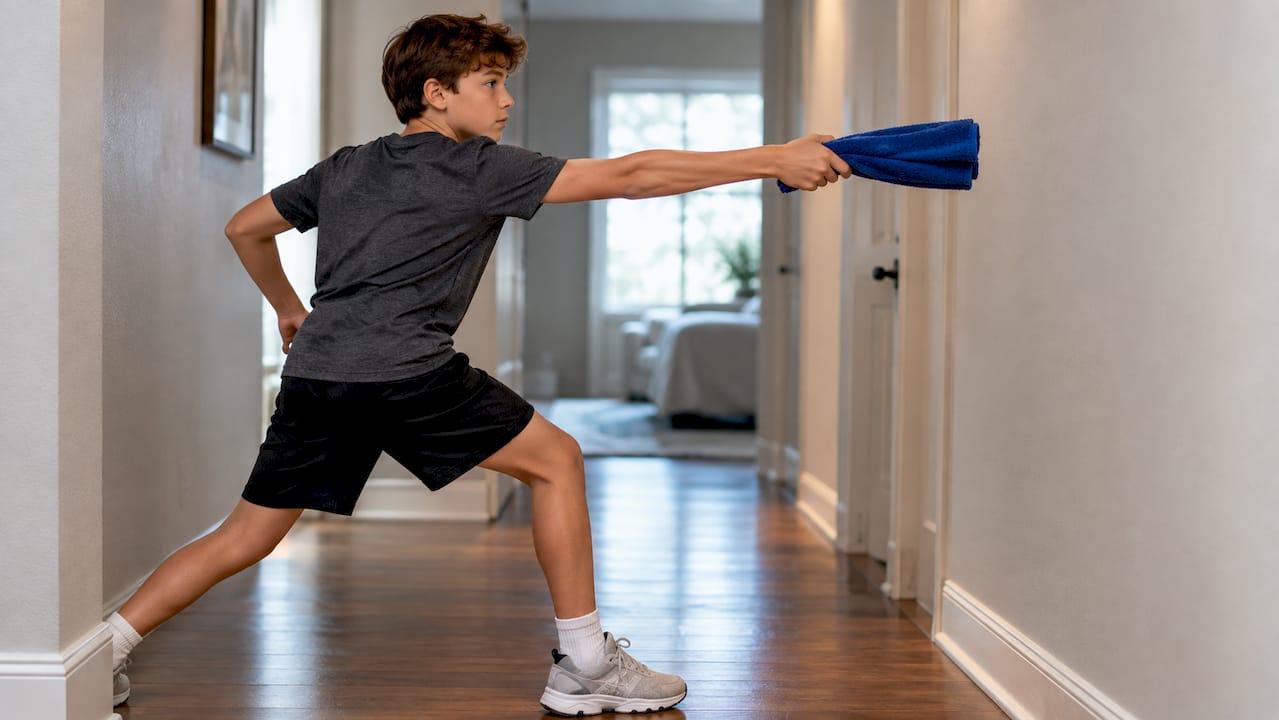
- Towel drill. Grip a hand towel like a ball and run through the full pitching motion, 8 to 12 reps, focusing on arm path and rhythm rather than speed. This isolates mechanics without a single actual throw.
- Rocker throws. Short, high-rep throws from a rocking stride, done at close range into a net, build release feel without the volume of full-distance pitches.
- Wrist snap drills. From a kneeling position a few feet from a partner or net, snap the wrist through short throws to groove spin and finger pressure, the foundation of a clean release.
- Short-distance target work. Using a net with a marked target and limited-flight balls, throw for command from a shortened distance rather than full mound length. This builds accuracy without the arm stress of max-effort throwing.
- Strength over throwing, when in doubt. On days when a young arm has already thrown in a game or a bullpen recently, swap throwing volume for medicine-ball rotational work or band strength circuits instead. Protecting the arm on a rainy day pays off on the next sunny one.
Pro Tip: If a pitcher’s towel drill looks rushed or sloppy, slow the whole session down before adding a single real throw. Bad mechanics practiced at high reps just get more grooved, not fixed.
Agility and Athletic Drills for Small Spaces
A garage floor or a cleared living room is plenty of room to keep young athletes explosive between throwing and hitting blocks.
- Agility ladder patterns. Two-in-two-out, lateral shuffles, and quick-step patterns build foot speed in a strip of floor barely 10 feet long.
- Tape-line shuttles. Mark two lines 10 feet apart with tape and run short sprint-and-stop repeats to train first-step quickness and direction change, the exact skill that turns a routine grounder into an athletic play.
- Bodyweight plyo circuit. Broad jumps, lateral bounds, and squat jumps in short sets (think 5 to 8 reps, 2 to 3 rounds) preserve explosive power without the joint pounding of a long conditioning session.
- Load monitoring. Keep total ground-contact volume low for players under 10, and watch for heavy, uneven landings, which are the first sign a young athlete is fatiguing past the point of useful work.
Some coaches working with older, more physically mature players use short pre-activation methods like whole-body vibration to boost lower-limb engagement before hitting before a swing session, though that kind of tool needs individual judgment and supervision, and it is not something to introduce casually with a 9-year-old.
The 30-Minute Rainy Day Practice Plan
Here is a clocked template you can run today, whether it is one player in a garage or a full team in a gym.
- Warm-up (5 minutes): Band shoulder work, hip openers, bodyweight squats, then a short towel-drill progression for anyone throwing that day.
- Hitting block (12 minutes): Tee work in three locations, 8 to 12 reps each, followed by 4 to 5 minutes of soft toss or front toss into a net. One coaching cue per round.
- Fielding or pitching block (8 minutes): Rotate between wall ball for fielders and towel drill or short-distance target work for pitchers. Split the group if you have more than two players.
- Athletic finish (5 minutes): Agility ladder or tape-line shuttles, followed by a short plyo circuit to close on an explosive note rather than a tired one.
A 30-minute structured indoor routine covering warm-up, hitting, defense or pitching, and a finishing block is genuinely enough to preserve, and often sharpen, youth skills through a short rainy stretch.
If it’s just one player, swap the fielding block for mirror swings, the PVC drill, or solo ladder work. With a group, rotate stations every 4 minutes so no one stands around waiting for a turn.
| Block | Time | Best drill(s) |
|---|---|---|
| Warm-up | 5 min | Band work, towel progression |
| Hitting | 12 min | Tee (3 spots), soft toss |
| Fielding/pitching | 8 min | Wall ball, towel drill, target work |
| Athletic finish | 5 min | Ladder, tape shuttles, plyo circuit |
Why Albert Trusts a Focused Indoor Routine
Coaching youth players indoors rewards precision over volume, and that principle shapes everything Pitchtrainingbaseball builds and writes about. A short indoor pitching session built around one clear focus per block outperforms a long, unstructured one almost every time.
Three things matter most from real product use: a strike-zone target net gives instant visual feedback on command drills without a single wasted rep chasing a ball that missed the zone. Soft training balls let you run full-speed fielding and pitching work without worrying about a mis-hit through drywall. And a compact checklist beats a mental list every single time a session gets busy.
Copy-and-use coaching checklist:
- Check ceiling clearance and clear breakables before anyone swings
- Warm up the arm before any throwing drill, every session
- One coaching cue per hitting round, no exceptions
- Limited-flight or soft balls only, indoors, always
- End on the athletic block, not the tired one
How to Track Progress During Indoor Sessions
Progress indoors is easy to lose track of because there is no scoreboard, no game result, and no obvious marker of improvement. That is exactly why a simple tracking habit matters more inside than it does on the field.
Keep it dead simple for younger players. A notebook or phone note logging “tee reps, contact quality (good, okay, missed), and one cue worked on” after each session gives you a week-over-week pattern without turning practice into homework. For catchers and pitchers, count strikes hit inside a taped target zone out of total reps, a number that climbs visibly over a few weeks of consistent target work.
Set one goal per week, not five. A goal like “hit the outside-third tee location cleanly 8 out of 10 times” is specific enough to measure and small enough to actually hit. Vague goals like “get better at hitting” give a kid nothing to aim at and nothing to feel proud of when they clear it.
For older players working through recognition and timing, some coaches use rest-interval tools like a baseball-specific perceptual-cognitive video task, which showed measurable gains in pitch-recognition accuracy in a youth pilot study, as a way to squeeze in decision-making reps without adding throwing volume. It is not something every family needs, but it shows the same principle: track a specific skill, not a vague impression of effort.
When Space Is Extremely Limited
Not every family has a garage, and not every apartment has a basement. A hallway, a bedroom, or even a parking spot under an overhang can still produce a useful session if you scale the drills down to match the room.
Dry swings and mirror work need almost no space at all, just enough room to take a full cut without clipping a wall. The PVC drill works the same way, since the shortened pipe removes most of the swing radius a real bat needs. Towel drill pitching mechanics fit in a space barely wider than a doorway.
For fielding, bare-hand reads against a wall or a folded blanket need only a few feet of clearance, and a rolled sock or a foam ball keeps things quiet enough for shared walls or downstairs neighbors. A low-noise indoor practice built around soft-contact drills is a real option for apartment living, not a compromise dressed up as one.
If even a hallway is off the table, lean on constraint-based tools. A connector ball or a pancake glove forces correct hand position through feel alone, which means a five-minute drill in a tiny corner still teaches something real. Community coaches on forums have swapped creative low-equipment ideas for facility-free rainy days for years, from hallway target throws to simple reaction games, proof that a lack of space is rarely the real barrier. A lack of a plan usually is.
Keeping Kids Engaged Through Repeated Indoor Sessions
The same four drills, run the same way, three weeks in a row, will lose a 9-year-old faster than almost anything else in coaching. Variety inside the structure, not a different structure every time, is what keeps engagement alive.
Rotate the feed pattern in soft toss, some days rapid-fire, some days slow and deliberate, so the drill feels fresh even though the skill being built is identical. Turn the wall ball fielding block into a quick contest: most clean fields out of 10 reps, tracked on a whiteboard or a phone note. Kids who could not care less about “improving glove mechanics” will absolutely care about beating their number from last week.
Let players call their own tee locations sometimes instead of always dictating them. A small amount of ownership over the session goes a long way for a 10 or 11-year-old who otherwise feels like practice just happens to them. For younger kids, keep blocks short, five minutes tops on any single drill, since attention drops off fast well before boredom becomes obvious.
Praise the process, not just clean contact. A hard-hit ball off a bad swing is luck; a good swing on a missed ball is progress, and saying so out loud matters more than most coaches realize.
A Coach’s Honest Take on Indoor Practice Priorities
Safety comes first, always, before a single drill gets run. But once the space is safe, the next fight is against yourself, the coach, piling on too many cues in one session. I have watched more indoor practices go sideways from a well-meaning adult stacking five corrections onto a nine-year-old’s swing than from any equipment problem.
The other trap is over-throwing indoors simply because the rain made outdoor throwing feel forbidden. Short towel drills can be more effective for teaching mechanics than lengthy bullpen sessions in tight indoor spaces. Pick one focus per block, protect the arm like it’s the only one that kid gets, and let the rest wait for a sunny field.
— Albert
Set Up a Safe Indoor Station With the Right Gear
Running these drills well comes down to having equipment that fits a small space and holds up to repeated indoor reps, not full-size gear that turns a garage into a hazard. Some companies build toward exactly that gap: compact, safe tools sized for the sessions above instead of full-field equipment that never fit indoors in the first place.

Start with a strike-zone target net for command work, it turns short-distance target throws into a measurable drill instead of guesswork. Add a set of soft training balls for fielding and pitching reps where a real ball would risk drywall or a window, and a training softball for batting work that needs a bit more heft than foam without the danger of a hard ball indoors. A single-player family working in a small garage might only need the net and a set of soft balls; a coach running a group session benefits from having both softballs and Pickeballs on hand for rotating stations. Check the full lineup of training gear and pick the pieces that match your space before the next rainy forecast rolls in.
Sources
- Acute effects of whole-body vibration on batting kinematics — Frontiers in Psychology
- Youth baseball batting cage drills: A coach guide — Veo