


At home, prioritize short, high-quality reps that train command and mechanics over velocity, starting with the wall, towel, dry-throw, and balance drills. Run one or two of these per session, keep sessions brief, and let one coaching cue guide each rep. Track every throw against Pitch Smart’s age-based pitch limits and required rest days, since safety on this front matters more than any single drill.
TL;DR:
- Focus on short, high-quality drills that isolate mechanics, such as the towel and wall drills, instead of trying to run all eight drills every session.
- Keep session lengths brief, with recommended practice frequencies of two to four times per week, adjusting for age and arm health, and always track pitch count limits carefully.
- Use simple checkpoints like glove-to-chest timing and balanced delivery observed via video to correct common flaws without needing a coach present.
- Incorporate a quick warm-up and arm-care routine lasting around five minutes to prioritize arm health and reduce injury risk during practice.
- Avoid stacking multiple corrections in one session, instead focusing on one cue at a time and reviewing video footage over weeks for meaningful improvement.
Table of Contents
- What Are the Best Home Pitching Drills?
- How Long and How Often Should Home Practice Sessions Run?
- Which Mechanics Should You Check at Home?
- What Warm-Up and Arm-Care Work Fits Into a Short Session?
- What Do Sample At-Home Session Plans Look Like?
- What Do Coaches Actually Get Wrong at Home?
- Tools That Make Home Drill Work Easier to Track
- Sources
What Are the Best Home Pitching Drills?
You do not need a mound, a catcher, or a bucket of balls to build a better delivery. You need a wall, a towel, and about 15 minutes. Below are the drills that show up again and again in youth coaching resources, including Little League’s own instructional library, because they isolate one mechanical piece at a time instead of asking a young arm to fix everything at once.
- Wall drill (release point). Stand about three feet from a wall, work through your delivery in slow motion, and finish with your hand pointing at a spot on the wall. Do 10 to 12 reps. Cue: “Point where you want it to go.” Mistake to fix: rushing the arm so the release happens before the front foot lands.
- Towel drill (arm path and deceleration). Swap the ball for a hand towel and go through a full arm circle and finish, snapping the towel at release. Ten reps per set, two sets. Cue: “Snap and stop.” This is the best drill for training a clean deceleration pattern without adding a single throw to the day’s count.
- Dry throws (mechanics only). Full windup and delivery with no ball at all, focused purely on sequencing. Great for beginners or for a fatigue day when you still want reps. Cue: “Hips, then hands.”
- Mirror or phone video check. Film five deliveries from the side and five from the front. Watch for a level glove and a stacked back leg. Best used once a week, not every session.
- Balance or one-leg drill (stability). Lift the front knee and hold for a three-count before starting the delivery. Five reps per side. Cue: “Freeze, then go.” This is the top pick for repeatability because a wobbly lift wrecks everything downstream.
- Stride-and-stop (landing control). Walk through the stride and freeze the instant the front foot lands, checking that the foot is closed and the front knee has some bend. Eight reps.
- Bucket or target drill (accuracy). Tape a strike-zone box to a wall or fence and throw soft-toss lobs or use a target net for real throws. Ten throws, tracking makes versus misses. This is the drill most directly tied to command.
- Finish and wrist-focus drill. Slow-motion reps that stop at full follow-through, checking that the throwing hand finishes outside the opposite knee. Six reps.
Pro Tip: Pick one drill for arm path (towel), one for accuracy (bucket or target), and rotate a balance drill in twice a week. Trying to run all eight every session is how kids burn out on drill work before they see any benefit.
How Long and How Often Should Home Practice Sessions Run?
Session length and frequency should shrink as arm health risk rises, not the other way around. Practical guidelines for youth practice volume suggest two to four total baseball touchpoints per week, with at-home reps kept short.
- Ages 7 to 10: short sessions a few times a week, drills only, minimal live throwing.
- Ages 11 to 14: moderate-length sessions a few times a week, mixing drills with light bullpen throws.
- Ages 15 and up: longer sessions several times a week, with more structured bullpen work.
Warm-up tosses and bullpen throws count toward the day’s total pitch volume, not just game pitches. Pitch Smart’s guidelines set daily maximums by age and require rest days scaled to how many pitches were thrown, and no pitcher should throw on three consecutive days regardless of age. A workable weekly rhythm: a 15-minute drill session on a light day, then a full rest day after any high-volume bullpen or game outing. Our guide to age-based throwing frequency breaks this down by grade level.
Statistic Callout: Pitch Smart’s tables are ceilings, not targets. Most healthy youth arms should throw well under the daily maximum, using the number as a hard stop rather than a goal to hit every outing.
Which Mechanics Should You Check at Home?
Five checkpoints cover almost every fixable flaw in a youth delivery, and none require a pitching coach standing in your yard.
- Glove-to-chest timing: the glove should tuck to the chest right as the front foot plants.
- Stacked shoulders and hips: shoulders stay level and don’t tilt early.
- Consistent arm path: same slot, same height, rep after rep.
- Firm front-side landing: the front leg holds its position instead of collapsing.
- Finish and balance: the pitcher ends the delivery under control, not falling off to one side.
A single phone propped on a chair, filmed from the side, catches all five. Watch the clip, pick one cue, and drill only that cue for the week rather than trying to fix everything you see. Our breakdown of the physics behind a better throw explains why sequencing errors compound if you skip straight to arm speed.
Pro Tip: One cue, one drill, one week. A kid who hears five corrections in a single session usually leaves worse off than one who heard none.
What Warm-Up and Arm-Care Work Fits Into a Short Session?
A five-minute dynamic warm-up (arm circles, band pulls if you have them, light jogging in place) should come before any throwing, followed by a gradual toss progression that starts at half speed from short distance. Simplified versions of the Thrower’s Ten rotator cuff and scapular exercises fit well here, using body weight or light bands rather than heavy resistance for younger players.
- Dynamic stretches and arm circles, two to three minutes.
- Light toss progression from 15 feet building to 30, no max effort.
- Band or bodyweight external rotation, two sets of 10.
- Scapular retraction holds, two sets of 10 seconds.
Fatigue is one of the clearest predictors of throwing injury, so any soreness, a dead arm feeling, or a noticeable drop in accuracy is the signal to shorten or skip the session and rest instead.
What Do Sample At-Home Session Plans Look Like?
- Quick maintenance session (10 to 20 minutes). Three-minute dynamic warm-up, wall drill and balance drill, five to eight soft toss throws at a target, finish with a short arm-care set. Good for a light week or a day after a game.
- Focused session (20 to 30 minutes). Full warm-up, then three sets of a primary drill (towel drill for arm path, or bucket drill for command) with a mechanics check on video between sets, closing with a brief cooldown and band work.
- Pre-season build-up plan (30 to 40 minutes, multi-week). Week one leans entirely on dry throws and drills with zero live pitching. Weeks two and three add short bullpen sets, tracked against Pitch Smart limits, counting every warm-up throw toward the day’s total. By week four, volume approaches a normal in-season bullpen, still followed by scheduled rest days. Our guide to building skill safely through youth pitching workouts lays out a longer version of this build-up if you’re prepping for a specific start date.
What Do Coaches Actually Get Wrong at Home?
The biggest mistake in backyard practice is stacking corrections. Parents want to help, so they call out everything they notice, and the kid ends up thinking about five things at once instead of repeating one clean pattern. Pick a single cue per session and let the rep count do the teaching.
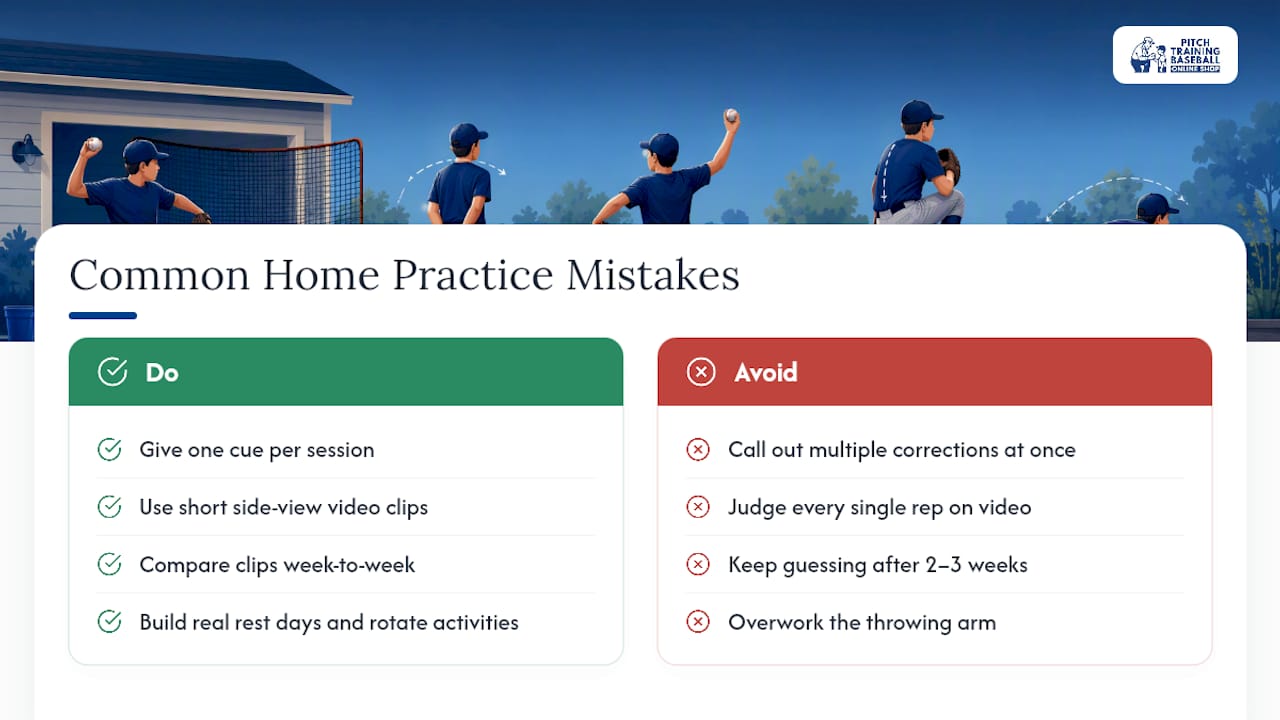
Video is the other underused tool. A ten-second clip filmed from the side tells you more than a parent’s eye ever will, but only if you compare it to the same clip a week later rather than judging every single rep. If a flaw doesn’t clear up after two or three weeks of focused drill work, that’s the moment to bring in an actual coach rather than keep guessing.
None of this works if the arm is worn down. Build in real rest days, rotate in other sports or activities, and treat variety as part of the training plan, not a distraction from it.
— Albert
Tools That Make Home Drill Work Easier to Track
None of the drills above require equipment, and that’s by design, but a couple of tools like the Pedal Baseball Launcher remove the friction that makes kids quit early. Chasing wild throws into the neighbor’s yard eats up practice time faster than anything else, and a soft ball takes the sting out of close-range reps in a garage or small backyard.

The Pitching Target Net with a 9-zone strike layout turns the bucket drill from a guessing game into something you can actually score, since every throw lands in a visible zone instead of disappearing into open space. For families practicing in tighter areas, the Pitch Training Softball lets kids throw at real intensity indoors or close to a fence without the risk that comes with a hard ball. Such tools do not replace the drills but can make the reps faster to run and easier for a parent to score from the porch. If your player is ready to add structure to the sessions above, start with the target net and see how many more accurate reps fit into the same 15 minutes.
Sources
- Mlb
- Baseball- Pitching Drills | Little League
- Little League pitching guidance and workload management | Lake Washington PT
- Youth Pitch Counts by Age: What the Research Actually Says | Nathan Critchett