


A slider is a breaking pitch that mimics a fastball out of the hand, then darts sharply to the glove side in the final 10–15 feet. It’s one of the highest-leverage out pitches in baseball when thrown with fastball intent and sound mechanics. Velocity typically sits below a pitcher’s four-seam fastball by a moderate amount, putting most amateur sliders in a lower speed range and elite MLB versions somewhat faster. One safety note before anything else: for youth pitchers, the Pitch Smart guidelines recommend delaying slider introduction until a pitcher is at least 14 and has demonstrated reliable fastball command.
Key Takeaways
The slider’s effectiveness depends on fastball-identical arm action, a middle-finger dominant grip, and a late release pull — introduced only after a pitcher has reliable fastball command and physical readiness.
| Point | Details |
|---|---|
| Master fastball first | Reliable four-seam command and repeatable delivery must come before any slider instruction. |
| Grip drives the spin | Middle-finger pressure on the horseshoe seam creates the gyro spin that produces late horizontal break. |
| Age 14+ for sliders | Pitch Smart and clinical guidance recommend delaying slider introduction until at least age 14 with coach oversight. |
| Overuse is the real risk | Research shows mechanics and pitch volume drive injury more than pitch type alone. |
| Pitchtrainingbaseball aids | Target nets and soft practice balls support safe, feedback-rich slider repetition during the learning progression. |
Table of Contents
- What makes a slider baseball pitch different from other breaking balls?
- How does slider grip and release mechanics work?
- How do you teach a slider step by step?
- What are the main slider variations and how do you read them?
- When should you throw a slider in a game?
- Why do sliders hang and what drills fix the problem?
- What does the research say about slider injury risk for youth pitchers?
- Which pitchers have the most effective sliders and what do the numbers show?
- The case for patience over repertoire
- Build your slider with the right training tools
- Sources
What makes a slider baseball pitch different from other breaking balls?
The slider’s signature is its late break. Unlike a curveball, which starts its arc early and drops sharply downward, a slider holds its fastball trajectory until it’s nearly at the plate, then deflects laterally with a tight gyroscopic spin. That deception is the whole point.
A few characteristics define it:
- Spin axis: A slider spins on a tilted gyro axis, somewhere between a bullet spin (pure backspin) and a curveball’s 12-to-6 topspin. The result is a mix of horizontal and slight downward movement.
- Primary movement: Glove-side horizontal break, often with a small amount of drop. Hitters see a fastball, then the ball disappears off the plate.
- Speed delta: Typically 6–10 mph slower than the pitcher’s fastball, which is tighter than a curveball’s 10–15 mph gap.
- Visual cue on video: Watch for a brief seam flash at release, then a late deflection in the final third of the flight path. On Statcast, look for horizontal movement values in the 3–8 inch range with moderate vertical drop.
How a slider compares to a curveball, cutter, and sweeper
| Pitch | Spin axis | Primary movement | Speed vs. fastball | Key release cue |
|---|---|---|---|---|
| Slider | Tilted gyro (2 o’clock) | Lateral + slight drop | 6–10 mph slower | Middle-finger pull, minimal wrist snap |
| Curveball | 12-to-6 topspin | Sharp downward break | 10–15 mph slower | Wrist over the top, forward roll |
| Cutter | Near-fastball axis | Late glove-side cut, minimal | 2–5 mph slower | Index/middle pressure shift, fastball action |
| Sweeper | Flatter gyro axis | Wide horizontal sweep (10+ inches) | 6–10 mph slower | Wider finger spread, more lateral pull |
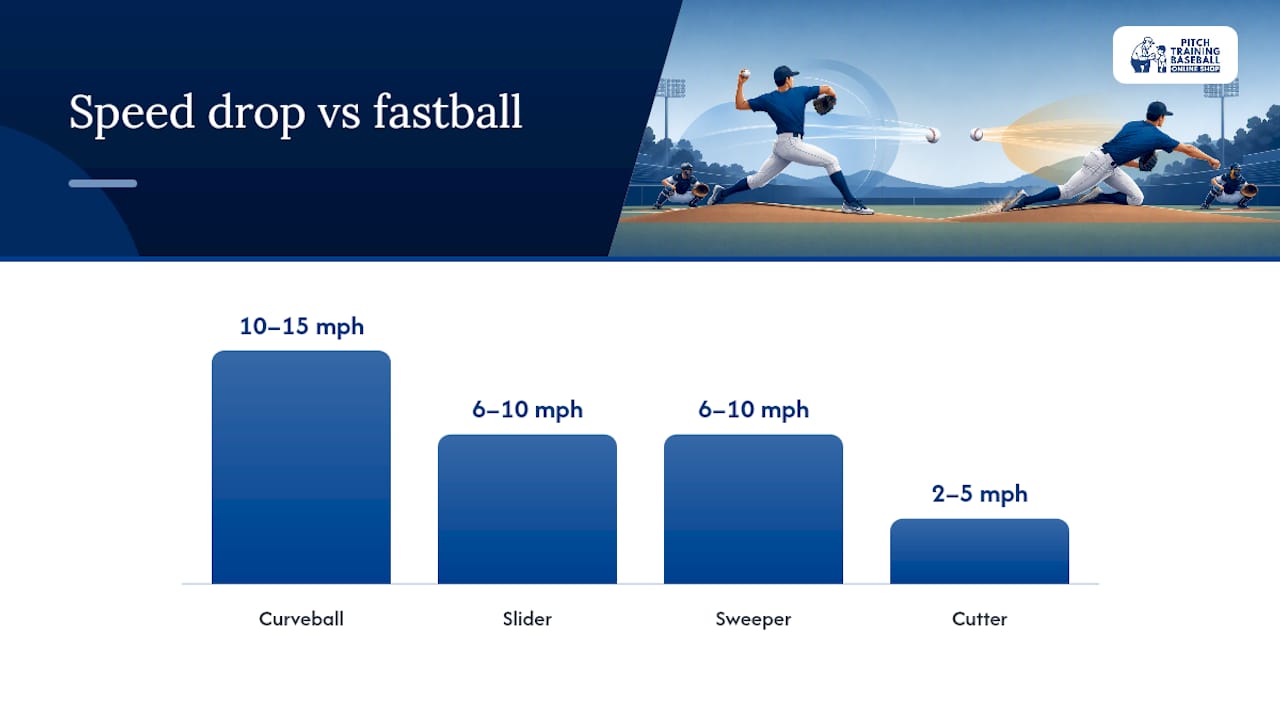
The sweeper is essentially a slider variant with a flatter axis and more horizontal travel. The cutter is the slider’s faster, subtler cousin. Confusing them matters because sequencing decisions depend on knowing which pitch you’re actually throwing.
How does slider grip and release mechanics work?
The grip is where everything starts. A slider’s tight gyro spin comes from a middle-finger dominant hold with the ball sitting slightly off-center, deeper in the hand than a four-seam fastball.
Standard grip setup:
- Place the middle finger along the inside of the horseshoe seam (the narrow U-shaped seam on the ball).
- The index finger rests lightly beside the middle finger as a guide, not a pressure point.
- The thumb sits underneath, roughly opposite the middle finger, providing support without gripping.
- The ball sits slightly deeper in the palm than a fastball, which naturally reduces spin rate and encourages the gyro axis.
Common grip variations:
- Tight horseshoe: Both fingers on the narrow seam. Produces the most spin efficiency and tightest break. Good for pitchers with larger hands.
- Off-center horseshoe: Middle finger slightly off the seam. Creates a softer, wider break. Useful when a pitcher’s slider is too tight and reads like a cutter.
- Two-finger variant: Index and middle fingers together on the seam. Helps younger pitchers who struggle with finger independence.
Release mechanics are where most sliders break down. The arm action must be identical to a fastball. Any early tipping, such as dropping the elbow or slowing the arm, telegraphs the pitch before it leaves the hand. At release, the middle finger pulls down and slightly across the ball, like snapping a finger. The wrist stays relatively firm. There’s no aggressive snap or twist.
Pro Tip: Film your delivery from behind the mound at 240 fps or higher. If your glove-side shoulder opens before your hips, your slider will flatten out and hang. The fix is almost always in the lower half, not the arm.
How do you teach a slider step by step?
Rushing to full-speed slider reps is the most common coaching mistake. The pitch requires a specific feel that takes time to develop, and throwing it at high intensity before that feel is grooved leads to compensations that hurt both performance and arm health.
Progression stages:
- Establish fastball command first. A pitcher who can’t locate a four-seam fastball consistently has no business learning a slider. Command comes before repertoire, every time.
- Finger independence drills (no ball). Have the pitcher practice the middle-finger pull motion with just their hand, feeling the snap without any arm stress. Two minutes per session.
- Short-toss shape drills (30–40 feet). Throw at 50–60% effort, focusing entirely on the release feel. The goal is to see the ball break, not to throw hard.
- Dry toss with a target. Move to a net or target at 45–50 feet. Still at reduced effort. The pitcher should be able to repeat the shape on 7 out of 10 throws before advancing.
- Full-speed bullpen reps. Only after the shape is repeatable at reduced effort. Start with 10–15 slider reps per bullpen session, mixed with fastballs.
Practice drills:
- Two-seam pull drill: Grip a two-seam fastball with the slider finger placement. Throw at 60% to a partner at 40 feet. The two-seam grip exaggerates the pull sensation and helps pitchers feel the correct finger action without forcing the wrist.
- Towel drill: Use a towel instead of a ball. Focus on arm path and follow-through. The towel removes the temptation to “aim” the pitch and reinforces the fastball arm action through release.
- Short-toss snap drill: Stand 25 feet from a net. Throw 20 reps focusing only on the final snap of the middle finger. No windup, no stride. Pure release repetition.
- Bullpen sequencing drill: Alternate fastball and slider in pairs. Throw a fastball, then immediately throw a slider with identical arm action. The contrast sharpens the pitcher’s feel for what changes (finger pressure) and what stays the same (arm speed, slot).
Safety callout: Limit slider reps to 15–20 per bullpen session during the learning phase. Monitor for forearm tightness or elbow soreness after sessions. If either appears, stop and rest. Film delivery at 240 fps where possible to catch mechanical drift before it becomes a habit.
What are the main slider variations and how do you read them?
The term “slider” covers a family of pitches that share a gyro spin axis but differ in velocity, axis tilt, and movement profile. Mislabeling them leads to bad sequencing decisions.
The four main variations:
- Traditional slider: 6–10 mph off the fastball, 3–6 inches of horizontal break, moderate vertical drop. The workhorse version. Tight gyro spin, late break.
- Sweeper: Same velocity range as a traditional slider but with a flatter axis and 8–14 inches of horizontal sweep. Less vertical drop. Particularly effective against same-side hitters because it exits the zone laterally rather than downward.
- Slurve: A hybrid between a slider and a curveball. More vertical drop than a traditional slider, slightly more horizontal break than a curveball. Axis sits around 1–2 o’clock. Often the result of a pitcher’s natural arm slot rather than a deliberate grip change.
- Cutter (cut fastball): Only 2–5 mph off the fastball. Minimal horizontal movement, 1–3 inches of late glide toward the glove side. Thrown with near-fastball arm action and finger pressure shifted slightly to the index finger.
How small mechanical changes shift the pitch:
Increasing finger spread widens the axis and pushes the pitch toward a sweeper. Firming up the grip and reducing the pull angle tightens the break toward a cutter. A slight wrist tilt at release adds vertical drop and moves the pitch toward a slurve. These aren’t dramatic changes. A quarter-inch shift in finger position can move a pitch from one category to another, which is why Statcast pitch-tracking data sometimes classifies the same pitcher’s “slider” differently from game to game.
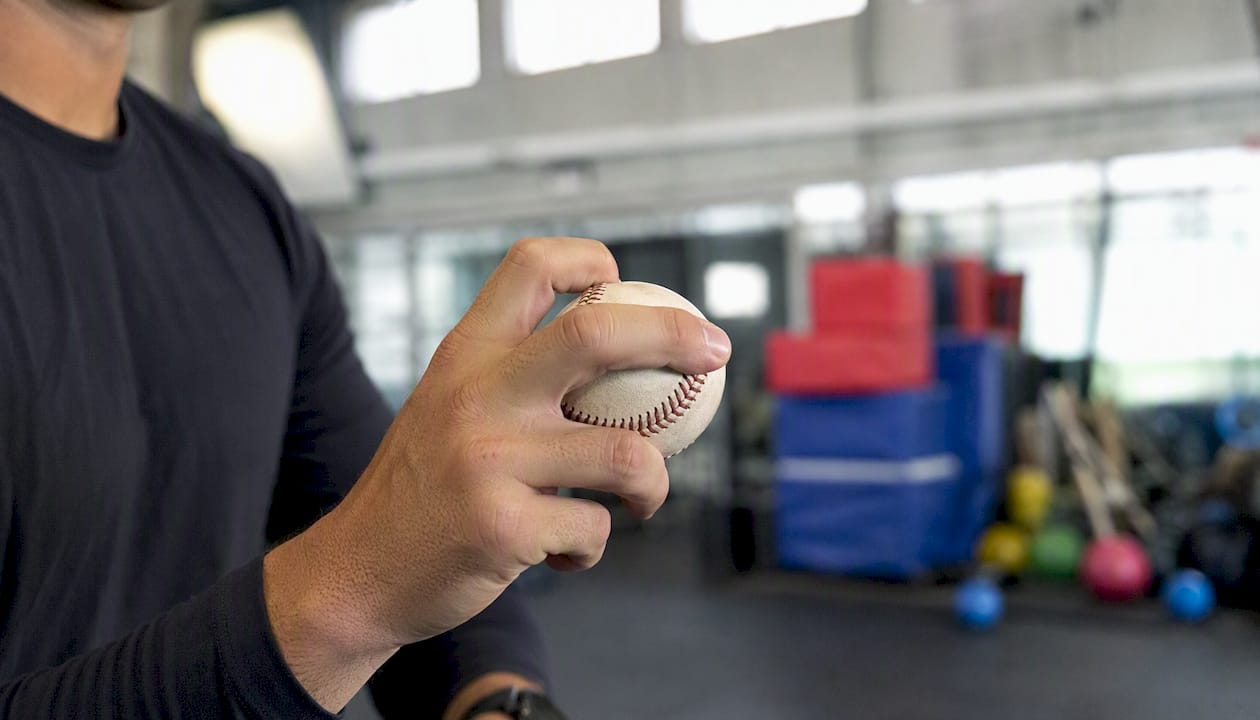
On Statcast, a traditional slider typically shows horizontal movement between 3–8 inches with a spin axis around 2–3 o’clock. A sweeper pushes past 10 inches of horizontal movement with a flatter axis near 3 o’clock. A cutter sits close to the fastball’s axis with minimal horizontal deviation.
When should you throw a slider in a game?
The slider is primarily a putaway pitch and a chase pitch. It’s not a first-pitch strike pitch for most pitchers, though elite command can change that.
Primary use cases:
- Same-side hitter, two-strike count: A slider breaking away from a right-handed hitter (thrown by a right-handed pitcher) is the pitch’s highest-percentage application. The hitter sees fastball, swings, and the ball exits the zone glove-side.
- Chase pitch off the plate: A slider that starts at the bottom of the zone and breaks off the outside corner generates swings on pitches that aren’t strikes. This works only when the fastball has established the zone earlier in the at-bat.
- Tunneling off a fastball: The slider’s effectiveness multiplies when it shares a tunnel with the fastball. Both pitches look identical until 20–25 feet from the plate. A fastball up in the zone followed by a slider down and away creates a decision problem the hitter can’t solve in time.
Sequencing examples:
A fastball at the letters sets up a slider at the knees. The hitter’s eye level is high; the slider drops below it. Alternatively, a fastball inside forces the hitter to protect the inner half, then a slider away exploits the shift in weight.
When to avoid it: Don’t throw a slider to an opposite-side hitter when you’re behind in the count. A slider running into the barrel of a left-handed hitter from a right-handed pitcher is a gift. Also avoid it when your fastball command has been poor that day. A slider without a credible fastball is just a slow pitch that breaks.
Pro Tip: Against a pull-happy hitter, throw the slider to the back foot. They’ll either roll over it or freeze. The pitch doesn’t need to break far — it just needs to start where the fastball would.
Why do sliders hang and what drills fix the problem?
A hanging slider is one of the most punishable pitches in baseball. It arrives at belt height with enough break to be identifiable but not enough to miss the barrel. Here’s what causes it and how to fix it.
Common mistakes:
- Opening the front shoulder early: The most frequent cause of a flat slider. When the shoulder flies open before the hips lead, the arm drags and the finger pull happens too late. The ball comes out with fastball spin instead of gyro spin.
- Wrist swivel or twist: Trying to “create” break by rotating the wrist at release. This produces a cement mixer (a pitch that spins visibly with no useful movement) and puts stress on the elbow.
- Pulling down too early: Starting the finger pull before the arm reaches the release point. The ball comes out high with no late break.
- Easing off velocity: Slowing the arm to “guide” the slider. This kills the gyro spin and turns the pitch into a slow, flat breaking ball. Throw it with fastball intent.
- Aiming at the finish point: Trying to steer the ball to its landing spot rather than throwing through the catcher’s mitt.
Drills and corrections:
| Drill | Problem it fixes | Setup | Reps |
|---|---|---|---|
| Towel drill | Early shoulder opening | Stand on mound, towel in throwing hand, focus on hip-first sequence | 15–20 per session |
| Short-toss snap | Wrist swivel / late pull | 25 feet from net, no windup, pure release focus | 20 reps |
| Hip-lead drill | Front shoulder flying open | Partner holds pitcher’s front shoulder until hip rotation begins | 10 reps with feedback |
| Mirror drill | Arm path and slot | Throw in front of a full-length mirror at 50% effort | 10–15 reps |
Coaching cues that work on the mound:
- “Throw through the catcher’s chest, not to the catcher’s glove.”
- “Your arm doesn’t know it’s a slider. Only your fingers do.”
- “Lead with the hip, let the arm follow.”
What does the research say about slider injury risk for youth pitchers?
The injury question around sliders is real, but the answer is more nuanced than “sliders hurt arms.” A biomechanical review concludes that while earlier studies suggested breaking pitches were categorically more dangerous, current evidence points to overuse, fatigue, and poor mechanics as the primary injury drivers. The pitch type itself is less predictive than how often it’s thrown and whether the pitcher’s mechanics are sound.
That said, older epidemiological data is worth knowing. A prospective cohort study of 9–14-year-old pitchers found the slider was associated with an 86% increased risk of elbow pain, and higher pitch counts were linked to greater rates of pain across all pitch types.
Pitch Smart guidance: “Overuse, fatigue, and improper mechanics are the primary risk factors for arm injuries in youth pitchers. Age-appropriate pitch counts, adequate rest, and proper mechanics are the most effective injury-prevention strategies.” — MLB Pitch Smart
A UF Health/Ortho guidance document reports that many parents of 11–12-year-olds said their child threw curveballs or sliders. Many learned these pitches from a parent rather than a coach, which underscores the need for structured, informed instruction.
Age-appropriate pitch introduction guidelines:
- Ages 8–10: Fastball only. Focus on mechanics, balance, and arm action.
- Ages 10–12: Add a changeup. No breaking pitches.
- Around age 13: Curveball may be introduced with coach supervision and proper mechanics in place.
- Age 14 and older: Slider introduction is appropriate when the pitcher has reliable fastball command, a repeatable delivery, and physical readiness. Coach oversight is non-negotiable.
These thresholds align with guidance from clinical youth pitching summaries and Eric Cressey’s coaching framework, which both emphasize that fastball command and delivery consistency must precede any breaking pitch instruction.
Red-flag symptoms that require immediate rest:
- Elbow pain on the medial (inner) side during or after throwing
- Forearm tightness that persists 24 hours after a session
- Loss of extension or flexion in the elbow
- Any sharp or sudden pain during a throw
For a detailed look at pitch-count monitoring and rest schedules, Pitchtrainingbaseball’s safety guide covers the specifics coaches and parents need.
Which pitchers have the most effective sliders and what do the numbers show?
Elite sliders share a few measurable traits regardless of who throws them. Here’s what the analytics show:
- High whiff rates: Top slider pitchers generate swinging-strike rates well above the MLB average on breaking pitches. The best sliders produce whiff rates in the 35–45% range on two-strike counts.
- Horizontal movement: Elite sliders average 6–9 inches of horizontal break on Statcast, with sweeper variants pushing past 12 inches.
- Velocity delta: The most effective sliders sit 7–9 mph below the pitcher’s four-seam fastball, tight enough to share a tunnel but different enough to disrupt timing.
A few characteristics that define historically great sliders:
- Late, tight break with minimal early drift: The pitch holds its line until the final 10 feet, giving hitters no early read.
- Consistent arm slot matching the fastball: Pitchers who throw their slider from the exact same slot as their fastball generate the most deception.
- High spin efficiency on the gyro axis: More of the spin contributes to movement rather than being “wasted” spin. Statcast’s spin efficiency metric captures this.
- Ability to locate it both in and out of the zone: The best sliders work as both a strike-zone pitch and a chase pitch, depending on the count.
Statcast data is the most reliable public source for comparing slider movement across pitchers. Baseball-Reference pitch logs provide historical context. When comparing sliders across eras or across scouting reports, always note whether the source uses Statcast’s movement values (measured from a spinless baseline) or traditional radar-gun-plus-scout descriptions, since the numbers differ.
The case for patience over repertoire
The conventional wisdom in youth baseball is that a bigger arsenal equals a better pitcher. Add a curveball, then a slider, then a changeup, and suddenly you’re “advanced.” Coaches and parents push for it. Kids want it because they see it on TV.
The problem is that most young pitchers who throw sliders early aren’t actually throwing sliders. They’re throwing a wrist-twist that looks like a slider to the naked eye and feels like one to the kid, but is mechanically a cement mixer with elbow torque baked in. The pitch doesn’t break late. It breaks early, or not at all, and it puts stress on the medial elbow structures that aren’t fully developed until the mid-teens.
The pitchers who develop the best sliders long-term are almost always the ones who spent ages 10–13 obsessing over fastball location and changeup feel. By the time they add a slider at 14 or 15, their mechanics are clean enough that the pitch comes out right almost immediately. The slider rewards a good foundation. It doesn’t create one.
The youth pitching myths that push early breaking-pitch introduction are worth examining closely. The research doesn’t support rushing it, and the developmental evidence points the other direction.
Build your slider with the right training tools
Repetition is how the slider gets grooved, but not all repetition is equal. Throwing 50 sliders into a backstop with no feedback teaches bad habits faster than it teaches good ones. Pitchtrainingbaseball’s Pitching Target Net with Strike 9-Zone gives pitchers a specific target for every rep, so location drills have a measurable standard. You can see immediately whether the slider is breaking into the zone or drifting out of it.
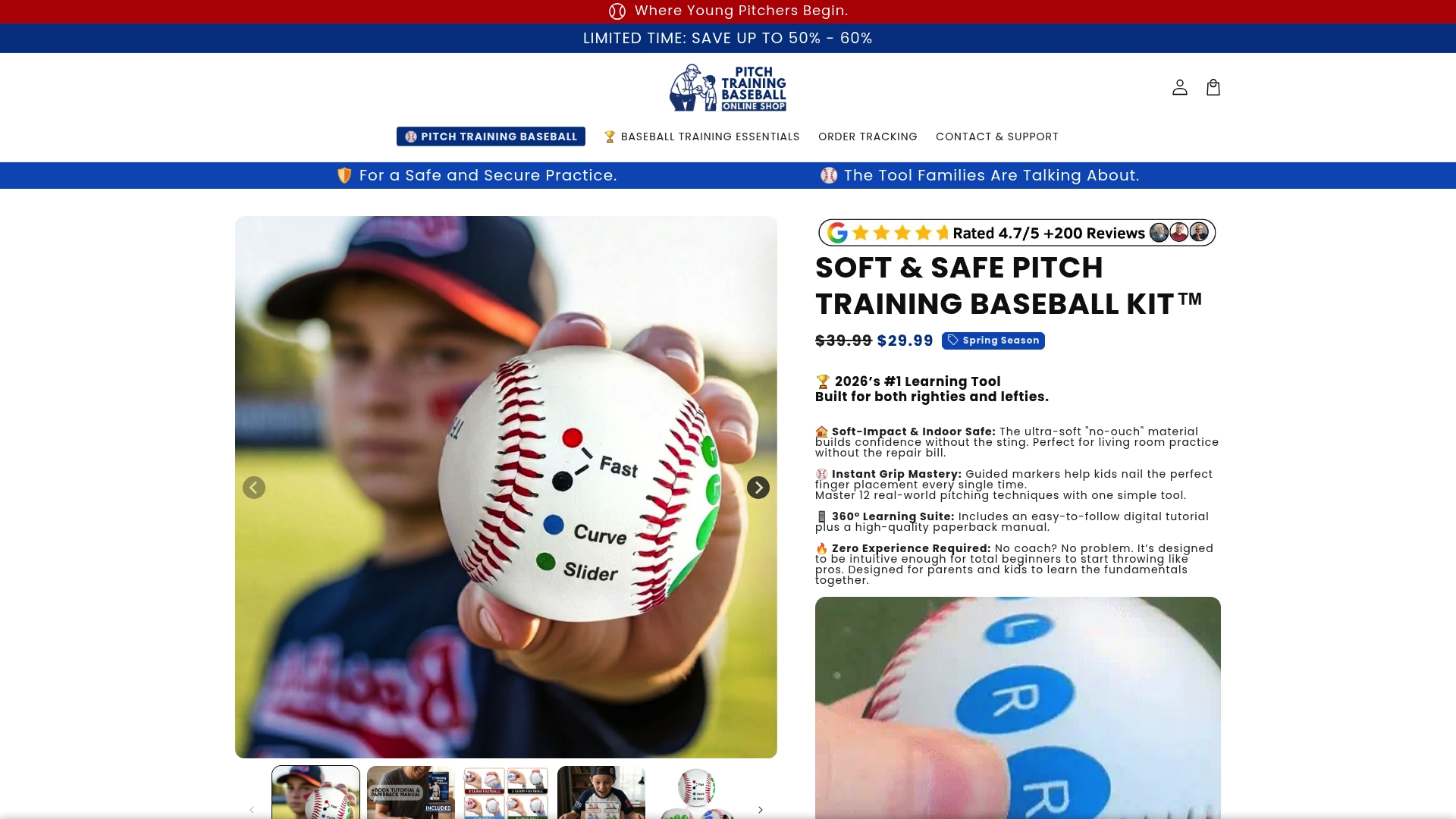
For early-stage progression work, the 5 Pickeballs are designed for low-intensity repetition during short-toss shape drills. Softer balls reduce arm stress during the learning phase, which is exactly when pitchers should be throwing the most reps at the lowest intensity. Browse the full Pitchtrainingbaseball training lineup to find the right setup for your practice environment.
Sources
- PMC article on pitching mechanics and injury risk
- Effect of pitch type, pitch count, and pitching mechanics on risk of elbow and shoulder pain in youth pitchers
- Pitch Smart — Risk factors
- How to Throw a Slider: Grip, Mechanics, and Drills for Every Level — BattingLeadoff
For safety decisions involving youth pitchers, always verify current guidelines directly with Pitch Smart or a qualified sports-medicine professional. Recommendations evolve as research develops.
Recommended
- Baseball Slider for Pitchers: Mechanics, Drills, and Safety – Pitch Training Baseball
- Slider Movement: What Players and Coaches Must Know – Pitch Training Baseball
- Safe pitching tools for youth baseball players – Pitch Training Baseball
- Youth Sports Safety: A Practical Guide for Parents & Coaches – Pitch Training Baseball