


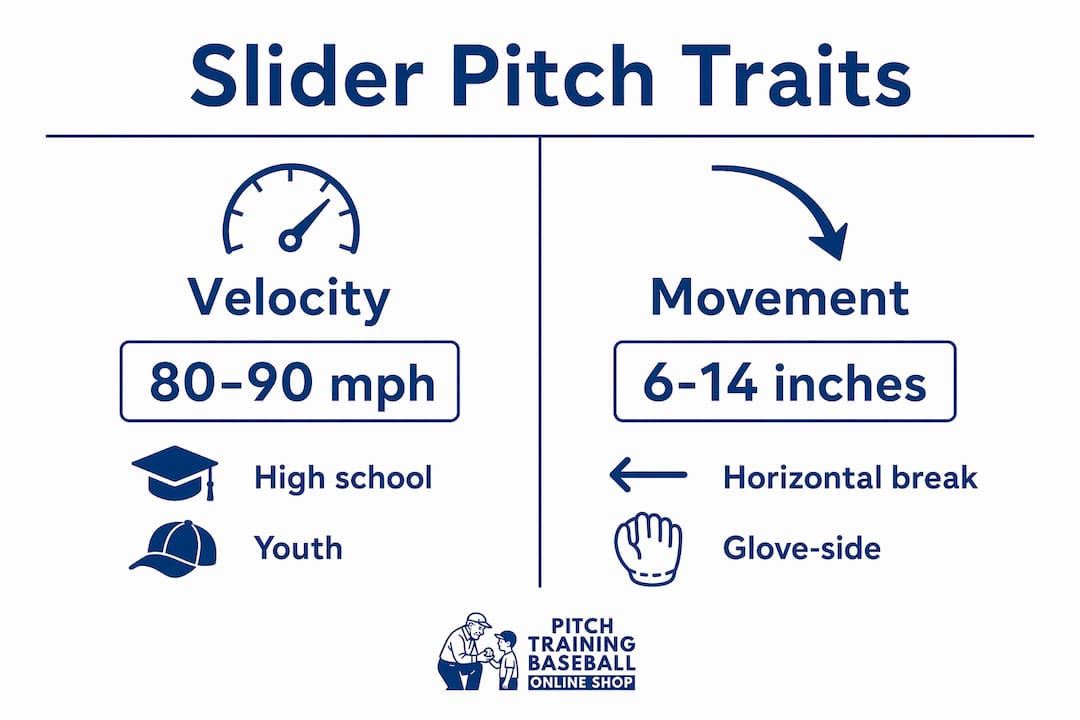
A slider is a breaking pitch thrown at 80–90 mph) that breaks sharply and laterally toward the pitcher’s glove side in the final third of its flight path. Three measurable signatures define it:
- Velocity: typically 80–90 mph at the MLB level, faster than a curveball and closer to fastball speed
- Spin rate: generally in the 2,200–2,600 RPM range, with spin axis orientation mattering as much as raw spin count
- Horizontal break: roughly 6–14 inches of glove-side movement relative to a spinless pitch at the pro level, with the break arriving late
Table of Contents
- How does a slider differ from a curveball, cutter, and sweeper?
- What actually makes a slider move the way it does?
- Velocity bands, spin rates, and how to read your device output
- How to grip and release a slider to get consistent movement
- What are the main slider variations?
- Why is a slider so hard to hit?
- Safe slider development for youth and adolescent pitchers
- Drills and a 6-week progression to build a repeatable slider
- Pitchers with elite sliders and what to watch for on video
- Key Takeaways
- The slider is taught wrong more often than it’s taught right
- Build your slider the right way with Pitchtrainingbaseball
- Useful sources and further reading
How does a slider differ from a curveball, cutter, and sweeper?
The slider sits between the fastball family and the curveball family, which is exactly what makes it so useful. A curveball breaks on a roughly 1-to-7 o’clock path (for a right-handed pitcher), is slower than the fastball, and shows its break early. A slider, by contrast, breaks on a 2-to-8 o’clock trajectory with a shorter, later break and can stay within 10 mph of fastball speed. That velocity gap is the key to the game: hitters read the pitch as a fastball until it’s too late to adjust.
A cutter (cut fastball) overlaps the slider in feel but is thrown harder than a slider, with less lateral break and more of a late glide than a snap. The seam orientation and spin axis differ, and a cutter rarely generates the same sharp glove-side bite a true slider does.
The sweeper is a newer label for a slider variant with pronounced horizontal movement and a flatter vertical profile. Think of it as a slider dialed toward maximum side-to-side action at the expense of some velocity. The gyro-slider sits at the other end: more bullet spin, less Magnus-driven break, and a deceptive “late” feel that comes from the spin axis rather than pure sideways force.
A simple way to picture the path: a slider leaves the hand looking like a fastball, holds that line for roughly 40 feet, then snaps glove-side in the final 20 feet. That late-break window is what makes it so hard to time.
What actually makes a slider move the way it does?
The physics come down to spin axis and the Magnus effect. When a pitcher releases a slider, the ball spins with a tilted axis that produces a sideways component of force. The Magnus effect converts that sideways spin into lateral movement: air pressure drops on the side the ball spins toward, and the ball curves in that direction. For a right-handed pitcher, the axis tilts so the ball breaks toward the left-handed batter’s box.
Spin axis orientation is the variable coaches should watch most closely. An axis pointing too far forward (toward the catcher) produces what’s called gyro or bullet spin. A gyro-slider generates less transverse Magnus force early in flight, which can create an unusual “late” feel or atypical movement patterns. Some pitchers exploit this deliberately; most of the time it produces a hanging, ineffective pitch.
Spin rate callout: Elite MLB sliders typically register 2,200–2,600 RPM on Statcast or Rapsodo. Higher spin alone doesn’t guarantee movement. A slider at 2,500 RPM with a forward (gyro) axis can break less than one at 2,100 RPM with a clean transverse axis. Spin efficiency, the percentage of spin that actually drives Magnus force, is the number that matters.
When reading Rapsodo or TrackMan outputs, watch for:
- Spin efficiency above 60–70%: the slider is generating real transverse force and should break reliably
- Spin efficiency below 40%: heavy gyro component; the pitch may look fastball-like but won’t bite hard
- Spin axis near 3 o’clock (for a RHP): ideal for glove-side break; deviations toward 12 or 6 o’clock shift the pitch toward curveball or sinker territory
A hanging slider commonly results when the spin axis drifts too far forward or when release timing is late, causing the ball to behave more like a gyro pitch and fail to generate lateral Magnus force.
Velocity bands, spin rates, and how to read your device output
The table below gives practical reference ranges by level. Youth figures are observational; MLB figures reflect Statcast-era data.
| Level | Velocity | Spin Rate | Horizontal Break |
|---|---|---|---|
| Youth (12–14) | — | — | 3–7 in |
| High school | 80 mph | 2,200 RPM | 5–10 in |
| College | 80–90 mph | 2,200–2,600 RPM | 6–12 in |
| MLB | 80–90 mph | 2,200–2,600 RPM | 6–14 in |
Horizontal break is measured against a spinless (theoretical) baseline. A pitch that breaks 10 inches glove-side relative to that baseline is generating real lateral force. Vertical drop on a slider is typically less than a curveball’s and more than a fastball’s, landing somewhere in the 20–35 inch range depending on release angle and spin axis tilt.
Three quick interpretation rules for device data:
- Spin efficiency above 70% + horizontal break above 8 inches: the slider is working; focus on command and tunneling
- Low efficiency (below 40%) + velocity near fastball: likely a gyro-slider; it may deceive hitters differently but won’t have the same sharp bite
- Velocity drop greater than 12 mph from fastball: the pitch is telegraphing itself; hitters will pick it up earlier
How to grip and release a slider to get consistent movement
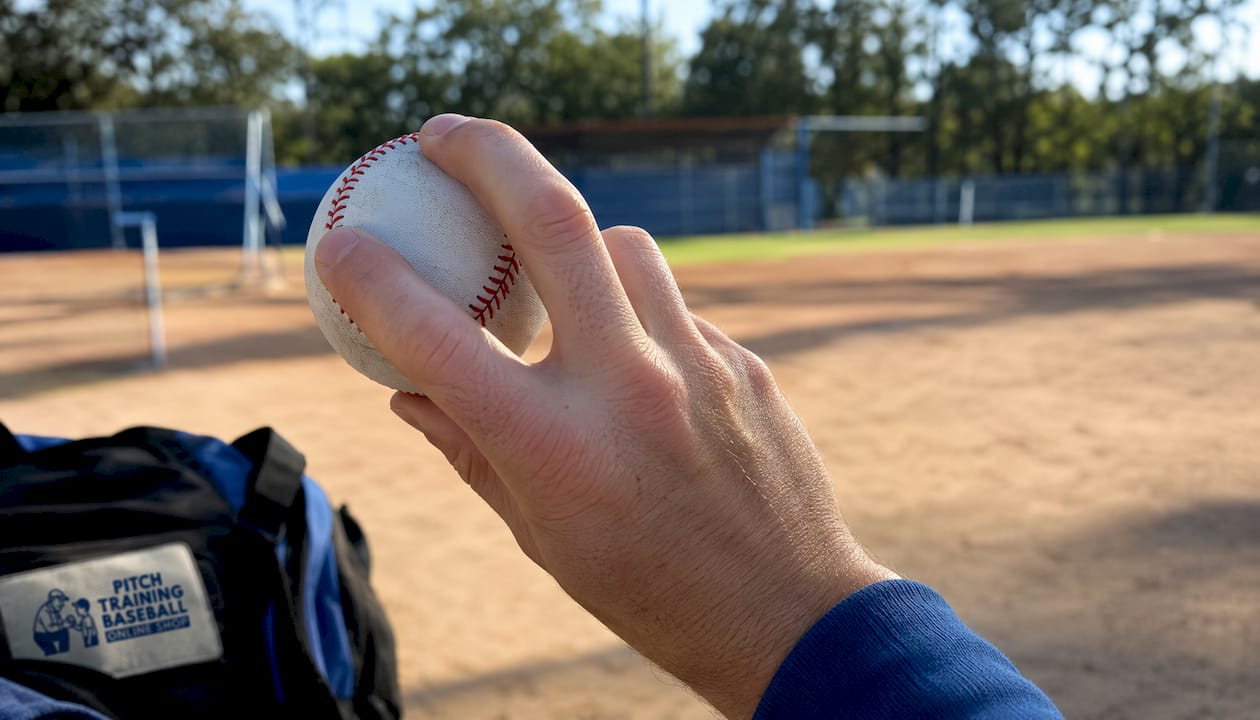
The most reliable grip places the middle finger along or just inside the right seam (for a right-handed pitcher), with the index finger resting lightly beside it. The thumb sits underneath on the opposite seam. The key is that the middle finger does the work: it applies pressure at release to generate the tilted spin axis that drives glove-side break.
Step-by-step release cues:
- Grip the ball slightly off-center, middle finger on the seam, index finger close but passive
- Keep the wrist in a neutral position throughout the delivery, not cocked inward or outward
- Match your fastball arm slot exactly. Any change in arm angle tips the pitch before it leaves your hand
- At release, apply downward pressure with the middle finger while the hand stays on the outside of the ball
- Let the ball roll off the middle finger naturally; do not snap or twist the wrist
The wrist-neutral point is where most youth pitchers go wrong. Forcing the wrist to turn in order to create break puts extra load on the flexor-pronator mass and the ulnar collateral ligament. Youth pitchers who twist the wrist to force break report more pain and higher injury rates than those who use natural release mechanics. The break should come from finger pressure and spin axis, not from wrist rotation.
Warning: mechanics that raise injury risk
- Dropping the elbow below the natural arm slot to “help” the ball break
- Yanking the shoulder across the body at release
- Supinating the forearm aggressively (turning the palm upward through release)
- Gripping the ball so tightly that forearm tension builds before the release point
A small finger offset variant, where the ring finger rests lightly against the ball for stability, works well for pitchers with smaller hands. The grip principle stays the same: middle finger pressure, neutral wrist, matched arm slot.
What are the main slider variations?
The sweeper is the most talked-about variation right now. It prioritizes horizontal movement over velocity, often sitting 3–5 mph slower than a standard slider but generating 15–20+ inches of lateral break. The arm slot tends to be lower, and the release hand position is further outside the ball. On video, you’ll see the ball appear to run almost parallel to the ground before snapping away.
The gyro-slider uses a more forward spin axis, closer to bullet spin. It generates less Magnus force but can look identical to a fastball for the first 40 feet. Dauri Moreta’s pitch is a well-documented example of how gyro components create unusual, gravity-defying movement patterns. Hitters often describe it as “doing nothing and then doing something.”
The slurve blends slider and curveball characteristics: more 12-to-6 tilt than a pure slider but more velocity than a true curve. On Statcast, it typically shows up with a spin axis between 2 and 4 o’clock and a movement profile that splits the difference between the two pitch types. It’s common among pitchers with a higher arm slot.
Cutter overlap happens when a cut fastball is thrown with enough lateral movement to register as a slider on tracking systems. The distinction matters for sequencing: a cutter is usually thrown at the hands of an opposite-handed hitter, while a slider is thrown away. When the two pitches blur, hitters can sit on one and get the other.
One genuinely rare case: the wrong-way slider. Tatsuya Imai’s slider averaged about six inches of arm-side movement, the opposite direction of a standard slider. Small changes in arm slot and release hand position can flip the entire movement profile. It’s unusual enough that most coaches will never see it, but it illustrates how sensitive slider movement is to release variables.
Why is a slider so hard to hit?
The answer is tunneling. A slider’s early flight path mimics a fastball closely enough that hitters can’t distinguish the two pitches during the critical first 30–40 feet. By the time the ball breaks, the hitter has already committed to a swing path based on fastball-read information.
Three specific reasons hitters struggle:
- Late horizontal movement: the break arrives in the final 20 feet, after the hitter’s decision window has closed
- Seam flash: the spin axis can produce a visible “red dot” on the ball, but only elite hitters with high-speed video training consistently pick it up in real time
- Velocity proximity to the fastball: at 83 mph versus a 93 mph fastball, the timing gap is small enough that a hitter who guesses fastball is only slightly early, making the swing look close even when it misses badly
The most effective sequencing scenarios use the fastball to establish timing, then exploit it:
- Fastball up and in → slider down and away (the hitter’s eyes track up, the pitch finishes low)
- Fastball inside → slider glove-side (same early path, opposite finish)
- Back-to-back sliders at different depths (one at the knees, one at the belt) to disrupt vertical timing
The slider’s deception is borrowed from the fastball. Without a credible fastball to set it up, the slider loses most of its effectiveness.
Safe slider development for youth and adolescent pitchers
The injury data here deserves a direct read. A 2002 study by Lyman et al. found the slider associated with an 86% increased risk of elbow pain in youth pitchers. Later research complicated that picture: Fleisig et al. found that joint loads were not significantly different between fastballs, curveballs, and sliders at the collegiate level. The likely explanation is that younger pitchers, lacking hand size and technical knowledge, compensate by rotating the wrist and elbow aggressively, placing stress on still-open growth plates.
The pitch itself isn’t necessarily the problem. Forcing the break through wrist twist and elbow drop is. That distinction shapes every coaching decision.
Age and skill progression:
- Under 14: focus on fastball command and change-up. No slider work, even in practice
- 14–16: introduce spin concepts with low-intensity drills only (kneeling spin reps, no full-effort throws); physical maturity and growth-plate status matter more than age alone
- 16+: begin structured slider development with a qualified coach, starting at 50–60% effort and building over 6–12 months
Drills that reduce elbow stress while building the right feel:
- Kneeling spin drill: from one knee, 30–40 feet, focus only on middle-finger pressure and spin axis. No velocity target
- Down-the-line hand drill: stand sideways to a fence, practice the release motion without throwing, feeling the finger roll without wrist rotation
- Short-distance accuracy reps: 45–50 feet, 60–70% effort, tracking where the ball breaks relative to a target
For daily pitching habits that support safe slider progressions, the principle is the same: volume at low intensity beats a few max-effort reps every time.
Pro Tip: Practice the spin and release motion with a soft training ball or even a tennis ball at home. Ten minutes of low-intensity spin reps builds muscle memory for the correct axis without any arm stress. Save full-effort slider work for bullpen sessions with a coach present.
The broader point from youth sports safety research: a young pitcher who masters fastball command and a clean change-up will outperform a peer who rushes into breaking balls. The slider is worth developing. Just not yet, for most youth players.
Drills and a 6-week progression to build a repeatable slider
A repeatable slider release comes from low-intensity volume, not from throwing hard and hoping the break shows up. Here’s a structured progression:
-
Week 1–2: Grip and spin only. Kneeling spin drills at 30–40 feet, 15–20 reps per session. No velocity. Track spin direction visually (does the ball spin glove-side?) and confirm with video or a Rapsodo unit if available.
-
Week 2–3: Short-distance accuracy reps. Move to 45–50 feet, 60% effort. Throw at a strike zone target, tracking whether the ball breaks into or out of the zone. Diagnose “cement mixers” (the ball spins flat with no glove-side break) by checking if the wrist is rotating at release.
-
Week 3–4: Bullpen integration at 60–70% effort. Mix sliders with fastballs in a 1:3 ratio. Focus on matching arm slot and release point. A coach or partner should watch from behind the pitcher to confirm the arm path doesn’t change between pitches.
-
Week 4–5: Sequencing reps. Practice fastball-slider pairs from the windup and stretch. The goal is identical early flight paths. Use game-like pitching practice formats to simulate real at-bat pressure.
-
Week 5–6: Bullpen at 80–85% effort. Track horizontal break on a device or by watching where the ball crosses the plate relative to the target. A good slider at this stage should show consistent glove-side break of at least 4–6 inches at the youth level.
-
Ongoing: Diagnostics. Two common failures to watch for: a backup slider (breaks arm-side instead of glove-side) usually means the hand is getting behind the ball too early; a hanging slider means the spin axis has drifted forward (gyro). Both are fixable with grip adjustments and video review.
Safety reminders throughout: never exceed pitch count guidelines, stop immediately if elbow or shoulder pain appears, and keep slider volume below 20% of total pitches thrown in any session during development.
Pitchers with elite sliders and what to watch for on video
These examples are observation guides, not how-to models for youth pitchers. Study the mechanics as a coach or analyst would.
Randy Johnson threw a slider with extreme late glove-side bite from a near-sidearm slot. Watch for the release point well below the shoulder and the way the ball stays on a flat plane before snapping down and away from right-handed hitters.

Steve Carlton used a slider that broke sharply and late, often described as the best in the game during his era. His release showed a clean middle-finger roll with minimal wrist involvement, a textbook example of the mechanics described above.
Yu Darvish offers a modern case study in slider variation. He throws multiple slider types, including a sweeper and a tighter version, often in the same at-bat. On slow-motion video, compare the hand position at release between the two: the sweeper shows the hand further outside the ball.
Tatsuya Imai’s wrong-way slider is worth watching specifically to understand how arm slot affects movement. His pitch runs arm-side rather than glove-side, a direct result of his release position. It illustrates that slider movement is not fixed; it’s a function of spin axis, which is a function of how the hand exits the ball.
Corbin Burnes built his career around a high-spin, high-efficiency slider that Statcast consistently rated among the best in baseball. His pitch shows the ideal combination: spin rate in the upper range, spin efficiency high enough to generate real lateral force, and velocity close enough to his fastball to maintain the tunnel.
When watching any of these pitchers, pause the video at the release point and look for seam orientation and hand position. The spin axis is visible in the first few feet of flight if you know what to look for.
Key Takeaways
A slider’s effectiveness comes from combining near-fastball velocity with a late, glove-side break driven by spin axis orientation, not wrist force.
| Point | Details |
|---|---|
| Velocity and break range | MLB sliders run 80–90 mph with 6–14 inches of horizontal break relative to a spinless baseline. |
| Spin axis beats spin rate | Spin efficiency matters more than raw RPM; a forward (gyro) axis reduces lateral Magnus force even at high spin counts. |
| Safe youth progression | Introduce sliders no earlier than age 14–16, starting with low-intensity spin drills and building over 6–12 months. |
| Wrist-neutral release | Middle-finger pressure on the seam with a neutral wrist produces consistent spin axis; wrist twisting raises elbow injury risk. |
| Pitchtrainingbaseball gear | Strike zone target nets and soft training balls from Pitchtrainingbaseball support low-intensity spin drills and accuracy reps safely. |
The slider is taught wrong more often than it’s taught right
Most coaches introduce the slider by showing a grip and telling the pitcher to “cut through the ball.” That cue produces wrist rotation in about half the kids who try it, which is exactly the mechanics that raise elbow stress. The pitch isn’t hard to teach correctly. It’s just that the shortcut version, the one that produces immediate break, also produces the mechanics that hurt arms.
The better frame is this: a slider is a fastball with a tilted spin axis. If a pitcher can throw a fastball with good mechanics and a repeatable release, the slider is one grip adjustment and one finger-pressure cue away. The break comes from the axis, not from doing something violent with the wrist. Coaches who start there, with the fastball as the foundation and the slider as a spin-axis variation, tend to develop pitchers who throw the pitch consistently and stay healthy doing it.
The other thing worth saying: a slider thrown at 70% effort with a clean axis is more useful in a game than one thrown at 100% with a compromised release. Nastiness comes from spin efficiency and late movement, not from effort. Young pitchers who understand that tend to develop the pitch faster, because they stop trying to muscle the break and start trusting the mechanics.
Build your slider the right way with Pitchtrainingbaseball
The drills in this article work best with the right gear behind them. Pitchtrainingbaseball’s 9-zone strike target net gives pitchers a specific landing zone for every slider rep, which is exactly what short-distance accuracy work requires. You’re not just throwing to a backstop; you’re tracking whether the ball breaks into the zone or out of it, rep by rep.
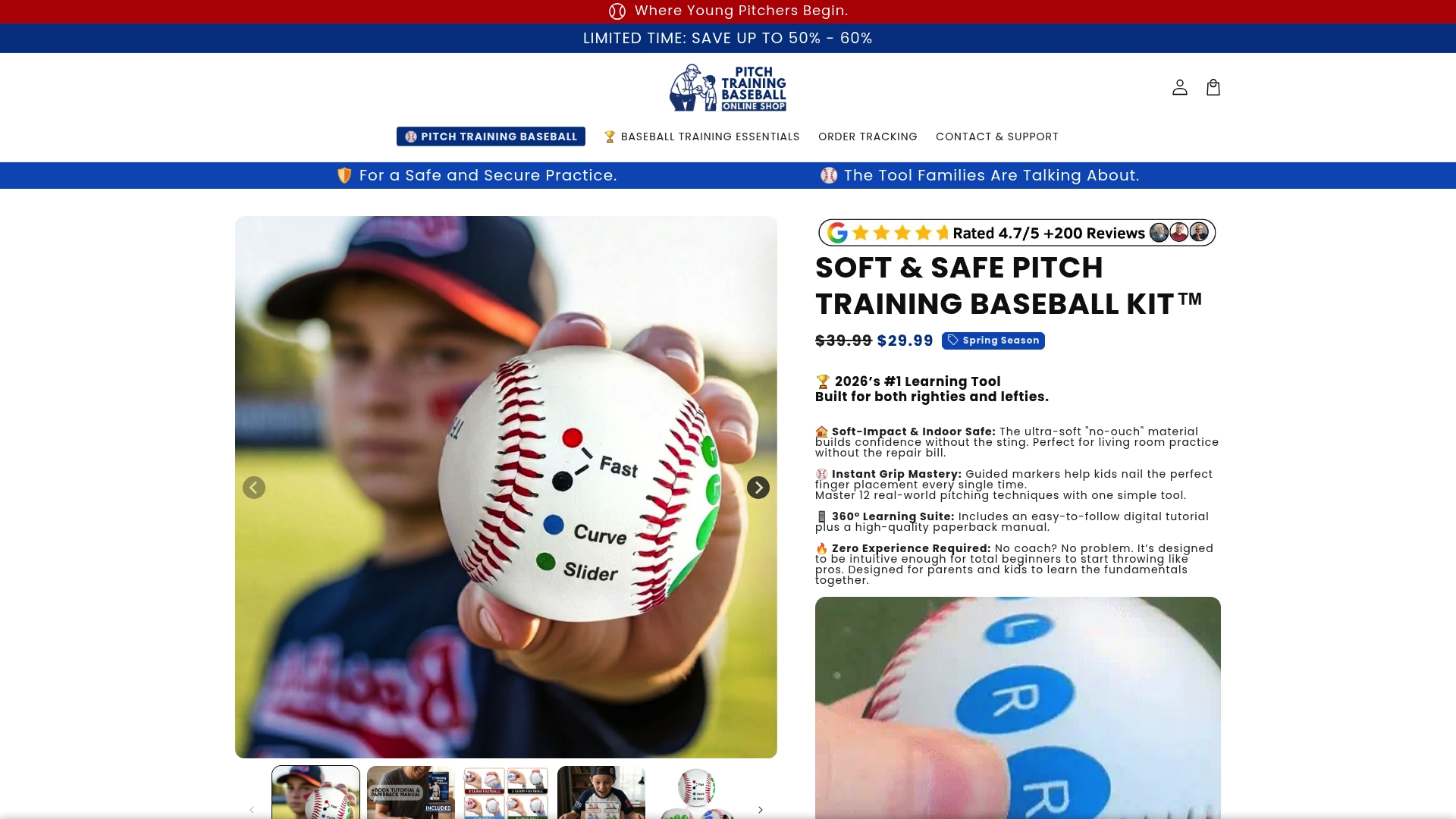
For low-intensity spin work at home or in the backyard, soft training balls let pitchers build muscle memory for the correct release without arm stress between bullpen sessions. That combination, a target for accuracy feedback and a soft ball for high-rep spin work, covers the two most important phases of slider development.
If you’re dealing with arm pain or soreness, stop throwing and consult a sports medicine professional before continuing any pitching work. Visit Pitchtrainingbaseball to see the full training lineup.
Useful sources and further reading
-
Slider (pitch) — Wikipedia): A solid starting point for velocity definitions, basic pitch comparisons, and historical context.
-
Q&A: Alan Nathan on the Physics of Pitching — FanGraphs: The clearest accessible explanation of spin axis, Magnus force, and why gyro spin produces different movement than transverse spin. Go here first for physics questions.
-
Is It Safe to Throw a Breaking Ball? — PMC/NCBI: Peer-reviewed editorial summarizing the Lyman et al. and Fleisig et al. research on youth injury risk. The most authoritative source on the age and mechanics questions.
-
Anatomy of a Pitch: Slider — The Hardball Times (FanGraphs): Detailed breakdown of slider movement profiles, tunneling data, and how the pitch compares to other breaking balls on Statcast-era metrics.
-
Tatsuya Imai’s Wrong-Way Slider — MLB.com: A specific case study on how arm slot and release position can flip slider movement direction entirely. Useful for coaches studying atypical spin profiles.
-
How to Introduce Breaking Balls Safely — Pitchtrainingbaseball: A coaching-focused progression guide for introducing sliders and curveballs to youth pitchers, with age-appropriate timelines and drill suggestions.
Recommended
- The In-Game Pitching Adjustment Process: A Coach’s Guide – Pitch Training Baseball
- The Role of Coaches in Training Youth Baseball Players – Pitch Training Baseball
- How to Plan Pitcher Rotations for Youth Baseball – Pitch Training Baseball
- Pitching Trends in 2026: What Coaches Must Know – Pitch Training Baseball