


Weighted throwing balls can add modest velocity and useful mechanical feedback, but only when programmed correctly, and the injury risk is real enough that casual use is a bad idea. A 6-week randomized study of high school athletes found a 3.3% velocity increase paired with a 24% injury rate across the program and the following season. That is the tension every coach and parent needs to sit with before handing a player a heavier ball.
Here is the short version:
- Effect size is real but small. Most controlled work points to single-digit percentage velocity gains, not dramatic jumps.
- Injury signals are documented, not theoretical. The same trial that showed a velocity bump also showed a meaningfully elevated injury rate.
- Fit matters more than the ball. Mature, mechanically sound throwers with a strength base and no current arm pain are reasonable candidates under supervision. Skeletally immature players without that foundation are not.
If your player fits the second group, the smartest move is building a throwing base first and revisiting weighted work later.
Key Takeaways
Weighted throwing balls can produce modest velocity gains and useful mechanical feedback, but only inside an individualized, workload-monitored program built on a solid strength and mechanics base.
| Point | Details |
|---|---|
| Gains are modest | Controlled research points to single-digit percentage velocity increases, not dramatic jumps. |
| Injury risk is documented | A 6-week trial cohort showed a 24% injury rate alongside its velocity gain. |
| Drill choice changes risk | Crow-hop and flat-ground throws stress joints differently than mound pitching, independent of ball weight. |
| Screen before starting | Skeletal maturity, strength base, and pain-free mechanics should come before any weighted-ball work. |
| Pitchtrainingbaseball supports safe progression | Its training ball sets and safe-use guide are built around age-appropriate weight increments and workload monitoring. |
Table of Contents
- What Are Weighted Throwing Balls and How Are They Categorized?
- Do Weighted Balls Actually Improve Velocity and Strength?
- Is There Solid Evidence Weighted-Ball Programs Are Safe?
- How Do You Build a Safe Weighted-Ball Program?
- Which Drills Work Best With Each Ball Type?
- How Should You Choose a Weighted Ball for Youth Players?
- How Do You Take Care of Weighted Training Balls?
- Why Programming Discipline Matters More Than the Ball Itself
- Train Smarter With the Right Equipment and Guidance
- Sources
What Are Weighted Throwing Balls and How Are They Categorized?
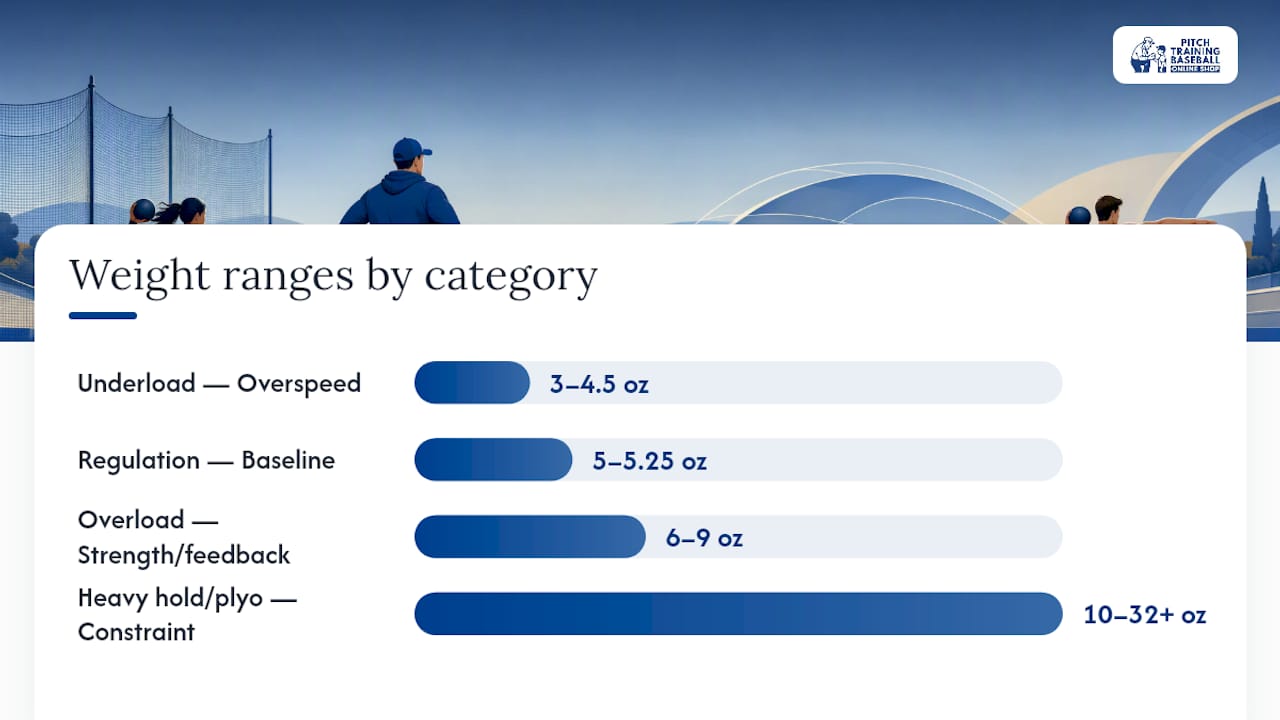
Weighted throwing balls fall into four practical categories, and mixing them up is one of the most common ways programs go sideways. Each one trains something different, and none of them substitute for the others.
Underload balls are lighter than a regulation baseball, typically in the 3 to 4.5 ounce range. Coaches use them for overspeed training, the idea being that a lighter implement lets the arm move faster than it can with a standard ball, which can help cue arm speed once mechanics are already solid.
Regulation-weight balls sit at 5 to 5.25 ounces, the standard baseball weight, and serve as the control point every other category is measured against.
Overload balls run slightly heavier, usually 6 to 9 ounces, and are used for submaximal strength and mechanical-feedback drills rather than max-effort mound work. A biomechanics analysis found that mass changes shift joint kinematics and kinetics depending on the drill. Overload work behaves differently than underload work, even though both get lumped into “weighted-ball training” casually.
Heavy holds or plyo balls range from roughly 10 ounces up past 32 ounces and are built for constraint-style drills like rebounds and reverse throws, not throwing for distance or velocity.
| Category | Typical weight range | Primary use |
|---|---|---|
| Underload | 3–4.5 oz | Overspeed/arm-speed cueing |
| Regulation | 5–5.25 oz | Baseline control and mechanics |
| Overload | 6–9 oz | Submax strength, mechanical feedback |
| Heavy hold/plyo | 10–32+ oz | Constraint drills, recovery work |
Pro Tip: Youth hands are smaller and grip strength is still developing, so a ball’s seam height and surface texture matter as much as its weight. A slick, high-seam ball built for an adult grip can force a young pitcher into a bad release just to hang onto it.
Do Weighted Balls Actually Improve Velocity and Strength?
Weighted-ball work can move the needle on a few specific things: modest velocity gains for some athletes, increased shoulder external rotation, and better mechanical feedback during submax drills. None of that is guaranteed, and none of it is dramatic.
- Velocity gains in controlled studies tend to be small and inconsistent between athletes.
- Shoulder external rotation range often increases with underload and overload work combined, according to a clinical viewpoint on weighted-ball safety and efficacy, though that same increase in range is part of what raises injury concern.
- Mechanical cueing, especially with underload balls, helps some pitchers feel arm speed and sequencing better than a regulation ball does.
- Not everyone responds. Some athletes see no change, and a few see a velocity decline, particularly if the program adds volume without enough recovery.
By the numbers: The most cited controlled trial found a 3.3% velocity increase over six weeks. That is a real gain, but it is not the double-digit jump marketing copy sometimes implies, and it came bundled with a substantial injury rate in the same cohort.
The honest takeaway is that weighted balls are a tool for fine-tuning an already-sound arm, not a shortcut around strength training, mechanics work, or time.
Is There Solid Evidence Weighted-Ball Programs Are Safe?
The evidence is real, but it is thinner than most sales pages suggest. The same 6-week randomized trial that produced the 3.3% velocity gain also tracked a 24% injury rate for shoulder or elbow issues across the program and the following season. That number is the single most important data point in this entire conversation, and it belongs in every conversation about whether to start a young pitcher on weighted balls.
A systematic review of weighted-ball training backs up the caution: velocity can increase in some studies, but the overall evidence quality is graded very poor, and protocols vary so much from one program to the next that no single “safe envelope” of weights, volumes, or progressions has been established. Some reviews found that many trials do not even report injury outcomes at all, which makes it hard to know how often the 24% figure gets replicated elsewhere.
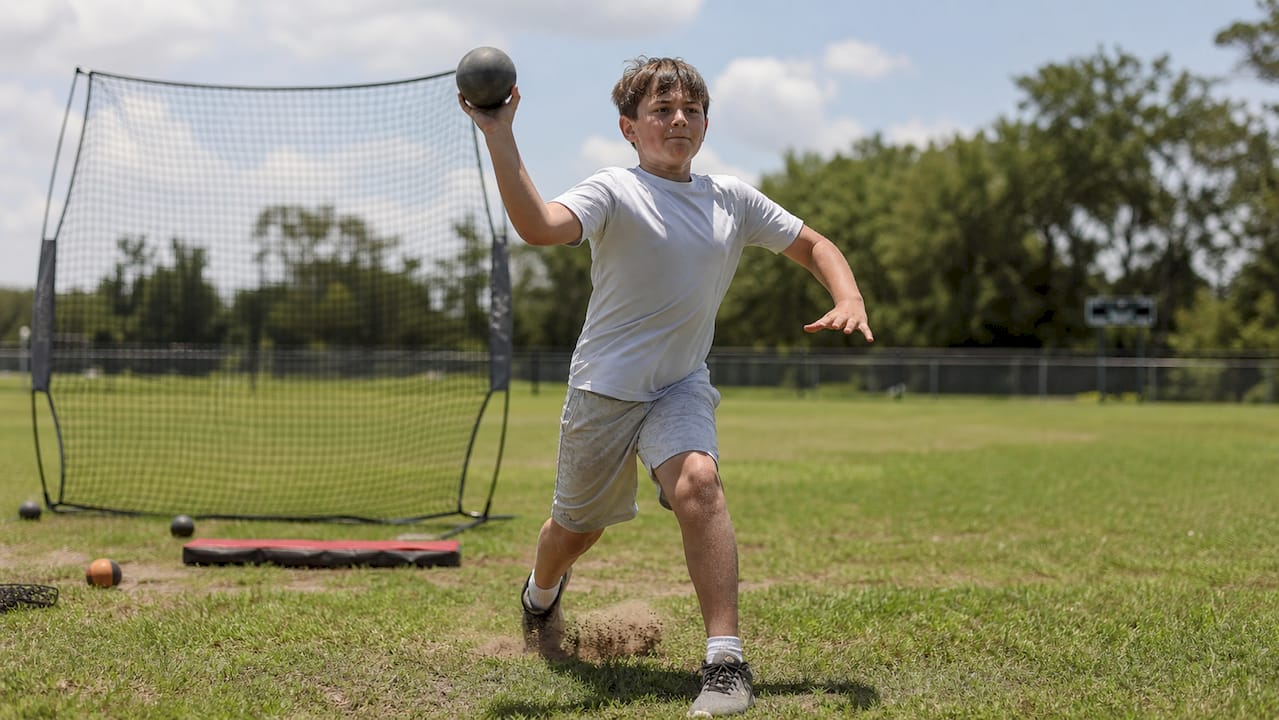
Biomechanics research fills in the mechanism. A study of 25 pitchers throwing balls from 4 to 32 ounces found ball velocity rose as mass dropped, while heavier balls reduced arm forces, torques, and overall velocity. Interestingly, flat-ground crow-hop throws produced higher joint velocities than mound pitching in that same study, which tells you that drill selection changes joint stress just as much as ball weight does. A separate lab study from Fleisig and colleagues found that bumping ball weight from 5 to 6 ounces, or increasing circumference by 5%, actually reduced elbow varus torque compared with a regulation ball. Small, deliberate overload can lower certain joint stresses even while lighter balls raise arm velocity elsewhere in the kinetic chain.
Pro Tip: When you read about a weighted-ball study, check the sample size and duration before trusting the headline number. A 6-week trial with a few dozen high schoolers tells you something real, but it is not the same weight of evidence as a large multi-year cohort. Treat small trials as a signal worth respecting, not a settled verdict.
How Do You Build a Safe Weighted-Ball Program?
Screening comes first, always. Before any player touches an overload or underload ball, check for skeletal maturity, a documented base of general strength and arm-care work, clean current mechanics, and zero current arm pain. A player without that foundation should not be starting here. Reviewing overuse injury signs beforehand gives parents and coaches a shared baseline for what “pain” versus “normal fatigue” looks like.
- Establish general strength and arm-care stability through basic conditioning and shoulder/scapular work.
- Confirm mechanics are sound using regulation-weight throws and video or coach feedback.
- Introduce light underload work in short sets, focused purely on feel and arm speed cueing.
- Return to regulation-ball throwing to confirm mechanics held under normal load.
- Add slight overload drills at submaximal effort, tracking soreness closely.
- Only after weeks of clean tolerance, introduce supervised max-effort work, and only with a coach present.
A sample 6-week block might run three weighted-ball sessions a week, each capped at 20 to 25 total weighted throws, layered onto (not added on top of) the player’s existing throwing program. Following progressive overload principles built for youth keeps volume increases gradual rather than jumping caps week to week.
Monitor soreness daily. Delayed muscle soreness that fades within 24 to 48 hours is normal. Sharp, localized joint pain, especially in the elbow or shoulder, is not, and it means stopping immediately and getting a medical evaluation rather than pushing through.
Avoid these high-risk practices entirely:
- Jumping straight to extreme overload or underload weights without a strength base.
- Reversing the weight progression abruptly (going straight to max-effort lightweight throws before building overload tolerance).
- Running full mound sessions with heavy balls instead of restricting them to flat-ground or constraint drills.
Pro Tip: Log every weighted throw the same way you log bullpen pitches. Weighted-ball volume adds to total arm stress for the week; treating it as “extra” instead of counted workload is how overuse injuries sneak up on otherwise careful programs.
Which Drills Work Best With Each Ball Type?
Drill selection matters as much as ball weight, since the same ball can be low-risk or high-risk depending on how it is thrown. Reverse throws and wall rebounds with heavy holds are constraint drills, meant for recovery and stability rather than max effort. Rocker-step throws and light crow-hop tosses with underload balls work well for arm-speed cueing at moderate effort. Flat-ground long toss with regulation or slightly overload balls builds submax strength without mound-level joint stress.
- Reverse throws (heavy hold, 14 to 32 oz): low effort, used for recovery and shoulder stability.
- Rocker-step throws (underload, 3 to 4.5 oz): moderate effort, cues arm speed and sequencing.
- Crow-hop flat-ground throws (regulation or slight overload): moderate to high effort, but remember crow-hop mechanics increase joint velocities compared with standing throws, so cap reps.
- Light-ball max-effort tosses (underload, supervised only): high effort, reserved for athletes who have already built tolerance through the earlier progression steps.
A workable session template: 5 minutes of standard arm-care warm-up, 10 minutes of weighted-ball drills mixed across categories, then a return to regulation-ball throwing to finish. That keeps total weighted-ball exposure to roughly 10 to 15 minutes inside a session that otherwise looks like normal practice, which is enough to get mechanical and strength benefit without turning practice into a specialty session. Pairing this with dedicated warm-up work beforehand reduces the odds of asking a cold arm to do submax overload work.
How Should You Choose a Weighted Ball for Youth Players?
Material and size decisions come down to durability versus feel. Leather balls hold their shape and weight longer but can be firmer on impact. Synthetic and soft-core training balls are gentler on hands during high-rep drills and tend to be the better starting choice for younger players still building grip strength and confidence.
What to check before buying:
- Weight increments are clearly and accurately labeled, not approximated.
- Seams are consistent across the set so grip feel does not change ball to ball.
- Circumference matches the player’s hand size rather than a generic “one size” youth claim.
- The set includes a sensible spread of weights for the player’s level, not just one or two extremes.
- Start with a basic three-ball spread: one underload, one regulation, one modest overload.
- Add heavy holds only once constraint drills are part of the actual program, not as an impulse buy.
- Budget for a mid-range set built with consistent manufacturing rather than the cheapest option available; inconsistent weights across a “matched” set defeat the purpose of progression training.
A quality starter set costs more than a bargain bin option, but the payoff is a spread of balls the player can actually track progress against.
How Do You Take Care of Weighted Training Balls?
- Wipe balls dry after outdoor use and store them somewhere that stays dry to prevent internal weight shift or surface breakdown.
- Inspect seams and cores regularly; retire any ball with a split, soft spot, or uneven bounce.
- Avoid repeated hard throws against concrete, which accelerates wear faster than grass or turf.
- Label each ball or set by weight clearly, since a mislabeled overload ball mixed into a light session defeats the entire progression plan.
Why Programming Discipline Matters More Than the Ball Itself
The biggest misconception in this whole conversation is that the ball does the work. It doesn’t. The research is consistent on this point: weighted-ball programs help when they are individualized, monitored for workload, and layered onto an existing base of strength and clean mechanics. They tend to hurt when they get bolted onto a throwing schedule as an “extra” without anyone counting the added reps.
What gets underestimated is how much drill selection changes risk independent of weight. A crow-hop throw with a regulation ball can stress the arm more than a standing throw with a mildly overloaded one, because the mechanics of the drill, not just the number on the ball, drive joint loading. Coaches who fixate on picking “the right weight” while ignoring drill mechanics are solving the wrong problem.
The other thing worth saying plainly: weighted balls are not a starting point. A player who hasn’t built general strength, arm-care stability, and consistent mechanics has no business skipping ahead to overload or underload work just because a program promises a velocity number. That sequencing, not the ball brand or the exact ounce count, is what separates a program that works from one that ends a season early.
Train Smarter With the Right Equipment and Guidance
Pitchtrainingbaseball builds training balls and instructional resources around the exact progression this article lays out: age-appropriate weight increments, consistent construction, and safety-first guidance instead of a single “buy this and throw harder” product.
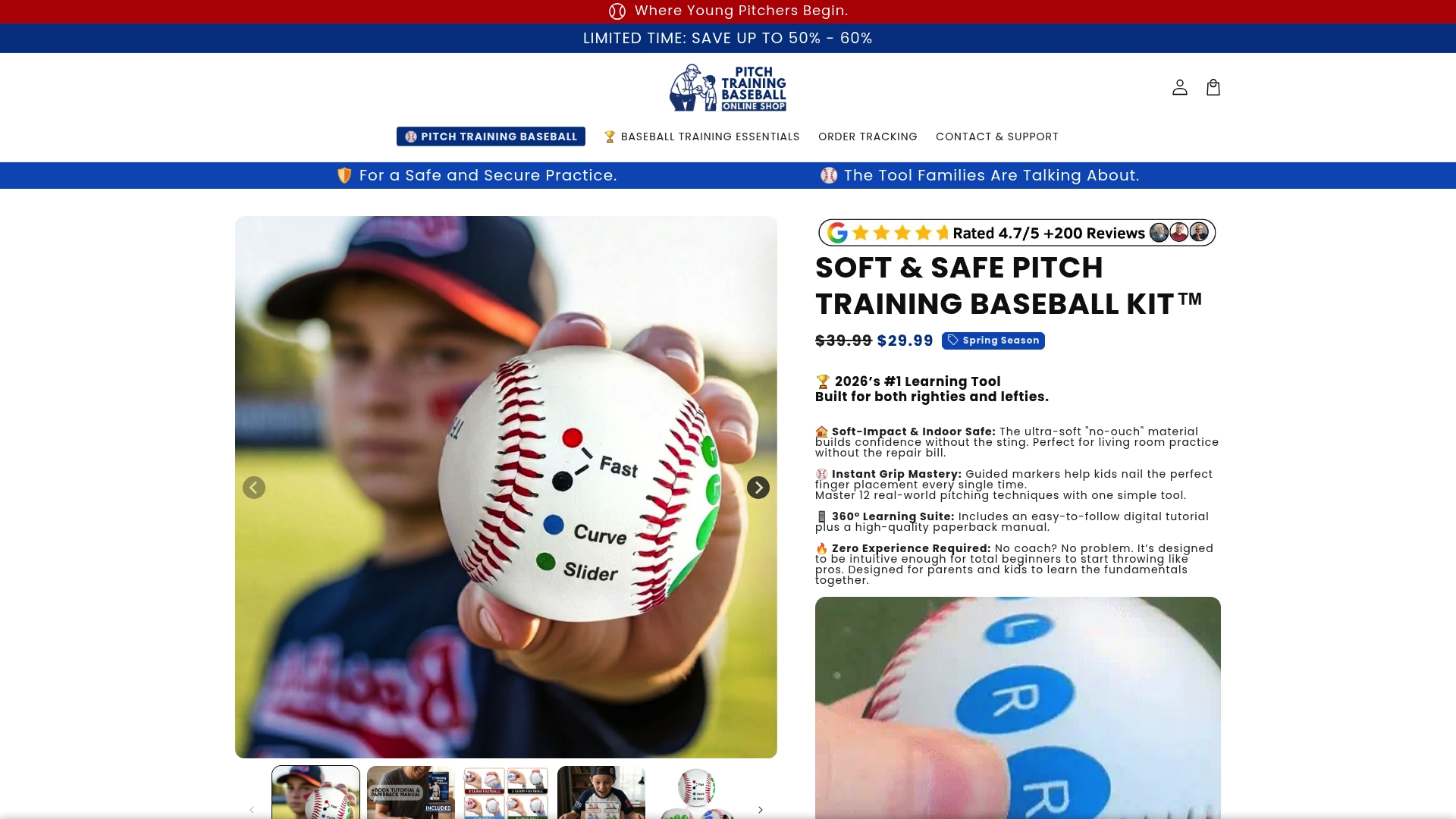
That means a set that actually lets you follow the underload-to-overload sequence without guessing whether two “5 ounce” balls from different brands are really the same weight. Pitchtrainingbaseball’s 5-ball training set gives coaches and parents a starter spread built for exactly the kind of staged program this article describes, and it pairs naturally with the pitching target net for mechanics-focused sessions once weighted work wraps up. Read the full safe-use guide for weighted balls alongside your purchase, and treat the program guidelines above as the manual that comes with it, not an optional extra. If you’re outfitting a youth pitcher this season, start with the training set and build the progression from there.
Sources
- Reinold et al. randomized trial (6-week study) — PubMed entry
- Systematic review on weighted-ball training — Journal DOI
- Biomechanics white paper (WEIGHT1.pdf) — PMR group
- The Safety and Efficacy of Weighted Baseballs — PMC clinical viewpoint
- Biomechanical analysis of weighted-ball exercises — PubMed entry
- Increases in ball weight and size decrease elbow varus torque during baseball pitching — Fleisig et al. (ASMI PDF)
Sources were selected from peer-reviewed trials, clinical viewpoints, and biomechanical analyses of pitching mechanics.
This article is general information, not a substitute for advice from a qualified doctor. Consult a qualified healthcare professional about your own circumstances before acting on anything here.
Recommended
- Weighted Balls: The Safe-Use Guide for Athletes and Coaches – Pitch Training Baseball
- Top Training Balls for Young Pitchers: Safe, Age-Appropriate Picks – Pitch Training Baseball
- Medicine Ball Workouts for Pitchers: 10 Drills That Work – Pitch Training Baseball
- Youth Sports Safety: A Practical Guide for Parents & Coaches – Pitch Training Baseball