


Pitch command is defined as a pitcher’s ability to throw each pitch to a precise, intended location at exactly the right moment, going well beyond simply throwing strikes. Where control means throwing strikes, command means placing the ball exactly where you want it, whether that’s the low outside corner, up and in, or just off the plate to bait a swing. For parents and coaches working with youth pitchers, understanding pitch command is the single most important concept separating average pitchers from effective ones. A pitcher with good command controls the at-bat. A pitcher with only good control just avoids walks.
What is pitch command vs. pitch control?
Pitch command and pitch control are not the same skill. Coaches and parents often use them interchangeably, but that confusion leads to training programs that fall short. Command is intentional pitch placement to manipulate hitter behavior, not just avoiding walks or throwing hard. That distinction changes everything about how you develop a young pitcher.
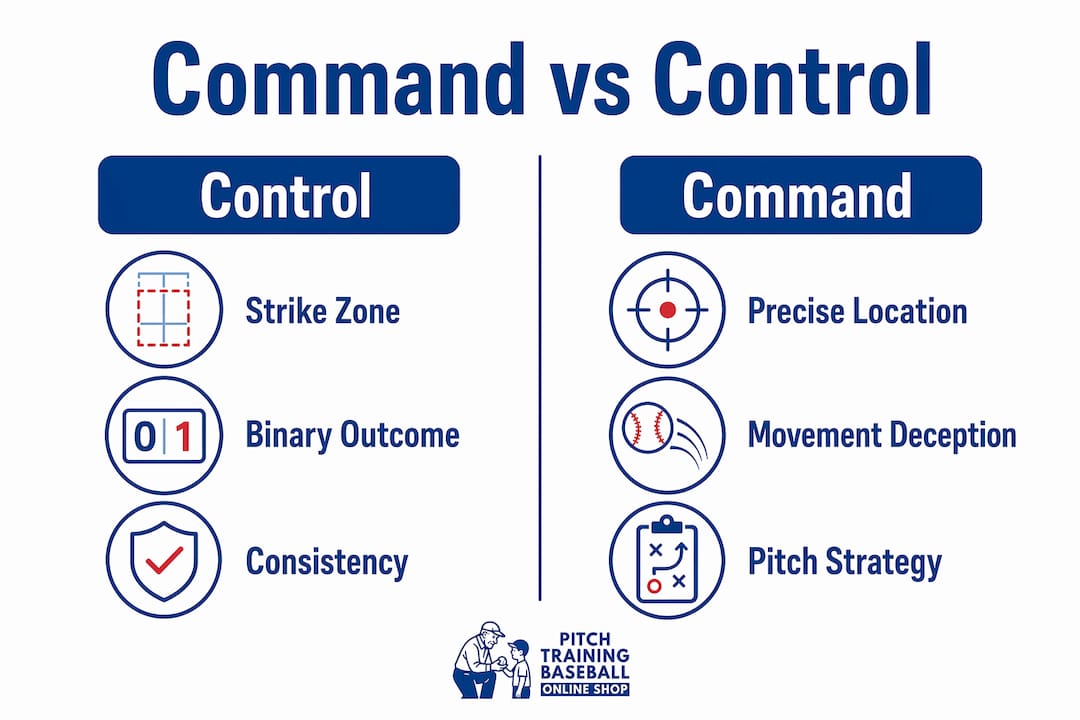
Control is binary. Either the pitch lands in the strike zone or it doesn’t. A pitcher who throws 65% strikes has good control. But if every one of those strikes lands belt-high over the middle of the plate, hitters will punish them. Command is what separates a pitcher who throws strikes from one who wins at-bats.
Here’s a clear side-by-side comparison:
| Skill | Definition | What It Achieves |
|---|---|---|
| Control | Throwing pitches within the strike zone consistently | Reduces walks, keeps pitch counts manageable |
| Command | Placing pitches to specific, intended locations | Disrupts hitter timing, generates weak contact |
| Command (advanced) | Throwing purposefully in or out of the zone | Creates chase pitches, sets up sequences |
The practical difference shows up in game situations. A pitcher with control throws a fastball for a strike. A pitcher with command throws that same fastball to the back foot of a right-handed hitter to jam them, then follows it with a changeup low and away to get a weak grounder. The second pitcher is running a plan. The first is just filling the zone.
- Command requires a pitcher to know where they want the ball before they throw it.
- Command requires consistent mechanics so the body delivers what the brain intends.
- Command requires pitch sequencing awareness, knowing how one pitch sets up the next.
- Control is a prerequisite for command, but command is the higher-level skill.
High velocity alone does not equate to command. Many hard throwers at the youth level get hit hard because they lack the ability to work corners or change eye levels. Command is what turns raw stuff into results.
Pro Tip: When watching your young pitcher in a game, don’t just track balls and strikes. Track where strikes land. A pitch down the middle and a pitch on the black are both strikes, but only one shows command.
How is pitch command measured and tracked?
Modern baseball has developed specific metrics to quantify command, moving well past simple strike percentage. These tools give coaches and parents an objective way to evaluate whether a pitcher’s location is improving over time.
Command Delta is a modern metric that measures pitch location consistency by calculating the dispersion of pitch locations relative to the intended target. Lower Command Delta values indicate tighter clusters around the target, which means better command. The metric converts this dispersion data into a 20–80 scouting scale, the same scale professional scouts use to grade tools like arm strength and speed.
Here’s how the 20–80 command scale breaks down in practical terms:
| 20–80 Grade | Command Level | What It Looks Like |
|---|---|---|
| 20–30 | Poor | Pitches scatter widely; no consistent location |
| 40–50 | Average | Hits the zone but misses intended spots often |
| 60–70 | Above average | Consistently hits corners and changes eye levels |
| 80 | Elite | Pinpoint location on demand, any pitch, any count |
A second tool worth knowing is Command+, a standardized performance metric that combines pitch shape, location, and effectiveness into a single number. It helps coaches identify which pitches a player commands best and flags when command slips in real time. That real-time feedback is what separates it from a simple strike-to-ball ratio.
Here’s why these metrics matter for youth development:
- Track progress objectively. Strike percentage can stay flat while command improves. Metrics like Command Delta reveal that hidden progress.
- Identify pitch-specific weaknesses. A pitcher might command the fastball well but scatter the curveball. Metrics show exactly where to focus.
- Distinguish luck from skill. A good outing with poor command metrics signals the pitcher got lucky. A tough outing with strong metrics signals the process is working.
- Guide pitch selection decisions. Command+ acts as a real-time feedback tool that validates a pitcher’s internal feel, separating genuine performance shifts from random variation.
You don’t need professional-grade technology to apply this thinking at the youth level. Even a simple chart tracking where pitches land in the zone during bullpen sessions gives you actionable data. Pitchtrainingbaseball recommends pairing this kind of tracking with game-like pitching practice to make the data meaningful.
Does pitch command go beyond accuracy?
The most common mistake coaches make is treating command as a pure accuracy problem. It isn’t. Pitchers with elite command use stable mechanics to reduce the visual cues that hitters rely on, forcing batters to guess and commit earlier. That’s deception, not just precision.
Researchers and pitching coaches refer to these visual cues as “specifying variables.” These are the subtle signals in a pitcher’s motion that tell a hitter what’s coming and where it’s going. A pitcher with poor command often has inconsistent mechanics that unintentionally telegraph pitch type or location. A pitcher with true command has a delivery that looks identical on every pitch, stripping the hitter of information.
“Command isn’t accuracy. It’s deception. The goal isn’t to aim at a spot. The goal is to build a movement system that naturally hides pitch intent.” — Florida Baseball ARMory
This reframes the entire purpose of command training. You’re not just trying to hit a target. You’re trying to build a delivery that gives hitters nothing to read.
The elements that contribute to deceptive command include:
- Consistent stride length and direction so hitters can’t read release point changes.
- Stable posture through the delivery so the arm path looks the same on every pitch.
- Repeatable timing and rhythm so hitters can’t time the release by watching the body.
- Arm speed consistency across pitch types so a changeup doesn’t tip itself off.
Training command through rhythm and movement coherence rather than strict aiming cues builds this deceptive delivery system naturally. When a pitcher focuses only on “hit the glove,” they often tighten up and lose the fluid mechanics that create deception. The better coaching cue is to focus on the feel of the delivery, then let location follow.
Pro Tip: Have your pitcher throw a bullpen session with no target at all. Focus entirely on rhythm and arm speed consistency. Then add the target back. Many youth pitchers find their location actually improves when they stop consciously aiming.
Understanding how command connects to pitch selection strategy is the next step once a pitcher grasps the deception concept. Command and selection work together to keep hitters off balance.
How do you develop pitch command in youth players?
Building command in a young pitcher takes a specific approach. Generic “throw more strikes” coaching does not develop command. It develops a pitcher who aims at the middle of the plate and hopes for the best. The methods below are grounded in how command actually develops as a motor skill.
1. Start with lighter training balls.
Effective command training begins with lighter balls that allow young arms to feel the delivery without fighting the weight of a regulation ball. Products like training softballs and pickleballs let pitchers focus on mechanics and feel before adding the demands of a full-weight ball. Progress to regulation weight as mechanics stabilize.
2. Build a pre-pitch routine.
Command is partly mental. A pitcher who steps on the rubber without a clear picture of where the pitch is going will rarely execute. Teach your pitcher to visualize the exact spot before every throw, not just “low and away” but a specific corner of the zone. This mental rehearsal builds the connection between intent and execution.
3. Use variability drills with purpose.
Throwing to the same spot repeatedly builds muscle memory but not adaptability. Variability training means changing the target location on every pitch, forcing the pitcher’s motor system to recalibrate constantly. This builds a more flexible and durable command skill that holds up under game pressure.
4. Prioritize rhythm over mechanics.
Command grows from movement coherence, not from hitting mechanical checkpoints. Coaches who give pitchers a list of positions to hit during the delivery often produce stiff, robotic throwers with poor command. Instead, focus on the feel of a smooth, connected delivery. Mechanical corrections should serve rhythm, not replace it.
5. Practice in game-like conditions.
A pitcher who commands the ball perfectly in a quiet bullpen but falls apart in a game has not truly developed command. Game-like practice means adding simulated pressure: a batter standing in the box, a count on the scoreboard, a specific game situation to execute. Game-like pitching practice accelerates command development because it trains the skill in the context where it actually needs to work.
6. Use a pitching target with defined zones.
Visual feedback is one of the fastest ways to build command awareness. A pitching target net with a defined strike zone gives a pitcher immediate feedback on location without needing a catcher. It also makes solo practice sessions productive and focused.
Pro Tip: Avoid correcting location mid-session with verbal cues like “you’re missing outside.” Instead, ask your pitcher where they were trying to throw. If their intent and execution don’t match, that’s a mechanics conversation. If they weren’t sure where they were throwing, that’s a focus conversation.
Solid pitching technique fundamentals underpin all of this. Command development without a sound mechanical foundation is building on sand.
Key takeaways
Pitch command is the highest-level pitching skill in youth baseball, combining precise location, deceptive mechanics, and mental intent to control hitters rather than just avoid walks.
| Point | Details |
|---|---|
| Command vs. control | Control means throwing strikes; command means placing pitches exactly where intended to disrupt hitters. |
| Deception is central | Stable, consistent mechanics hide pitch intent from hitters, making command more than pure accuracy. |
| Metrics reveal progress | Tools like Command Delta and Command+ track location precision beyond simple strike percentage. |
| Training method matters | Rhythm-based, game-like practice builds command faster than mechanical checklists or repetitive drills. |
| Start with the right tools | Lighter training balls and pitching target nets with defined zones accelerate command development in youth pitchers. |
What i’ve learned watching youth pitchers develop command
The biggest mistake I see parents and coaches make is celebrating strike percentage as the goal. A kid who throws 70% strikes but lives in the middle of the zone is not developing command. They’re developing a habit that will get them hit hard the moment they face better hitters.
Command takes longer to develop than control, and that patience is hard to sell to a parent watching their kid walk batters. But the research is clear. Intentional pitch placement is what separates pitchers who succeed at higher levels from those who plateau. Rushing a young pitcher toward strike percentage at the expense of location awareness creates a ceiling they’ll hit around age 14.
The deception piece surprises most coaches when they first encounter it. The idea that command is about hiding information from hitters, not just hitting a spot, changes the entire training philosophy. Once you accept that, you stop yelling “hit the glove” and start asking “did that delivery feel the same as the last one?” That shift in coaching language produces better pitchers.
I also think data tools like Command+ and Command Delta are underused at the youth level. You don’t need a Rapsodo unit to apply the concept. A simple chart tracking pitch location in a bullpen session gives you more useful information than a radar gun reading. Command should be tracked by pitch type over time, not just measured in a single outing.
The pitchers who master command early are the ones who advance. Not the hardest throwers. Not the tallest kids. The ones who can put the ball where they want it, when they want it, while giving hitters nothing to read.
— Albert
Build pitch command with the right training tools
Understanding pitch command is the first step. Giving your pitcher the tools to practice it is the second.
Pitchtrainingbaseball offers training aids designed specifically for command development in youth players. The Pitching Target Net with Strike 9-Zone gives pitchers a colorful, defined target that reinforces location awareness on every throw. For pitchers building up from lighter loads, the Pitch Training Softball and 5 Pickeballs let young arms develop feel and mechanics before moving to a regulation ball. Browse the full baseball training essentials collection to build a complete practice setup that turns command concepts into real results.
FAQ
What is pitch command in baseball?
Pitch command is the ability to throw each pitch to a specific, intended location, whether inside the zone or just off it, to influence hitter decisions. It goes beyond throwing strikes by adding purpose and precision to every pitch.
How is pitch command different from pitch control?
Control is the ability to throw strikes consistently within the strike zone. Command is the ability to place pitches exactly where intended, including spots outside the zone designed to generate chases or weak contact.
Can youth pitchers develop command at a young age?
Yes. Youth pitchers can begin developing command through rhythm-based training, pre-pitch visualization, and variability drills. Starting with lighter training balls and using pitching target nets with defined zones accelerates this development.
What does command delta measure?
Command Delta measures the dispersion of a pitcher’s pitch locations relative to the intended target, converted to a 20–80 scouting scale. Lower values indicate tighter location clusters and better command.
Why do coaches say command is about deception?
Pitchers with high command use stable, consistent mechanics to remove the visual cues hitters use to anticipate pitch type and location. That consistency forces hitters to guess, making command a tool of deception as much as precision.