


If you’ve ever watched your kid throw and wondered why their arm looks different from a teammate’s, you’ve already noticed pitching arm slot in action. Understanding what is pitching arm slot is one of the most overlooked pieces of the youth baseball puzzle. It affects how a pitch moves, how much stress lands on a young elbow, and whether a mechanical tweak will help or hurt. The good news: once you understand how arm slot actually works, you can make smarter decisions as a parent, player, or coach.
Table of Contents
- Key takeaways
- What is pitching arm slot, exactly?
- How arm slot shapes pitch movement and spin
- Arm slot, joint stress, and injury risk
- The biggest misconception about arm slot
- How to improve arm slot naturally
- My honest take after years around the mound
- Build better mechanics with the right training tools
- FAQ
Key takeaways
| Point | Details |
|---|---|
| Arm slot is the release angle | It measures the angle of the pitching arm at release, ranging from sidearm to straight overhand. |
| Four main slot categories exist | Overhand, three-quarters, sidearm, and submarine each produce distinct pitch movement and spin. |
| Lower slots reduce joint stress | Research shows lower arm positions cut elbow and shoulder torque without losing throwing velocity. |
| Arm slot is body-driven | It emerges from the pitcher’s natural motor system and posture, not from a conscious arm decision. |
| Posture changes beat arm tweaks | Improving trunk control and scapular mobility is the safest way to naturally optimize arm slot. |
What is pitching arm slot, exactly?
Pitching arm slot is the angle of the throwing arm at the moment the pitcher releases the baseball. Think of it like a clockface attached to your shoulder. Arm slot ranges from 0 degrees, which is purely sidearm, all the way up to 90 degrees, which is straight over the top. Most pitchers land somewhere in between.
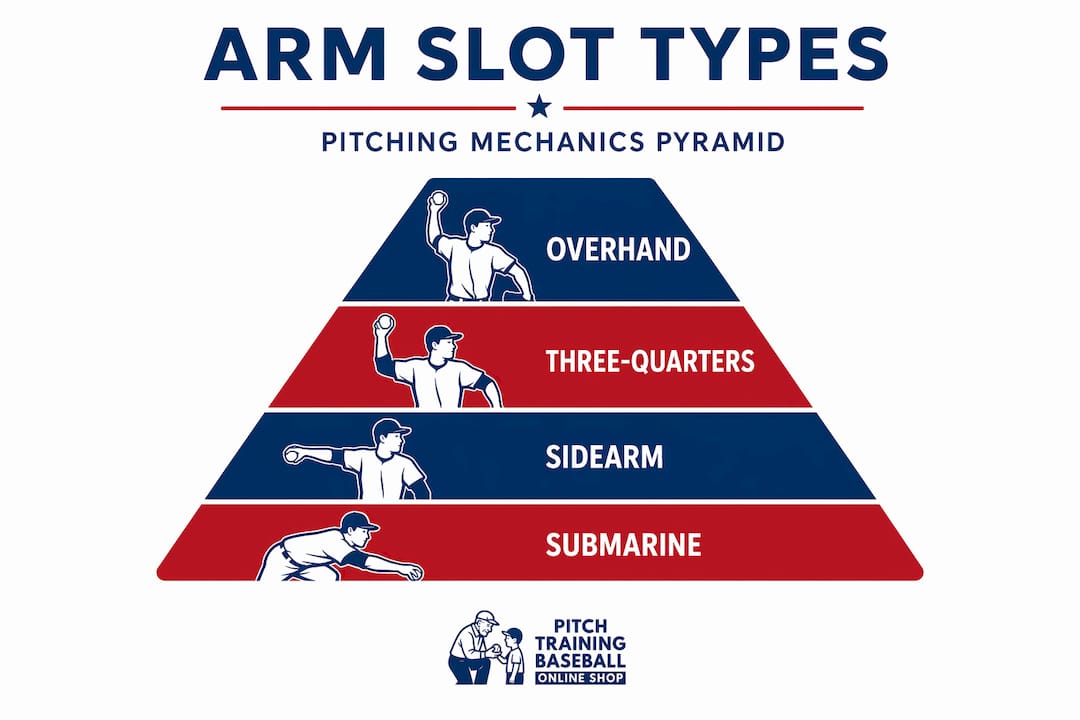
The four main arm slot categories
Coaches and scouts typically describe arm slot in four general groups. Here is a quick breakdown of each:
| Arm slot | Clock position | Typical pitch behavior | Common use |
|---|---|---|---|
| Overhand | 12 o’clock | High backspin, sharp downward break | Fastballs with downward plane |
| Three-quarters | 10 to 11 o’clock | Lateral and vertical movement blend | Most common in youth and pro ball |
| Sidearm | 9 o’clock | Heavy horizontal break, runs into same-side hitters | Platoon specialists, relief pitchers |
| Submarine | Below 9 o’clock | Extreme rise effect on hitters, unusual trajectory | Rare, highly deceptive |
The three-quarters slot is by far the most natural for most young players. You will see it across every level of the game because it sits in the zone where arm mechanics feel comfortable and pitches move in predictable ways.
How arm slot connects to release height
Release height and arm slot are related but not the same thing. A tall pitcher throwing three-quarters and a shorter pitcher throwing overhand might release the ball at similar heights, but the angle of their arms at that release point will differ. That angle is what defines arm slot. Trunk tilt and posture patterns play a large role here. Overhand pitchers tend to show significantly more lateral trunk tilt and forward flexion compared to sidearm pitchers, which naturally pushes the apparent arm slot higher.
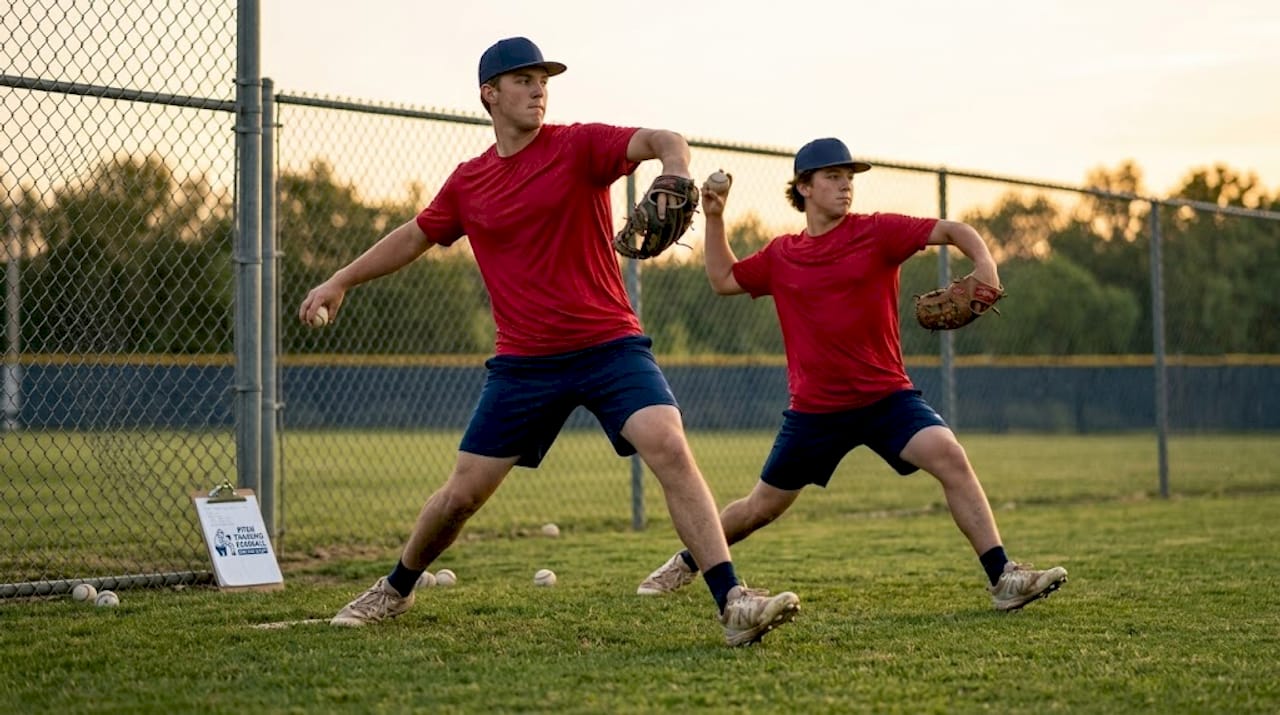
Pro Tip: When evaluating a young pitcher’s arm slot, video them from directly behind the mound. That angle gives you the clearest view of where the arm actually sits at release, not where it appears from the dugout.
How arm slot shapes pitch movement and spin
Arm slot does not just describe where the arm is. It determines how the baseball spins off the fingertips and, as a result, how the pitch moves toward home plate.
When a pitcher throws overhand, the ball gets more pure backspin on a fastball. That backspin creates the sensation of “rise” that hitters describe, keeping the pitch on a flatter plane than gravity alone would produce. Drop down to sidearm, and the spin axis rotates toward the horizontal. Now that same fastball runs hard into a same-handed batter or cuts sharply away from an opposite-handed one.
The performance impact is real at every level
Emerson Hancock’s arm slot change is one of the clearest modern examples of this in action. He lowered his slot from 27 degrees down to 13 degrees in 2026, and the result was improved spin efficiency, better pitch shape, and an ERA of 3.21 with a 1.01 WHIP. That is not a coincidence. A lower slot changed how his pitches interacted with the strike zone and how batters read them out of his hand.
Here is what changes mechanically when arm slot shifts:
- Fastball spin axis rotates from 12 to 6 o’clock (overhand) toward 3 to 9 o’clock (sidearm), changing movement direction entirely
- Curveball shape moves from a traditional 12 to 6 break toward a sweeping lateral plane as the slot lowers
- Slider and cutter movement often sharpens with lower slots because of increased horizontal spin
- Deception angle changes for the batter, who must read arm action from a different launch window
For young pitchers, understanding this connection helps explain why a coach might encourage a slightly different slot as a kid develops new pitch types. It is not random. There is a direct mechanical reason tied to arm slot and pitch movement.
Arm slot, joint stress, and injury risk
This is where arm slot stops being just a performance topic and becomes a health topic for every parent in the stands.
Research on elite college pitchers shows that elbow varus torque increases approximately 4.23 N for every 10-degree rise in arm slot angle. In plain terms: the higher the arm slot, the more stress piles onto the inside of the elbow. The study also found that velocity showed no significant difference across arm slot variations. That is a critical finding. Higher stress does not buy you more speed.
What this means for youth pitchers
Youth elbow and shoulder tissue is still developing. Growth plates are open. Ligaments are not fully mature. The UCL, which is the ligament that Tommy John surgery repairs, sits directly in the path of that elbow torque load. Any factor that increases that load without a corresponding performance benefit deserves serious attention.
The good news is that sidearm pitchers show lower elbow and shoulder torque compared to their overhand counterparts, and their average velocity of 86.3 mph showed no significant drop. You do not have to sacrifice speed to protect the arm.
Key factors that influence arm slot safety for young players:
- Trunk posture and spinal position at the point of foot plant affect how the arm loads
- Scapular mobility determines how freely the shoulder blade glides and supports the arm path
- Hip to shoulder separation controls how much rotational energy gets transferred to the arm
- Rib cage position limits or enables scapular motion, directly affecting arm path control
Pro Tip: If your young pitcher complains of elbow soreness on the inner side after games, have a pitching coach check their arm slot and trunk tilt together. Inner elbow pain in youth pitchers is a warning sign tied directly to elevated joint torque loads.
Tracking pitch counts matters, but tracking mechanics matters just as much. Pitchtrainingbaseball has a helpful resource on how to track pitching stats to protect arm health over a full season.
The biggest misconception about arm slot
Here is what most parents and many coaches get wrong: arm slot is not a setting you can just turn up or down.
Arm slot is not a mechanical choice that a pitcher makes consciously. It emerges from the pitcher’s natural motor preferences, body organization, and spinal mobility patterns. Four natural release windows exist based on how a pitcher’s body is oriented vertically or horizontally and where their spine’s mobile point sits. These windows shape what feels natural and what actually works during a high-speed throw.
Think about it this way. When you tell a kid to “raise your arm slot,” their nervous system has to override what feels natural to the body. That is not a small ask. The motor system is optimized over years of movement, and forcing the arm against that grain without addressing the underlying body position is like trying to change where a river flows by pushing the water rather than reshaping the banks.
Here is why this matters practically:
- Forcing an arm slot change without addressing posture first will usually fail or cause new mechanical problems
- The pitcher’s vertical or horizontal body orientation determines which of the four natural release windows they belong in
- Coaches should focus on identifying the natural slot and optimizing around it, not replacing it
- Changing arm slot effectively at the professional level almost always involves adjusting plant foot position, shoulder level, and delivery posture rather than directly manipulating the arm path
“Arm slot changes should be seen as changes in how the whole body moves toward the plate. The goal is to pitch like a Ferris wheel rather than a merry-go-round so energy flows efficiently from the ground up.”
That framing changes everything. The arm is the last link in the chain. Fix the chain, and the arm follows.
How to improve arm slot naturally
If forcing changes is risky and counterproductive, what should parents and young pitchers actually do? The answer is to build the physical foundation that allows the arm to find its best natural slot.
Flexibility in pitching is a foundational piece of this puzzle. Tight hips, a stiff thoracic spine, and limited shoulder mobility all push the body into compensations that distort arm slot. Here is where to focus training energy:
- Thoracic spine rotation drills such as thread-the-needle stretches and cat-cow variations free up the upper back, which directly affects how the shoulder moves at release
- Scapular stability exercises including band pull-aparts, face pulls, and wall slides train the shoulder blade to move properly across the rib cage
- Hip mobility work like 90/90 hip stretches and leg swings allow full hip-to-shoulder separation during the delivery
- Single-leg balance drills build the lower body control needed to maintain consistent posture at foot plant, which is when trunk tilt and arm slot get set
Coaching strategy matters just as much as physical preparation. Rather than pointing at arm position during a throw, a good pitching coach will adjust where the plant foot lands, how the lead shoulder stays closed, and whether the trunk stays tall or collapses. Those changes naturally move the arm slot because the arm follows the body.
Pro Tip: Film your young pitcher from behind and from the side on the same day. Compare the two views side by side. If the arm slot looks different from each angle, the issue is almost always trunk tilt or balance, not the arm itself.
Building arm strength for baseball through structured workouts also supports healthy slot development. A stronger arm within a mobile, well-controlled body produces better mechanics over time.
My honest take after years around the mound
I’ve watched coaches spend entire practice sessions telling kids to “get on top of the ball” or “raise your elbow,” and I’ve seen those same kids walk away more confused and tighter than before. The arm slot conversation in youth baseball is broken in one specific way: it treats the arm like it operates independently from the rest of the body.
What I’ve learned is that the body has a vote, and it almost always wins. A twelve-year-old whose natural slot is three-quarters is not going to become an overhand pitcher just because a coach says so. What they might become is a twelve-year-old with elbow soreness and a hitch in their delivery that nobody can explain.
The research backs this up. Youth pitchers need customized approaches that account for their developmental stage, not a one-size-fits-all arm angle handed down from a pro broadcast. What works for a fully developed adult with years of motor patterning does not automatically translate to a growing kid.
My actual advice to parents: stop focusing on where the arm is and start asking about how the whole body moves. Watch the hips. Watch the trunk. Watch where the stride foot lands. If those pieces are working well, the arm almost always finds a healthy, natural slot on its own. If they are not, no amount of arm position coaching will fix the downstream problem.
The pitchers I’ve seen develop the best long-term mechanics are the ones whose coaches respected their natural movement patterns and built physical capacity around them. That is not passive coaching. That is smart coaching.
— Albert
Build better mechanics with the right training tools
When your young pitcher is ready to put these concepts into practice, having the right equipment makes every rep count.
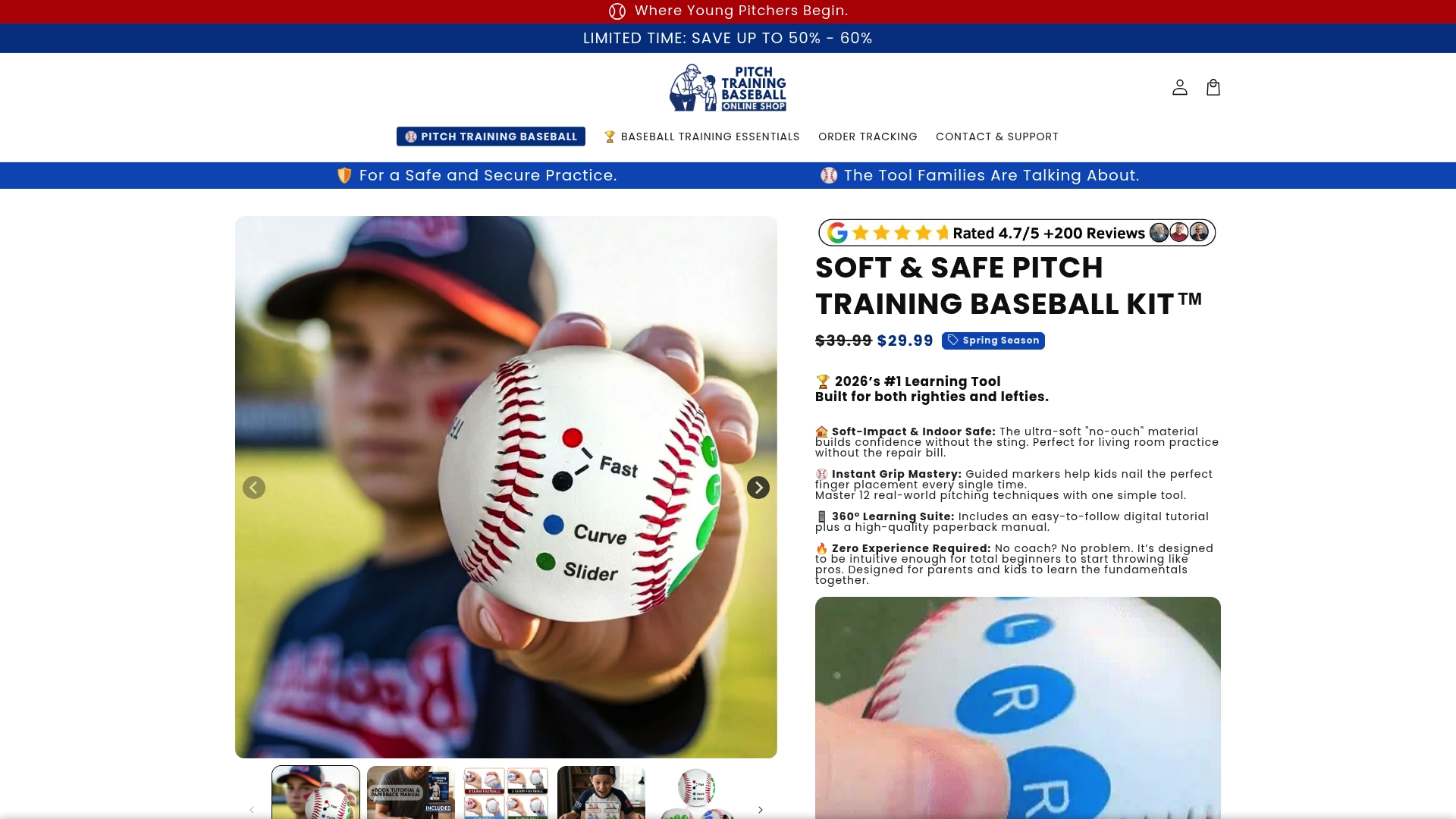
Pitchtrainingbaseball designs training tools specifically for young players who want to build real pitching skills without guessing. The Pitching Target Net with Strike 9-Zone gives pitchers immediate visual feedback on location and release angle, which reinforces proper mechanics during solo practice. The Pitch Training Baseball is built to develop grip control and arm path awareness from the very first throw. Both tools work together to build the muscle memory and body awareness that support a natural, healthy arm slot over time. Browse the full product line at Pitchtrainingbaseball to find the right setup for your player’s age and skill level.
FAQ
What is pitching arm slot in simple terms?
Pitching arm slot is the angle of the throwing arm at the moment of ball release, measured from the shoulder. It ranges from flat sidearm (0 degrees) to straight overhand (90 degrees), with most pitchers falling in a three-quarters position.
Can a young pitcher change their arm slot?
Arm slot is not a direct mechanical choice. It emerges from the pitcher’s body organization and motor patterns, meaning effective changes require adjusting posture, trunk tilt, and foot position rather than the arm itself.
Does arm slot affect injury risk for youth pitchers?
Yes. Higher arm slots increase elbow torque by approximately 4.23 N per every 10-degree rise, with no corresponding gain in velocity, making lower slots generally safer for developing pitchers.
What arm slot do most youth pitchers use?
The three-quarters slot, roughly the 10 to 11 o’clock position on a clockface, is the most common and natural for most youth pitchers. It balances pitch movement, velocity, and joint comfort effectively.
How do I know if my child’s arm slot is healthy?
Watch for inner elbow pain, inconsistent mechanics, or unusual trunk compensation during the delivery. A qualified pitching coach can assess whether the natural arm slot is being supported or forced into a position that creates unnecessary stress.