


Stretching more does not automatically make a young pitcher better. That idea is worth stopping on, because the role of flexibility in pitching is far more nuanced than most parents and coaches realize. Flexibility matters deeply, but only when it works alongside strength, sound mechanics, and smart workload management. Get that balance right and your young athlete moves more freely, throws with better control, and stays healthier. Get it wrong and you can actually increase their injury risk while chasing gains that will never come from stretching alone.
Table of Contents
- Understanding flexibility’s role in youth pitching mechanics
- The balance between strength, range of motion, and injury risk
- Workload management and flexibility: The safety net for young pitchers
- Integrating flexibility with mechanics and training drills for effective pitching
- Returning from injury: Role of flexibility in rehabilitation and gradual progression
- Reconsidering flexibility: Why “more” isn’t always better in youth pitching
- Enhance your young pitcher’s flexibility and control with expert training tools
- Frequently asked questions
Key Takeaways
| Point | Details |
|---|---|
| Flexibility supports pitching mechanics | Proper functional flexibility enables efficient energy transfer and less arm stress during pitching. |
| More is not always better | Excessive flexibility without strength can increase injury risk in youth pitchers. |
| Workload controls matter | Pitch counts and rest are essential safety measures that complement flexibility training. |
| Mechanics are key | Emphasizing balance, stride, and arm path drills leads to better control and injury prevention. |
| Rehab requires full recovery | Pain-free range of motion and strength are vital before safely returning to pitching. |
Understanding flexibility’s role in youth pitching mechanics
Pitching is not a single-joint movement. It is a coordinated sequence of the whole body, where energy starts at the feet, travels through the hips, and finally transfers into the arm and out through the fingertips. Every joint in that chain needs adequate mobility to allow that energy to flow without redirection or compensation. When one link is restricted, the body finds another way, and that workaround is usually what causes pain over time.
Hip and shoulder mobility are the two areas that most directly affect pitching mechanics. During the stride phase, a pitcher needs hip external rotation to open toward the plate while the back hip drives forward. Without that range, the torso compensates by over-rotating early, which throws off timing and places excess stress on the shoulder and elbow. During arm cocking, adequate shoulder external rotation allows the arm to lay back efficiently. Without it, the elbow rises or the arm drags, and control suffers.
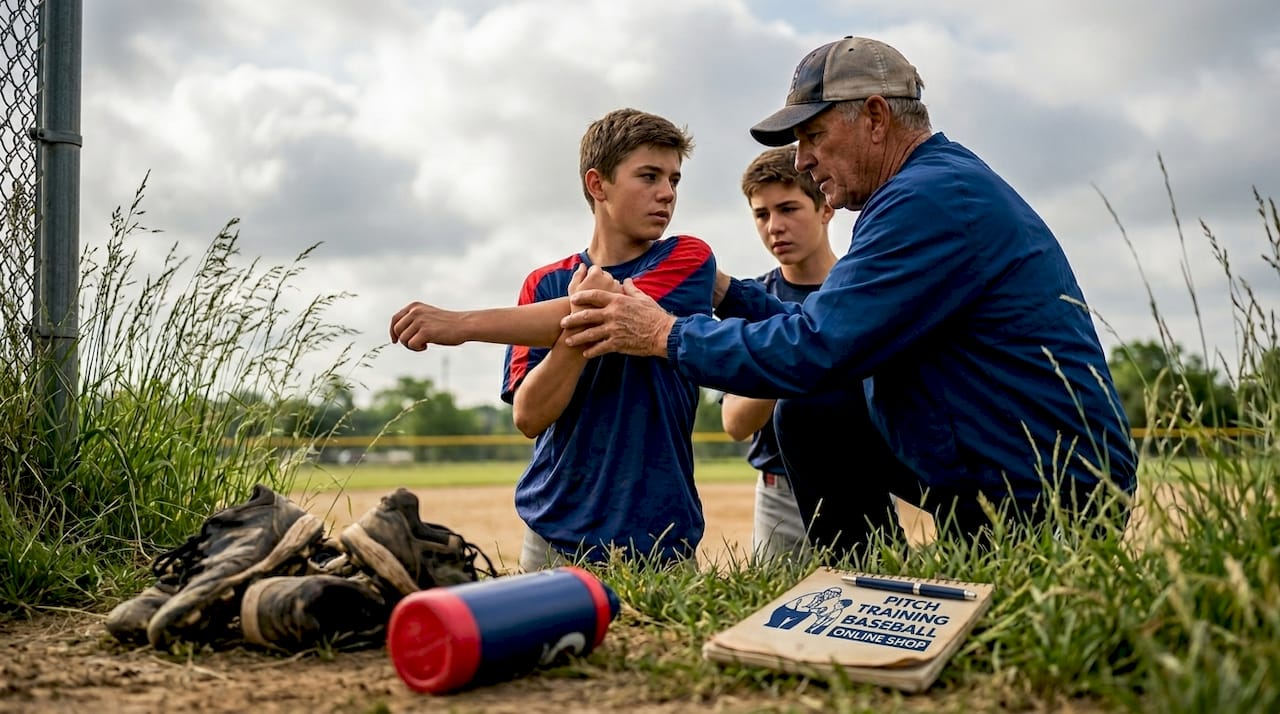
The key insight here is that flexibility must be functional. It has to work in rhythm with muscle strength and timing, not just exist on a therapist’s table. Limited hip external rotation and rotational strength are linked to upper-extremity pain in softball pitchers even without differences in ball speed, which tells us that the problem is not just about how far a joint moves, but whether it can control that movement under load. Isolated static stretching misses this entirely.
Key joints and their role in the pitching chain:
- Hips: External rotation powers the stride and drives lower-body energy into rotation
- Thoracic spine: Rotation here reduces shoulder and elbow compensations
- Shoulder: External and internal rotation balance protects the rotator cuff during arm cocking and deceleration
- Elbow and wrist: Appropriate mobility supports release point consistency
Building pitching balance from the ground up gives flexibility somewhere to live. Without balance and a stable base, joint mobility becomes a liability rather than an asset.
The balance between strength, range of motion, and injury risk
Here is where the conversation gets important, and where a lot of well-meaning coaches and parents go wrong. More flexibility is not the goal. Optimal flexibility, supported by appropriate strength, is the goal. These are very different targets.
Research makes this concrete: pitchers with greater shoulder internal rotation strength but reduced total arc ROM showed increased elbow valgus torque at maximal shoulder external rotation. In plain language, a strong but stiff shoulder can actually crank up stress at the elbow. The reverse is also dangerous. A hypermobile shoulder without the surrounding muscle strength to control it will shift and grind through pitching mechanics in ways that accumulate damage quietly.
The concept of shoulder total arc is worth understanding. It refers to the combined range of internal and external rotation at the shoulder. Most youth pitchers develop some asymmetry between their throwing and non-throwing arms, which is normal. The concern is when that arc shrinks significantly on the throwing side, which often signals adaptive tightness from overuse.
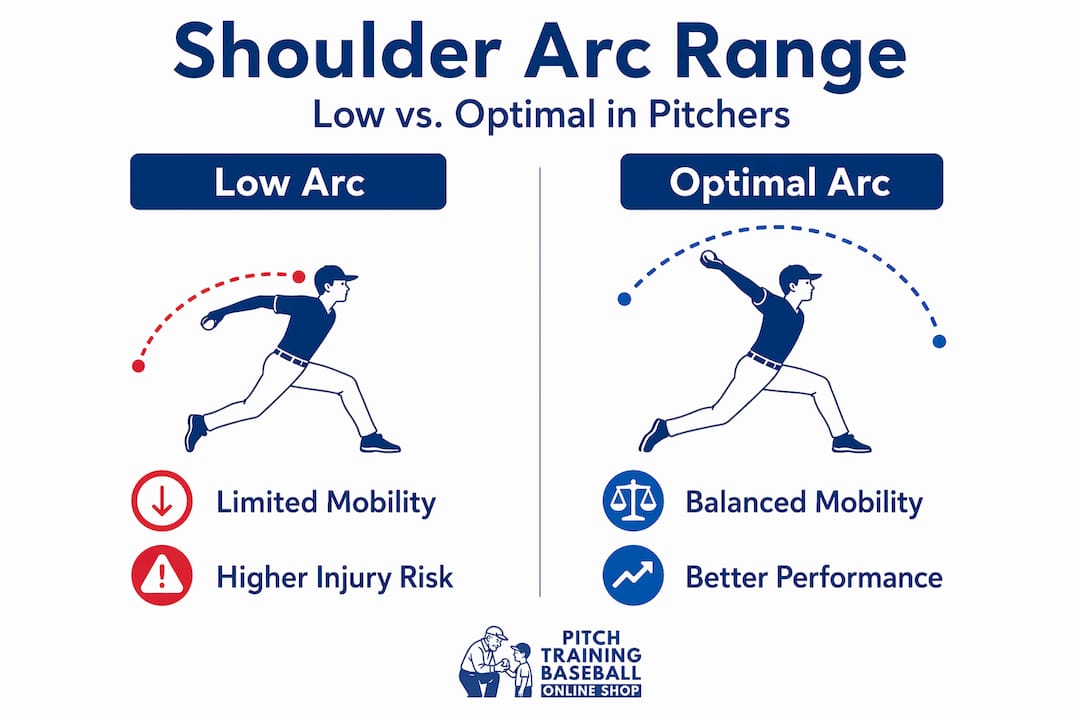
Shoulder ROM comparison: Low vs. optimal arc in adolescent pitchers
| Condition | Total arc ROM | Joint stress pattern | Velocity impact |
|---|---|---|---|
| Low total arc | Below 150° | Elevated elbow valgus torque | Slight reduction possible |
| Optimal total arc | 160–180° | Distributed across kinetic chain | Supported and consistent |
| Hypermobile (no strength) | Above 185° | Shoulder instability risk | May initially feel easier |
What increases injury risk in young pitchers related to ROM:
- Rapid loss of internal rotation on the throwing side over a season
- High external rotation strength without matching internal rotation strength
- Overstretching shoulder capsule tissue without building cuff and scapular stability
- Chasing passive flexibility gains without measuring functional joint control
Pro Tip: Instead of measuring whether your young pitcher can touch their toes or do a shoulder stretch, track their throwing-side versus non-throwing-side rotation values across the season. A widening gap signals a problem developing.
Understanding and fixing the root of these issues starts with reviewing youth pitching mechanics before layering on flexibility work. And if your athlete is already showing signs of mechanical breakdown, addressing common pitching mistakes early prevents them from becoming ingrained habits that stress the arm further.
Workload management and flexibility: The safety net for young pitchers
You can do everything right with flexibility and mechanics, and still destroy a young arm with too many pitches. Workload is the variable that most parents and coaches underestimate because it is invisible until something breaks.
Fatigue changes everything. When a pitcher gets tired, their body loses precise control over joint motion. A hip that moved well in inning one starts compensating by inning five. Muscles that were supporting the shoulder’s arc of motion stop doing their job reliably. The flexibility and strength work you built in practice becomes irrelevant when the system is too tired to use it.
Little League pitch count regulations exist specifically to prevent this, and they represent one of the most important safety tools in youth baseball.
Age-specific pitch count limits and rest requirements under Little League rules:
- Ages 7 to 8: Maximum 50 pitches per day
- Ages 9 to 10: Maximum 75 pitches per day
- Ages 11 to 12: Maximum 85 pitches per day
- Ages 13 to 16: Maximum 95 pitches per day
- Ages 17 to 18: Maximum 105 pitches per day
- Required rest: 1 to 3 days depending on pitch volume thrown, with 66 or more pitches requiring 4 days of rest for ages 14 and under
These pitch count limits protect tissue tolerance, but they only work if you count everything, including bullpen sessions, warm-up tosses, and long toss.
Little League International introduced formal pitch count rules in 2007 and has been refining them ever since. No other organization in youth sports has done more to formalize arm safety standards at the youth level.
Fatigue and its effect on joint control:
When muscles fatigue, the rotator cuff loses its ability to keep the humeral head centered in the shoulder socket. Essentially, the ball of the shoulder starts to migrate during the pitch, which puts abnormal stress on ligaments and cartilage. No amount of flexibility training prepares tissue for that level of mechanical disruption. Rest and pitch count adherence are non-negotiable.
Pro Tip: Keep a throwing log that includes every throwing activity, not just official game pitches. Many young pitchers hit their pitch count limits in games without anyone accounting for the 30-pitch bullpen they threw an hour earlier.
Connecting flexibility work to safe baseball training practices creates a program that addresses both performance and protection at the same time.
Integrating flexibility with mechanics and training drills for effective pitching
Flexibility gains only translate to better pitching when they are practiced inside proper movement patterns. A pitcher who stretches daily but throws with a collapsing front side or a dragging arm is not benefiting from that mobility work. The body learns to move the way it repeats, which is why drill selection matters as much as stretching.
The most effective drills for youth pitchers build the mechanics that allow functional flexibility to show up in actual throwing:
- Balance point hold: The pitcher holds the leg lift position for three to five seconds before throwing. This builds single-leg stability and teaches the body to load properly before initiating the stride.
- Stride direction drill: Using a line on the mound or a chalk mark, the pitcher focuses on striding toward the target consistently. This corrects one of the most common mechanical errors that causes hip mobility to go wasted.
- Towel drill: The pitcher holds a small towel in the throwing hand and performs a full pitching motion, snapping the towel at a target distance. This reinforces arm path and release point without live ball stress on the arm.
- Hip to shoulder separation drill: The pitcher pauses at foot plant and consciously fires hips before the throwing arm comes through. This trains the kinetic chain connection that makes hip flexibility actually useful.
These baseball pitching drills build repeatable mechanics that reduce injury risk and make the body’s range of motion serve a purpose. Velocity and control both improve as a result, but from the ground of solid mechanics, not from chasing looseness.
Pair these drills with gradual throwing volume increases that stay within pitch count limits. A pitcher who adds one to two competitive innings per week, supported by mechanics work and appropriate rest, builds arm fitness safely. Jumping from 40 pitches to 80 pitches because “they felt good” is the scenario that turns into an MRI appointment three weeks later.
Pro Tip: Film your young pitcher from the side and from behind during drills using a smartphone in slow motion. Mechanical breakdowns that are invisible at full speed become obvious at 25 percent speed, especially at foot plant and release.
Once mechanics and workload are stable, game-like pitching practice and targeted pitching balance drills give flexibility a real environment to perform in.
Returning from injury: Role of flexibility in rehabilitation and gradual progression
When a young pitcher does get hurt, usually from overuse rather than acute trauma, the temptation is to rush back. The arm feels better, the team needs them, and they want to play. But incomplete rehabilitation is the most common reason pitchers end up with the same injury again, often worse.
Flexibility plays a critical role in recovery, but again, not in isolation. Restoring range of motion comes before any strengthening, and strengthening comes before any throwing. Recovery from Little League elbow includes rest, rehabilitation with range of motion and strengthening exercises, and only then a gradual return to full pitching once the athlete is pain-free with full ROM and normal strength.
Step-by-step return-to-pitching progression:
- Rest and pain resolution: No throwing until there is zero pain at rest and during daily activity
- Passive range of motion: Gentle, pain-free movement to restore joint range with no loading
- Active range of motion: The athlete moves the joint through its range under their own muscle control
- Strengthening: Rotator cuff, scapular stabilizer, and hip strengthening before any throwing begins
- Interval throwing program: Start with short tosses at low intensity, typically 30 to 45 feet, and progress distance and effort over two to four weeks
- Flat-ground pitching: Full mechanics at lower intensity on flat ground before returning to the mound
- Bullpen sessions: Controlled mound throwing, beginning with 15 to 20 pitches, increasing by no more than 15 pitches per session
- Return to competition: Only with full pain-free ROM, normal bilateral strength, and consistent mechanics
The mechanics piece during rehab deserves emphasis. A pitcher who rushes back and compensates around soreness will reinforce faulty patterns. Those patterns become the new normal. Making sure the athlete moves correctly before adding load protects the repair and prevents a second injury.
Connecting recovery back to safe training guidelines ensures the return program fits within the broader pitching development plan rather than existing as a separate medical event.
Reconsidering flexibility: Why “more” isn’t always better in youth pitching
Most parents and coaches arrive at this topic convinced that looser equals safer. It feels logical. A stiff arm breaks. A flexible one bends. So teach your kid to stretch more, and they will be fine. That belief, while understandable, causes real harm when it drives training decisions.
Here is the uncomfortable reality: passive flexibility, the kind you measure on a table or in a yoga pose, has very limited direct transfer to pitching performance. The pitcher does not throw from a static position. Every phase of the delivery demands strength-controlled range of motion under high-speed, high-load conditions. Functional arcs and strength interplay are what manage pitching stress, not how far a shoulder can be pushed by an outside force.
We have seen coaches dedicate 20 minutes of every practice to static shoulder stretching while completely ignoring hip strength work, scapular stability, and throwing mechanics. Then they wonder why their pitcher’s elbow still hurts. The stretching was not wrong exactly, it just was not addressing the actual problem.
The other side of this is the athlete who has genuinely excessive mobility, often called hypermobility, where joints move beyond normal ranges without the muscle control to protect them. These pitchers can look impressive in warm-ups. They are also among the most injury-prone because their ligaments are doing work that muscles should be doing.
The framework worth adopting is this: flexibility serves pitching when it is functional, controlled, and proportional to strength. A pitcher needs enough range to complete mechanics cleanly. They need the strength and neuromuscular control to own that range at full pitching speed. And they need workload limits that protect the tissue while all that development is happening.
Reviewing what the research says about common pitching mistakes and understanding the balance demands of pitching gives coaches and parents a much clearer framework than “stretch more and throw more.”
Pro Tip: Ask your young pitcher to perform a single-leg balance on their stride leg for 10 seconds with eyes closed. If they cannot do it steadily, their stability is not ready to support the range of motion they have. That is the real test.
Enhance your young pitcher’s flexibility and control with expert training tools
Understanding flexibility’s true role is step one. Putting it into practice requires the right tools and structure. At Pitch Training Baseball, the training aids are built specifically to support the kind of mechanics-driven, controlled development this article covers.
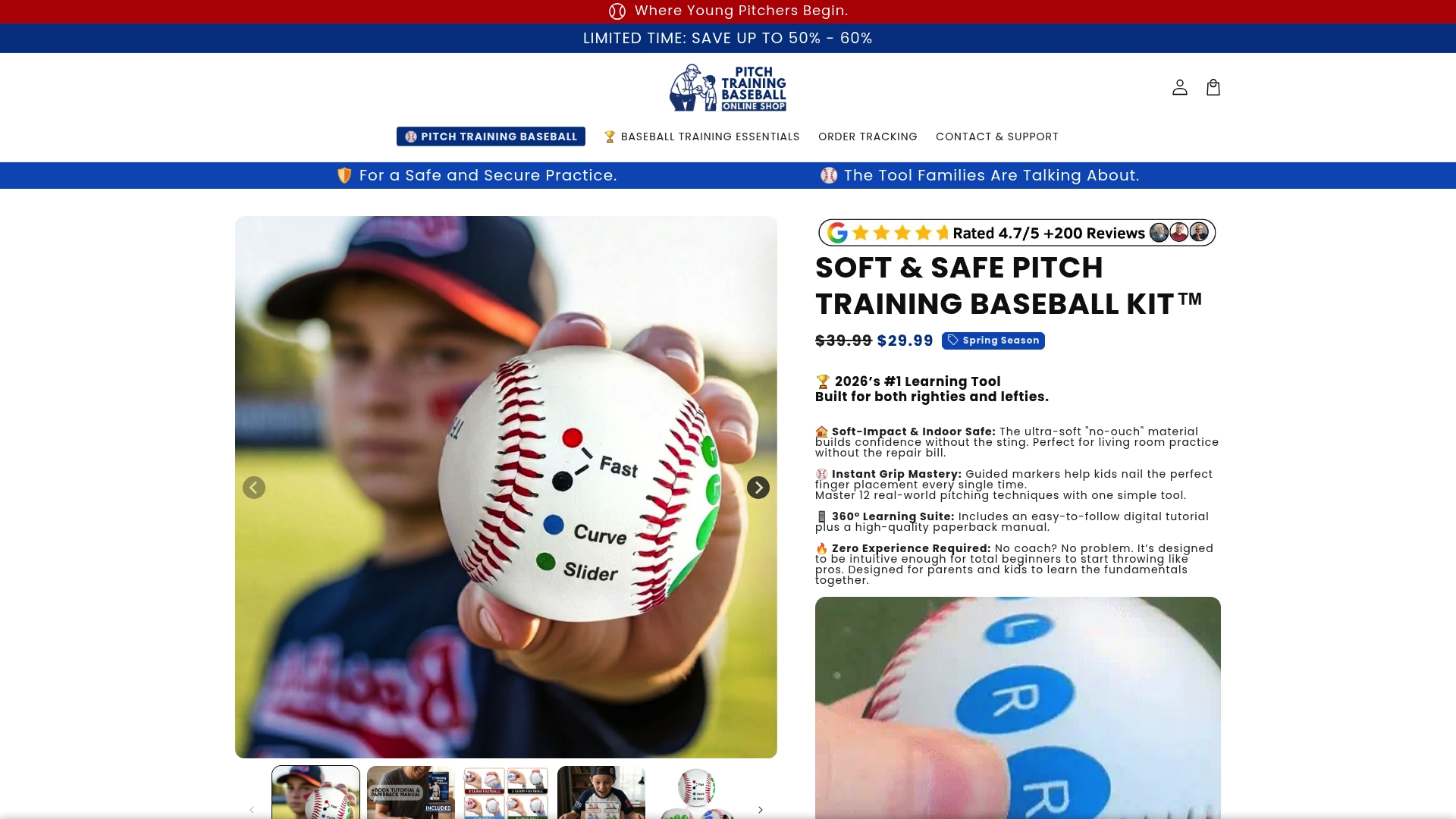
The pitching target net with strike zone gives young pitchers immediate feedback on accuracy and arm path consistency, making every rep in practice count toward real mechanical improvement. For players developing fundamentals, the pitch training softball program offers a structured approach that emphasizes control and safe arm development from the start. And because protecting young athletes during training matters as much as developing them, the package protection gear is designed to reduce injury risk so practices stay productive and players stay on the field.
Frequently asked questions
Why is flexibility important in pitching for young players?
Hip and shoulder flexibility directly affects how well energy transfers through the kinetic chain during pitching, reducing arm stress when paired with adequate strength. Without adequate joint mobility, young pitchers compensate with mechanics that increase injury risk over time.
Can too much flexibility increase injury risk in youth pitchers?
Yes. Excessive flexibility without sufficient strength and control can lead to joint instability, where ligaments absorb force that muscles should be managing. Functional motion with strength balance reduces joint stress more reliably than passive flexibility alone.
How does pitch count relate to flexibility and injury prevention?
Fatigue from exceeding pitch count limits causes the muscular control that supports joint flexibility to break down, making even well-trained range of motion a liability. Following age-specific pitch count limits keeps tissue tolerance high so flexibility and strength work actually perform under game conditions.
What drills help improve functional flexibility in youth pitchers?
Balance point holds, stride direction work, and towel drills all build the mechanical patterns that allow a young pitcher to use their range of motion productively. Mechanics-focused drills produce more durable improvements than static stretching because they train flexibility inside the actual movement of pitching.
Recommended
- Mastering proper pitching grip: boost youth baseball skills – Pitch Training Baseball
- How to assess youth pitching performance step by step – Pitch Training Baseball
- Pitching balance: Boost control and power in young players – Pitch Training Baseball
- Game-like pitching practice: Raise youth baseball skills fast – Pitch Training Baseball