


A workable backyard pitching space starts at roughly 40 to 50 feet of clear length with full containment on both sides, a net at least 10 feet tall, and 10 feet of overhead clearance. Anything tighter forces you to use foam balls and short-toss drills instead of live pitching. Before anything else, confirm helmets and netting are in place. The full safety checklist is a few sections down.
TL;DR:
- Most backyard pitching setups should be 40 to 70 feet long to match common youth pitching distances, not the full 90-foot regulation.
- Nets and containment structures need at least 10 feet in height and should be anchored securely with ground stakes or sandbags to withstand wind.
- Shorter drills at 25 to 45 feet focusing on accuracy and rhythm build better control than long throws in limited spaces.
- Use foam or low-compression balls to reduce property damage and injury risks in confined backyards.
- Portable mounds from DIY materials and setup guides make adjusting distances easy as players grow or change division levels.
Table of Contents
- Layouts and Dimensions for a Backyard Pitching Area
- Choosing Containment: Cages, Nets, L-Screens, and Backstops
- What Pitching Distance Should Youth Players Use in a Backyard?
- Which Balls and Gear Actually Reduce Backyard Risk?
- Small-Space Drills When You Can’t Get Full Distance
- Installation Checklist Before Anyone Throws Live
- How PitchTrainingBaseball Applies These Layouts
- Why Control Beats Velocity in Backyard Sessions
- Starter Kits That Put This Plan to Work
- Where to Check the Official Specs
- Sources
- FAQ
Layouts and Dimensions for a Backyard Pitching Area
Three templates cover almost every yard. Which one fits depends less on how much land you own and more on how you’re willing to arrange it diagonally, along a fence line, or against a garage wall.
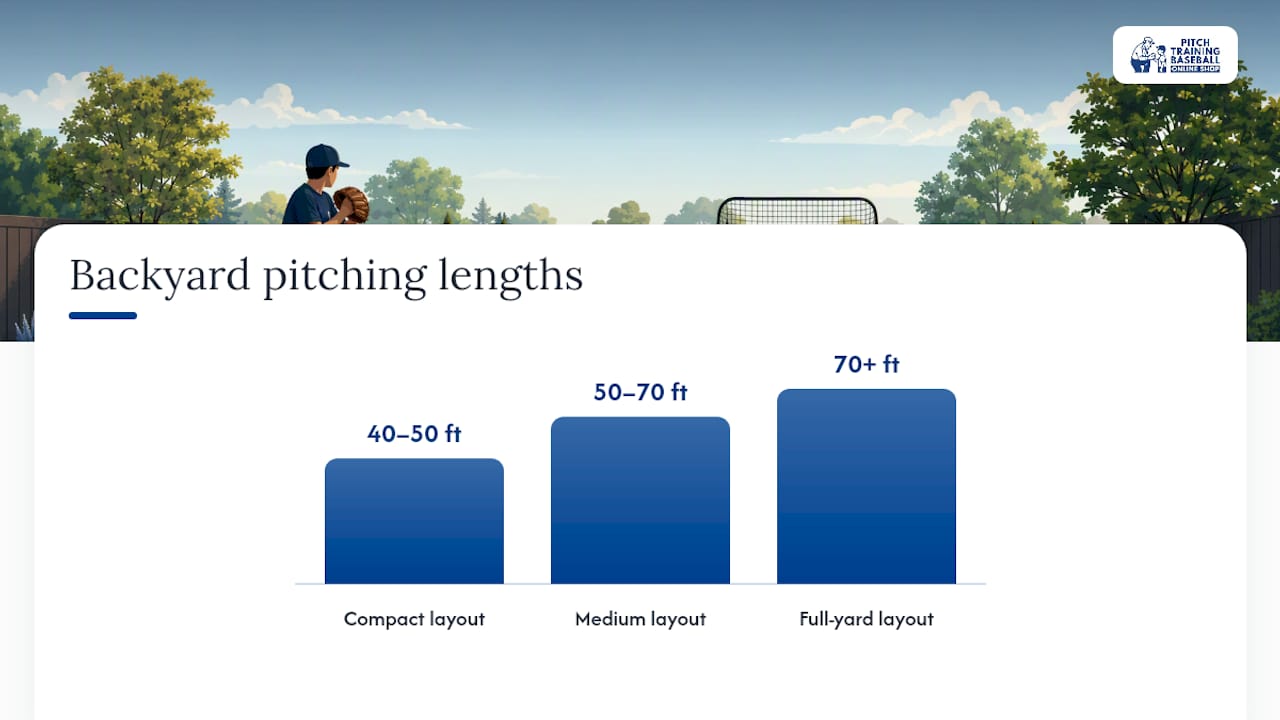
The compact layout runs about 40 to 50 feet and works for pitching-only sessions, no hitter involved. This is the right call for row-house yards, narrow city lots, or anyone converting a driveway. The medium layout stretches 50 to 70 feet, long enough to add a batter and still keep some buffer behind the plate for a backstop net. The full-yard layout pushes past 70 feet, closing in on regulation distance for older divisions. Supplier data on backyard cages backs this up: most DIY and commercial backyard batting cages run 35 to 70 feet long, which lines up almost exactly with what a rec-league family actually has room for.
Width and height matter as much as length. A pitching lane needs 10 to 20 feet of width to account for stride variation and errant throws, and you need adequate vertical clearance so netting and a pitcher’s natural arm slot don’t collide with overhead obstacles such as tree branches or a low roofline.
Before you buy a single net, walk the space with stakes and string:
- Drive a stake at the planned pitching spot and another at the target end, then measure the straight line between them, not the diagonal across your yard.
- Run a string line at chest height to check for overhead obstructions like power lines, gutters, or tree limbs.
- Face the pitching lane away from direct afternoon sun when possible, and keep it parallel to fence lines rather than cutting across the yard at an angle, which wastes usable width.
Backyard machine planning guides note that most youth pitching setups work fine anywhere from 40 to 70 feet, depending on the player’s age and throwing speed. That range is your real planning target, not the full 90 feet you see on a televised game.
Choosing Containment: Cages, Nets, L-Screens, and Backstops
Containment isn’t optional. A stray fastball through a fence or into a neighbor’s window turns a training session into a liability problem, so this is where your budget should go first, not last.
Pop-up cages work well for families who need to reclaim the yard after practice. They fold down in minutes, cost less than permanent frames, and suit anyone renting or sharing a yard with other activities. Permanent frame nets cost more upfront but hold up better through a full season of daily reps, and they don’t require setup time before every practice.
A few specs matter regardless of which style you pick:
- Net height should run at least 10 feet to catch high pitches and pop-ups without gaps.
- Width should match your batting or target area, generally 10 to 14 feet for a single-station setup.
- Knotless polyethylene netting resists fraying better than nylon and holds up to repeated ball strikes over a full season.
- L-screens belong in front of any coach running a pitching machine or throwing batting practice, protecting the feeder from line drives back up the middle.
Wind is the quiet failure point most families overlook. A loose net on a windy afternoon can collapse mid-session or drag a frame over.
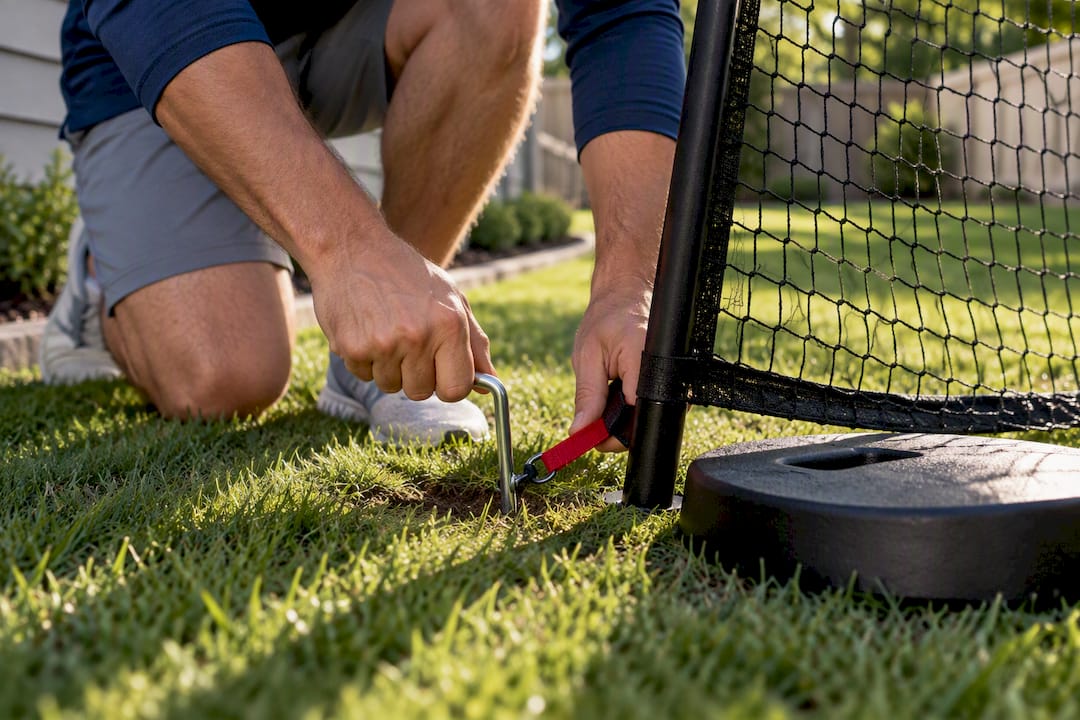
Pro Tip: Stake every net corner with ground anchors rated for at least 40 pounds of pull, and add a sandbag or weighted base plate on any leg near an open fence line. A net that shifts three inches during a live pitch is a net that’s about to fail.
What Pitching Distance Should Youth Players Use in a Backyard?
Regulation distances aren’t arbitrary, and matching them matters more than most parents realize, because a pitcher who trains at the wrong distance builds mechanics that don’t transfer to game day. Little League sets Majors division pitching distance at 46 feet, intermediate 50/70 at 50 feet, and Junior/Senior levels at 60 feet 6 inches, measured from the apex of home plate to the front edge of the pitching rubber.
Measure it the same way at home: run your tape from the point of home plate, not the batter’s box line, straight back to where the rubber or mound will sit. A few inches of error compounds fast when you’re trying to train release timing.
For the mound itself, you have three real options:
- Portable mounds built from plywood, OSB decking, and artificial turf let a family move between 46 and 50 feet without regrading any ground, since DIY portable mound projects show the whole build can be assembled from standard lumber and turf in a weekend.
- DIY dirt or clay mounds work if you have a permanent practice corner and don’t mind the upkeep, but they’re harder to adjust once poured or built up.
- Flat-surface pitching skips the mound entirely and works fine for early-season control work, arm-slot drills, and anyone rehabbing after a break, since mound slope should sit around 1 inch of drop per foot from the plateau when you do build one, and getting that wrong changes a pitcher’s release point.
A portable mound is the practical middle ground for most families: no regrading, and you can shift distance as your player grows into a new Little League pitching division.
Which Balls and Gear Actually Reduce Backyard Risk?
Foam and dimple training balls belong in every backyard setup smaller than 60 feet. They travel less on contact, rebound softer off siding or fences, and cut the chance of a broken window or a bruised sibling standing too close. Regulation baseballs simply carry too much energy for tight spaces, and coaches generally favor mechanics and control work over velocity training at younger ages, using low-compression balls precisely because they let players repeat reps without raising the risk of property damage or injury.
Beyond the ball itself:
- Batters and catchers need helmets any time a pitcher is throwing live, no exceptions for “just soft toss.”
- Pad the wall or fence directly behind your net with foam sheeting or old gym mats to stop ricochets from hard surfaces.
- Reinforce net anchor points where the ball hits most often, usually center mass, since that’s where webbing wears out first.
- Schedule sessions for daytime hours and rotate practice spots in the yard if a neighbor’s fence sits close, since a bouncing ball at 7 a.m. wins you no goodwill.
Small-Space Drills When You Can’t Get Full Distance
A 25 to 40 foot driveway or garage stretch is plenty of room if you shift the goal from throwing hard to throwing exactly where you want. Short-toss work at that range builds release consistency and rhythm without needing a single extra foot of yard.
Three drills carry most of the value in a tight space:
- Short-toss command work. Throw from 25 to 30 feet at a fixed target, focusing entirely on repeating the same arm slot and follow-through, not velocity.
- Target progression drills. Use a strike-zone target with marked zones and call out a corner before each pitch, forcing the pitcher to aim rather than just throw.
- Rhythm and tempo sets. Ten pitches at half speed, focused purely on a repeatable leg lift and stride length, before adding any intent behind the throw.
A 30 to 45 minute session built around these three blocks, split roughly into a warmup, a target-based accuracy block, and a cooldown set of easy reps, produces more usable development than an hour of unstructured hard throwing.
Pro Tip: Track strikes to a specific zone, not just strikes overall. A pitcher who hits the low outside corner eight times out of ten is building something game day rewards. One who throws hard down the middle isn’t.
Installation Checklist Before Anyone Throws Live
Run this sequence every time you set up or adjust a backyard pitching space, not just the first time.
- Measure and mark your pitching distance from the front edge of the rubber or mound to the apex of home plate, then double check with a second tape pull.
- Check overhead clearance for branches, gutters, or lines that sit within 10 feet of the pitching lane.
- Anchor all netting with weighted bases or ground stakes before the first pitch, and retest anchor tension after any windy day.
- Pad hard surfaces directly behind the net, especially concrete, brick, or vinyl siding.
- Secure any pitching machine base on a level, non-slip surface before powering it on.
Enforce a short list of non-negotiables every session: helmets for batters, an adult present at all times, and pitch counts and rest days that follow MLB’s Pitch Smart age-based guidelines rather than “however many the kid wants to throw.” Beyond the yard itself, keep the setup away from busy streets and check your HOA’s rules on backyard structures before building anything permanent. A quick read through general youth sports safety practices is worth the ten minutes it takes.
How PitchTrainingBaseball Applies These Layouts
These recommendations come out of watching what actually works across compact yards, driveways, and full-length setups. PitchTrainingBaseball’s own posts on net placement at 30 to 45 feet and home pitching drills grew out of the same question this article answers: how do you get real repetition without a full field?
For compact layouts, a target net with marked zones does more for accuracy than any mound investment. For driveway and garage work, a soft-ball kit removes the property-damage worry entirely, letting a session run longer without a parent hovering near the windows.
Why Control Beats Velocity in Backyard Sessions
The biggest mistake I see in backyard setups isn’t the dimensions. It’s the goal. Parents build a 60 foot lane and immediately start chasing radar gun numbers, when a young arm gets far more out of hitting a target consistently than throwing hard at nothing in particular.
Keep sessions short, keep the mood loose, and treat backyard time as a supplement to team practice, not a replacement for it. A pitcher who throws 20 controlled pitches at a target three times a week develops faster than one who throws 60 pitches at a fence with no target at all.
— Albert
Starter Kits That Put This Plan to Work
Pitchtrainingbaseball is built for exactly the setups covered above: compact yards, driveways, and garage lanes where accuracy matters more than raw velocity. Instead of guessing at equipment or piecing together mismatched gear, the PITCH TRAINING BASEBALL KIT™ gives you a target net and training balls sized for backyard distances right out of the box.

If your space runs under 50 feet or you’re working off a driveway, the SOFT PITCH TRAINING BASEBALL KIT™ uses low-compression balls that cut rebound risk against siding, fences, and garage doors, which matters more in tight spaces than in a full backyard cage. Both kits run $29.99 as a one-time purchase, no separate net or target to source elsewhere. Head to the product collection to match a kit to your yard’s actual dimensions and start running the drills covered above this weekend.
Where to Check the Official Specs
For exact numbers, go straight to the source: Little League’s field specifications cover pitching distances and mound dimensions, while Pitch Smart’s guidelines set pitch-count and rest standards by age.
Sources
- Field specifications | Little League
- Pitching guidelines ages 8 and under | Pitch Smart (MLB)
- Is your backyard actually big enough for a pitching machine? Here’s how to know
FAQ
Can I build a pitching mound in my backyard?
Yes. A portable mound built from plywood, OSB decking, and artificial turf is the most practical option, since DIY guides show the full build using standard lumber and turf over a weekend. Portable designs also let you shift between the 46 foot and 50 foot distances as your player moves up divisions, without regrading any ground.
What is the best pitching machine for backyard baseball?
There’s no single best machine, but the space matters more than the model: most backyard setups work with machines anywhere from 40 to 70 feet depending on the player’s age and pitch speed. Whatever machine you choose, pair it with an L-screen in front of the coach or feeder and full containment netting behind the hitter.
How can I build a DIY pitching mound in my backyard?
Start with a plateau built from framed lumber and OSB decking, then slope it roughly 1 inch of drop per foot away from the pitching rubber, following dimension guidance from established mound-building guides. Top the surface with artificial turf or packed clay, and keep the whole structure portable if you want to adjust distance later.
What is a good portable batting cage for a backyard?
A workable range runs 35 to 70 feet long and 10 to 14 feet wide, which matches what most backyard batting cage builders settle on for youth practice. Pick a pop-up frame if you need to clear the yard between sessions, or a permanent frame if the cage stays up all season.
Does Pitchtrainingbaseball sell equipment for small backyard spaces?
Yes. The PITCH TRAINING BASEBALL KIT™ and SOFT PITCH TRAINING BASEBALL KIT™ are both priced at $29.99 and built around target accuracy work that fits compact yards, driveways, and garage lanes.