


A safe pitching improvement timeline runs roughly four weeks for habit-building, one to three months for mechanics and conditioning gains, three to six months for measurable velocity and command growth, and a full year for structural strength. The three guardrails that make it work: fix mechanics before chasing speed, raise workload gradually, and protect a real off-season. USA Baseball’s Long-Term Athlete Development plan and Pitch Smart guidelines back this pacing, and practice tools for pitching training build around the same phased approach.
TL;DR:
- Pitching development should follow phased progress: four weeks for habit-building, up to a year for structural strength, with workload and mechanics carefully managed.
- Inexperienced pitchers need to focus on mechanics, mobility, and consistency during the initial months before velocity increases are expected, avoiding premature intensity.
- Pitch counts over 100 innings annually significantly heighten injury risk, emphasizing the importance of rest days, off-seasons, and monitoring soreness and fatigue.
- Velocity gains typically manifest in three to six months, only if mechanics are sound and strength training progressed gradually through the phases.
- Training tools like strike-zone target nets and controlled-intensity softballs support each developmental phase but do not replace proper medical evaluation if pain occurs.
Table of Contents
- What Does a Pitching Development Schedule Look Like by Phase?
- Sample Weekly and Monthly Plans You Can Start This Week
- Which Drills Match Each Phase of Development?
- How Many Pitches and Innings Are Actually Safe?
- How Do You Track Whether the Plan Is Working?
- How Should Strength Training Fit Around Throwing Days?
- How Pitchtrainingbaseball’s Tools Fit Into Each Phase
- Why Patience Beats Every Shortcut in Pitching Development
- Practice Tools Built for This Exact Timeline
- Sources
- FAQ
What Does a Pitching Development Schedule Look Like by Phase?
Progress doesn’t arrive on a straight line, and it shouldn’t. Each phase asks for something different, and skipping ahead is where most arm problems start.
Weeks 0 to 4 are about baseline data and habits, not gains. Check current velocity, arm mobility, and mechanics on video. Light throwing, cadence work, and mobility drills dominate this stretch. This is groundwork, not a growth spurt.
Months 1 to 3 bring consistency. Mechanics get repeated under mild fatigue, intensity climbs in small steps, and basic strength and conditioning (S&C) enters the picture. A 2019 systematic review found that mechanical competency built in low-pressure settings supports safer long-term development better than simply piling on pitch counts.
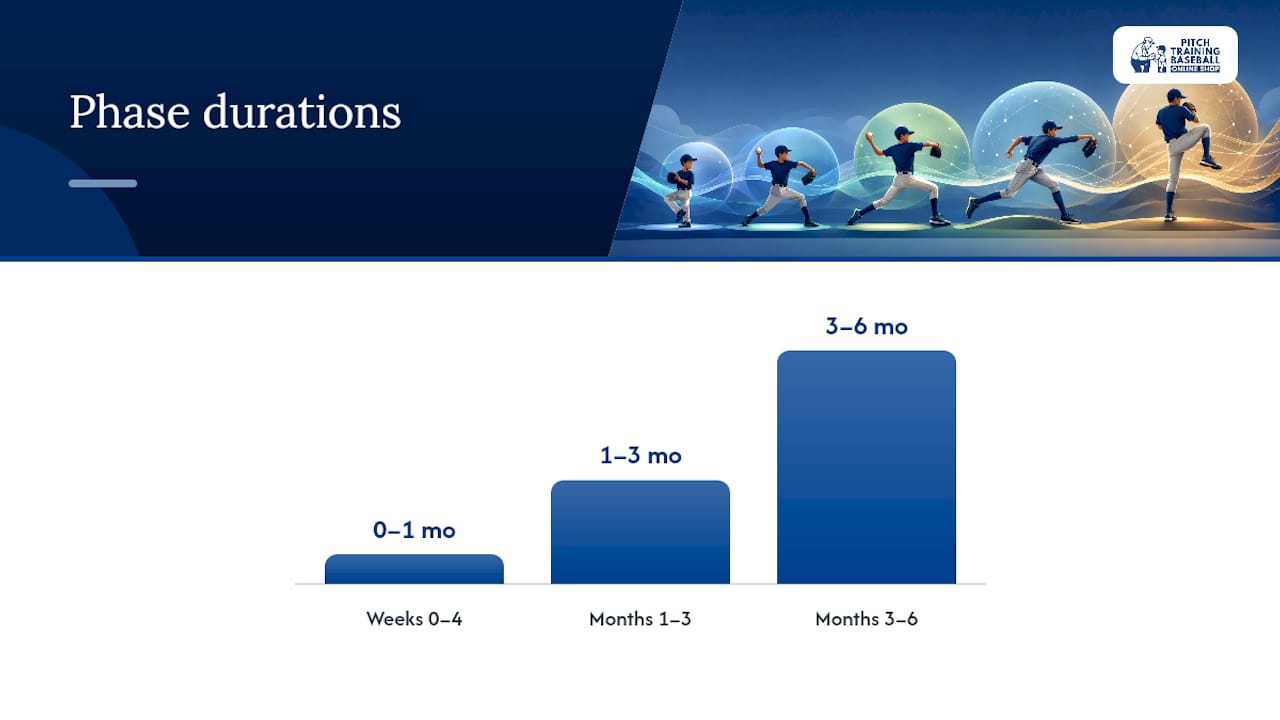
Months 3 to 6 are where velocity and command usually start to shift, but only if the first two phases were done right. Rotational power work gets added here, once mechanics hold up under load.
Season and year-long planning revolves around innings caps and a genuine off-season. USA Baseball’s LTAD framework recommends progression based on physical readiness rather than age alone, and it discourages year-round single-sport throwing.
- Ages 9 to 12: slower phase transitions, shorter throwing sessions, more rest between outings.
- Ages 13 to 15: moderate pacing, with growth plates still a factor in how fast intensity should climb.
- Ages 16 to 18: faster progression is possible, but only with a clean injury history and solid mechanical baseline.
Sample Weekly and Monthly Plans You Can Start This Week
A workable weekly plan for a healthy high school pitcher with no current arm issues looks like this:
- Monday: Bullpen focused on mechanics, moderate intensity pitching with pitch counts adjusted to age and recovery status.
- Tuesday: Lower-body and posterior-chain strength work, no throwing.
- Wednesday: Light long toss, mobility, and recovery work.
- Thursday: Higher-intensity bullpen or live at bats, higher-intensity pitching within age-appropriate pitch count limits.
- Friday: Rest or very light throwing, arm care focus.
- Saturday: Game day or simulated game, pitch count capped by age guidance.
- Sunday: Full rest.
Over four weeks, intensity should climb by small increments, with the fourth week built as a deload, cutting volume by roughly 30 to 40 percent to let tissue recover before the next push. Younger pitchers (9 to 12) should stretch this into a five or six-week cycle instead of four. Older pitchers (16 to 18) can compress the cycle slightly if recovery markers stay clean. For daily structure between sessions, recommended daily pitching habits fill in the warm-up and cooldown routine that a weekly plan alone won’t cover.
Which Drills Match Each Phase of Development?
Drill selection should track the phase, not the calendar. Early on, everything centers on repeatable movement patterns.
Early-phase mechanics work includes balance throws, towel drills, and mirror work to groove arm path without the stress of a full-effort pitch. These build the movement library a pitcher draws on later.
Mid-phase development adds power and rotation:
- Rotational medicine ball throws for hip-to-shoulder sequencing.
- Lateral bounds for single-leg power and stability.
- Posterior chain strength work (hip hinges, single-leg deadlifts) to support the deceleration phase of a pitch.
- Anti-rotation core exercises (Pallof presses, dead bugs) to stabilize the trunk under load.
Weighted-ball progressions can help refine arm speed, but the ABCA’s review of velocity enhancement programs is clear that these tools only make sense once mechanics are repeatable and a coach is monitoring load closely. Introducing them too early, before a pitcher owns his mechanics, is one of the more common ways well-meaning parents accelerate an injury instead of a fastball.
Pro Tip: Film every bullpen from the same angle for eight weeks straight. Small mechanical drift shows up on video long before it shows up on a radar gun or in soreness.
How Many Pitches and Innings Are Actually Safe?
The workload numbers here aren’t arbitrary. A 10-year cohort of 481 youth pitchers found that throwing high numbers of innings in a year is associated with an increased risk of serious throwing injury compared to pitchers who stayed under that mark.
Pitchers who threw over 100 innings annually were 3.5 times more likely to need surgery or retire due to injury, according to a decade-long study of 481 youth pitchers.
That single number should reset how any parent or coach thinks about a “big year.” The 2019 systematic review adds that acute fatigue changes, measurable strength loss and tendon swelling, can show up after a substantial pitching volume in a single outing, varying by age, which is exactly why Pitch Smart’s daily and weekly limits exist.
- Never catch on the same day a pitcher throws a bullpen or start.
- Build in at least one full rest day between high-intensity outings.
- Take two to three continuous months off pitching every year, not scattered rest days.
- Stop immediately for sharp pain, numbness, or a sudden drop in control. That warrants medical evaluation, not a lighter bullpen.
For age-specific pitch counts, how often youth pitchers should throw breaks down the numbers by age bracket, and why monitoring pitch counts matters covers the reasoning behind those limits in more depth.
How Do You Track Whether the Plan Is Working?
Track pitching accuracy and velocity together, not one or the other. A pitcher who throws harder but loses the zone hasn’t actually improved.
- Log fastball velocity monthly against a baseline reading taken in week one.
- Track strike percentage per bullpen session, not just game outings.
- Rate perceived exertion (1 to 10) after every throwing session.
- Keep a simple soreness log, noting location and whether it clears within 24 hours.
Test formally at baseline, then again at the end of each phase. Only increase intensity when mechanics stay consistent on video and soreness resolves within a day. If either slips, hold at the current phase rather than pushing forward on schedule.
How Should Strength Training Fit Around Throwing Days?
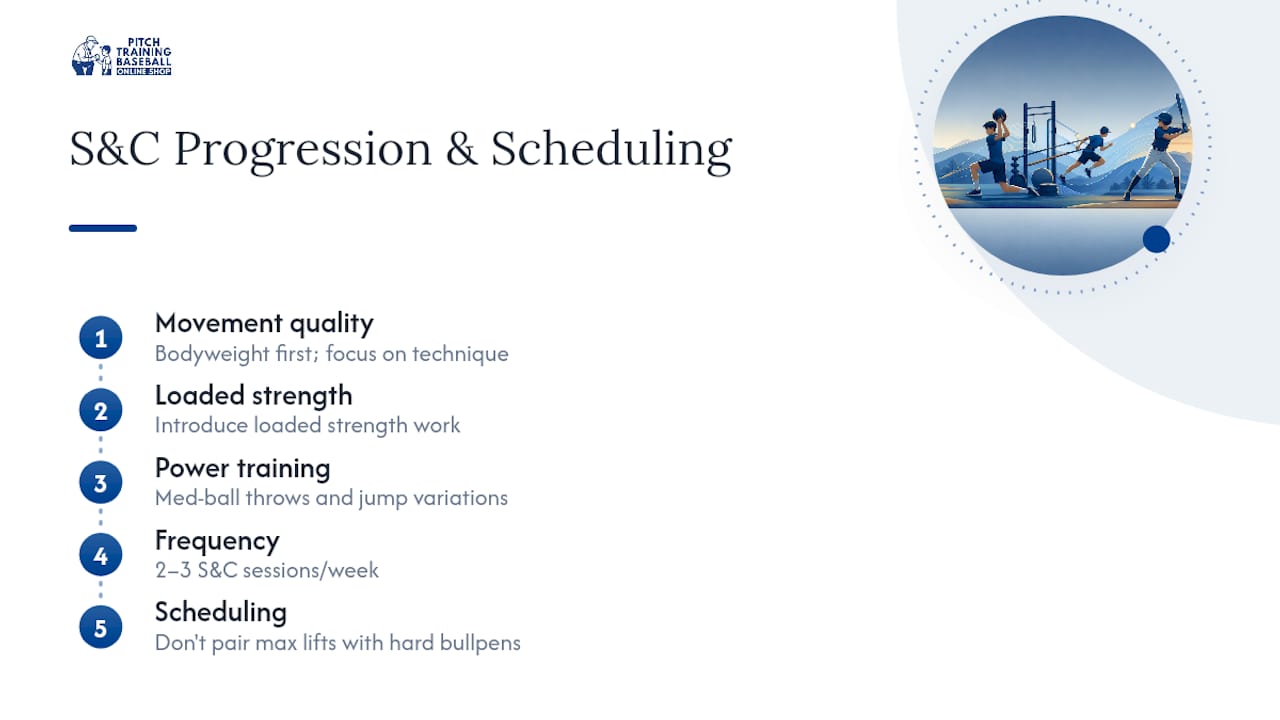
Strength and conditioning should never collide head-on with a high-intensity throwing day. Pair heavy lower-body or full-body lifting with lighter throwing days, and save the hardest bullpens for days when the body isn’t also recovering from a max-effort lift.
Progression typically runs bodyweight movement quality first, then loaded strength work, then power-specific training like med-ball throws and jump variations, mirroring the LTAD stages USA Baseball outlines. Two to three S&C sessions a week is plenty for most youth and high school pitchers. For structuring these blocks month to month, this guide to training periodization offers useful background on sequencing load across a season. Recovery basics, sleep, hydration, and adequate protein intake, matter more here than any supplement or gadget.
How Pitchtrainingbaseball’s Tools Fit Into Each Phase
The focus is on youth pitching equipment built around exactly this kind of phased development. A strike-zone target net supports the early mechanics phase, where repeatable location matters more than velocity. Training balls suit command work in the one to three month window, when a pitcher is grooving feel without max-effort strain. Pair these tools with daily pitching habits and fatigue prevention strategies for a fuller plan. None of this replaces a doctor’s evaluation when pain shows up.
Why Patience Beats Every Shortcut in Pitching Development
The biggest mistake I see is chasing radar gun numbers before mechanics are repeatable. Weighted balls introduced too early, or soreness brushed off as normal, cause more setbacks than any single bad outing. Use this timeline as a framework for decisions, not a fixed script.
— Albert
Practice Tools Built for This Exact Timeline
Consistency is what actually moves a pitcher through these phases, and consistency is hard without the right setup at home. Pitchtrainingbaseball’s Pitching Target Net with Colorful Strike 9-Zone turns command work into something measurable, letting a pitcher log strikes per zone during exactly the mechanics-first phase this timeline calls for.

The Pitch Training Softball is built for controlled-intensity bullpens, useful for the one to three month window when volume is climbing but max effort still isn’t the goal. Both products are designed for home, backyard, or field use, so practice doesn’t depend on gym access or a full team session. Check the strike-zone target net product page for current bundle options and get a session on the calendar this week.
Sources
- Current workload recommendations in baseball pitchers: A systematic review (2019)
- USA Baseball releases Long-Term Athlete Development plan (2017)
- The Science Behind Velocity Enhancement Programs (ABCA, 2017)
FAQ
At What Age Do Pitchers Start to Decline?
Velocity and arm health typically peak for adult pitchers after full physical maturity, but for youth athletes, decline usually isn’t age-related. It’s overuse-related, tied to exceeding safe innings and pitch-count limits during the developmental years.
How Many Pitches Should an 11-Year-Old Throw in a Week?
Pitch Smart guidance calls for conservative daily and weekly caps for this age group, generally staying well under 100 pitches across the week with mandatory rest days between outings. Exact daily limits depend on outing length, so check age-based throwing frequency for specific numbers.
Is 50 mph Fast for a 9-Year-Old Pitcher?
Fastball speeds vary widely at that age, and 50 mph is a solid, above-average mark for many 9-year-olds. Mechanics and command matter more than velocity at this stage of a pitching development schedule.
How Fast Were Pitchers Throwing in the 1950s?
Reliable radar tracking wasn’t widespread in earlier eras, so precise comparisons over time are unreliable. What’s better documented is that modern workload science, including the innings and pitch-count research cited above, didn’t exist yet, which is part of why injury patterns have shifted since then.
How Long Does It Take to See Real Velocity Gains?
Most pitchers following a structured plan see measurable velocity or command shifts in the three to six month range, provided mechanics work and progressive strength training happened in the months before that.