


Pitching under pressure is the ability to deliver consistent, precise pitches in high-stress game situations by combining mental reframing, physical routine, and biomechanical control. This guide to pitching under pressure covers every layer of that skill, from breathing techniques and pre-pitch rituals to ground-up power mechanics and proprioceptive drills. Whether you’re facing a full count with the bases loaded or stepping onto the mound for the first time in a playoff game, the strategies here are built specifically for young athletes and student pitchers who want to perform when it matters most.
What mental strategies help pitchers stay calm under pressure?
The most effective mental tool for dealing with pressure while pitching is anxiety reappraisal. Instead of trying to calm down, you reframe those nerves as excitement. Anxiety reappraisal is more effective than suppression because trying to calm down depletes the cognitive resources you need to execute your mechanics. Your body is already primed. The goal is to point that energy in the right direction.

Breathing to reset your nervous system
Slow, exhale-led breathing is the fastest way to shift your body out of threat mode. Breathe in for 4 counts, then breathe out for 6–8 counts. That extended exhale activates the parasympathetic nervous system, which slows your heart rate and clears your head. Do this between pitches or during a timeout, and you will feel the difference within two or three cycles.
Reframing pressure as privilege
High-performing pitchers do not suppress stress. They treat it as proof they are competing at the right level. The mindset shift is simple: move from “I have to pitch this inning” to “I get to pitch this inning.” That single change moves pressure from a threat to an opportunity. It sounds small, but it changes how your brain processes the moment.
Visualization before you throw
Mental rehearsal is a proven tool for youth pitching focus. Before you take the mound, close your eyes and picture the exact pitch you want to throw. See the release point, the trajectory, and the catcher’s mitt. Pitchers who rehearse mentally before high-stakes at-bats make fewer mechanical errors because their brain has already run the sequence once.
Pro Tip: Use a verbal anchor, a single word or short phrase you say to yourself before every pitch. Words like “smooth” or “trust it” cue your body to execute without overthinking. Repeat it in practice so it fires automatically in games.
Here is a quick breakdown of the core mental tools:
- Anxiety reappraisal: Label nerves as excitement, not fear
- Exhale-led breathing: 4 counts in, 6–8 counts out between pitches
- Visualization: Picture the full pitch sequence before you throw
- Mindset shift: Replace “I have to” with “I get to”
- Verbal anchor: One word or phrase that cues your best mechanics
How do pre-pitch routines improve command and consistency?
A consistent pre-pitch routine is the single most reliable tool for overcoming nerves in pitching. Routines work because they shift your nervous system out of threat response without relying on willpower. When you follow the same steps every time, your brain stops scanning for danger and starts executing a familiar pattern. That is the difference between freezing on the mound and throwing with confidence.
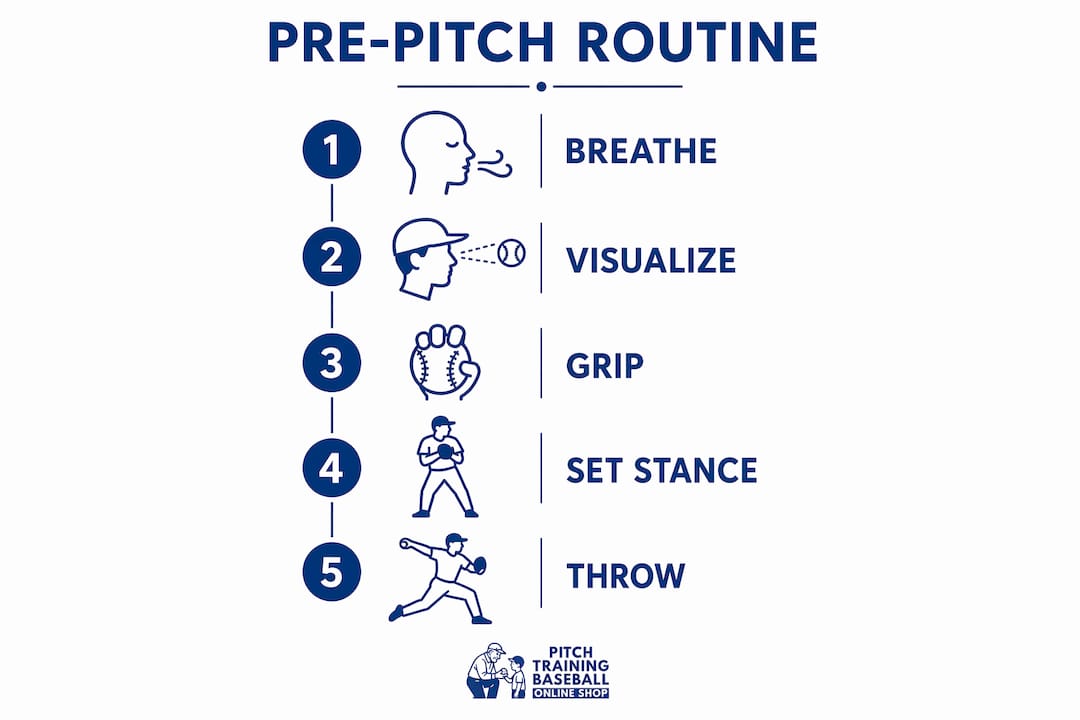
A pre-pitch ritual built around breathing, verbal anchoring, and stillness helps reset your physiology before each pitch. The recommended structure runs about 30 minutes for a full pre-game routine, with 10 minutes of slow exhale-led breathing, 5 minutes of verbal anchoring, and 5–10 minutes of stillness. That sequence is not random. Each step builds on the last to bring your nervous system into a ready state.
Here is a step-by-step routine you can start using today:
- Step back from the rubber. Take one full step back and break eye contact with the plate. This physically interrupts any spiral of negative thinking.
- Breathe. Take one slow breath in for 4 counts, out for 6–8 counts. Do not skip this step, even if it feels awkward at first.
- Say your verbal anchor. Speak your cue word quietly or in your head. This fires the same neural pathway you have built in practice.
- Set your grip. Feel the seams deliberately. Grip pressure should be firm but not tight. Tension in your hand travels up your arm and kills spin.
- Lock your focus. Pick your target in the catcher’s mitt and commit. Do not look away until you release.
Pro Tip: Practice this routine during every bullpen session, not just games. The goal is to make it automatic. When adrenaline spikes in a real game, your body will default to what it has repeated most.
The key insight from routine-based preparation is that you are not memorizing a script. You are building a scaffold of simple physical and mental anchors. Scripts break under pressure. Scaffolds hold because they are flexible and familiar at the same time.
What physical training and biomechanics improve pitching under stress?
Physical consistency under pressure starts from the ground up. Pitching power is generated through triple extension of the hip, knee, and ankle, creating a kinetic chain that drives velocity without overloading the arm. When you are nervous, your body tends to rush and shorten that chain. The result is a flat, arm-only delivery that loses both speed and control.
Command drills and count awareness
Elite college pitchers hit their target zone 60–65% of the time in command drills. High school pitchers range from 35–55%. That gap is closable. Proprioception-based training, including closed-eye drills, can improve command by 15–20% in three weeks. The method works because it forces your body to feel the delivery rather than guide it visually.
Count awareness is the other half of command. MLB data shows hitters slug .487 on pitches in the heart of the zone during full counts, compared to .312 on pitches at the edges. That gap is enormous. Pitching to the edges under pressure is not just smart. It is the difference between giving up a run and getting out of the inning.
Grip pressure and effort level
Grip pressure is one of the most overlooked variables in tips for pitching under stress. Tight grip kills spin rate and flattens movement. Your grip should feel like you are holding a small bird: firm enough that it cannot fly away, loose enough that you are not squeezing the life out of it. Under pressure, check your grip between every pitch.
Reducing your effort level slightly also improves control. Throwing at 90% effort instead of 100% keeps your mechanics intact and prevents the rushing and collapsing that happens when adrenaline takes over. You lose very little velocity, but you gain a lot of accuracy.
| Physical element | What to do | Why it matters |
|---|---|---|
| Triple extension | Drive through hip, knee, and ankle | Generates power without arm strain |
| Grip pressure | Firm but relaxed hold on seams | Preserves spin and pitch movement |
| Effort level | Throw at 90%, not 100% | Keeps mechanics stable under stress |
| Command drills | Simulate full counts in practice | Builds edge-targeting under game pressure |
| Active recovery | Mobility work during dead arm phase | Prevents injury and sustains arm health |
Active recovery during the dead arm phase is non-negotiable for young pitchers. Mobility flows and light band work keep the arm healthy during periods of fatigue. Skipping recovery is the fastest path to injury and lost velocity.
How can pitchers train to perform well in pressure situations?
The best way to train for pressure is to practice under pressure. Live at-bat drills and game-like simulations force you to execute your routine and mechanics when the stakes feel real. Throwing in a quiet bullpen with no one watching is useful for building mechanics. It does not build pressure resilience.
Here are the most effective training methods for building clutch performance:
- Simulated at-bats with count scenarios. Start every bullpen session with a specific count, such as 3-2 with runners on base. Make decisions about pitch selection and location as if it were a real game.
- Closed-eye proprioceptive drills. Closed-eye drills train your body to feel the delivery without visual guidance. This makes your mechanics more resilient when adrenaline distorts your perception during games.
- Mistake reset practice. After every bad pitch in a bullpen session, go through your full pre-pitch routine before the next one. This trains the habit of resetting quickly instead of carrying mistakes forward.
- Audience pressure. Ask coaches, teammates, or parents to watch your bullpen sessions. Social observation raises your heart rate and mimics game-day stress better than solo practice.
- Mental training integration. Combine physical drills with mental cues. Say your verbal anchor before every rep, not just in games.
Mental toughness is not a personality trait. It is a skill you build through repetition. Every time you reset after a bad pitch in practice, you are training your brain to do the same thing in a game. The pitcher who bounces back fastest from a mistake is almost always the one who has practiced bouncing back the most.
Proprioceptive drills deserve special attention for student pitchers. When you close your eyes and throw to a target, you are forcing your body to rely on feel rather than sight. That feel becomes your autopilot. Under pressure, when your eyes are wide and your heart is pounding, your autopilot takes over. That is exactly what you want.
Key Takeaways
Pitching under pressure requires mental reframing, a repeatable pre-pitch routine, and mechanics built from the ground up through deliberate, pressure-simulated practice.
| Point | Details |
|---|---|
| Reframe anxiety as excitement | Anxiety reappraisal outperforms suppression and keeps cognitive resources available for mechanics. |
| Build a pre-pitch routine | A consistent breathing, anchoring, and stillness sequence resets your nervous system before every pitch. |
| Train ground-up mechanics | Triple extension through hip, knee, and ankle generates power and protects the arm under stress. |
| Practice under simulated pressure | Live at-bat drills and closed-eye proprioceptive work build the autopilot mechanics that hold up in games. |
| Target the edges on full counts | Edge pitches yield significantly lower slugging than heart-of-zone pitches, making command the top run-prevention tool. |
What I learned about pressure the hard way
The first time I faced a bases-loaded, two-out situation in a meaningful game, I did everything wrong. I tried to calm down. I gripped the ball tighter. I aimed instead of throwing. The result was exactly what you would expect.
What changed everything for me was not a new pitch or a new workout. It was learning that trying to suppress nerves is a losing battle. The moment I stopped fighting the adrenaline and started treating it as fuel, my command got better almost immediately. That shift from “I have to get this out” to “I get to make this pitch” sounds like a motivational poster, but it is backed by real sports psychology and I felt it work in real games.
The pre-pitch routine took longer to build. I spent three weeks doing the same breathing and anchor sequence in every bullpen session before it felt automatic. The first game I used it under real pressure, I noticed I was not thinking about the routine at all. My body just did it. That is the goal. You want the routine to run in the background while your focus stays on the target.
The hardest lesson was about mechanics under fatigue. I used to throw harder when I was nervous, which is the exact opposite of what works. Dropping to 90% effort felt like giving up. It was not. It was the only way to keep my delivery intact when my heart rate was at 160. Young pitchers who learn that lesson early save themselves years of frustration.
The proper pitching technique conversation always comes back to the same truth: mechanics built in calm conditions will fail under pressure unless you have also practiced them under stress. Build the routine. Train the feel. Trust the process.
— Albert
Build your pressure training setup with the right tools
Practicing strategies to pitch confidently is far more effective when your training environment matches game conditions. A pitching target net with a color-coded 9-zone strike zone gives you immediate visual feedback on every pitch, so you can run command drills and count simulations with a real target to aim at. That kind of specific feedback is what turns bullpen reps into measurable progress.

Pitchtrainingbaseball carries the training equipment young pitchers need to practice under realistic conditions, from strike-zone target nets to training balls designed for proprioceptive drills. The tools are portable, adjustable, and built for the kind of repetitive, focused practice that builds pressure resilience over time. If you are serious about improving your command and composure on the mound, the right equipment makes every session count.
FAQ
What is the fastest way to calm nerves before pitching?
Anxiety reappraisal is faster and more effective than trying to calm down. Relabel your nerves as excitement, then use slow exhale-led breathing (4 counts in, 6–8 counts out) to reset your nervous system within a few cycles.
How often should young pitchers practice their pre-pitch routine?
Every single bullpen session. Routines only become automatic through repetition, and the goal is for the sequence to run without conscious thought during a high-pressure game situation.
What does triple extension mean in pitching?
Triple extension refers to driving power through the simultaneous extension of the hip, knee, and ankle during the pitching motion. This ground-up kinetic chain generates velocity and reduces stress on the arm.
How can closed-eye drills improve pitching command?
Closed-eye proprioceptive drills train your body to feel the delivery rather than guide it visually. Research shows this approach can improve command by 15–20% in three weeks, making mechanics more reliable when adrenaline is high.
Why does pitching effort level affect control under pressure?
Throwing at full effort under stress causes mechanical breakdown, including rushing and arm-only delivery. Reducing effort to around 90% keeps the kinetic chain intact and improves location without a significant drop in velocity.
Recommended
- Mentally Preparing to Pitch: Youth Baseball Guide – Pitch Training Baseball
- Game-like pitching practice: Raise youth baseball skills fast – Pitch Training Baseball
- What Is Pitch Selection? A Youth Baseball Guide – Pitch Training Baseball
- Step by Step Bullpen Routine for Youth Pitchers – Pitch Training Baseball