


To throw more strikes, build a repeatable delivery and drill fastball command at 70 to 85 percent effort instead of max effort. Start with a short session focused on two or three drills, then track strike percentage across sets of throws to see what’s working. Little League’s coaching guidance and Available pitching training resources both back this approach: control comes from repetition, not raw arm speed.
TL;DR:
- Focusing on control at 70 to 85 percent effort during targeted drills is more effective than max effort for building command and consistency.
- Using specific drills like balance point hold, towel, flat-ground, stride, and fielding finish improves command by addressing common biomechanical issues.
- Practicing two to three times weekly with deliberate repetition and proper rest yields better progress than daily high-effort throwing.
- Tracking strike percentage over sets of 20 to 30 throws and filming progress helps coaches measure improvements objectively.
- Equipment like a nine-zone target net simplifies drill setup and provides clear, trackable feedback to enhance accuracy training.
Table of Contents
- Build a Practice Plan That Actually Improves Strike Percentage
- Which Drills Actually Improve Command?
- What Mechanics Actually Cause Missed Strikes?
- How Often Should Young Pitchers Practice?
- How Do You Know If the Drills Are Working?
- What Youth Pitching Coaches Get Wrong
- How Pitch Training Baseball Tools Make These Drills Easier to Run
- Sources
- FAQ
Build a Practice Plan That Actually Improves Strike Percentage
A session built around too many drills accomplishes less than one built around a few done well. Here’s a template that fits in under an hour and respects a young arm’s limits.
- Warm-up (10 to 15 minutes). Dynamic stretching, light jogging, and a gradual arm-prep progression from short toss to half distance. Skip static stretching before throwing.
- Focused drills (20 to 30 minutes). Start with balance and stride work before moving to full-motion command drills. Sequencing matters here. Fixing balance and stride first gives the arm-path and release drills a clean foundation to build on.
- Command reps at 70 to 85 percent effort. This intensity range lets a pitcher feel their mechanics and self-correct in real time. Max-effort throwing overrides that feedback loop. Stop the moment mechanics start to break down. More reps on a flawed pattern just grooves the flaw.
- Cooldown and fielding work (5 to 10 minutes). Light throws to bring the arm down, followed by a few fielding-finish reps off the mound to connect delivery to the next play.
This structure gives a pitcher three clear phases: prepare, sharpen, finish. Running it two or three times a week beats one marathon session on a Saturday.
Which Drills Actually Improve Command?
Five drills cover almost every command problem a youth pitcher runs into, and each one takes 8 to 10 minutes to run properly, according to Veo’s breakdown of youth pitching drills.
- Balance point hold. Have the pitcher lift the front knee to hip height and hold for two to three seconds before continuing the delivery. Ten to twelve reps per side. This isolates the leg lift so a wobbly balance point doesn’t throw off everything downstream.
- Towel drill. Swap the ball for a hand towel and have the pitcher go through a full delivery, snapping the towel at a target. A crisp snap toward the target means good arm path; a towel that trails off to one side flags a timing issue in the arm or a hip that’s opening too early.
- Flat-ground command drill. Set up at 30 to 40 feet with a simple nine-zone target, either taped on a wall or a net designed for it. Score each set out of 20 throws and log the strike count. This is the drill that gives you real numbers.
- Stride-direction drill. Lay a strip of chalk or a rope from the rubber straight to the target, then have the pitcher land with the front foot on or near the line. A stride that consistently lands across the line pulls the whole delivery off target.
- Fielding-finish drill. After the release, the pitcher should hold their finish position with the chest over the front knee and glove up, ready to field. This trains the follow-through that keeps pitches from sailing high.
Run these in short blocks rather than one long grind, and rotate which two or three get emphasis each week. Trying to fix five things in one session usually fixes none of them.
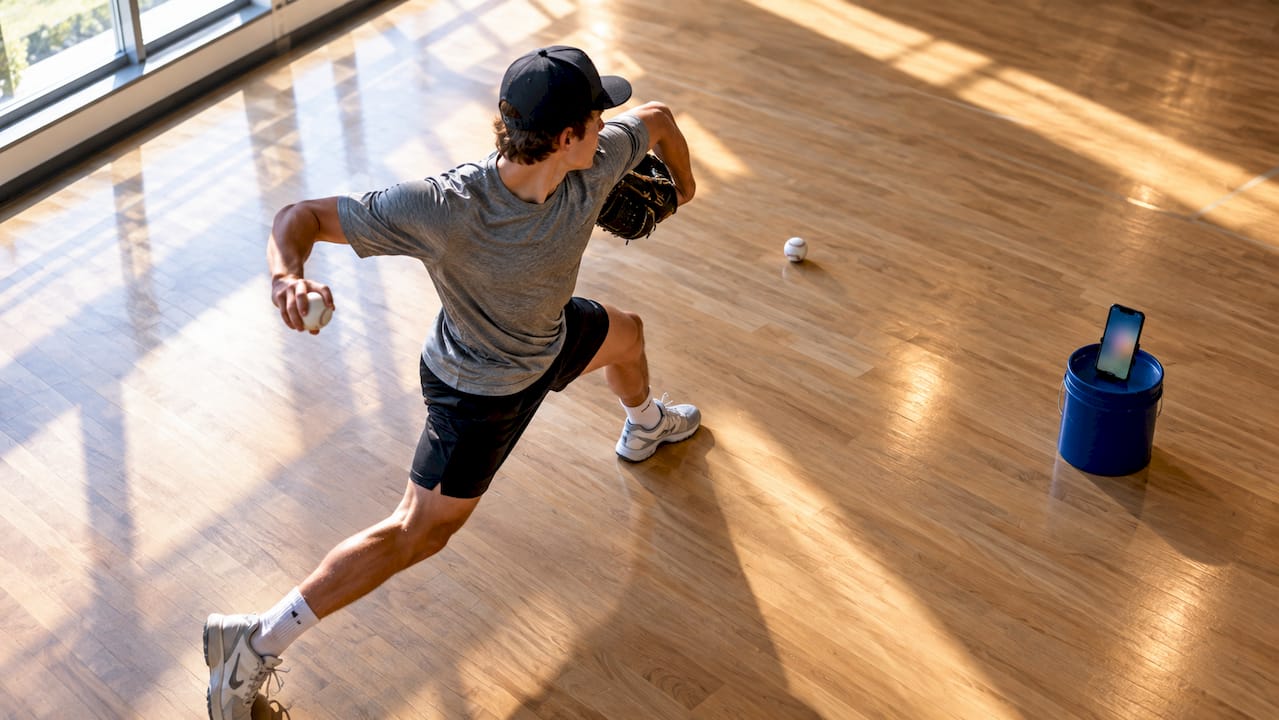
Pro Tip: Film the flat-ground command drill from the side every few weeks. A phone propped on a bucket works fine, and comparing clips over time shows mechanical drift long before it shows up in the strike zone.
Our throwing accuracy improvement guide walks through additional variations on these drills for different skill levels.
What Mechanics Actually Cause Missed Strikes?
Most command problems trace back to one of five checkpoints, and biomechanical research on youth pitchers backs up why each one matters.
- Balance and tempo. A rushed or unstable leg lift throws off timing for everything that follows.
- Hip-first sequencing. The hips should rotate before the shoulders. A stride that lands off-line disrupts that order, and a biomechanics review of youth pitching links that kind of misfire to both inconsistent release points and added stress on the elbow and shoulder.
- Arm path. Short-arming (a compressed, rushed arm circle) usually produces a low, erratic release. Watch for a full, relaxed arm path instead of a jerky one.
- Release point. The same review notes stride length typically falls between 66 and 85 percent of a pitcher’s height. Landing consistently outside that range often shows up as an inconsistent release point.
- Follow-through. An incomplete finish, especially one where the chest stays upright instead of dropping over the front knee, is a common cause of pitches sailing high.
Safety note: breaking pitches should wait until a pitcher’s mechanics and physical maturity catch up, and any elbow or shoulder pain during or after throwing means stop and rest, not push through. Correcting these patterns early also builds better neuromuscular habits long term, since the same review found that early mechanical faults tend to compound rather than fade on their own. Our physics-based breakdown of pitching mechanics covers the kinetic chain in more depth.
How Often Should Young Pitchers Practice?
- Practice 2 to 3 times per week, focused on deliberate, low-intensity drill work rather than long bullpen sessions, per Little League’s coaching guidance.
- Follow age-appropriate pitch counts and rest days. Younger arms need more recovery days between outings, and pitch counts should scale down with age, not just innings.
- Watch for fatigue signs mid-session: a dropped elbow, shortened stride, or sudden loss of accuracy. Stop the session rather than push through it.
- Bookend every session with a warm-up and cooldown, even short drill days. Skipping this on a “light” day is how minor soreness turns into missed weeks.
Rest is what makes the repetition in these drills pay off. A pitcher who drills every day without recovery days tends to plateau faster than one who trains three focused days and rests the rest. Our guide to arm injuries in youth baseball covers warning signs worth knowing before a season starts.
How Do You Know If the Drills Are Working?
Track strike percentage across sets of 20 to 30 throws, not single pitches. A single wild throw means nothing; a pattern across 25 throws means everything.
- Set a realistic short-term goal: a 5 to 10 percent strike-rate improvement over four to six weeks is a fair target for most youth pitchers.
- Log the basics each session: which drill you ran, the effort level, and how the pitcher’s arm felt afterward.
- Film from the side every two to four weeks. Side-angle video catches arm-path and release issues that are hard to see live, even for an experienced coach.
- Only add intensity or new pitch types once strike percentage is stable, not while it’s still climbing.
This kind of simple tracking, rather than chasing velocity, is what separates command training that works from throwing that just accumulates volume.
What Youth Pitching Coaches Get Wrong
Most well-meaning coaches try to fix everything they see in one session, and that’s usually the fastest way to stall a young pitcher’s progress. Pick one, maybe two cues per outing and repeat them for weeks. A kid who hears five different corrections in a single bullpen session leaves more confused than when he started, and confusion doesn’t show up as strikes.
Repetition under control beats more max-effort throws every time. Velocity chases attention, but strikes come from a delivery the arm can repeat without thinking about it, which only happens through submaximal reps done correctly, over and over. Mechanical changes take weeks to stick, not one practice. Trust the strike-percentage numbers over gut feel about how a session “looked,” because gut feel is where overcoaching creeps in.
— Albert
How Pitch Training Baseball Tools Make These Drills Easier to Run
Running the flat-ground command drill gets a lot simpler with an actual target instead of a taped square on a fence. The Pitching Target Net with Colorful Strike 9-Zone gives pitchers nine defined zones to aim at, so tracking strike percentage stops being a guessing game and becomes an actual number you can log after every set.

Pitchers who split time between baseball and softball can use the Pitch Training Softball for the same repetition-based command work without switching gear. And once the ball leaves the hand, the America Sliding Mitt supports the fielding-finish drill described above, connecting a clean follow-through to the next play in the sequence.
None of this replaces sound coaching or smart pitch-count management. What it does is give families and volunteer coaches an objective target and consistent feedback at home, between practices, without needing a full field or a second coach on hand. If you’re ready to build that kind of routine, browse the full training lineup and start with whichever tool matches the drill you’re running first.
Sources
- Coaching Young Pitchers in Baseball – Keep It Simple - Little League
- Biomechanics review of youth pitching (PMC)
- Veo — baseball pitching drills (2026)
FAQ
How Many Days a Week Should a Youth Pitcher Practice?
Two to three sessions per week of deliberate, low-intensity drill work builds command better than daily high-effort throwing, according to Little League’s coaching guidance.
What’s the Fastest Way to Improve Pitching Accuracy?
Focus on a repeatable delivery through drills like the balance point hold and flat-ground command work at 70 to 85 percent effort, then track strike percentage to confirm progress.
How Long Should Each Pitching Drill Take?
Most command drills, including the towel drill and balance point hold, run effectively in 8 to 10 minute blocks, per Veo’s drill guidance.
What Causes a Pitcher to Consistently Throw High?
An incomplete follow-through, where the chest doesn’t finish over the front knee, is a common cause of pitches sailing high.
Can a Target Net Really Improve Strike Percentage?
A defined target, like a nine-zone strike net, gives pitchers immediate visual feedback and lets coaches log strike percentage accurately across practice sets, which is harder to do with an undefined target.