


When a young player comes off the mound gripping their elbow or rolling their shoulder, the right first move is simple: stop throwing immediately. Baseball arm injuries in youth players are overwhelmingly overuse-based, and the structures most at risk — growth plates, cartilage, and developing ligaments — don’t tolerate being pushed through pain the way adult tissue sometimes can. The American Academy of Orthopaedic Surgeons (AAOS) has documented that many youth players report arm pain after throwing, yet many parents remain unaware of safe pitching practices.
Immediate steps when arm pain appears:
- Stop all throwing activity at once — no “one more inning”
- Apply ice to the affected area for 15–20 minutes
- Limit overhead activity and rest the arm fully
- Track recent pitch counts and note when pain started
Red flags that require urgent medical evaluation:
- Pain that doesn’t improve after 2–3 days of complete rest
- Visible swelling or deformity at the elbow or shoulder
- Numbness or tingling in the ring or pinky finger
- Sudden, significant drop in pitching velocity or control
Key Takeaways
Youth baseball arm injuries are overwhelmingly preventable when coaches and parents enforce pitch-count limits, mandate seasonal rest, and act immediately when pain appears.
| Point | Details |
|---|---|
| Stop throwing with any pain | Continuing to throw through arm pain is the primary driver of overuse injuries becoming structural damage. |
| Track pitch volume across all teams | Cumulative load across travel, school, and rec teams is what causes overuse — count every pitch, not just yours. |
| Four months off per year | UT Southwestern specialists recommend no competitive pitching for four months annually to reduce UCL stress in athletes 18 and younger. |
| Delay breaking pitches | Curveballs and sliders before skeletal maturity place abnormal valgus torque on the medial elbow; most specialists recommend waiting until at least age 14. |
| Use phased return-to-play criteria | Return decisions should be based on pain-free full range of motion and symmetric strength, not calendar dates alone. |
Table of Contents
- Why do youth players get baseball arm injuries?
- What are the most common shoulder and elbow diagnoses in youth players?
- How do you know when arm pain is serious?
- What to do in the first 48–72 hours after arm pain starts
- How do clinicians evaluate a throwing-arm injury?
- What are the treatment options and how long does recovery take?
- How can you prevent baseball arm injuries in youth players?
- What does a safe return to throwing look like?
- Drills and training tools that protect young arms
- How do arm injuries affect a young player’s mental health?
- What is the long-term outlook after a youth arm injury?
- A coach’s perspective on protecting young arms
- Sources
Why do youth players get baseball arm injuries?
The short answer: too many throws, not enough rest, and tissue that isn’t ready for the load. Young athletes are not small adults. Their growth plates — the cartilaginous zones at the ends of developing bones — are biomechanically weaker than the surrounding ligaments. That means repetitive throwing stress can damage the growth plate before it damages the ligament, which is the opposite of what happens in adult throwers.
A prospective study of 900 players ages 7–11 found shoulder pain in 18.3% and elbow pain in 35.2% over a single season. Pitcher and catcher positions, longer weekly training hours, and a prior history of arm pain were all independent risk factors. Those numbers are striking for a population that young.
- Year-round play and multiple-team participation. Little League identifies year-round play as the number-one risk factor for arm injuries in youth players. Playing on a travel team and a school team simultaneously doubles cumulative pitch volume with no added recovery.
- High pitch and inning volumes. Exceeding recommended pitch counts per outing or per week accelerates microtrauma accumulation.
- Pitching while fatigued. Mechanics break down when a player is tired, shifting stress from the larger muscle groups to the elbow and shoulder structures.
- Early breaking pitches. Curveballs and sliders before skeletal maturity place abnormal valgus torque on the medial elbow. PMC research links early breaking-pitch use directly to higher medial elbow injury rates.
- Poor mechanics. Dropping the elbow, early trunk rotation, and inadequate hip drive all funnel excess force into the arm.
- Single-sport specialization. Skipping cross-training leaves core and lower-body deficits that the arm compensates for with every throw.
Understanding overuse injury in baseball is the first step toward preventing it.
Pro Tip: Ask your player to rate arm soreness on a 0–10 scale before and after every practice. Anything above a 3 the morning after throwing is a signal to reduce load, not push through. Track this number across all teams the player is on — not just yours.
What are the most common shoulder and elbow diagnoses in youth players?
Not all arm pain is the same, and the diagnosis often depends on the player’s age and position. Growth-plate conditions dominate in younger athletes (roughly ages 8–14), while ligamentous injuries become more common after skeletal maturity.
Little Leaguer’s elbow
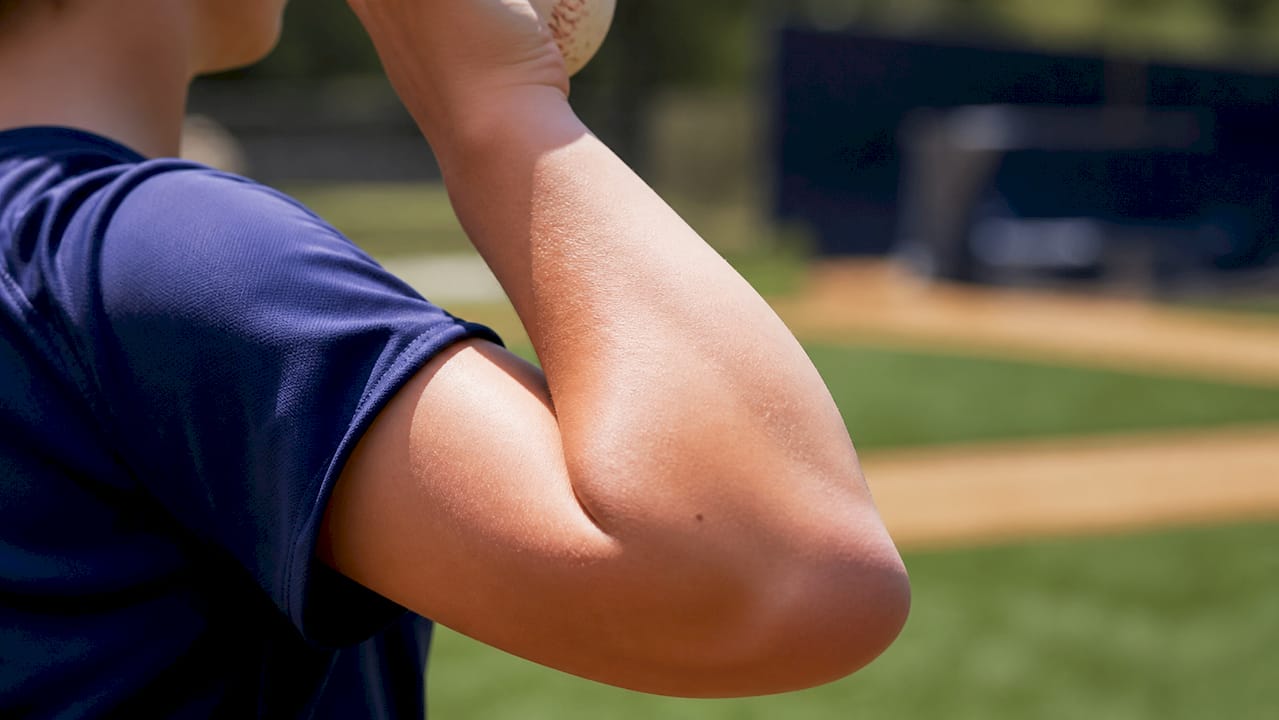
The most common diagnosis in youth throwers. Medial apophysitis or epiphysitis involves stress and sometimes fragmentation at the medial epicondyle apophysis — the bony bump on the inside of the elbow where several forearm muscles attach. It produces pain on the inner elbow, especially during or after throwing.
Little Leaguer’s shoulder
Proximal humeral epiphysiolysis is a stress injury to the growth plate at the top of the upper arm bone. It shows up as shoulder pain in adolescent pitchers, often with tenderness directly over the growth plate. X-ray typically confirms widening of the physis.
UCL sprain or tear
The ulnar collateral ligament (UCL) runs along the inner elbow and absorbs the enormous valgus forces generated during pitching. Partial sprains can often be managed conservatively; complete tears in athletes who want to continue throwing at a high level frequently require UCL reconstruction (Tommy John surgery).
Osteochondritis dissecans (OCD) of the capitellum
OCD involves a disruption of blood supply to a segment of cartilage and underlying bone on the outer (lateral) side of the elbow. It’s less common than medial injuries but more serious — unstable OCD lesions often require surgery and carry a longer recovery.
Rotator cuff tendinopathy and labral tears
These shoulder conditions are more typical in older adolescents and young adults. Rotator cuff tendinopathy produces diffuse shoulder pain and fatigue. Labral tears — particularly SLAP lesions — cause a deep, catching pain and can significantly affect throwing mechanics.
A 10-year cohort study reported an overall arm-injury incidence of 25.6 per 100 athletes across adolescent players, with a cumulative surgical incidence of 5.4 per 100 athletes. Players who continued competing beyond high school faced meaningfully higher surgical risk.
How do you know when arm pain is serious?
Most arm soreness after a long practice is normal. What separates manageable fatigue from a genuine injury signal is persistence, location, and the presence of any neurological symptoms.
Red flags that require prompt medical evaluation:
- Pain that doesn’t resolve after 2–3 days of complete rest. Soreness that lingers is the body’s clearest signal that something structural is involved.
- Loss of full elbow extension. A player who can’t fully straighten their arm after rest likely has swelling or a mechanical block inside the joint.
- Sudden drop in velocity or control. When a pitcher abruptly loses 5–8 mph or can’t locate pitches they normally command, the arm is compensating for pain.
- Numbness or tingling in the ring and pinky fingers. This pattern points to ulnar nerve involvement, which can accompany medial elbow injuries.
- Visible swelling or deformity. Any acute swelling after a single throw — not gradual soreness — warrants same-day evaluation.
- Locking, catching, or clicking in the joint. These mechanical symptoms suggest loose bodies or OCD lesions that can progress rapidly without treatment.
The AAOS notes that many youth athletes are encouraged to play through pain, which is one of the primary behavioral drivers of worsening overuse injuries. Growth-plate damage in particular is uniquely dangerous to push through — the cartilaginous growth center can fracture or displace under continued stress, turning a manageable stress reaction into a surgical problem.
Pro Tip: If a player mentions arm pain during a game, pull them immediately. Don’t wait for the inning to end. Boston Children’s Hospital is direct: persistent pain or loss of motion requires physician evaluation, not a wait-and-see approach.
What to do in the first 48–72 hours after arm pain starts
Stop throwing. That’s the whole first step, and it’s non-negotiable.
After that, apply modified RICE principles adapted for throwing athletes:
- Rest from all throwing. No light tossing, no “just warming up.” Complete rest from overhead activity.
- Ice the affected area. 15–20 minutes every 2–3 hours for the first 48 hours. A bag of frozen peas wrapped in a thin towel works fine.
- Limit overhead and weight-bearing activity. Avoid push-ups, pull-ups, or anything that loads the shoulder or elbow.
- Avoid using anti-inflammatories as a long-term fix. A single dose of ibuprofen for acute pain is reasonable, but masking pain with medication to return to throwing faster is dangerous. Always follow dosage guidance for the player’s age and weight, and consult a physician before extended use.
Two things coaches and parents should specifically avoid: stretching into pain and any return-to-throwing before a clinician clears the athlete. Stretching a growth-plate injury can worsen it. Returning too early is the most common reason youth arm injuries become chronic.
Pro Tip: Before the clinic visit, write down the player’s pitch counts from the past two to three weeks across every team they play for. Include the date, number of pitches, and any games where they mentioned soreness. Clinicians use this information to assess cumulative load — it’s as useful as an X-ray for understanding what happened.
How do clinicians evaluate a throwing-arm injury?
A thorough evaluation starts with the history, not the imaging. A sports-medicine physician or orthopedist will ask about pitch counts, position played, when pain started, whether it’s sharp or dull, and whether it appeared gradually or after a single throw. That context shapes everything that follows.
The physical exam typically includes:
- Range-of-motion testing (full elbow extension is a key benchmark)
- Palpation of the medial and lateral epicondyle, UCL, and growth-plate regions
- Valgus stress testing to assess UCL integrity
- Neurologic screening for ulnar nerve involvement (grip strength, sensation in the ring and pinky fingers)
- Shoulder impingement and rotator cuff strength tests when shoulder pain is present
Imaging pathway:
- Plain X-rays first for any youth player with elbow pain. Growth-plate injuries, apophyseal avulsions, and OCD lesions often show on plain films. X-rays are also useful for comparison views of the opposite elbow when asymmetry is suspected.
- MRI when soft-tissue or cartilage pathology is suspected. UCL tears, labral injuries, and advanced OCD lesions require MRI for accurate characterization. Some centers use MRI arthrography (with contrast) for clearer UCL imaging.
- Ultrasound is used in some sports-medicine clinics for dynamic assessment of the UCL and to guide injections, but it’s operator-dependent and less definitive than MRI for most structural diagnoses.
Refer to a pediatric sports-medicine specialist or orthopedic surgeon when: imaging shows a growth-plate fracture or displaced apophysis, UCL integrity is in question, OCD is identified, or conservative management hasn’t produced improvement after 4–6 weeks. Bring the pitch log, a list of teams the player is on, and any prior injury history to that appointment.
What are the treatment options and how long does recovery take?
The vast majority of youth arm injuries respond to conservative care when caught early. Surgery is the exception, not the default.
Conservative care
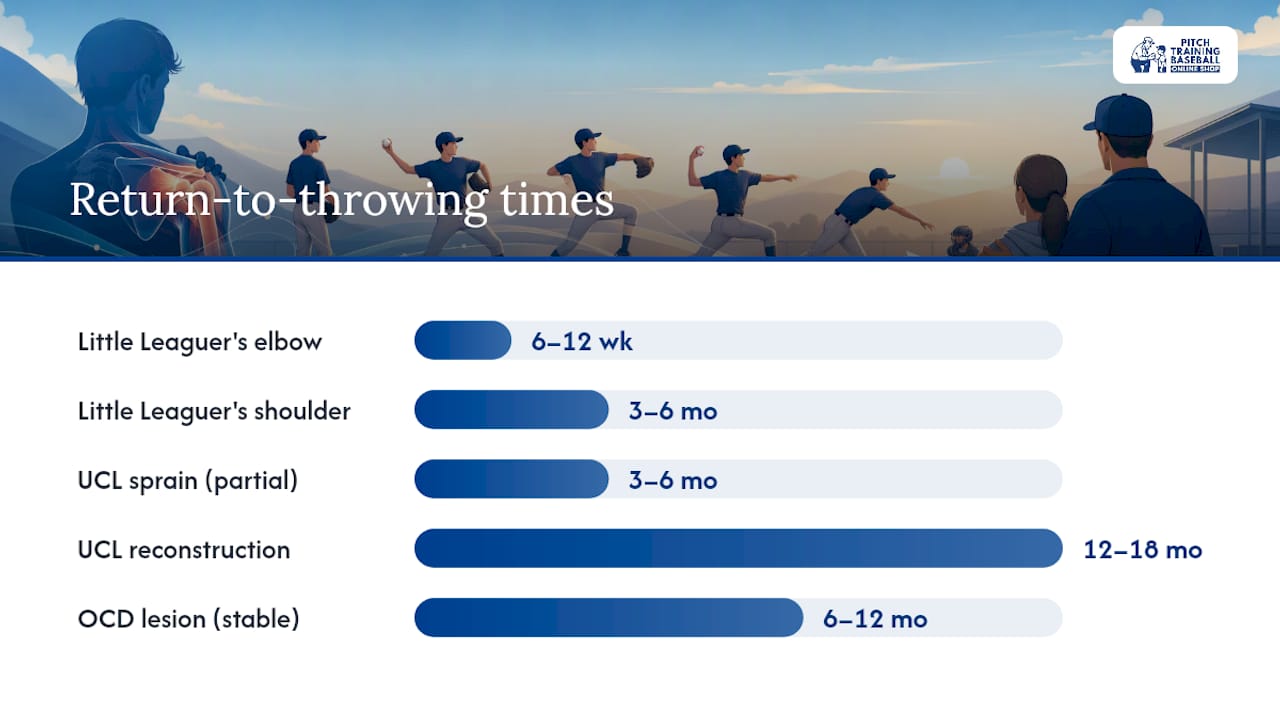
Rest is the primary treatment for growth-plate injuries, and the timeline is longer than most parents expect. Little Leaguer’s elbow typically requires 6–12 weeks of complete rest from throwing, followed by a structured return-to-throwing program. Little Leaguer’s shoulder often needs a similar or longer rest period.
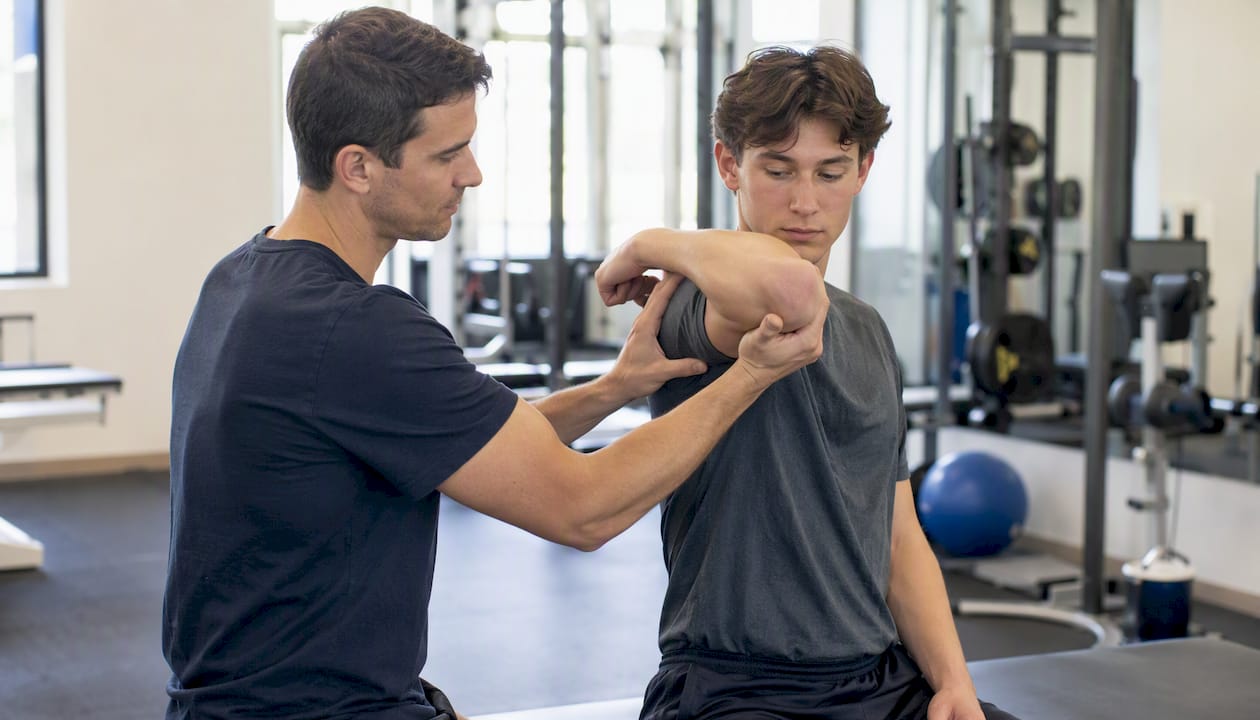
Physical therapy targets the whole kinetic chain, not just the sore elbow or shoulder. CHOP’s sports-medicine team emphasizes that effective rehab for throwing injuries includes core strengthening, hip mobility, and lower-extremity conditioning — because throwing is a full-body motion and arm stress is often a downstream consequence of proximal weakness. Working with a physical therapist experienced in athlete recovery makes a measurable difference in both recovery speed and re-injury prevention.
When surgery is considered
Surgery becomes the conversation when:
- A UCL tear is complete (Grade III) and the athlete wants to return to competitive throwing
- A growth-plate fracture is displaced and cannot heal in position
- An OCD lesion is unstable or has produced a loose body in the joint
- Conservative care over 3–6 months has not resolved symptoms
UCL reconstruction (Tommy John surgery) replaces the torn ligament with a tendon graft, typically from the forearm or hamstring. Recovery to full competitive pitching typically spans 9–12 months, and some athletes require closer to 18 months before returning to full game intensity. Tommy John is a reconstructive procedure, not a performance upgrade — UT Southwestern orthopedic specialists are explicit that it is a last resort, not a shortcut.
| Diagnosis | Typical rest/recovery | Return to throwing |
|---|---|---|
| Little Leaguer’s elbow (mild) | 4–6 weeks rest | 6–12 weeks total |
| Little Leaguer’s shoulder | 6–12 weeks rest | 3–6 months total |
| UCL sprain (partial) | 6–12 weeks conservative | 3–6 months with PT |
| UCL reconstruction (Tommy John) | Surgery + 9–12 months rehab | 12–18 months to competition |
| OCD lesion (stable) | 3–6 months conservative | Variable, 6–12 months |
A 10-year cohort study found a cumulative surgical incidence of 5.4 per 100 athletes in adolescent baseball players, with risk increasing significantly for those who continued playing at higher competitive levels.
How can you prevent baseball arm injuries in youth players?
Prevention is where parents and coaches have the most leverage. The evidence is consistent: volume control, mandatory rest, and delayed breaking pitches are the highest-impact interventions.
Pitch count and rest guidelines
UT Southwestern recommends limiting competitive pitching to no more than 100 innings per calendar year for athletes 18 and younger, and advises four months per year with no competitive pitching. Little League and USA Baseball publish age-specific daily pitch limits with mandatory rest periods based on pitches thrown.
Source: Little League Baseball pitch-count regulations
These limits apply per game, not per week. A player who hits 61 pitches on Saturday needs three full days of rest before pitching again — regardless of what the travel-team schedule says.
Coaching checklist for arm protection
- Enforce pitch counts across all teams, not just your own
- Delay curveballs and sliders until at least age 14 (many sports-medicine specialists recommend 16)
- Build a proper warm-up: light jogging, dynamic stretching, and graduated throwing before full-effort pitches
- Monitor mechanics for early trunk rotation, elbow drop, and inadequate hip drive
- Schedule four months per year with no competitive pitching — HSS recommends this as a core prevention measure
- Integrate core and lower-body strength work into every practice week
Safe baseball training practices that include cross-training and workload monitoring are among the most effective tools a coach has. Planning pitcher rotations with built-in rest days is equally important and often overlooked at the youth level.
What does a safe return to throwing look like?
Return-to-throwing is a phased process, not a single clearance decision. The benchmark at every stage is the same: pain-free, full range of motion, and mechanics that look normal.
Objective criteria before starting any return program:
- Full, pain-free elbow extension and shoulder range of motion
- Symmetric grip and shoulder strength compared to the uninjured side
- No neurologic symptoms (numbness, tingling)
- Physician or physical therapist clearance
Phased throwing progression:
- Phase 1 (weeks 1–2): Flat-ground tossing at 45 feet, 10–15 throws per session, every other day. Stop immediately if any pain occurs.
- Phase 2 (weeks 3–4): Progress to 60 feet, increase to 20–25 throws. Evaluate mechanics and pain response after each session.
- Phase 3 (weeks 5–6): Advance to 90 feet for position players; pitchers remain at 60 feet with focus on mechanics, not effort.
- Phase 4 (weeks 7–8): Pitchers begin mound work at 50–60% effort, 15–20 pitches per session. Position players progress to game-distance throws.
- Phase 5 (weeks 9–10+): Gradual increase to full-effort pitching and game simulation. Pitch counts restart at the low end of age-appropriate limits.
After UCL reconstruction, return-to-throwing protocols are longer and more conservative. Most sports-medicine programs don’t begin mound work until 6–9 months post-surgery, with full competitive return typically at 12–18 months. PMC research supports objective, pain-free progression benchmarks as the standard for clearing athletes — not calendar dates alone.
Understanding why pitcher recovery matters is essential for coaches who want to protect their athletes during this vulnerable phase.
Drills and training tools that protect young arms
The best arm-protection program is one that builds strength, reinforces mechanics, and keeps throwing volume controlled. These drills fit into a 20–30 minute pre-practice routine.
Warm-up and activation drills:
- Arm circles and band pull-aparts. Light resistance bands for scapular retraction and rotator cuff activation before any throwing.
- 90/90 external rotation with band. Targets the posterior rotator cuff — the deceleration muscles that absorb force on every throw.
- Hip hinge and lateral band walks. Core and hip activation before throwing reduces the arm’s compensatory load.
- Wrist flexor and extensor stretches. 30 seconds each side, held gently — not forced.
Progressive throwing drills:
- Short-distance accuracy work. Start at 30–40 feet with a strike-zone target net to reinforce mechanics without high-effort throws. Target nets give immediate visual feedback on location, which keeps young pitchers focused on mechanics rather than velocity.
- Long-toss progression. Gradual distance increases over multiple sessions build arm strength safely. Use light training balls for younger players to reduce peak stress per throw.
- Deceleration emphasis. After each throw, cue the player to follow through fully and let the arm decelerate naturally. Cutting off the follow-through is a common mechanical flaw that concentrates stress at the elbow.
Strength exercises for arm durability:
- Scapular push-ups and prone Y-T-W raises for shoulder stability
- Pallof press and anti-rotation holds for core strength
- Single-leg Romanian deadlifts for hip and posterior chain development
Pitchtrainingbaseball’s training equipment — including strike-zone target nets and light training balls — is designed for exactly this kind of controlled, progressive practice. They work at home, in the backyard, or on the field. Building arm strength safely starts with the right tools and the right volume.
Pro Tip: You don’t need a full practice to get quality arm work done. A 15-minute session of band activation, 20 throws at a target net, and 5 minutes of core work is more protective than a 90-minute bullpen session with no warm-up. Consistency beats volume every time.
Stop any drill the moment a player reports pain. No drill is worth the risk of converting a minor irritation into a structural injury.
How do arm injuries affect a young player’s mental health?
The physical injury is visible. The psychological toll is not, and coaches and parents often underestimate it.
Being sidelined during a season a player has trained for is genuinely hard. Young athletes frequently tie their identity to their sport, and an arm injury can trigger anxiety, frustration, and a sense of falling behind teammates. For pitchers especially, the arm is their primary tool — losing it, even temporarily, can feel like losing their role on the team.
A few patterns show up consistently. Players who are told to “just rest” without a clear timeline or return plan tend to struggle more with anxiety than those given structured milestones. The uncertainty is often harder than the injury itself. Adolescents are also susceptible to social pressure: fear of losing a starting spot or a scholarship opportunity can push them to return before they’re ready, which is exactly the behavioral pattern the AOSSM notes as a driver of re-injury and guideline non-compliance.
Practical coping strategies that actually help:
- Give the player a role during recovery. Keeping them involved as a scorer, base coach, or practice helper maintains team connection and reduces isolation.
- Set clear, objective milestones. “You’ll start tossing again when your elbow is fully straight and pain-free” is more reassuring than “we’ll see how it goes.”
- Normalize the experience. Many elite pitchers have had arm injuries. Framing recovery as part of athletic development, not a career-ending event, matters.
- Consider a sports psychologist or counselor for players who show signs of prolonged anxiety, depression, or loss of motivation. This is not overreacting — it’s good sports medicine.
Parents play a significant role here. The pressure to perform, even when unspoken, is felt. Modeling patience and prioritizing health over roster spots sends a message that sticks.
What is the long-term outlook after a youth arm injury?
Most youth players who follow proper treatment and return-to-play protocols recover fully and go on to pitch without chronic problems. The key word is “follow.” Cutting the recovery short is the most reliable predictor of re-injury.
Growth-plate injuries that heal completely with adequate rest carry a good prognosis. The growth plate closes as the athlete matures, and a well-healed apophyseal injury typically leaves no long-term structural deficit. UCL sprains managed conservatively have similarly favorable outcomes when the underlying volume and mechanics issues are addressed.
The picture changes for players who return too early, continue year-round play without adequate rest, or accumulate multiple injuries over several seasons. The 10-year cohort data show that players who advance to higher competitive levels face a meaningfully higher cumulative surgical incidence — 5.4 per 100 athletes overall, with risk rising for those who continue beyond high school. That’s not a reason to stop playing. It’s a reason to manage load carefully at every level.
After UCL reconstruction, re-tear rates exist and are not trivial, particularly when athletes return before the graft has fully matured. Most sports-medicine programs use objective strength and functional testing before clearing a post-Tommy John pitcher for full competition, precisely because calendar time alone is an unreliable guide.
Chronic issues — persistent medial elbow pain, early-onset arthritis, or recurring UCL stress — are most common in players who had repeated injuries without adequate treatment or who pitched through pain for multiple seasons. Prevention of chronic problems starts with the same steps as acute injury prevention: volume control, rest, mechanics, and honest communication between players, parents, and coaches.
A coach’s perspective on protecting young arms
The clinical guidance is clear. What’s harder is applying it when a team is down two runs in the sixth inning and your best arm is sitting in the dugout at 85 pitches.
Prevention isn’t just a medical concept — it’s a coaching philosophy. The players who stay healthy longest are the ones whose coaches treat pitch counts as non-negotiable, who build rest into the weekly schedule rather than fitting it in when convenient, and who create an environment where a player feels safe saying “my arm hurts” without fear of losing their spot.
The evidence from AAOS, Little League, and longitudinal cohort studies all points to the same conclusion: the arm injuries that end careers are almost always preventable. They accumulate over months and seasons, not in a single game. That means every practice decision — how long a pitcher throws, whether to skip the warm-up, whether to let a fatigued player “push through” — is a prevention decision.
Pitchtrainingbaseball’s resources and training tools are built around this philosophy. Controlled, structured practice with the right equipment and the right volume is how you develop a pitcher without burning out their arm. The goal is a player who’s still throwing at 18, not one who had a great season at 12 and a surgery at 14.
Sources
These are the primary clinical and research sources cited throughout this guide. Bringing relevant links or printed pitch logs to clinic visits helps clinicians assess cumulative load quickly.
- The Risks of Shoulder and Elbow Injury from Participation in Youth Baseball (AAOS)
- Risk factors for shoulder and elbow pain in youth baseball players (PubMed)
- Arm injury in youth baseball players: a 10-year cohort study (PubMed)
- Throwing-related medial elbow injuries and youth pitching recommendations (PMC article)
- UCL reconstruction (Tommy John surgery) — CHOP
- UT Southwestern: Elbow injuries among young baseball players
- Preventing Arm Injuries During Baseball Season — HSS
This article is general information, not a substitute for advice from a qualified doctor. Consult a qualified healthcare professional about your own circumstances before acting on anything here.
Recommended
- What Is Overuse Injury in Baseball: A Parent’s Guide – Pitch Training Baseball
- Arm Strength in Young Players: A 2026 Parent and Coach Guide – Pitch Training Baseball
- Baseball parents: safety, support, and pitching success – Pitch Training Baseball
- Youth Sports Safety: A Practical Guide for Parents & Coaches – Pitch Training Baseball