


Pitch trajectory is defined as the three-dimensional path a baseball travels from the pitcher’s release point to the catcher’s mitt, shaped by gravity, drag, spin, and aerodynamic forces. Understanding pitch trajectory in baseball is not just for advanced players or data analysts. Young athletes, parents, and coaches who grasp this concept gain a real edge in developing smarter, more effective pitching. Key metrics like Vertical Approach Angle (VAA) and Induced Vertical Break (IVB) now give coaches the tools to measure and improve trajectory with real precision.
What is pitch trajectory and why does it matter?
Pitch trajectory is the exact flight path a baseball follows through the air, from the moment it leaves the pitcher’s fingers to the moment it crosses home plate. The path is never a straight line. Multiple forces including gravity, drag, the Magnus effect, and Seam Shifted Wake all act on the ball simultaneously to shape its curve, movement, and final location.
This matters because hitters read trajectory to predict where the ball will cross the plate. A pitcher who controls trajectory controls the hitter’s timing and contact point. That is the core reason understanding pitch trajectory is one of the most useful skills a young pitcher can develop.
Trajectory is not the same as speed. Two pitches thrown at the same velocity can follow completely different paths depending on spin rate, spin axis, and release mechanics. A four-seam fastball and a sinker thrown at the same speed will arrive at the plate from different angles and with different movement profiles.
Pro Tip: Watch a pitcher’s release point, not just the ball. The release height and arm slot set the baseline trajectory before spin even takes effect.
What physical forces shape the trajectory of a baseball pitch?
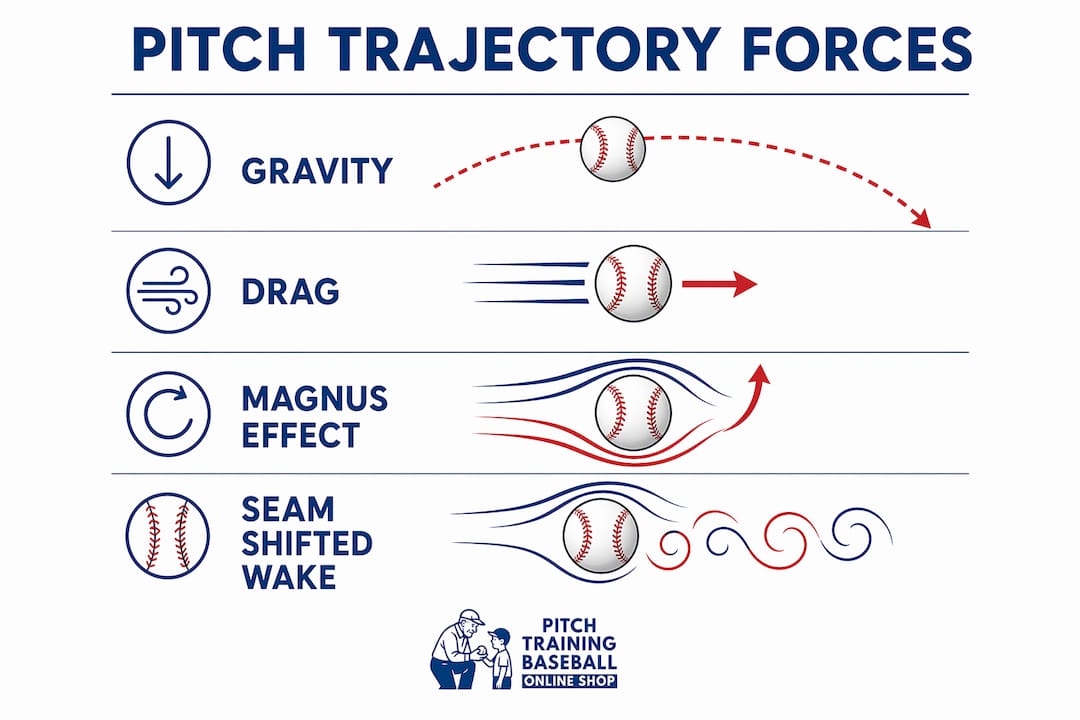
Four forces determine pitch trajectory mechanics on every single pitch thrown. Each one acts differently, and together they create the unique flight path of every pitch type.
Gravity
Gravity pulls the ball downward at a constant rate throughout its flight. Every pitch drops. The question is how much it drops and how fast. A pitch with high backspin drops less than a pitch with low spin, which creates the illusion that some fastballs rise. Gravity is the one force that never changes, which makes it the baseline against which all other forces are measured.
Drag
Drag slows the ball as it moves through the air. A pitch thrown at 90 mph does not arrive at 90 mph. Drag reduces velocity throughout the flight, which affects how long the ball is in the air. Longer flight time gives hitters more time to react. Pitchers with high velocity reduce flight time and shrink the hitter’s reaction window.
The Magnus effect
The Magnus effect is the force created by spin. When a pitcher throws a four-seam fastball with backspin, the spinning ball creates a pressure difference between the top and bottom of the ball. That pressure difference generates lift, which fights gravity and reduces drop. When a pitcher throws a curveball with topspin, the Magnus force pushes the ball downward, adding to gravity’s pull and creating sharp downward break.
Seam Shifted Wake
Seam Shifted Wake is a newer concept that explains why some pitches move differently than their spin axis predicts. Small changes in grip or release cause the ball’s seams to interact with the air boundary layer in unexpected ways, producing late movement that surprises hitters. This is why two pitchers throwing the same pitch type can get very different results from similar spin rates.
Here is a quick breakdown of how each force affects the ball:
- Gravity: Constant downward pull on every pitch, every time
- Drag: Slows the ball, increases flight time, reduces late movement
- Magnus effect: Spin creates lift or drop depending on spin axis direction
- Seam Shifted Wake: Seam orientation causes deviation from spin-predicted path
Pro Tip: Young pitchers do not need to memorize physics equations. Focus on grip and spin axis first. The forces take care of themselves once mechanics are consistent.
How do VAA and IVB measure pitch trajectory?
Vertical Approach Angle and Induced Vertical Break are the two most important metrics for quantifying pitch trajectory. Both come from pitch tracking systems and give coaches a precise way to describe what a pitch is doing in the air.
Vertical Approach Angle explained
Vertical Approach Angle measures the angle at which a pitch descends as it crosses the front of home plate. A flatter angle means the ball is more level as it arrives. A steeper angle means the ball is dropping more sharply. VAA ranges vary by pitch type: four-seam fastballs typically fall between -4.0° and -6.0°, sinkers between -6.5° and -8.0°, and curveballs between -9° and -12°.
A flatter VAA on a fastball is generally harder to hit because the ball stays in the hitter’s contact zone for a shorter window. A steeper VAA on a curveball increases the chance of a swing and miss or a weak ground ball.
Induced Vertical Break explained
Induced Vertical Break measures how much a pitch rises or drops compared to what gravity alone would produce. It isolates the spin contribution to movement. A four-seam fastball with strong backspin achieves 18 or more inches of IVB, meaning it drops 18 fewer inches than a spinless pitch would. That is what creates the perceived rise.
Spin Induced Break vs. Trajectory Break
Older training models used Spin Induced Break, which calculated movement based only on spin axis and spin rate. Modern systems now use Trajectory Break, which measures the difference from a straight-line path influenced only by gravity. Trajectory Break accounts for wind, seam effects, and other aerodynamic factors that Spin Induced Break misses. This shift gives coaches a more complete picture of what a pitch is actually doing.
| Metric | What it measures | Typical range |
|---|---|---|
| VAA (four-seam fastball) | Descent angle at plate | -4.0° to -6.0° |
| VAA (sinker) | Descent angle at plate | -6.5° to -8.0° |
| VAA (curveball) | Descent angle at plate | -9° to -12° |
| IVB (elite fastball) | Spin-driven vertical movement | 18+ inches |
Pro Tip: VAA alone does not tell the full story. Pair trajectory with location to understand whether a pitch will actually be effective in a game situation.
How do different pitch types show unique trajectories?
Every pitch type produces a distinct trajectory profile. Recognizing these differences helps coaches teach pitch design and helps young athletes understand what they are trying to create with each throw.
Four-seam fastball
The four-seam fastball is thrown with backspin, which generates maximum Magnus lift. This reduces drop and creates a flat, rising appearance. Elite four-seam fastballs achieve 18 or more inches of IVB. The pitch works best up in the strike zone where the flat trajectory is hardest to square up.
Sinker
The sinker is thrown with a spin axis that generates downward Magnus force. It drops more than a four-seam fastball and arrives at a steeper angle. The sinker’s VAA of -6.5° to -8.0° makes it ideal for generating ground balls when located low in the zone.
Curveball
The curveball uses topspin to add downward force on top of gravity. The result is a steep, looping trajectory with a VAA of -9° to -12°. Hitters see the ball start high and watch it drop sharply, making it difficult to time correctly.
The rising fastball myth
There is no true rising fastball. High spin fastballs drop less than expected, creating an optical illusion of rising. Gravity always wins. The brain expects the ball to drop at a certain rate, and when it drops less, the visual system interprets that as a rise. Understanding this myth helps young pitchers focus on maximizing IVB rather than chasing an impossible outcome.
Spin efficiency measures how much of a pitch’s spin actually contributes to Magnus force. Near 100% spin efficiency means the pitch moves exactly as the spin axis predicts. Lower spin efficiency, often caused by gyroscopic spin, reduces the intended movement and makes the pitch less deceptive.
| Pitch type | Spin direction | Typical VAA | Primary movement |
|---|---|---|---|
| Four-seam fastball | Backspin | -4.0° to -6.0° | Reduced drop (perceived rise) |
| Sinker | Side-spin/topspin | -6.5° to -8.0° | Downward and arm-side run |
| Curveball | Topspin | -9° to -12° | Sharp downward break |
How can pitchers improve performance by controlling pitch trajectory?
Understanding trajectory is only useful if it connects to real practice. These steps give coaches and young athletes a clear path from concept to execution.
-
Work on release height and extension. Release height directly sets the starting point of the trajectory. A higher release point with good extension toward the plate produces a flatter VAA on fastballs. Pitchers who release the ball closer to the plate give hitters less time to react. Focus on throwing mechanics that maximize extension without sacrificing arm health.
-
Train spin efficiency, not just spin rate. A high spin rate with poor spin efficiency produces less movement than a moderate spin rate with near-perfect efficiency. Grip adjustments are the fastest way to improve spin efficiency. Experiment with finger placement on the seams to find the grip that produces the cleanest spin axis for each pitch type.
-
Adjust arm slot to change VAA. A higher arm slot produces a flatter VAA. A lower arm slot produces a steeper VAA. Coaches can use this knowledge to match arm slot to the pitcher’s best pitch type. A pitcher with a natural low arm slot may be better suited to a sinker or curveball than a high-ride fastball.
-
Use flight time and approach angle data strategically. Flight time and approach angle affect hitter timing in ways that velocity alone does not capture. A slower pitch with a steep approach angle can be just as disruptive as a faster pitch with a flat one. Mixing trajectories forces hitters to recalibrate between pitches.
-
Avoid the most common mistake young pitchers make. Most young pitchers focus entirely on velocity and ignore trajectory. They throw hard but predictably. A pitch that arrives fast but on a consistent, readable path is easier to hit than a slower pitch with unexpected movement. Daily pitching habits that include trajectory-focused drills build the awareness needed to pitch with intention.
Pro Tip: Use a pitching target with marked zones during practice. Hitting specific zones at specific approach angles builds the muscle memory that transfers directly to game situations.
Key Takeaways
Pitch trajectory is the single most important physical concept for young pitchers to understand, because controlling the ball’s path through the air determines whether a pitch gets hit hard or misses bats entirely.
| Point | Details |
|---|---|
| Trajectory is shaped by four forces | Gravity, drag, Magnus effect, and Seam Shifted Wake all act on every pitch. |
| VAA and IVB quantify trajectory | Four-seam fastballs target -4.0° to -6.0° VAA and 18+ inches of IVB for best results. |
| Trajectory must match location | The same VAA produces different outcomes depending on where the pitch lands in the zone. |
| Spin efficiency drives movement | Near 100% spin efficiency means the pitch moves exactly as intended by the spin axis. |
| Release mechanics set the baseline | Arm slot and release height determine VAA before spin effects even begin. |
What I have learned coaching pitchers who obsess over movement
Most coaches and parents hear about pitch movement and immediately think more is better. I used to think the same thing. After working with young pitchers at multiple levels, I have come to believe that obsessing over raw movement numbers without context is one of the fastest ways to develop a pitcher who throws impressive bullpen sessions and gets hit hard in games.
The pitchers who improve fastest are the ones who learn to pair trajectory with location. A fastball with 20 inches of IVB thrown belt-high over the middle of the plate is still a batting practice pitch. That same fastball thrown at the top of the zone, where the flat trajectory is hardest to track, becomes a swing-and-miss pitch. The movement did not change. The location did.
What I tell parents is this: do not evaluate your child’s progress by watching the ball curve. Watch where it lands. A pitcher who can put a pitch with a specific trajectory into a specific zone consistently is far ahead of a pitcher who throws wild movement with no control. Pitch command and trajectory work together. Neither one alone wins games.
The other thing I have seen repeatedly is that young pitchers have unique mechanics that produce unique baseline trajectories. Trying to force a short pitcher with a low arm slot to throw a high-ride four-seamer is fighting physics. The best coaching respects the pitcher’s natural release point and builds pitch design around it rather than against it. Individualized training based on real mechanics always outperforms cookie-cutter programs.
— Albert
Training tools that put trajectory concepts into practice
Understanding pitch trajectory is a strong start. Putting it into practice requires the right equipment and consistent repetition.
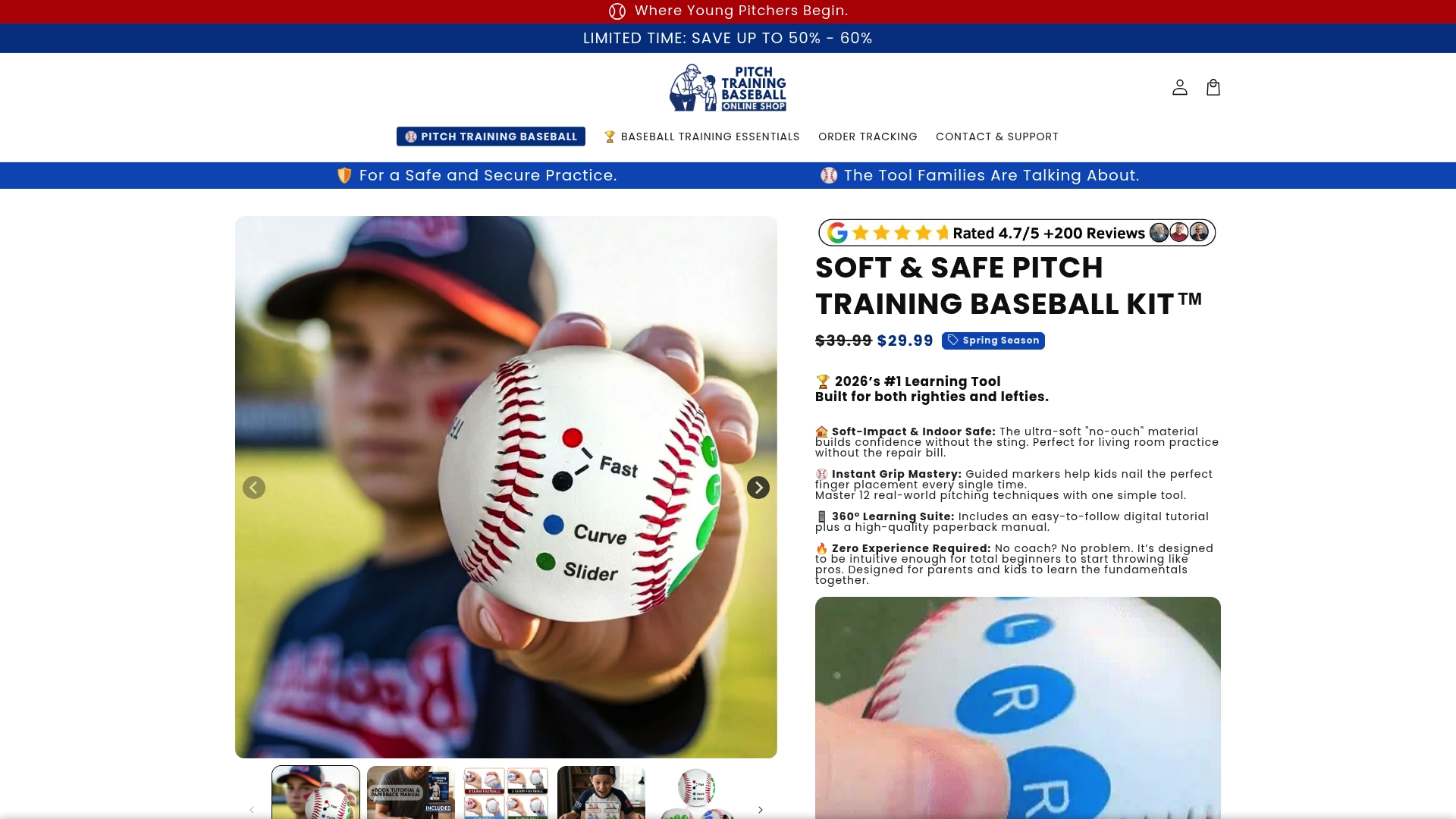
Pitchtrainingbaseball offers the Pitching Target Net with Strike 9-Zone, a training tool designed to help young pitchers practice hitting specific zones with intention. The nine-zone target gives immediate visual feedback on location, which is exactly what trajectory training requires. When a pitcher knows their approach angle and can consistently land the ball in the right zone, the concepts covered in this article become real skills. Pitchtrainingbaseball also carries pitch training baseballs built to support grip and spin work during practice sessions.
FAQ
What is pitch trajectory in simple terms?
Pitch trajectory is the path a baseball takes through the air from the pitcher’s hand to home plate. It is shaped by gravity, spin, drag, and the ball’s seam orientation.
What affects pitch trajectory the most?
The Magnus effect from spin is the biggest variable a pitcher can control. Gravity is constant, but spin rate, spin axis, and spin efficiency determine how much the ball rises, drops, or moves sideways.
What is Vertical Approach Angle?
Vertical Approach Angle is the downward angle at which a pitch crosses the front of home plate. Four-seam fastballs typically fall between -4.0° and -6.0°, while curveballs range from -9° to -12°.
Can a fastball really rise?
No. A fastball cannot physically rise against gravity. High backspin fastballs drop less than expected, which creates the visual illusion of rising. The brain predicts more drop and perceives the reduced drop as upward movement.
How can young pitchers improve their pitch trajectory?
Young pitchers improve trajectory by working on grip, spin axis, release height, and arm slot. Consistent accuracy drills that target specific zones reinforce the connection between trajectory and location that makes pitches effective in games.
Recommended
- What Is Pitch Command? A Guide for Youth Baseball – Pitch Training Baseball
- What Is Pitch Selection? A Youth Baseball Guide – Pitch Training Baseball
- Defining Youth Pitching Mechanics: A Coach’s Guide – Pitch Training Baseball
- Why Proper Pitching Technique Matters for Young Players – Pitch Training Baseball