


Most parents and coaches track pitch counts religiously. It makes sense. Pitch counts are visible, easy to measure, and widely promoted as the frontline defense against youth arm injuries. But here is what those numbers alone cannot capture: how tired a pitcher’s legs are, how stable their core is, or whether their hips have enough strength to protect their elbow. Understanding why physical fitness for young pitchers goes beyond simple counting is the difference between a kid who stays healthy through high school and one who needs surgery before their sophomore year.
Table of Contents
- Key takeaways
- Why physical fitness for young pitchers is about more than the throwing arm
- Fitness components every young pitcher needs to develop
- Common injuries linked to fitness deficits and how to prevent them
- Practical strategies for parents and coaches
- Performance benefits that go beyond staying healthy
- My take: fitness is the missing conversation in youth baseball
- Build your pitcher’s fitness foundation with Pitchtrainingbaseball
- FAQ
Key takeaways
| Point | Details |
|---|---|
| Pitch counts alone are not enough | Movement quality and full-body fitness determine joint stress more than pitch volume alone. |
| The kinetic chain drives arm health | Weak hips and a soft core force the elbow and shoulder to compensate, raising injury risk significantly. |
| Fatigue is the biggest hidden danger | Pitching while fatigued increases surgical risk by 36 times, making fatigue monitoring critical. |
| Year-round play without rest causes injuries | Taking at least two to three months off from throwing each year is one of the most protective things a young pitcher can do. |
| Fitness produces measurable performance gains | Structured arm care and strength programs can increase velocity by 1 to 3 mph while cutting injury rates by roughly 50%. |
Why physical fitness for young pitchers is about more than the throwing arm
Pitching looks like an arm activity. Watch a 12-year-old on the mound and most observers focus on hand position, arm path, and release point. What they miss is the chain reaction happening from the ground up. Every pitch starts with a push off the pitching rubber, travels through the ankle, knee, hip, core, shoulder, and elbow before the ball ever leaves the hand. That entire sequence is called the kinetic chain, and when any link in it breaks down, the arm pays the price.
Pitch counts alone are insufficient for injury prevention because different movement patterns create different joint stresses, even when the volume is identical. A pitcher with strong hips who drives powerfully off the mound distributes force across large muscle groups. A pitcher with weak hips does the opposite. The shoulder and elbow absorb stress that the legs should have handled.
Muscular endurance is the other piece that gets overlooked. A young pitcher might execute textbook mechanics on pitch 15. By pitch 55, fatigue has changed everything. The trunk rotates earlier. The front leg collapses. The arm drags. These are not mechanical flaws you fix with a different drill. They are fitness problems that produce mechanical breakdowns.
Pro Tip: Watch for early trunk rotation and front leg collapse during late innings. These subtle shifts signal rising injury risk before the pitcher ever feels pain, and they are direct signs of fitness-related fatigue, not just poor mechanics.
Subtle biomechanical breakdowns like these are among the most reliable early warnings a coach can spot. Catching them early, and addressing the underlying fitness deficit, keeps young arms healthy far longer than any pitch count limit ever could.
Here is the bottom line on kinetic chain health for pitchers:
- Leg strength creates pitch velocity and protects the elbow from overload
- Core stability transfers that leg power efficiently to the throwing arm
- Hip mobility allows proper rotation without compensating at the shoulder
- Shoulder and scapular stability control arm deceleration after release
- Full-body endurance preserves all of the above through an entire outing
Fitness components every young pitcher needs to develop
Not all fitness is equally valuable for a pitcher. A young athlete who spends most of their conditioning time on isolated bicep curls is missing the point entirely. The fitness components that actually move the needle for pitching performance and injury prevention fall into four categories: lower body strength, core stability, arm and shoulder conditioning, and flexibility.
Lower body strength
Greater lower body strength correlates directly with increased pitching velocity and reduced joint stress. Strong quadriceps, glutes, and hamstrings allow a pitcher to generate force from the ground, creating the foundation for everything that follows in the delivery. Exercises like single-leg squats, Romanian deadlifts, and lateral band walks build the specific strength patterns pitchers need. The goal is not bodybuilder legs. It is functional, explosive power that transfers directly to the mound.
Core stability
The core is the transfer zone between the lower body and throwing arm. A weak core leaks energy. Instead of power moving efficiently from the hips through the torso and into the arm, it dissipates. The shoulder then tries to make up the difference, which is a losing battle that leads to rotator cuff stress. Medicine ball rotational throws, pallof presses, and anti-rotation holds are far more useful for pitchers than traditional crunches because they train the core to resist and transfer force under dynamic conditions.
Arm and shoulder conditioning
This is where the research is especially persuasive. Rotator cuff and scapular stabilizer strength can reduce injury rates by approximately 50% and improve pitching velocity by 1 to 3 mph over just 8 to 12 weeks. Scapular stabilizers control how the shoulder blade moves during the throwing motion. When those muscles are weak, the shoulder joint loses its stable platform, and arm path becomes erratic and hard on soft tissue. Exercises like prone Y-T-W raises, side-lying external rotation, and band pull-aparts are the unglamorous work that keeps pitchers on the mound.
Flexibility and mobility
Range of motion at the hip and thoracic spine directly affects how a pitcher rotates and decelerates. A pitcher with tight hips cannot rotate fully through the pelvis, which means the arm has to travel a longer path to compensate. That extra stress accumulates pitch by pitch. Consistent hip flexor stretching, thoracic spine rotations, and shoulder sleeper stretches preserve the range of motion that healthy mechanics depend on.
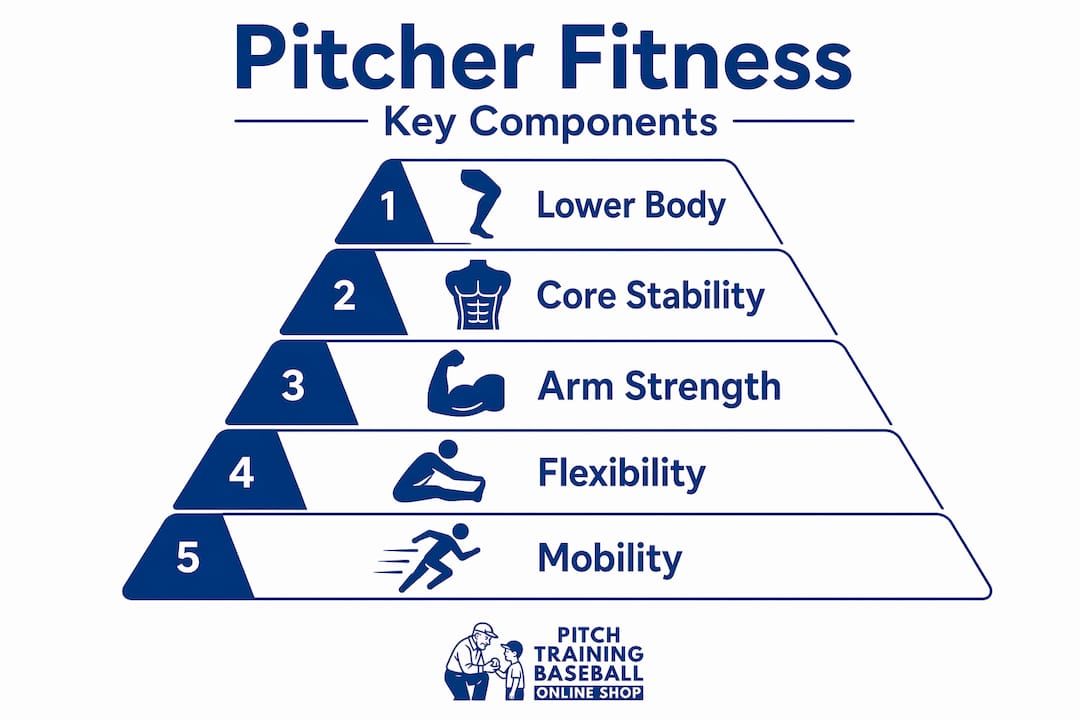
| Fitness component | Primary benefit for pitchers |
|---|---|
| Lower body strength | Generates velocity; reduces joint stress at elbow and shoulder |
| Core stability | Transfers power efficiently; prevents energy leaks in delivery |
| Shoulder and arm conditioning | Reduces injury rates; improves velocity and arm durability |
| Flexibility and mobility | Maintains full range of motion; reduces compensatory stress |
Pro Tip: Build a pitcher’s conditioning program around compound, multi-joint movements before adding isolation exercises. A young pitcher who can control their body through a single-leg squat will perform far better on the mound than one who can only do a bicep curl.
Common injuries linked to fitness deficits and how to prevent them
The injuries youth pitchers suffer most often are not random bad luck. They follow predictable patterns tied directly to fitness gaps, overuse, and fatigue. Understanding those patterns gives coaches and parents the roadmap to prevention.
Youth pitchers who throw more than 100 innings in a single calendar year face a 3.5 times greater risk of serious shoulder or elbow injury. That statistic alone should recalibrate how any parent thinks about fall ball, winter training, and travel team schedules. But volume is only part of the story.
The table below connects common youth pitcher injuries to the fitness deficits that most often contribute to them:
| Injury type | Common fitness deficit | Preventive fitness focus |
|---|---|---|
| UCL sprain (Tommy John) | Weak hip and core; poor kinetic chain transfer | Hip and core strength; mechanics monitoring |
| Rotator cuff tendinitis | Weak scapular stabilizers; poor shoulder endurance | Arm care program; rotator cuff conditioning |
| Little League elbow (medial apophysitis) | Early specialization; insufficient rest | Throwing cessation periods; strength balance |
| Shoulder impingement | Tight posterior capsule; weak external rotators | Sleeper stretch; external rotation exercises |
Now consider what happens when fatigue enters the picture. Pitching with arm fatigue increases the risk of elbow or shoulder surgery by 36 times compared to healthy teammates. That number is not a typo. Thirty-six times. Yet youth coaches routinely leave tired pitchers in games because the pitch count still has room.
Here is a practical sequence for reducing injury risk through fitness-informed decisions:
- Establish a baseline strength and mobility assessment at the start of each season so you know each pitcher’s physical starting point.
- Design age-appropriate arm care programs that include rotator cuff and scapular work at least three times per week.
- Monitor fatigue markers actively during games: velocity drops, accuracy loss, front leg collapse, and early trunk rotation.
- Remove a pitcher from competition at the first sign of fatigue-related mechanical breakdown, regardless of pitch count.
- Enforce annual throwing cessation periods. Year-round pitching is the single biggest risk factor for youth arm injuries, exceeding even pitch counts or mechanical flaws.
The variability-overuse hypothesis adds another layer worth understanding. Injury risk rises not just from how many pitches a kid throws, but from repeating the same movement pattern without variation, which loads the same tissues over and over without relief. Fitness variety and cross-training protect pitchers by distributing demand across different movement patterns and muscle groups.
Practical strategies for parents and coaches
Knowing why physical fitness matters is step one. Knowing how to actually build it into a young pitcher’s routine is where most families get stuck. These strategies are specific, realistic, and grounded in what actually works for kids between ages 9 and 16.
-
Start with a pre-season fitness assessment. Before a pitcher throws their first bullpen session, evaluate hip mobility, core stability, and shoulder external rotation strength. Structured arm care programs with pre-season starts yield the best results in injury prevention. Identifying weaknesses before the season starts gives you time to address them without competition pressure.
-
Build a three-day-per-week conditioning habit. Strength and conditioning for young pitchers does not need to be elaborate. Two to three sessions per week focusing on lower body strength, core stability, and arm care exercises is enough to produce real results. Bodyweight movements, resistance bands, and light dumbbells are appropriate for most youth athletes. Heavy barbell work is generally not appropriate until the mid-teen years.
-
Establish a post-pitch routine. What happens in the 20 minutes after a pitcher comes off the mound matters significantly. Aggressive static stretching of a fatigued shoulder immediately after throwing can increase instability. The better protocol is light aerobic movement (a short walk or jog) to maintain blood flow, followed by stability exercises targeting the shoulder and scapula. This flushes metabolic waste from the arm and reinforces the joint before inflammation sets in.
-
Watch for fatigue beyond the scoreboard. Fatigue monitoring predicts injury better than pitch count alone. Train yourself to look for velocity drops of more than 3 mph, a sudden loss of command, a flattening of the front leg at foot strike, or the elbow dropping below shoulder height. Any combination of these signals means the pitcher comes out.
-
Mandate off-season throwing breaks. Every young pitcher needs at least two to three months per year completely away from throwing. This allows growth plates to recover, connective tissue to regenerate, and the nervous system to reset. Safe baseball training practices consistently point to this as one of the highest-leverage interventions available.
Pro Tip: Keep a simple training log for each pitcher that tracks pitch counts, perceived effort, and any physical complaints. Over two to three months, patterns emerge that reveal which pitchers are accumulating fatigue faster and need more recovery built into their schedule.
Performance benefits that go beyond staying healthy
Injury prevention tends to dominate the conversation around fitness for pitchers, and rightly so. But physical training for young athletes produces performance improvements that are worth highlighting on their own merits. Fitness does not just keep pitchers safe. It makes them better.
The most direct performance benefit is velocity. When a pitcher develops genuine hip and leg strength, they tap into the largest power source in the human body. That energy travels up the kinetic chain and arrives at the ball with more force behind it. Lower body strength increases in kinetic chain efficiency translate to measurable velocity gains without any additional stress on the arm.
Here are the performance gains coaches and parents should expect from a consistent, well-designed fitness program:
- Velocity increases of 1 to 3 mph are achievable within 8 to 12 weeks through targeted rotator cuff and scapular work, even without changing mechanics.
- Improved core stability leads to better command and location. A stable trunk lets the arm repeat the same release point more consistently, which is the physical basis of control.
- Stronger legs reduce the mechanical drift that accumulates late in games. A conditioned pitcher in the sixth inning looks a lot more like that same pitcher in the first inning than an unconditioned one does.
- Full-body conditioning improves a pitcher’s ability to assess and manage their own fatigue, which is a skill that serves them throughout their athletic career.
- Mental confidence grows with physical capability. A pitcher who knows their body is prepared to compete is calmer in high-leverage situations, which affects command and decision-making on the mound.
The compounding effect of all these gains across a full season and across multiple seasons is significant. Pitchers who build genuine physical fitness in their early development years do not just survive youth baseball. They arrive in high school with stronger arms, better mechanics, and a competitive edge that purely skill-focused training cannot replicate.
My take: fitness is the missing conversation in youth baseball
By Albert
I’ve spent years watching parents and coaches pour time into mechanics clinics, private pitching lessons, and pitch count spreadsheets. All of that has value. But I’ve seen too many talented 14-year-olds walk into a surgeon’s office because nobody ever talked seriously about why their hips were weak or why they were throwing year-round without a real break.
Pitch counts are a proxy for fitness, and a rough one at that. What they actually measure is exposure time. They say nothing about how well the body is absorbing that exposure. I’ve watched a physically conditioned 12-year-old complete 85 pitches with clean mechanics start to finish. I’ve watched an underconditioned kid show visible fatigue-related breakdown by pitch 40. The pitch count told both stories the same way. The body told them very differently.
The hard truth I’ve come to believe is that youth baseball culture treats fitness as an add-on when it should be the foundation. We celebrate radar gun numbers without asking whether the athlete’s posterior hip strength and scapular control can sustain that velocity safely across a season. We worry about arm slots without addressing whether the core is stable enough to make that arm slot repeatable under fatigue.
The culture shift I’d like to see is simple: treat conditioning as part of pitching development, not as a separate athletic activity. When a young pitcher does their hip strengthening and arm care alongside their mechanical work, fitness becomes normal. It stops being extra homework and starts being part of what it means to pitch.
The payoff is a healthier, more effective pitcher who can still play the game they love through high school and beyond. That is the outcome every parent and coach in this sport is actually working toward. Fitness is not the whole answer. But without it, no other answer holds up for long.
— Albert
Build your pitcher’s fitness foundation with Pitchtrainingbaseball
Pitchtrainingbaseball understands that the best pitching training tools work in partnership with physical development, not separate from it.
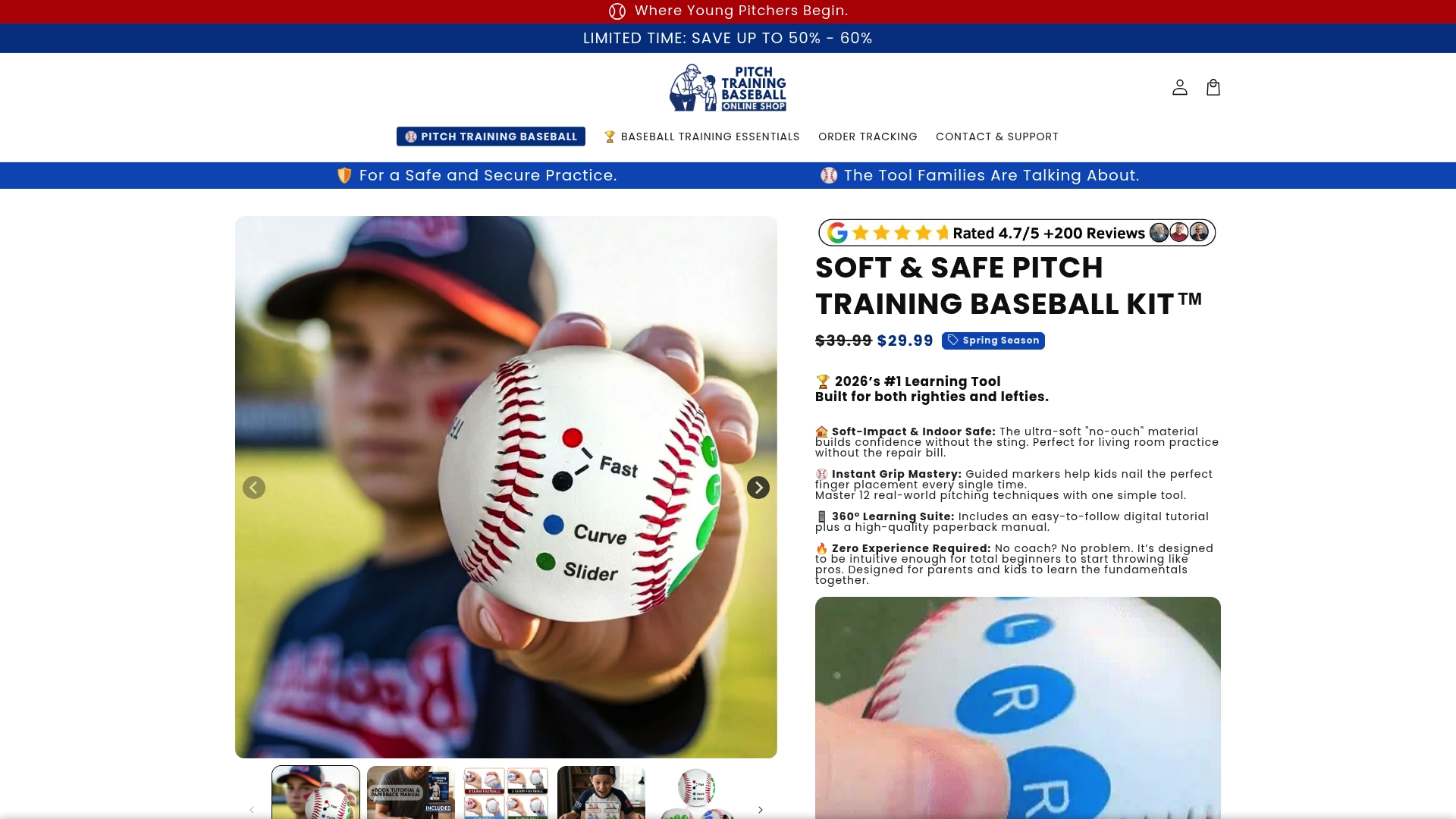
If you are a parent or coach looking to support your young pitcher’s fitness and skill development, Pitchtrainingbaseball offers training aids designed specifically for youth athletes at every stage of development. From pitch training tools that reinforce proper mechanics and build arm strength, to resources that complement your off-mound conditioning work, the products at Pitchtrainingbaseball are built with young arms in mind. They are portable, adjustable, and easy to use at home or at practice. Explore the full lineup and give your pitcher the training environment that matches the effort they are putting into their fitness. Their arm will thank you.
FAQ
What does physical fitness do for a young pitcher’s performance?
Physical fitness improves pitching velocity, command, and mechanical consistency. Stronger legs and a stable core allow pitchers to repeat their delivery with more power and accuracy, especially late in games.
How do pitch counts and physical fitness work together?
Pitch counts track volume but not how well the body handles that volume. Movement quality and energy transfer through the kinetic chain determine actual joint stress, which means a fit pitcher with good mechanics faces less risk at 80 pitches than an unfit pitcher at 50.
What are the warning signs that a young pitcher is too fatigued to keep throwing?
Watch for velocity drops, loss of command, front leg collapse, or early trunk rotation. Muscle fatigue typically resolves in 24 to 48 hours; pain that persists beyond 72 hours or occurs during rest means the athlete needs professional evaluation.
What strength training exercises are safest for young pitchers?
Bodyweight and resistance band exercises are the safest starting points for most youth pitchers. Focus on single-leg squats, hip bridges, pallof presses, and band-based rotator cuff work before adding external load.
How much rest does a young pitcher need each year?
Every young pitcher should take at least two to three months completely away from throwing each year. Year-round play without rest is the single greatest factor driving youth arm injuries, and this rest period is one of the most protective interventions available.
Recommended
- Mastering proper pitching grip: boost youth baseball skills – Pitch Training Baseball
- Pitching balance: Boost control and power in young players – Pitch Training Baseball
- Track pitching stats to protect arms and boost performance – Pitch Training Baseball
- Pitching zone knowledge: Boost your young player’s skills – Pitch Training Baseball