


Youth pitchers average a stride of about 66% of their height, according to a peer-reviewed study of 92 pitchers ages 9 to 14. That’s well short of the 80% to 85% range often cited for adult and elite throwers. Measure your pitcher’s stride as a percentage of height using simple video before chasing a bigger number, and build strength and balance first. Overstriding on command, without the physical base to support it, doesn’t reliably add velocity and can load the arm the wrong way.
TL;DR:
- Most youth pitchers aged 9 to 14 have an average stride length of around 66% of their height, with significant variation depending on physical maturity.
- Proper timing and knee extension during stride are more important for velocity than simply reaching a longer stride, with extension linked to about 1 mph increase per 18 degrees.
- Field tests like vertical jump and single-leg balance can help assess whether a young pitcher has the strength and stability to support increased stride length.
- Increasing stride length safely involves progressive drills focused on posture, balance, and sequencing, not just reaching farther on command.
- Attempting to overstride without a supporting physical base can increase injury risk and impair pitching mechanics.
Table of Contents
- Understanding Youth Pitcher Stride Length: What the Studies Actually Found
- Why Stride Length Matters More for Timing Than Distance
- How to Measure Stride Length at Practice (No Lab Required)
- Field Tests That Predict Whether a Longer Stride Is Realistic
- A Safe Drill Progression for Building Stride and Power
- Red Flags: When a Longer Stride Becomes a Health Risk
- A Coach’s Honest Take on Chasing Stride Numbers
- Practice Tools That Make Stride Training Safer
- Primary Sources and Clinical Commentary
- Sources
- FAQ
Understanding Youth Pitcher Stride Length: What the Studies Actually Found
Most parents hear “stride length” and picture a single magic number. The research says otherwise, and the differences between studies explain why so much advice online contradicts itself.
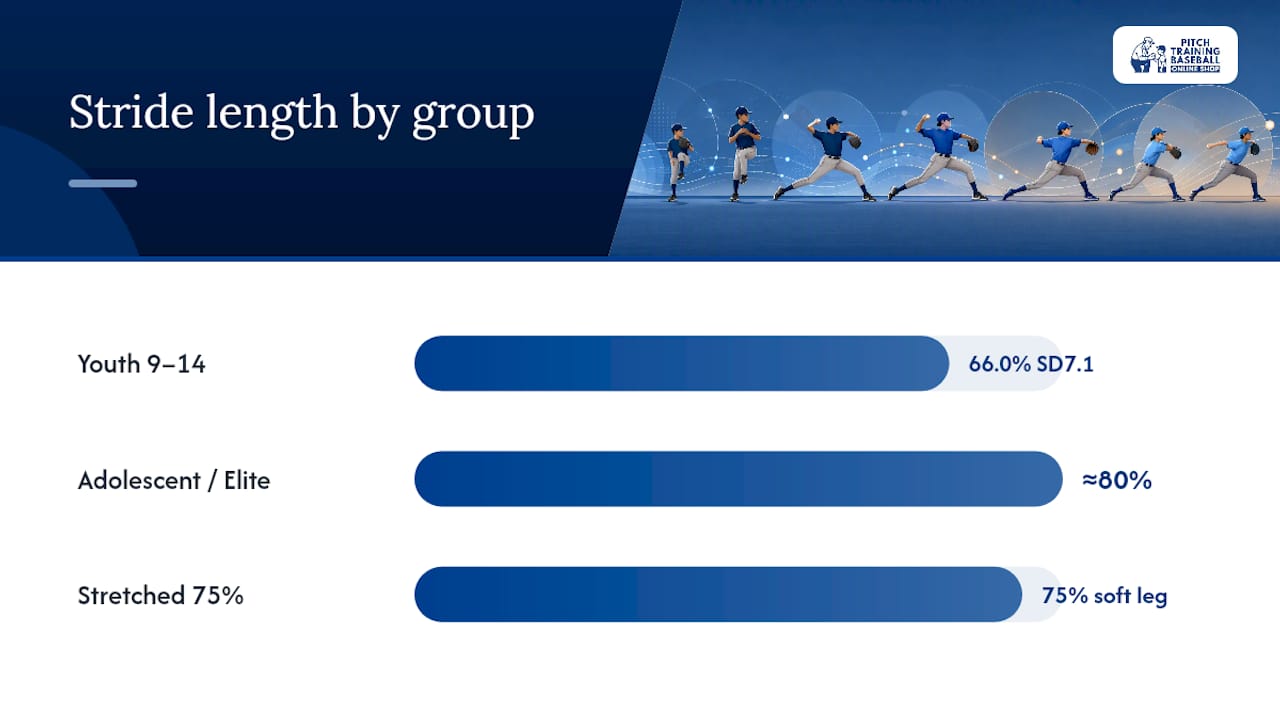
The most cited youth dataset comes from a 2017 cohort study published in Sports Health. Researchers measured 92 pitchers between ages 9 and 14 using 2D video, marking the front of the pitching rubber and the back of the landing heel to calculate stride as a percentage of standing height. The mean came out to 66.0%, with a standard deviation of 7.1%. Just as important, the measurement itself proved reliable. Different raters scoring the same video landed on nearly identical numbers, with intraclass correlation coefficients above 0.98. That reliability matters because it means the 2D video method isn’t just convenient, it’s trustworthy enough to track a kid’s progress month over month.
Compare that youth baseline to older or elite samples, and the gap is real. Some literature on adolescent and adult pitchers reports stride lengths closer to 80% of height or higher. Part of that difference is age and physical maturity, but part of it is definition drift. Studies measure from different landmarks, use different camera setups, and pull from different competition levels, so a “stride length” figure from a college pitching lab doesn’t translate directly to a 10-year-old on a Little League mound.
By the Numbers: Youth pitchers ages 9 to 14 average a stride of 66.0% of height (SD 7.1%), based on 2D video analysis of 92 pitchers with excellent measurement reliability.
Velocity research adds another layer. A high-speed biomechanical analysis of elite youth pitchers found that stride length by itself didn’t always correlate cleanly with ball speed. What tracked more consistently was knee extension of the front leg at two specific moments: maximal external rotation of the throwing shoulder, and ball release. Pitchers who extended that front knee more at those instants threw harder, roughly 1 mph faster for every 18 degrees of added extension. The lesson: stride distance is a means, not the goal. A pitcher can land at 66% of height and still generate excellent velocity if the front leg braces and extends at the right moment. Stretching to 75% with a soft, bent front leg often does nothing but bleed off energy.
Why Stride Length Matters More for Timing Than Distance
Stride length isn’t really about how far the foot travels. It’s about what that distance sets up for the rest of the body. Think of the kinetic chain as a whip: the legs load energy into the hips, the hips pass it to the trunk, the trunk hands it off to the arm. Stride length determines how much room the hips and trunk have to rotate before the arm has to catch up. A longer stride, timed correctly, gives the trunk a longer lever arm to build rotational speed. A longer stride, timed poorly, just gets the pitcher’s body ahead of the throwing arm.
That timing problem shows up constantly in youth pitching, usually described as “opening up early.” The front hip and shoulder rotate toward home plate before the stride foot has even landed and stabilized. When that happens, the trunk has already spent its rotational energy by the time the arm starts working, and the shoulder and elbow end up absorbing forces the hips and core should have handled. Foot angle and offset compound the issue. A stride foot that lands open, angled toward third base for a right hander, tends to drag the hips open with it. A stride foot that lands too far across the body’s midline, or too far outside it, throws off the whole rotational sequence.
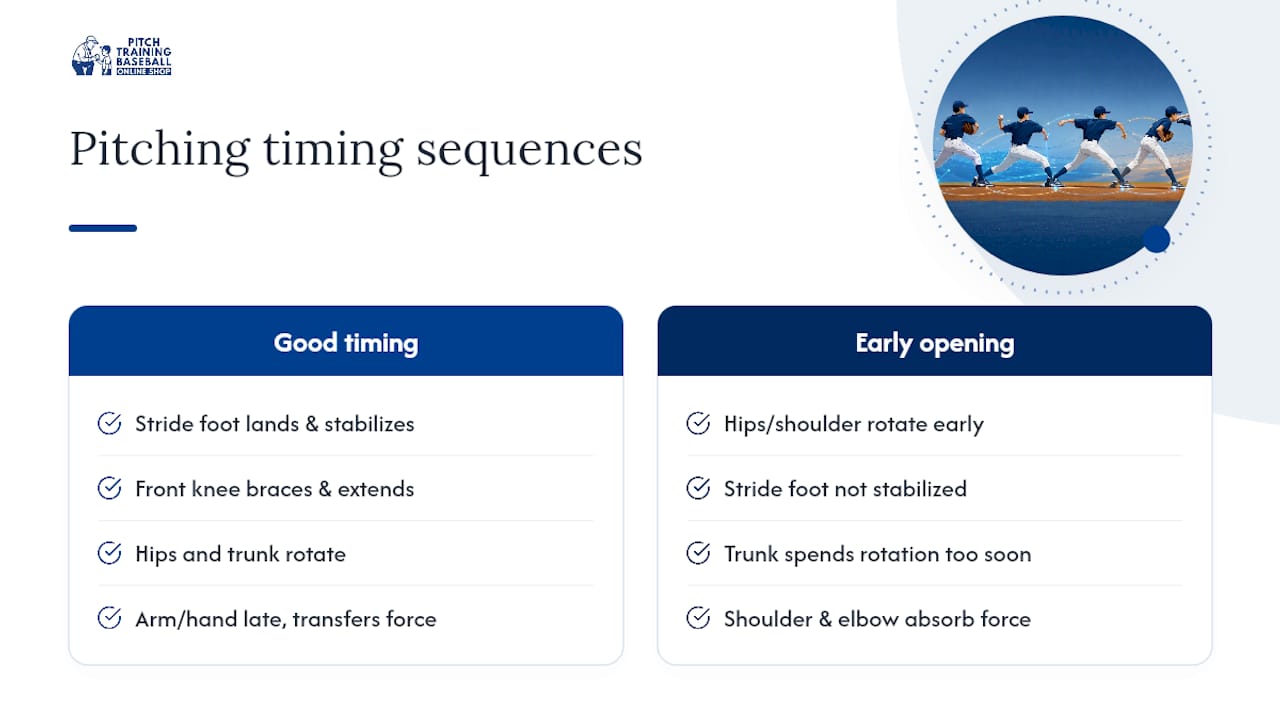
This is where the knee extension finding becomes practical rather than academic. The MDPI velocity study links harder throwing to a braced, extending front leg at maximal external rotation and at release, not simply to a longer stride. A pitcher who lands with good balance, keeps the front leg firm, and delays trunk rotation until the stride foot is planted gives that knee the chance to extend at the right moment. Chase stride distance without that sequencing, and you get a longer landing spot and the same, or worse, velocity. Coaching cues that protect timing and knee mechanics tend to outperform cues that just say “reach farther.”
How to Measure Stride Length at Practice (No Lab Required)
You don’t need a biomechanics lab to get a usable number. The 2D video protocol researchers used in the youth cohort study works fine with a smartphone and a tape measure.
- Set the camera. Place it perpendicular to the pitching line, at hip height, far enough back to capture the rubber and the landing spot in one frame.
- Mark the rubber. Note the front edge of the pitching rubber as your starting reference point.
- Record three max-effort throws. Fatigue and mechanics both drift on lower-effort pitches, so only measure throws where the pitcher is going full speed toward a target.
- Measure heel to rubber. For each throw, measure from the front of the rubber to the back of the landed heel.
- Convert to percent of height. Divide the stride distance by the pitcher’s standing height and multiply by 100.
- Average the three trials. A single throw can be an outlier; three gives you a number worth trusting.
Consistency matters more than fancy equipment. The reliability reported in the youth normative study came from keeping camera position and measurement landmarks identical across trials, which is exactly what let researchers see intrarater and interrater agreement above 0.98. If you move the camera angle between throws or eyeball the heel position instead of pausing the video, your numbers will bounce around for reasons that have nothing to do with the pitcher’s actual mechanics.
It gives you an instant visual reference on the video playback instead of pausing to measure every single throw.*
The most common mistake is measuring off a single pitch and treating it as gospel. The second most common is inconsistent mound distance, which changes stride mechanics even if the percentage-of-height math doesn’t directly account for it. Keep the setup boring and repeatable, and the numbers will actually mean something.
Field Tests That Predict Whether a Longer Stride Is Realistic
Before working on stride distance directly, check whether the pitcher has the physical base to support one. The youth stride study found meaningful correlations between stride length and a handful of simple field tests, which gives coaches a screening tool instead of a guess.
- Double-leg vertical jump correlated with stride length at roughly r=0.38, a moderate relationship suggesting lower-body power feeds directly into how far a pitcher can drive off the rubber.
- Single-leg balance correlated at about r=0.28, tying stability on the landing leg to stride capacity.
- Years of pitching experience also correlated with stride length (r≈0.36), which is a reminder that stride tends to grow with repetition and maturity, not with a single mechanical cue.
A simple screening flow works well at practice: test vertical jump and single-leg balance, compare the results to what’s typical for the pitcher’s age group, and treat weak scores as your answer for why stride hasn’t grown yet. A pitcher who can’t hold a five-second single-leg balance probably isn’t ready to add three inches to his stride, no matter how many times you tell him to “reach out more.” Build the balance and power first, retest monthly, and let stride length follow as a byproduct rather than forcing it as a standalone target. Our guide on pitching balance and control walks through specific balance drills that pair well with this screening approach.
A Safe Drill Progression for Building Stride and Power
Increasing stride length safely follows a sequence, not a shortcut. Skipping steps is exactly how coaches end up with a pitcher who strides longer but throws with worse timing.
- Posture and timing (weeks 1 to 2). Work on balance point and delayed trunk rotation with slow-motion pitching drills, two to three sets of 8 to 10 reps, two or three times a week. No velocity focus yet.
- Balance and strength (weeks 2 to 4). Single-leg balance holds, step-and-hold drills, and basic banded hip work build the stability that supports a longer stride. Three sets of 10 to 15 seconds per hold, three times a week.
- Controlled stride-extension drills (weeks 4 to 6). Mini-hurdle stride drills and the wall/tilt drill teach the body to reach a specific landing spot without sacrificing posture. Start at the pitcher’s current measured stride and nudge it forward by an inch or two at a time.
- Live-throw integration (weeks 6 and beyond). Bring the new stride length into bullpen work at reduced intent first, then full-effort throws once the mechanics hold up consistently.
Specific drills matter here. The wall/tilt drill, where the pitcher practices the balance point against a wall for support, builds the posture that keeps the trunk from tipping forward early. Step-and-hold drills isolate the landing phase so the pitcher feels what a stable front leg is supposed to do. Mini-hurdle strides give a visual target for distance without letting the pitcher lunge. Resisted push-off work, using a light band anchored behind the back foot, reinforces drive off the rubber, which is the power source stride length is actually measuring.
Throughout all four stages, three coaching cues matter more than any drill: keep the front foot angled slightly closed rather than wide open, stay balanced at landing instead of collapsing forward, and delay trunk rotation just long enough to let the front knee extend at the right moment. Our breakdown of youth pitching mechanics covers these cues in more depth if you want drills to pair with them.
Pro Tip: If a pitcher’s measured stride hasn’t budged in two full progression cycles, stop chasing distance and go back to the balance and strength phase. A stalled stride number is almost always a strength problem wearing a mechanics costume.
Red Flags: When a Longer Stride Becomes a Health Risk
Not every stride increase is progress. Some are just a longer runway to the same, or worse, injury risk.
- Overstriding beyond what balance supports forces the front leg to collapse or “give” on landing, which cuts power transfer and can shift stress toward the shoulder and elbow.
- Opening up early, before the front foot plants, robs the trunk of rotational energy and makes the arm do work the hips should have done.
- Excessive foot offset, landing too far across or away from the body’s midline, throws off the rotational sequence the clinical commentary on torso biomechanics ties to increased medial elbow loading.
- An open landing foot angle tends to drag the hips open too soon, compounding the early-rotation problem.
- Poor knee extension timing, a soft or collapsing front leg at maximal external rotation, removes the very mechanism that research links to added velocity.
If any of these show up, don’t push through them hoping mechanics will “click.” Reduce pitch volume immediately, roll the pitcher back to an earlier drill progression, and get a physical therapist involved if elbow or shoulder pain persists beyond normal post-outing soreness. A bigger stride number on a stopwatch is worthless if it comes with a sore elbow in June.
A Coach’s Honest Take on Chasing Stride Numbers
Stride length isn’t a fixed target, it’s a moving marker that shifts as a kid grows stronger and more coordinated. Expect small, monthly gains rather than a jump you can force in one practice. Pair your video measurements with simple written notes on balance, pitch counts, and how the arm feels afterward, because the number alone tells you less than the number in context. Our resources on flexibility and warm-up routines are worth pairing with any stride work you start.
— Albert
Practice Tools That Make Stride Training Safer
Working through balance drills, mini-hurdle strides, and live-throw integration takes a lot of repetition, and repetition is where the right equipment earns its keep. A soft training ball takes the sting out of early-rep mistakes while a pitcher is still finding a new landing spot, and a marked target net lets you watch accuracy and stride distance in the same glance instead of guessing where the ball ended up.

The PITCH TRAINING BASEBALL KIT™ is built around exactly that kind of repetition: safe, portable tools designed for the backyard, the driveway, or the field, not a specialized lab. Pair it with a pitching target net marked with a 9-zone strike layout, and you can track both stride consistency and command in the same session. None of this replaces a coach or physical therapist if pain shows up or a mechanical fault won’t correct itself. It’s an adjunct, not a substitute, for the progressions covered above. If you’re ready to build a safer at-home practice setup, check out the PITCH TRAINING BASEBALL KIT™ collection and start with the drills that match where your pitcher’s stride and balance actually are today.
Primary Sources and Clinical Commentary
- Youth stride length norms and field testing correlations
- Knee extension and ball velocity in youth pitchers
- Torso biomechanics and medial elbow injury risk
- Experimental effects of stride length on pitched velocity
Sources
- Youth Baseball Pitching Stride Length: Normal Values and Correlation With Field Testing
- Knee angle and stride length in association with ball speed in youth baseball pitchers
- Stride length and torso biomechanics as they relate to medial elbow injuries in adolescent-aged baseball pitchers: a clinical commentary
- The Effect of Stride Length on Pitched Ball Velocity
FAQ
Is 50 mph fast for a 9 year old pitcher?
Yes, pitch velocity at that age varies widely with growth, mechanics, and knee extension timing rather than stride length alone, per the MDPI velocity study.
How long was Nolan Ryan’s stride?
Nolan Ryan’s exact stride measurement isn’t documented in peer-reviewed research, but elite adult pitchers typically land in the 80% to 85% of height range, well beyond the 66% average seen in youth pitchers ages 9 to 14.
What’s the fastest pitch thrown by a 12 year old?
There’s no single verified record for youth pitch velocity, and claims circulating online often lack reliable sourcing. Focus less on chasing a specific number and more on tracking your own pitcher’s stride and velocity trends using consistent 2D video measurement.
Should a coach force a youth pitcher to stride farther?
No. Research on experimental stride manipulation shows forced overstriding doesn’t reliably raise velocity and can disrupt timing, so stride gains should follow improvements in balance and lower-body strength instead of a direct command to reach farther.