


A baseball fastball is the highest-velocity pitch in a pitcher’s arsenal and the most common pitch thrown at every level of the game. MLB currently recognizes three primary fastball types: the four-seam, the two-seam/sinker, and the cutter. The splitter, while it feels like a fastball out of the hand, is classified as an off-speed pitch in modern pitch-tracking systems.
Speed varies dramatically by level:
- Youth (9–10 years old): roughly 40–50 mph
- 12U: approximately 55 mph average
- High school varsity: typically 75–85 mph
- College: 85–92 mph depending on division
- MLB average four-seam: 94.7 mph
- Elite/triple-digit: 100+ mph
That 100 mph threshold gets a lot of attention, and for good reason. Baseball America’s season-by-season tracking shows a clear multi-year rise in pitchers and individual pitches exceeding 100 mph, yet it remains something fewer than a few dozen MLB pitchers can do consistently in a given season. For youth players and high school arms, the goal isn’t triple digits. It’s building a repeatable, healthy delivery that adds velocity over time.
Key Takeaways
The most effective fastball development combines repeatable mechanics, age-appropriate velocity targets, and consistent workload management, not just chasing the highest radar reading.
| Point | Details |
|---|---|
| Three fastball types | Four-seam, two-seam/sinker, and cutter each produce distinct movement through grip and spin axis changes. |
| Velocity by level | MLB average sits at 94.7 mph; youth 12U averages ~55 mph; reaction time shrinks with every mph gained. |
| Rising fastball illusion | High backspin reduces gravity drop, making the ball appear to rise; it does not actually travel above its release point. |
| Arm health first | Follow Pitch Smart pitch-count limits by age and stop immediately if pain, velocity drop, or loss of command appears. |
| Pitchtrainingbaseball gear | The 9-zone target net, training softballs, and Pickeballs directly support the three at-home session templates in this article. |
Table of Contents
- What are the main types of baseball fastballs?
- How spin and the Magnus effect create fastball movement
- How fast is a fastball at each level?
- How to throw a faster, more accurate fastball
- Arm health, pitch counts, and when to stop
- How to measure a fastball and which metrics actually matter
- Three at-home pitching sessions for youth players
- What I actually look for when evaluating a pitcher’s fastball
- Gear that supports every session in this article
- Sources
What are the main types of baseball fastballs?
Every fastball starts with the same basic idea: throw it as hard as you can with a grip that produces the movement profile you want. The grip is where the four types diverge.
Four-seam fastball
This is the pitch most people picture when they hear “fastball.” Place your index and middle fingers across the horseshoe seam so that all four seams rotate through the air on each revolution. The result is maximum backspin, minimal horizontal movement, and the straightest possible flight path. Four-seamers are typically the fastest pitch a pitcher throws, and they’re the primary pitch for establishing the strike zone early in counts.
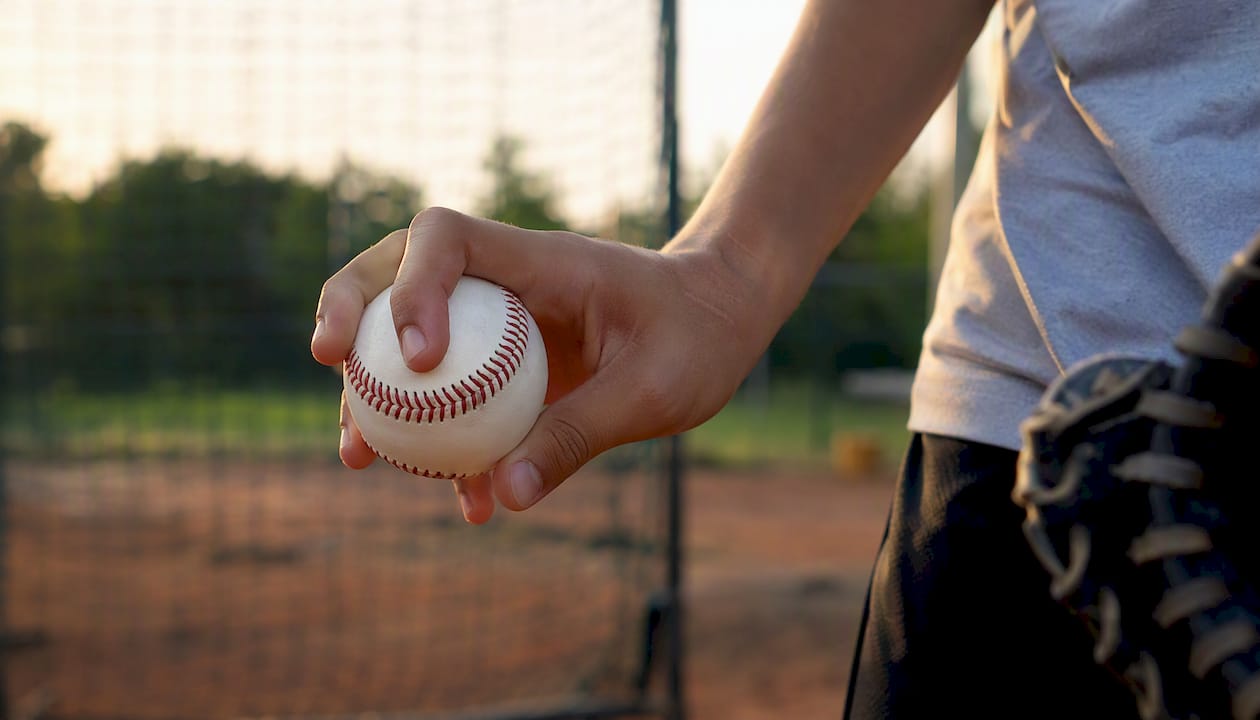
The release cue is simple: drive through the ball with your fingertips, keeping your wrist firm and your fingers directly behind the ball at release. Any pronation or supination bleeds spin efficiency and flattens the pitch.
Two-seam fastball and sinker
Shift your grip so your fingers rest along the narrow seams rather than across them. That small change produces more sidespin and topspin, which generates arm-side run and downward movement. A two-seamer from a right-handed pitcher will tail in on a right-handed hitter’s hands, while a sinker drops more aggressively and generates ground balls. When your defense is built around contact management, this is the pitch to lean on.
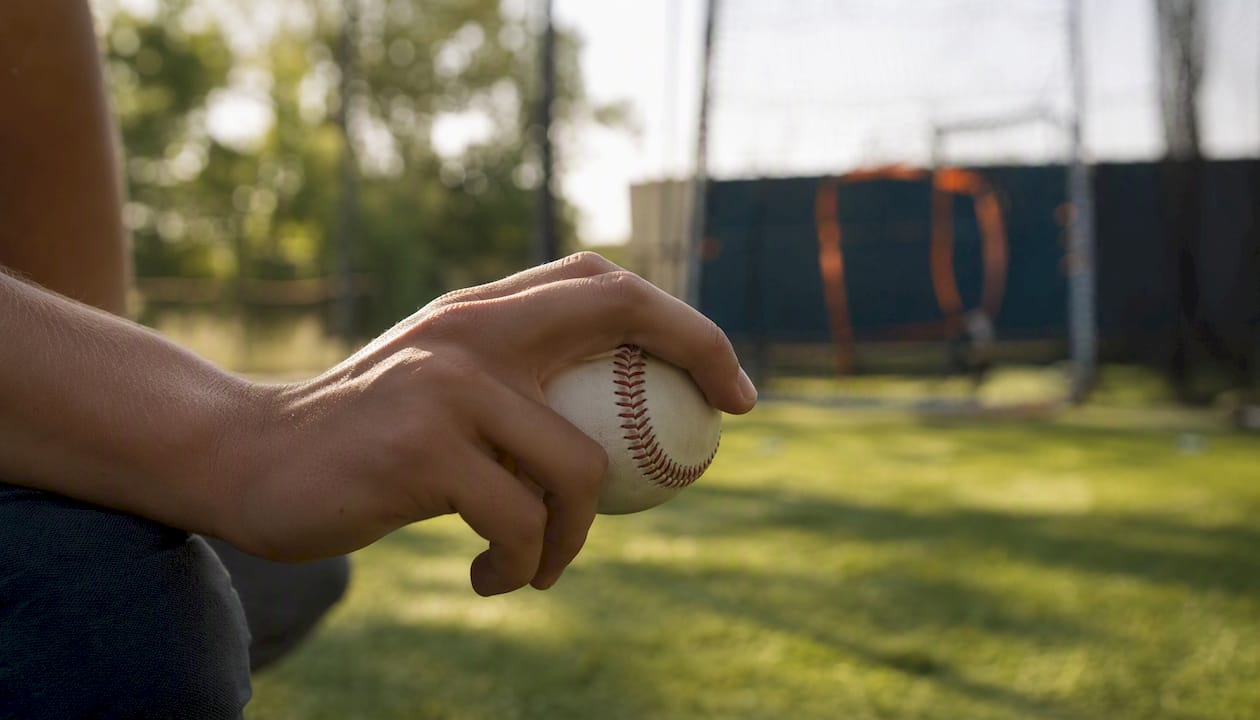
The release cue differs slightly: let the wrist turn inward just a touch at release, almost like you’re turning a doorknob. Too much and it becomes a slow slider. The goal is a firm wrist with a subtle inside-out feel.
Cutter
The cutter sits between a four-seam and a slider. Move your grip slightly off-center toward the thumb side, and at release, apply slight pressure with the middle finger. The ball cuts away from a same-handed hitter at the last moment, often breaking bats when it catches the handle. It’s not a breaking ball, and it’s not a pure fastball. It typically runs 2–5 mph slower than a pitcher’s four-seam.
The key distinction coaches should reinforce: the cutter is thrown with fastball arm speed and fastball intent. The moment a pitcher slows their arm to “help” the cut, it turns into a mediocre slider with no identity.
A note on the splitter
The splitter is gripped with the fingers spread wide outside the seams, producing tumbling action and a late drop. It feels like a fastball to the pitcher and often looks like one to the hitter until it dives out of the zone. Modern classification systems, including Statcast, treat it as an off-speed pitch because its movement profile and purpose align with changeups and forkballs rather than fastballs. Youth pitchers should avoid it entirely until their hands are large enough to grip it safely and their arms are mature enough to handle the stress.
Pro Tip: For youth pitchers learning the two-seam, start by simply rotating the four-seam grip a quarter turn and throwing it with identical arm speed. The movement will develop naturally without forcing wrist action that strains the forearm.
How spin and the Magnus effect create fastball movement
The physics behind a fastball are more interesting than most coaches realize, and understanding them changes how you teach grips and release points.
Spin rate and spin axis
Spin rate, measured in revolutions per minute (RPM), determines how much the Magnus effect acts on the ball. The Magnus effect is the aerodynamic force generated when a spinning object moves through air. For a four-seam fastball with high backspin, that force pushes upward, counteracting gravity. The ball still drops, but it drops less than a batter’s brain predicts based on a lifetime of watching thrown objects.
Spin axis controls the direction of that force. A perfectly vertical spin axis (12 o’clock to 6 o’clock rotation) produces pure backspin and maximum vertical lift. Tilt the axis and you introduce horizontal movement. A cutter’s axis is tilted slightly, which is why it cuts rather than rising.
The “rising fastball” is an optical illusion
The rising fastball does not actually rise above its release point. What happens is that a high-spin four-seamer drops roughly 8–10 inches less than a batter expects based on gravity alone. The batter’s brain, calibrated to normal thrown-object trajectories, interprets that reduced drop as upward movement. The result is a swing under the pitch, which is exactly what a pitcher wants.
PITCHf/x analysis quantifies this precisely: the system tracks position versus time throughout the pitch’s flight, allowing researchers to calculate the actual forces acting on the ball, including the Magnus lift from backspin and the drag that slows the pitch from release to plate. That data confirms the illusion and gives coaches a number to target: elite four-seamers typically generate 18–24 inches of “induced vertical break,” meaning they drop that much less than a spinless pitch would.
Seam-shifted wake and extension
Seam orientation matters beyond just grip. When seams are positioned to create asymmetric airflow, a phenomenon called seam-shifted wake (SSW) can produce additional movement that spin rate alone doesn’t predict. This is why two pitchers with identical spin rates can generate different movement profiles: the seam orientation at release creates a pressure differential that shifts the ball’s wake and adds run or cut.
Extension, meaning how far in front of the rubber a pitcher releases the ball, directly affects perceived velocity. A pitcher who releases the ball 6.5 feet in front of the rubber gives the hitter roughly 5–6 feet less distance to react compared to a pitcher releasing at 5.5 feet, even if their radar gun readings are identical. PITCHf/x and Statcast capture this as “extension,” and it’s one of the most undervalued metrics in pitcher development.
How fast is a fastball at each level?
Velocity is the number everyone wants to know, but the context around it matters as much as the number itself.
How speed gets measured
Consumer radar guns typically measure the ball’s speed at the point it crosses the plate or at peak velocity near release, depending on the gun’s mode. TrackMan and Statcast measure release speed, which is the standard in professional baseball. Release speed is always higher than plate speed because the ball decelerates throughout its flight. A pitch that reads 95 mph at release might cross the plate at 87–88 mph. When comparing numbers across devices and levels, always clarify which measurement point is being used.
Velocity benchmarks by level
WIN Reality’s age-by-age benchmarks show the average four-seam fastball in MLB sitting at 94.7 mph, with the average climbing steadily since 2008. At the youth level, 12-year-olds average around 55 mph and 13-year-olds around 60 mph, and even those small velocity jumps meaningfully compress the hitter’s reaction window.
The 100 mph question
ESPN’s reporting on the 100 mph club documents a record spike in triple-digit pitches in recent seasons, reflecting a velocity trend that has reshaped how scouts and coaches evaluate arms. Baseball America’s year-by-year counts confirm the multi-year trajectory: more pitchers and more individual pitches are crossing 100 mph than at any point in the sport’s tracked history.
Still, the debate about theoretical upper limits is genuinely unsettled. Historical claims about pitchers from earlier eras are complicated by measurement-method differences: older radar guns measured plate speed, not release speed, making direct comparisons unreliable. The honest answer is that no one knows the true ceiling, and the biomechanical constraints of the human elbow and shoulder will likely define it before any other factor does.
How to throw a faster, more accurate fastball
Velocity and command don’t develop from arm strength alone. The kinetic chain from the ground up drives both, and the drills that work are the ones that reinforce that chain.
The mechanical foundation
Before any velocity drill makes sense, the mechanics need to be in order. The key checkpoints:
- Lower half drive: push off the rubber with the back leg and drive the hips toward the plate before the arm begins its path
- Hip-shoulder separation: hips open first, shoulders follow; the lag between them is where power is stored
- Scap load: the throwing-side shoulder blade pulls back and down as the arm goes up, creating a stretch-shortening cycle in the posterior shoulder
- Arm path: the elbow should be at or slightly below shoulder height at foot strike; a dropped elbow bleeds velocity and stresses the UCL
- Extension: finish with the arm driving through the release point and continuing down past the hip
Common faults to watch: rushing the upper half (arm drags behind), collapsing the front side (kills hip-shoulder separation), and short-arming (cutting off the follow-through).
A single-session velocity and command progression
- Dynamic warm-up (10 minutes): hip circles, leg swings, arm circles, band work for the rotator cuff and scapular stabilizers
- Flat-ground mechanics reps (10 minutes): slow-motion walk-throughs focusing on hip-shoulder separation and scap load, no throw
- Long toss (15 minutes): start at 60 feet and extend to comfortable max distance, focusing on carry and extension rather than max effort; building arm strength progressively is the goal, not showing off distance
- Medicine-ball throws (10 minutes): rotational chest passes and overhead slams against a wall or with a partner; ballistic training methods like these develop the explosive hip and trunk rotation that translates directly to the mound
- Intent bullpen (20 pitches): throw at 90–95% effort with a focus on extension and release consistency; use a radar gun or app if available to track peak readings
- Command slots (15 pitches): reduce effort to 80–85% and work specific quadrants of the zone, tracking hit rate on a target net
Pro Tip: The intent bullpen works best when the pitcher has a clear internal cue to focus on, not just “throw hard.” Pick one mechanical cue per session, such as “drive through the release point,” and let velocity be the byproduct.
For medicine-ball drill progressions that complement this session structure, Pitchtrainingbaseball has a full drill library worth bookmarking.
A note on weighted balls: they can be effective for older, physically mature pitchers under supervised programs, but the evidence for youth use is not strong enough to recommend them broadly. Volume and intent with a standard ball produce results without the added joint stress.
Arm health, pitch counts, and when to stop
Throwing hard is a physical stress event. The elbow absorbs enormous torque on every pitch, and the UCL is the structure most at risk when volume or intensity exceeds what the arm can recover from.
Biomechanical research shows that the forces on the elbow during a high-velocity throw approach the structural limits of the UCL itself. That’s not a reason to avoid throwing hard. It is a reason to manage volume carefully, especially in youth athletes whose connective tissue is still developing.
Pitch Smart principles
MLB and USA Baseball’s Pitch Smart program provides age-based workload guidelines that every youth coach should know. The core principles:
- Ages 7–8: maximum 50 pitches per game, 1 day rest after 21+ pitches
- Ages 9–10: maximum 75 pitches per game, 1 day rest after 26+ pitches
- Ages 11–12: maximum 85 pitches per game, 1 day rest after 36+ pitches
- Ages 13–16: maximum 95 pitches per game, 1 day rest after 36+ pitches
- Ages 17–18: maximum 105 pitches per game, 1 day rest after 36+ pitches
These are ceilings, not targets. A pitcher who hits 85 pitches but shows mechanical fatigue should stop at 60.
Warning signs coaches and parents must act on
- Elbow or shoulder pain during or after throwing (any pain, not just severe)
- A sudden drop in velocity of 3+ mph with no obvious mechanical cause
- Loss of command that wasn’t present at the start of the session
- Tingling or numbness in the fingers
- Swelling or tenderness along the medial elbow
Any of these is a stop-now signal. Rest for at least a week and consult a sports medicine clinician if symptoms persist beyond 48 hours. Tracking pitching stats including soreness scores and velocity readings across sessions is one of the most practical ways to catch a developing problem before it becomes a structural one.
The most common injuries in pitchers are UCL tears (often requiring Tommy John surgery), rotator cuff strains, and shoulder impingement. All three are associated with overuse and poor mechanics, and all three are largely preventable with proper workload management.
How to measure a fastball and which metrics actually matter
Not all measurement tools are equal, and not all metrics deserve equal attention.
Device comparison
Consumer radar guns like the Stalker Sport 2 or Bushnell Velocity measure release speed or plate speed depending on mode, with accuracy typically within 1–2 mph. They’re practical for coaches who need a quick read during bullpens.
Smartphone apps that use the phone’s camera to estimate velocity are convenient but less accurate, often varying by 3–5 mph from a calibrated radar gun. Useful for trend tracking, not for precise benchmarking.
TrackMan and Statcast are the professional standard. They use Doppler radar and optical tracking to capture release speed, spin rate, spin axis, extension, and full pitch trajectory. The data they generate is what MLB teams use for player evaluation and what researchers use for biomechanical analysis.
Metrics that matter for fastball development
- Release speed (mph): the primary velocity metric; always clarify whether a reading is release or plate speed
- Spin rate (RPM): higher spin on a four-seamer generally means more induced vertical break; elite four-seamers typically spin at 2,200–2,500 RPM
- Spin efficiency/active spin: the percentage of total spin that contributes to movement; a high spin rate with low efficiency produces less movement than expected
- Extension (feet): how far in front of the rubber the ball is released; every additional foot of extension adds perceived velocity without adding arm stress
- Vertical break (inches): how much the pitch rises relative to a spinless pitch; the primary indicator of four-seam effectiveness
- Horizontal break (inches): arm-side or glove-side movement; more relevant for two-seamers and cutters
- Tilt: the clock-face description of spin axis (12:00 = pure backspin, 1:30 = slight cut)
Don’t let one number dominate the conversation. A pitcher with a 2,400 RPM spin rate and 5.5 feet of extension is less effective than one with 2,100 RPM and 6.8 feet of extension. The metrics work together, and PITCHf/x data archives give coaches and educators the raw kinematic data to understand those relationships in real pitches.
Three at-home pitching sessions for youth players
These sessions are designed for parents and coaches running practice at home with basic equipment. Each has a clear goal, a time budget, and a safety check built in.
Session 1: Technique day (30 minutes)
Goal: reinforce mechanics without high-intensity throwing.
- Warm-up (8 minutes): light jog, dynamic stretching, band exercises for the rotator cuff
- Slow-motion walk-throughs (7 minutes): practice the full delivery at 25% effort, focusing on hip-shoulder separation and scap load; no target needed
- Flat-ground mechanics reps (10 minutes): throw training softballs at 50–60% effort into a net or fence, 20 throws maximum; focus on one mechanical cue per set of 5
- Cool-down (5 minutes): light stretching, arm circles, band pull-aparts
Safety check: stop if any arm soreness develops. This session should feel easy.
Session 2: Velocity session (35 minutes)
Goal: develop explosive hip and trunk rotation that translates to arm speed.
- Warm-up (10 minutes): dynamic warm-up plus long toss starting at 30 feet and extending to 60–90 feet over 8–10 throws
- Power training exercises (10 minutes): rotational medicine-ball throws against a wall or with a partner, 3 sets of 8 reps; focus on hip rotation speed, not arm
- Intent throws (10 minutes): 15 throws at 85–90% effort using Pickeballs into a net; track perceived effort on a 1–10 scale after each set
- Cool-down (5 minutes): light jog, stretching
Volume cap: 15 intent throws maximum for ages 10–12, 20 for ages 13–15. Stop immediately if the arm feels heavy or fatigued.
Session 3: Command and target session (30 minutes)
Goal: develop zone control and release consistency.
- Warm-up (8 minutes): standard dynamic warm-up and 10 easy warm-up throws
- Target work (17 minutes): set up a 9-zone pitching target net and throw at specific zones; 25 throws at 75–80% effort, calling the target zone before each throw
- Tracking (5 minutes): record how many throws hit the called zone; aim to improve the hit rate across sessions
Coach cue: call the zone out loud before each throw. This builds the mental habit of pitching with intention, not just throwing.
For a full guide on managing practice time and volume across a week or season, Pitchtrainingbaseball has a dedicated resource for youth coaches.
What I actually look for when evaluating a pitcher’s fastball
Raw velocity is the first number everyone checks, and it’s also the most overrated one.
When I watch a pitcher throw, the first thing I’m looking for is release consistency: does the ball come out of the same spot on every pitch? A pitcher who throws 88 mph with a repeatable release point and 6.5 feet of extension is more effective than one who touches 92 but releases the ball from three different arm slots depending on the count. Hitters time release points, not radar guns.
The second thing is what I call “plane change ability.” Can this pitcher throw the four-seamer up in the zone and the two-seamer down in the zone with the same arm action? If yes, the pitch sequence writes itself. If no, the fastball becomes predictable regardless of velocity.
Here’s the practical checklist I use during bullpens:
- Release consistency: does the arm slot repeat across pitch types and counts?
- Extension: is the pitcher releasing the ball out front, or short-arming it near the ear?
- Spin/axis feel: does the four-seamer have carry, or does it flatten out and get hit hard?
- Plane change: can the pitcher locate the fastball in at least two distinct vertical zones?
- Sequencing: does the pitcher use the fastball to set up the off-speed, or are they throwing it in isolation?
Pro Tip: The most effective fastball sequence isn’t four-seam, four-seam, breaking ball. It’s four-seam up, two-seam down, four-seam up. The vertical plane change is what creates genuine swing-and-miss, not velocity alone.
One thing pitching trends in 2026 make clear: the velocity arms race has pushed coaches to prioritize spin metrics and movement profiles alongside raw speed. That’s the right direction, but it only works if the mechanical foundation is solid enough to repeat the delivery under pressure.
Gear that supports every session in this article
The three at-home sessions above work best with equipment built for youth pitchers, not scaled-down adult gear.
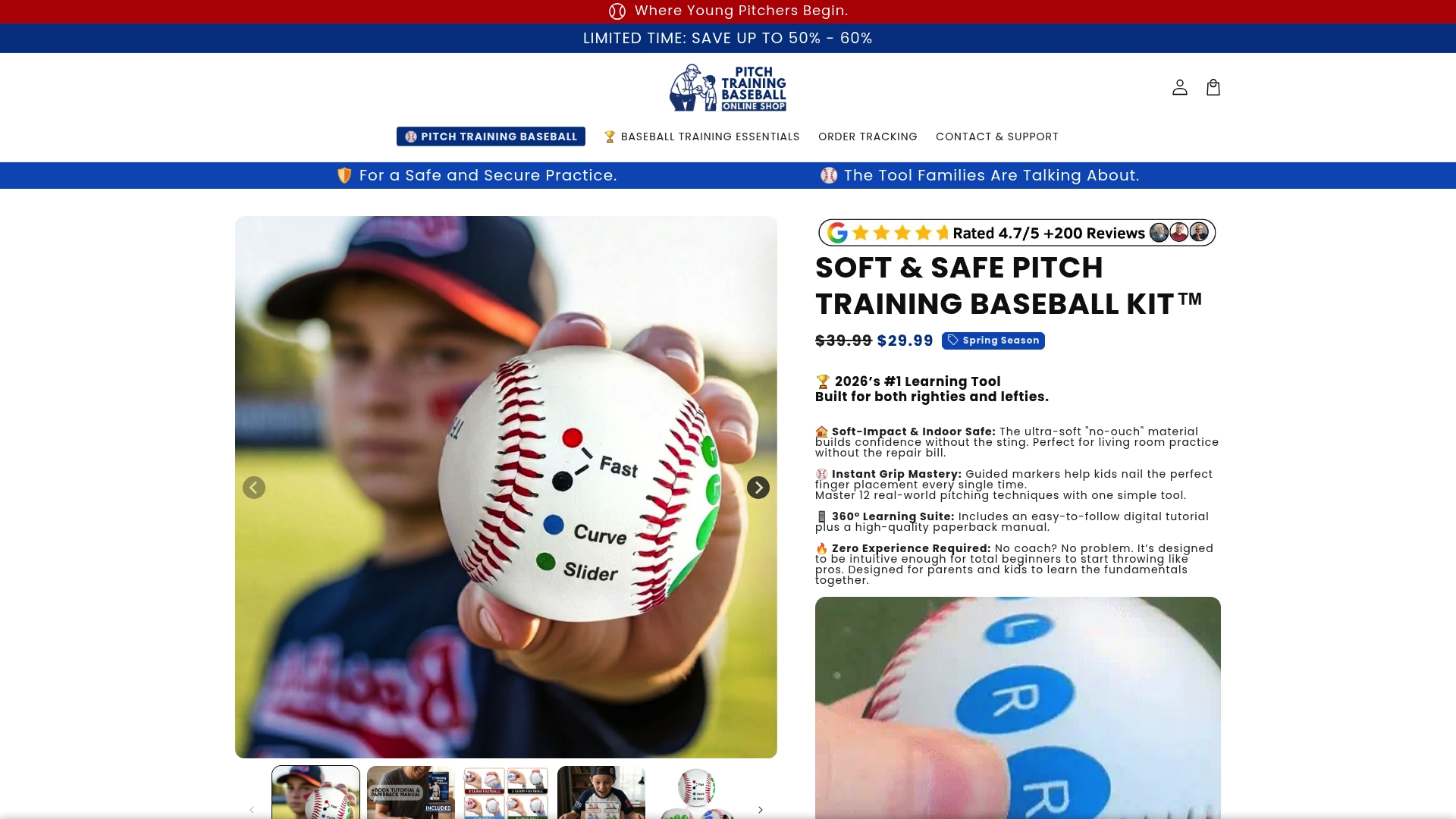
Pitchtrainingbaseball’s 9-zone strike target net is the anchor for command sessions: it gives pitchers a specific target in each zone and makes hit-rate tracking straightforward. The training softballs are designed for controlled at-home bullpens where a standard hardball isn’t safe or practical. And the 5-pack of Pickeballs gives coaches a lightweight, low-risk option for target work and reaction drills with younger athletes.
All three products ship directly to your door and are ready to use in a backyard, driveway, or gym. Browse the full training gear catalog at Pitchtrainingbaseball and pick the setup that fits your next practice.
Sources
The sources below are the primary references behind this article. Each is worth bookmarking if you want to go deeper on the physics, data, or velocity research.
- Fastball — Wikipedia
- Physics
- How many professional pitchers throw 100 mph? — Baseball America
- Pitching velocity by age: average benchmarks — WIN Reality
- How fast can a pitcher throw? — The Athletic / The New York Times
For raw pitch data, Statcast’s public-facing Baseball Savant tool (baseballsavant.mlb.com) lets you filter by pitch type, spin rate, velocity, and extension for any MLB pitcher. It’s the fastest way to see what elite four-seam profiles actually look like in practice.
This article is general information, not a substitute for advice from a qualified doctor. Consult a qualified healthcare professional about your own circumstances before acting on anything here.
Recommended
- Pitching Trends in 2026: What Coaches Must Know – Pitch Training Baseball
- What Is Off Speed Pitching: a Coach’s Guide – Pitch Training Baseball
- Pitching zone knowledge: Boost your young player’s skills – Pitch Training Baseball
- Slider Movement: What Players and Coaches Must Know – Pitch Training Baseball