


Repetition builds motor memory in youth pitchers, but only when it’s structured with clear intent, task variability, and timely feedback. Start today by replacing any block of identical throws with a short mixed sequence: vary the target zone, the pitch type, or the release angle every few reps, then give one specific cue after each set with ideas from the Free Workouts To Achieve Any Goal | Onemor App. That single change, backed by motor-learning research, separates practice that sticks from practice that just fills time. Pitchtrainingbaseball’s tools and the session templates below are built around exactly that principle.
Table of Contents
- How does the brain actually learn a pitching motion?
- When is repetition failing your pitcher?
- How do you design repetition that actually builds skill?
- Safety, arm health, and when to cut a session short
- What tools and drills make repetition practical and safe?
- How Pitch Training Baseball gear supports safe, productive repetition
- Three copy-and-use practice session templates
- How do you know repetition is producing real learning?
- Key Takeaways
- Why the “just throw more” mindset keeps young pitchers stuck
- Build your starter training setup the right way
- Useful sources and further reading
How does the brain actually learn a pitching motion?
The short answer: random practice is harder in the moment and more durable over time. Neural plasticity studies show that repetitive, rewarded movements strengthen cortical representations in the motor cortex and basal ganglia, accelerating movement planning. But the type of repetition matters enormously.
“Random practice orders increase frontal and motor-cortex engagement and lead to better retention on later tests, while blocked practice produces faster short-term gains but shallower learning.” — Review of neural correlates in motor practice
| Practice Type | Short-Term Performance | Long-Term Retention | Example Order |
|---|---|---|---|
| Blocked | High | Low | A-A-A-B-B-B |
| Random/Variable | Lower initially | High | A-C-B-C-A-B |
Blocked practice (throwing fastballs until they feel automatic) produces quick confidence. Random practice (mixing fastball, changeup, and location in no fixed order) feels messier but rewires the brain more deeply. The ASPIRE framework (Analyze, Select, Practice, Individualize, Repetition, Evaluate) formalizes this cycle so coaches treat repetition as a tool to evaluate, not just accumulate.
Repetition alone can also lock in bad habits. Use-dependent learning research shows that repeating the same movement shifts subsequent movements toward that pattern, even without feedback. Repeat a flawed arm path 200 times and the brain gets very good at that flaw.
When is repetition failing your pitcher?
Immediate drill success doesn’t guarantee learning. Check retention and transfer before concluding a skill is mastered.
Common signs that repetition is producing performance, not learning:
- Great drill accuracy, zero game transfer. The pitcher hits the target net at 90% in practice, then misses the zone consistently in scrimmages.
- High variability under pressure. Mechanics fall apart when a runner is on base or the count is full.
- Cue dependence. The pitcher can only execute correctly when the coach calls out a specific reminder.
- No retention after 48 hours. Skills that disappear overnight were never consolidated.
The 48-hour retention check: After a session, record the pitcher’s accuracy rate on a specific drill (say, hitting the low-outside zone on a 9-zone target). Do nothing related to that skill for two days. At the next session, run the same drill cold, before any warm-up coaching cues. If accuracy drops sharply, the earlier performance was temporary. If it holds within a reasonable range, consolidation occurred. Run this check every two to three weeks on a rotating skill.
Pro Tip: Don’t coach during the retention check. The whole point is to see what the brain retained on its own. Save corrections for after you’ve measured the baseline.
Extensive research confirms that conditions boosting immediate performance often reduce retention and transfer. Coaches who mistake a good-looking practice for learning skip the one test that actually tells them something.
How do you design repetition that actually builds skill?
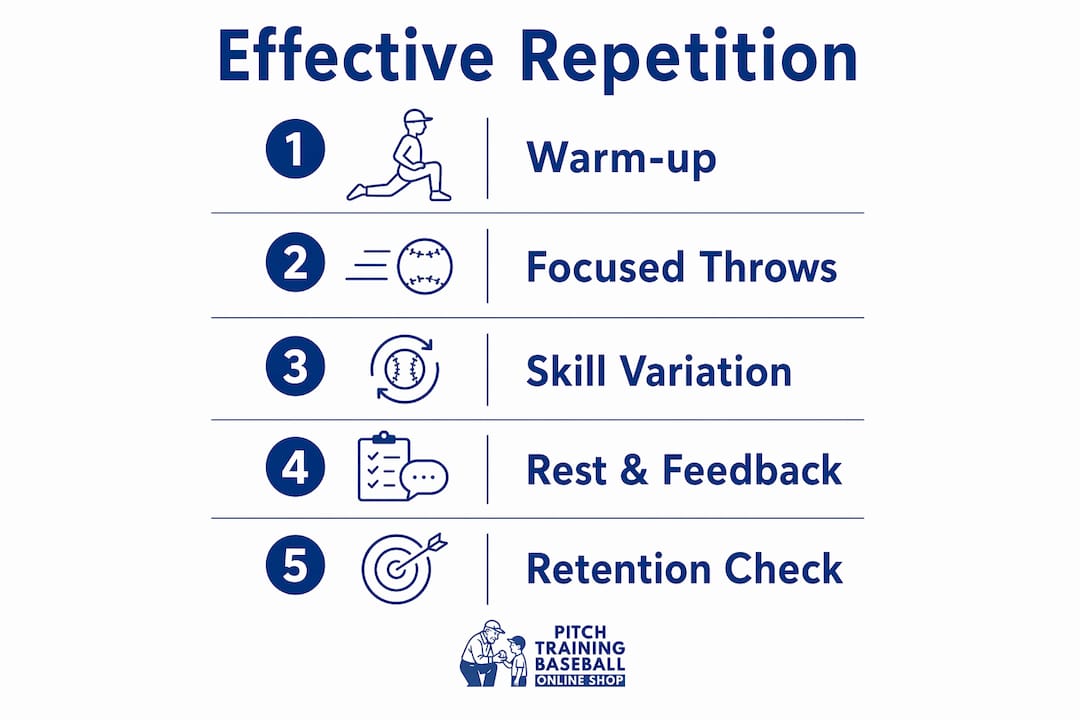
Structure every repetition with intent, variability, appropriate spacing, and specific feedback. That’s the principle. Here’s what it looks like in practice:
Core principles:
- Clear intent per rep. Each throw has a stated goal: hit zone 7, land the changeup at the knees, stay tall through release.
- Variable sequencing. Mix pitch types, target zones, and distances within a set rather than running identical reps in a row.
- Low-frequency, specific feedback. Give one precise cue after a set of 4–6 reps, not after every throw. Skill acquisition research shows high-feedback practice improves immediate performance but weakens long-term learning.
- Progressive overload. Add a constraint (smaller target zone, reduced rest, eyes-closed balance drill) once the pitcher hits 70–75% accuracy consistently.
- Age-appropriate volume. Follow USA Baseball and Little League pitch-count and rest guidelines as the hard ceiling on total throws.
Sample drill variations:
- Target-zone circuit: Call out a different zone number before each throw on a 9-zone strike net. No two consecutive throws go to the same zone.
- Mixed-pitch progression: Alternate fastball, changeup, and curveball in a random order the pitcher doesn’t see in advance.
- Gamified accuracy task: Score points for hitting called zones; deduct for uncalled zones. Adds decision-making pressure that mirrors game conditions.
Hybrid training, mixing structured reps with game-like pitching practice, supports both motivation and skill development in youth athletes.
Pro Tip: Time your feedback. Wait until the pitcher has finished a full set before commenting. Immediate rep-by-rep correction creates cue dependence and prevents the brain from self-correcting, which is where real learning happens.
Safety, arm health, and when to cut a session short
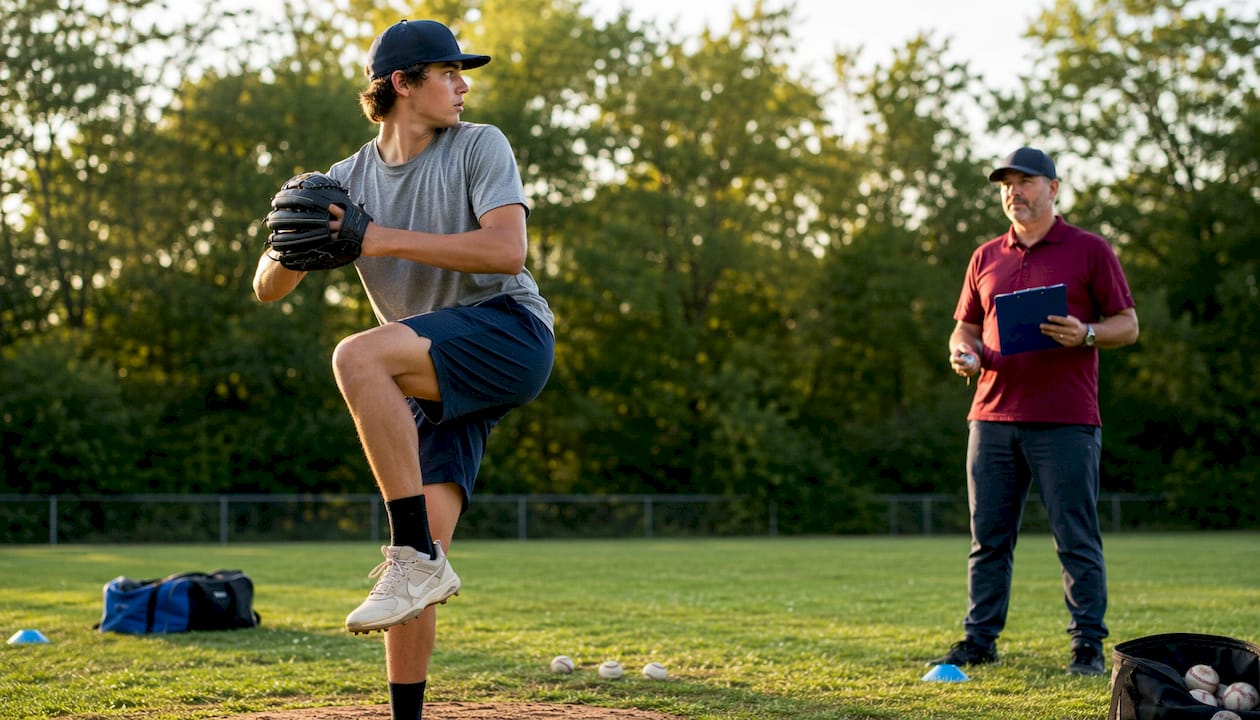
Arm health sets the ceiling on how much repetition a youth pitcher should do. Safety must shape practice structure, not just follow it.
Stop immediately if the pitcher reports:
- Sharp or shooting pain anywhere in the arm or shoulder
- Elbow pain, especially on the inside (medial) or outside
- Pain that changes mechanics or causes the pitcher to “protect” the arm
- Numbness or tingling in the fingers
- Persistent soreness that doesn’t resolve within 24 hours
Scale back if you observe:
- Declining velocity or accuracy over the second half of a session
- Visible mechanical breakdown (dropping elbow, shortened stride)
- Complaints of fatigue or “dead arm” feeling
USA Baseball and Little League International publish pitch-count and mandatory rest-day guidelines by age group. These are the hard limits. No training principle overrides them. When a pitcher hits their count, substitute accuracy drills with soft training balls or Pickeballs at reduced intensity rather than ending the session abruptly. That keeps the learning environment active without adding arm stress.
Structured, progressive practice reduces overuse risk compared with high-volume, poorly designed repetition. If a young pitcher is sore two days after a session, the volume was too high regardless of what the pitch count said.
What tools and drills make repetition practical and safe?
Targeted tools make structured repetition measurable and safer. A strike-zone net, soft training balls, and a video or direct-feedback system cover most of what a youth pitcher needs.
Three quick drills:
-
Target-net accuracy circuit. Set up the Pitching Target Net with Colorful Strike 9-Zone. Call a zone number before each throw. Track hits per set of 8. Rotate zones randomly. This drill builds variable practice into every rep without extra planning.
-
Mixed-sequence pitch progression. Using soft training balls or Pickeballs, run a 12-rep set in a random pitch-type order written on a card the pitcher doesn’t see until the moment of each throw. Reduces anticipation and forces real decision-making.
-
Constrained-variability drill. Pitch from three different distances (60%, 80%, and 100% of game distance) in rotating order. Same target, different constraint. Builds adaptability and reduces the risk of locking in a single mechanical pattern.
When to use soft balls vs. full-velocity reps:
- Use soft training balls or Pickeballs for high-rep technique work, warm-up sets, and any session where the pitcher is already near their pitch count.
- Reserve full-velocity reps for the main development block, when the arm is warm and the pitcher is fresh.
Video review after a set, even on a phone, gives pitchers a concrete reference point that coach cues alone can’t match. Pair it with feedback principles to avoid overwhelming young athletes with too much information at once.
How Pitch Training Baseball gear supports safe, productive repetition
Pitchtrainingbaseball products are designed to enable varied, feedback-rich repetition while protecting young arms.
- Pitching Target Net with Colorful Strike 9-Zone. The color-coded zones make random target selection instant and visual. A coach calls a color; the pitcher responds. No setup time, no ambiguity, immediate feedback on every throw.
- Pitch Training Softball. A lower-impact option for younger pitchers or high-rep technique sessions. Reduces arm stress during the volume-heavy portions of a practice without sacrificing the accuracy feedback loop.
- 5 Pickeballs. Lightweight balls suited for drill variety, skill games, and progressive overload with less stress on the arm. Useful for the constrained-variability drill and any session where the pitcher is working near their daily limit.
Albert, a Pitchtrainingbaseball contributor, recommends pairing the 9-zone net with Pickeballs for any session focused on location rather than velocity. The combination lets a pitcher run many purposeful reps without the arm load of a full-velocity bullpen.
Three copy-and-use practice session templates
Structured templates that mix variable repetition, limited volume, and feedback produce measurable learning. Use these as starting points and adjust based on age, pitch count, and the 48-hour retention results.
Template 1: Technique (20–30 min)
- Dynamic warm-up: arm circles, band work, light jog (5 min)
- Soft-ball accuracy circuit: 3 sets × 6 reps, random zone calls, 60-second rest between sets
- Constrained-variability drill: 2 sets × 4 reps at varied distances
- Cool-down: light stretch, one coaching cue per set reviewed verbally
Goal: Reinforce mechanics at low intensity. Stop cue: any arm discomfort.
Template 2: Development (45–60 min)
- Dynamic warm-up (8 min)
- Mixed-pitch progression: 3 sets × 8 reps, random pitch-type card, 90-second rest
- Target-net accuracy circuit: 4 sets × 6 reps, coach calls zone before each throw
- Gamified accuracy task: 2 sets × 6 reps, scoring system
- Cool-down and one-cue feedback review
Goal: Build variable practice and decision-making. Progress to smaller zones when accuracy exceeds 70% across two sessions.
Template 3: Skill Maintenance (25–30 min)
- Light warm-up (5 min)
- Retention check: 8 reps cold on a previously drilled zone, no coaching cues
- Mixed-sequence drill: 2 sets × 6 reps
- Cool-down
Goal: Confirm retention, not add new load. Back off if retention check shows sharp accuracy drop.
Progressive overload planning and coaching method examples from Pitchtrainingbaseball can help you adapt these templates as the season progresses.
How do you know repetition is producing real learning?
Measure retention and transfer, not just immediate accuracy. In-session performance is a weak signal on its own.
What to track:
- Target hits per set (record before and after coaching cues separately)
- Release-point consistency (video or coach observation)
- Perceived effort on a simple 1–10 scale
- Any pain or discomfort noted immediately
How to interpret the data:
- Three to four sessions of trend data give a reliable picture. One good session proves nothing.
- If accuracy improves session-to-session but collapses in the retention check, the practice schedule needs more variability and spacing.
- If accuracy holds in the retention check but doesn’t transfer to scrimmage situations, add more game-like constraints to the main drill block.
The performance-vs-learning distinction is the single most underused diagnostic tool available to youth coaches. Run the retention check. The data will tell you more in 10 minutes than watching a week of clean bullpen sessions.
Key Takeaways
Repetition builds durable pitching skill only when it is structured with variability, intent, and feedback, and kept within safe volume limits for young arms.
| Point | Details |
|---|---|
| Random beats blocked practice | Variable rep sequences produce better long-term retention than identical-throw blocks, despite feeling harder in the moment. |
| Check retention, not just accuracy | Run a 48-hour retention test cold before concluding a skill is learned; in-session performance often overstates real learning. |
| Safety sets the volume ceiling | Follow USA Baseball and Little League pitch-count guidelines; substitute soft balls or Pickeballs when the pitcher nears their daily limit. |
| Feedback less, but specifically | Give one precise cue after a set of 4–6 reps; rep-by-rep correction creates cue dependence and slows consolidation. |
| Pitchtrainingbaseball gear maps to the principles | The 9-Zone Strike Net, Pitch Training Softball, and 5 Pickeballs support variable, feedback-rich, low-impact repetition in every session template above. |
Why the “just throw more” mindset keeps young pitchers stuck
The most persistent mistake in youth pitching development isn’t laziness. It’s confusing a smooth bullpen session with actual learning. A pitcher who looks great throwing 40 fastballs to the same spot has trained their brain to execute one pattern under zero pressure. That’s not a skill. It’s a habit that breaks the moment the game situation changes.
The research on repetition in pitching is clear: quality of practice, not raw volume, drives development. A 20-minute session with varied targets, mixed pitch types, and one sharp feedback cue per set will outperform an hour of mindless identical throws every time. The templates above aren’t complicated. They just require coaches and parents to resist the urge to measure effort by how many throws got thrown.
The safety piece is equally non-negotiable. Young arms are still developing, and overuse injuries at 12 can limit a pitcher’s ceiling at 18. Following USA Baseball and Little League guidelines isn’t being cautious. It’s being smart about the long game.
Build your starter training setup the right way
The fastest path to applying these repetition principles at home is a setup that covers accuracy feedback, low-impact volume, and drill variety without requiring a full facility.
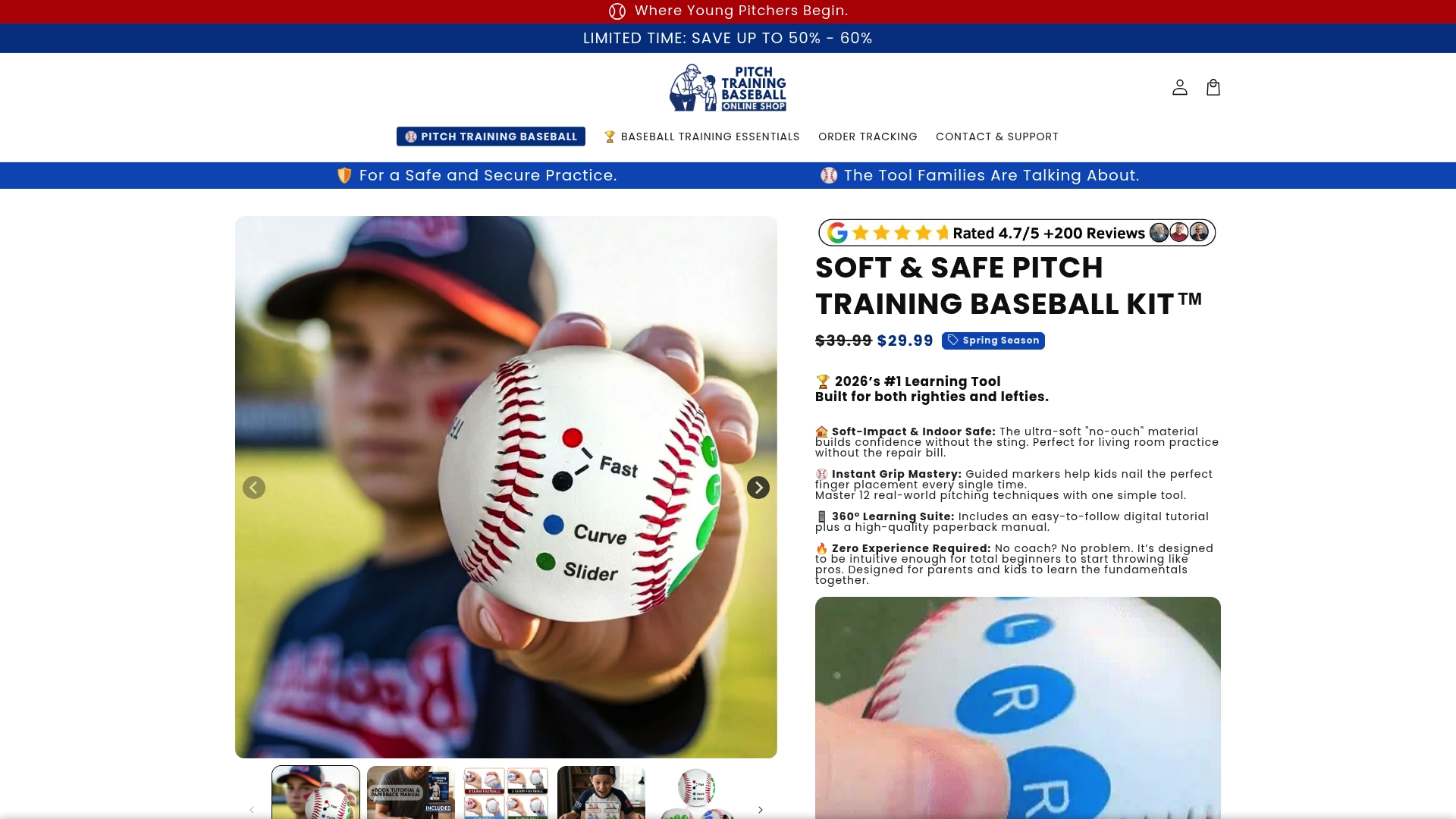
The combination of the Pitching Target Net with Colorful Strike 9-Zone, the Pitch Training Softball, and 5 Pickeballs maps directly to the principles in this article:
- The 9-Zone Net delivers instant visual feedback on every throw and makes random target selection effortless.
- The Pitch Training Softball handles high-rep technique work and recovery sessions without the arm load of a hard ball.
- The Pickeballs support lightweight drill variety, skill games, and progressive overload at reduced intensity.
All three ship directly from Pitchtrainingbaseball. Pick up the starter bundle and run Template 1 this week.
Useful sources and further reading
- Random vs. blocked practice: neural correlates review — The primary source for the blocked vs. random practice comparison and retention findings used throughout this article.
- Neural mechanisms of motor skill consolidation — Covers cortico-basal ganglia plasticity and why rewarded, varied repetition accelerates motor learning.
- Skill acquisition framework (ASPIRE) — Source for the ASPIRE cycle, feedback frequency principles, and the performance-vs-learning distinction.
- Multiple motor learning processes and use-dependent learning — Explains how pure repetition can lock in poor mechanics via use-dependent bias.
- Deliberate practice in young athletes — Supports age-appropriate volume and structured progression to reduce overuse risk.
- Performance vs. learning in human neuroscience — Foundational source for the retention-check diagnostic and the performance-learning trap.
- USA Baseball pitch-count and rest guidelines — Official source for age-based pitch limits and mandatory rest days.
- Little League pitching regulations — Official pitch-count rules by age division for Little League programs.
- Pitchtrainingbaseball: repetition in pitching — Internal deep-dive on when repetition helps vs. when it doesn’t, with coaching context.
- Pitchtrainingbaseball: feedback in baseball training — Practical guide to timing and structuring feedback so repetitions build learning.
Recommended
- Why Focus on Repetition in Pitching: a Coach’s Guide – Pitch Training Baseball
- The Role of Training Balls in Youth Baseball Pitching – Pitch Training Baseball
- Recommended Daily Pitching Habits for Youth Players – Pitch Training Baseball
- How Practice Drives Skill Development in Youth Pitching – Pitch Training Baseball