


A fastball is a pitch thrown for maximum velocity, usually with backspin, and it’s the foundation against which every other pitch in baseball and softball gets measured. It’s the first pitch most kids learn and the one every scout clocks with a radar gun before anything else.
Three variations dominate the game:
- Four-seam fastball: the fastest, straightest version, thrown across the seams for max velocity and backspin.
- Two-seam fastball (and its sinker cousin): thrown along the seams for extra tailing action or downward sink.
- Cutter: a fastball variant with a tight, late lateral break, closer to a slider in shape but faster in speed.
The rest of this guide breaks down each type’s grip, how the mechanics behind a clean release actually work, the physics that make a fastball move (or appear to “rise”), realistic speed benchmarks by level, and a safe way to build velocity without wrecking a young arm in the process.
Key Takeaways
A fastball’s effectiveness depends less on raw velocity than on a repeatable release and clean spin, with grip and seam orientation determining whether it plays straight, sinks, or cuts.
| Point | Details |
|---|---|
| Three core variants | Four-seam (velocity, carry), two-seam/sinker (movement, ground balls), and cutter (late lateral cut) each start from a different grip. |
| Movement comes from physics | The Magnus effect and seam orientation explain why fastballs appear to “rise,” an illusion caused by reduced drop, not upward flight. |
| Speed is relative to level | A “fast” fastball ranges from around 40 mph in youth baseball to 100+ mph in MLB, so context matters more than a single number. |
| Safety requires progression | Warm-ups, gradual long toss, and pitch-count limits protect the elbow and shoulder far more than any drill improves velocity alone. |
| Practice tools support the reps | Pitchtrainingbaseball’s target nets and practice balls help pitchers build release consistency at home, alongside coaching, not instead of it. |
Table of Contents
- What Are the Main Types of Fastballs?
- How Do Pitchers Throw a Fastball?
- Why Does a Fastball Move the Way It Does?
- How Fast Is a Fastball, and What Counts as Fast?
- How Should Players Practice Fastball Mechanics Safely?
- How Does a Fastball Compare to Other Pitches?
- How Has the Fastball Evolved Over Baseball History?
- Which Pitchers Are Known for Their Fastball, and Why Does It Matter?
- What Are the Injury Risks Behind Fastball Pitching?
- A Coach’s Take on Teaching the Fastball
- How Training Aids Support Fastball Development at Home
- Frequently Asked Questions
- Sources
What Are the Main Types of Fastballs?
Every fastball variant starts from the same basic idea, speed plus spin, but small changes in grip and seam orientation change how the ball behaves in the last few feet before the plate. The MLB Glossary identifies three core variations: the four-seam, the two-seam/sinker, and the cutter. Each variant uses a specific finger placement to manipulate spin.
Four-seam fastball
The four-seam is the pitch most beginners throw first because it’s the most direct: hard, straight, and thrown with backspin that fights gravity just enough to look like it’s rising as it crosses the plate.
- Place your index and middle fingers across the four seams where they’re spaced widest apart.
- Keep a small gap between the ball and your palm, don’t choke it.
- Rest your thumb underneath, centered on a seam for balance.
- Point your fingers straight down the target, keeping pressure even across both fingers at release.
Two-seam fastball and sinker
The two-seam rides along the narrow seams instead of across them, and that small shift changes the airflow enough to produce a tailing or sinking action rather than a straight line. It’s the pitch pitchers reach for when they want ground balls instead of swings and misses.
- Place index and middle fingers together along the narrow part of the seams, where they run close together.
- Set your thumb underneath, slightly off center for extra side spin.
- Apply a touch more pressure with your middle finger to encourage downward sink.
- Aim slightly inside or outside the zone, letting the tail bring it back over the plate.
Cutter
A cutter is a fastball run off-center, so it keeps most of its velocity but breaks late and sharply toward the pitcher’s glove side. It’s the pitch MLB.com’s pitch-type guide groups with fastballs because of its speed, even though the shape borrows from breaking pitches.
- Shift your grip slightly off-center from a standard four-seam, offset toward one side of the ball.
- Apply extra pressure with your middle finger on release.
- Pull down slightly through the side of the ball rather than straight through the middle.
- Expect the ball to stay flat longer than a slider, then dart late.
Pro Tip: If you’re standing behind the mound watching a bullpen, look at the ball’s flight path in the last ten feet. A four-seam holds its line and seems to hop. A two-seam drifts and dips. A cutter looks like a fastball right up until it darts hard to one side just before the glove.
| Variant | Motion | Primary intent | Grip cue |
|---|---|---|---|
| Four-seam | Straight, minimal drop | Velocity-first | Fingers across wide seams, even pressure |
| Two-seam/sinker | Lateral tail or downward sink | Movement-first, ground balls | Fingers along narrow seams, thumb off-center |
| Cutter | Late, tight lateral cut | Movement-first, jam hitters | Off-center grip, middle-finger pressure |
How Do Pitchers Throw a Fastball?
A good fastball comes down to one thing above all else: a release point and spin axis you can repeat pitch after pitch. Velocity matters, but a 75 mph fastball with a dead-consistent release beats a 78 mph fastball that arrives from three different arm slots.
- Set your stance with feet shoulder-width apart, weight balanced, glove and ball together at your chest.
- Stride toward the target, leading with your hip rather than your shoulder, landing with your front foot pointed roughly at home plate.
- Create hip-shoulder separation, letting your hips open slightly before your shoulders follow. This is where most of a fastball’s power actually comes from.
- Drive your arm through a natural path, elbow rising to around shoulder height, never dragging behind or getting yanked down early.
- Release out front, close to your body’s centerline, with your fingers on top of the ball at the moment of separation.
- Snap your wrist and fingers down and through the ball at release, the action that actually generates backspin.
- Follow through fully, letting your back leg come around so your chest finishes facing the target.
Two mechanical habits sabotage more young fastballs than anything else. Pulling the elbow down early, sometimes called “dragging,” kills arm speed and flattens spin. The fix: cue the pitcher to think “elbow up, hand on top” through the throwing motion. The second is snapping the wrist too soon, before the arm is fully extended, which bleeds velocity and sends the ball off-line. The fix: have the pitcher focus on releasing the ball as close to the target as their arm extension allows, not early out of the hand.
A quick red-flag checklist for anyone watching from behind the plate or the mound:
- Elbow dropping below shoulder height during the arm swing.
- Front foot landing closed off or wide open instead of toward the target.
- Follow-through stopping short instead of finishing across the body.
- Consistent pain complaints in the elbow or shoulder, not just fatigue.
For a deeper walkthrough of the full kinetic chain, Pitchtrainingbaseball’s guide on pitching biomechanics breaks down how each body segment contributes to arm speed and health.
Why Does a Fastball Move the Way It Does?
Spin and seam orientation change how air flows around the ball, and that airflow difference is what makes a fastball move at all. The Magnus effect explains most of it: backspin on a fastball creates higher pressure underneath the ball and lower pressure on top, generating an upward force that fights gravity. That force doesn’t make the ball rise. It just makes it drop less than a hitter’s brain expects, which is exactly why a well-thrown four-seam looks like it’s hopping at the plate.
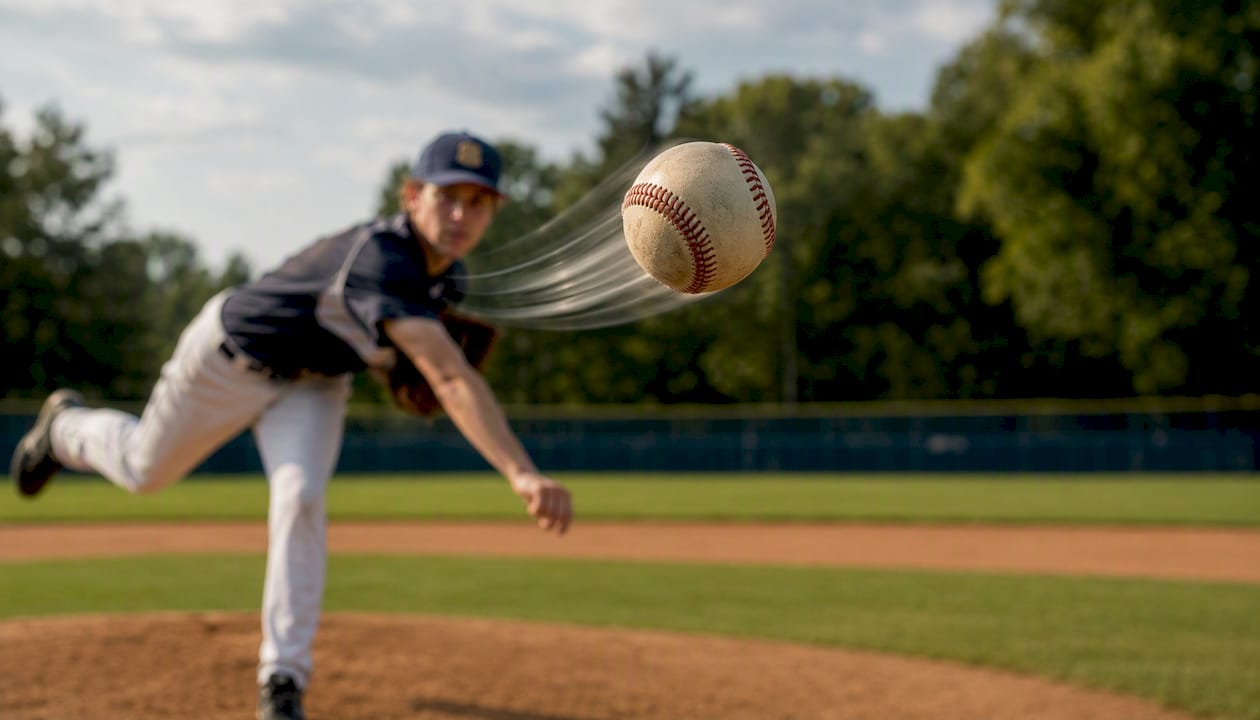
Seam orientation adds another layer. A four-seam grip presents the seams to the air in a way that maximizes that backspin lift, keeping the pitch flatter and straighter. A two-seam grip changes the airflow pattern enough to shift the ball’s movement sideways or downward instead of just resisting drop. High-speed video studies of pitch flight, including work from physicists analyzing seam interaction and boundary-layer separation, show that this seam effect can produce movement patterns that look almost unpredictable to the naked eye, even though they follow consistent physical rules.
The “rising fastball” that broadcasters talk about is a perceptual illusion, not an actual physical event. As MLB’s own pitch-identification guide notes, hitters calibrate their swing to the trajectory a normal pitch would follow. A high-spin four-seam drops less than that expectation, so the bat passes underneath it. The ball never leaves its downward arc; the hitter’s timing just gets fooled.
Spin rate backs this up with real numbers. One peer-reviewed analysis of collegiate pitchers recorded a mean initial ball speed of 34.5 ± 0.2 meters per second (about 77 mph) and a mean spin rate of 31.2 ± 1.5 revolutions per second, roughly 1,870 rpm, in the sample studied. Spin rate isn’t fixed to velocity either. Grip friction plays a role: research on ball-doctoring in American Scientist found that stickier substances on the ball can push spin rates up by around 400 rpm on some pitches, a shift big enough to noticeably change how much a pitch moves, which is part of why MLB tightened enforcement around foreign substances.
| Metric | Reported value | Source |
|---|---|---|
| Mean initial ball speed (collegiate sample) | 34.5 ± 0.2 m/s (about 77 mph) | Journal of Physical Fitness and Sports Medicine |
| Mean ball spin rate (same sample) | 31.2 ± 1.5 rps (about 1,870 rpm) | Journal of Physical Fitness and Sports Medicine |
| Spin-rate increase from grip substances | Roughly 400 rpm on some breaking pitches | American Scientist |
If you want to visualize this, picture the ball’s spin axis as an arrow poking straight out of the top and bottom of a spinning top. When that axis is nearly horizontal and perpendicular to the flight path, backspin lift is maximized, the classic four-seam look. Tilt that axis even slightly, and the ball starts curving sideways instead of just staying flatter. For more on how trajectory concepts connect to what hitters see, Pitchtrainingbaseball’s piece on pitch trajectory works through the visual side of this in more detail.
How Fast Is a Fastball, and What Counts as Fast?
What counts as a fast pitch depends entirely on the level you’re watching. A 60 mph fastball is exceptional for a 10-year-old and unremarkable in a college bullpen.
| Level | Typical fastball range | Notes |
|---|---|---|
| Youth (10U baseball) | 40 mph | Varies widely by age, mound distance, and growth stage. |
| High school baseball | 85 mph | Top varsity arms can exceed this range. |
| College baseball | 80 mph | Scouting standards have historically flagged the high 80s as a benchmark worth attention. |
| MLB | 90–100+ mph | Elite relievers regularly touch triple digits. |
| Fastpitch softball (advanced) | 70 mph | Underhand delivery and shorter pitching distance change the effective difficulty. |
Ranges vary by data source and by how the pitch was measured, so treat these as general benchmarks rather than hard cutoffs.
Quick answers to the questions people actually type into a search bar:
- Is 100 mph elite? Yes, pitches at or near this velocity are considered fast at the professional level, though only a limited number of pitchers regularly achieve this speed.
- How fast is a 100 mph pitch really, in terms of reaction time? The batter has a fraction of a second, roughly 400 milliseconds, to recognize pitch type, judge location, and swing.
- Does softball “count” differently? Yes, because the pitching distance is shorter and the delivery is underhand, so a 60 mph softball fastball reaches the plate in comparable time to a much faster overhand pitch.
One more wrinkle worth knowing: a radar gun reading right out of the pitcher’s hand often reads a couple mph higher than tracked systems that measure velocity partway down the flight path, since the ball decelerates in flight. That’s part of why the same pitcher can get different readings from different tools on the same day.
How Should Players Practice Fastball Mechanics Safely?
The safest, most effective path to a better fastball starts with a warm-up, moves through progressively longer and harder throws, and only adds real intensity once mechanics hold up consistently. Chasing velocity before command and clean mechanics are locked in is the single most common mistake in youth pitching development.
- Warm up with dynamic mobility work, arm circles, band work, and light jogging, for at least 10 minutes before picking up a ball.
- Start with short-distance toss, 30 to 40 feet, focusing purely on grip and release feel.
- Progress into long toss, stretching out to 60 to 90 feet gradually, prioritizing arc and clean release over max effort.
- Move into a focused bullpen, throwing fastballs from the mound or a flat surface at game distance, tracking command over velocity.
- Add velocity-building drills only once mechanics are consistent, things like resisted throws or specific strength work under a coach’s guidance.
- Finish with simulated at-bats against a hitter or a target, adding the pressure of a real target and count situations.
A simple drill that covers most of this in one session: start at 45 feet and throw 10 relaxed tosses focusing only on a clean release. Move back to 60 feet for 10 more, adding a touch of arc. Stretch to 90 feet for 10 throws, prioritizing a full arm circle and follow-through. Then come back down to mound distance and throw 15 fastballs into a target, grading each one on release consistency rather than speed.
Safety guidance that matters more than any drill:
- Follow pitch-count limits appropriate for the player’s age; USA Baseball and most youth leagues publish specific guidelines by age group.
- Any sharp elbow or shoulder pain, as opposed to normal muscle fatigue, means stopping immediately and resting.
- Build in at least one to two full rest days between high-intensity bullpen sessions for youth arms.
- See a coach for mechanical issues and a clinician for anything resembling joint pain that doesn’t resolve with rest.
Pro Tip: Command beats velocity for young pitchers, every time. A coach should only introduce weighted balls or heavy resistance training once a pitcher’s mechanics are clean and consistent, and even then, only under qualified supervision. Rushing that step is how promising arms get hurt. Pitchtrainingbaseball’s guide to youth pitching workouts walks through age-appropriate strength work in more depth, and recovery techniques like the Graston Technique can help manage soft-tissue tightness that builds up from repeated throwing.
How Does a Fastball Compare to Other Pitches?
A fastball’s job is speed and command; breaking and off-speed pitches exist to disrupt a hitter’s timing once the fastball has set the tone.
- Fastball vs. curveball: A curveball uses topspin to create a large vertical drop, the opposite spin direction of a fastball’s backspin. Hitters gear up for fastball timing, and the curveball’s late, steep break is what makes it effective off that setup.
- Fastball vs. slider: A slider breaks laterally and later than a curveball, with less vertical drop but a sharper, tighter break near the plate. It’s often used to get swings and misses on the outer edge of the zone.
- Fastball vs. splitter: A splitter looks like a fastball out of the hand but drops sharply as it nears the plate, thanks to reduced spin from a wider finger split. The deception comes entirely from the visual similarity to a fastball before the late drop.
For hitters, the practical takeaway is timing: fastballs demand the fastest reaction, so a hitter’s swing gets calibrated to fastball speed first, which is exactly what makes off-speed pitches effective as a follow-up. For pitchers, the sequencing logic runs the other way. Establish the fastball early to set hitter timing, then introduce breaking or off-speed pitches to exploit that calibration.
The coaching cue for adding a new pitch safely is simple: never introduce a breaking pitch like a slider until fastball mechanics and arm health are solid, since the grip and wrist action for pitches like the slider put different stress on the elbow than a fastball’s straight-through release.
How Has the Fastball Evolved Over Baseball History?
The fastball has been the backbone of pitching since baseball’s earliest organized decades, but what counted as “fast” has changed dramatically. Early 20th-century fastballs were often clocked informally, with legends like Walter Johnson praised for velocity that, by modern radar standards, likely sat well below what a hard-throwing high schooler produces now.
Radar gun technology, introduced widely in the 1970s, changed the sport’s relationship with velocity entirely. For the first time, scouts and fans could put a hard number on a pitch instead of relying on reputation and eyeball estimates. That shift pushed velocity into scouting reports as a headline stat, and historical scouting benchmarks show the high 80s mph became a long-standing threshold for serious professional attention.
More recently, pitch-tracking systems like Statcast added spin rate and movement data to the conversation, revealing that two fastballs at the same velocity can behave completely differently depending on spin efficiency and axis. That data explains why some pitchers with modest velocity numbers still get outsized swing-and-miss results: their spin quality does work that raw speed alone can’t. Softball’s fastpitch tradition tells a parallel story. The underhand fastball has anchored fastpitch strategy since the sport’s early competitive days, with pitcher development built around the same command-first philosophy that defines baseball’s approach today.
Which Pitchers Are Known for Their Fastball, and Why Does It Matter?
Certain pitchers built entire careers, and in some cases reshaped how hitters approach the plate, purely on the strength of one dominant fastball.
Nolan Ryan’s fastball became the standard against which velocity itself was measured for decades, a career built on a pitch that stayed dominant well past the age when most power arms fade. Randy Johnson’s fastball, delivered from an unusually tall, low arm-slot frame, made his four-seam look like it was coming from an entirely different angle than hitters were used to seeing, which amplified its effective speed in a hitter’s perception. More recently, pitchers known for triple-digit velocity combined with elite spin rates have shown how modern data changes the evaluation: it’s no longer just about the radar gun number, but about spin efficiency and movement profile layered on top of raw speed.
What connects all of them isn’t just velocity. It’s that their fastball set up everything else in their arsenal. A hitter forced to respect a fastball at the top of the velocity range has less time to sit on a breaking pitch, and that leverage is the real reason a great fastball has outsized value beyond its own strikeout numbers.
What Are the Injury Risks Behind Fastball Pitching?
The fastball’s high-effort, high-repetition nature puts real stress on the elbow and shoulder, and most serious youth pitching injuries trace back to volume and mechanics rather than the pitch type itself. The elbow’s ulnar collateral ligament (UCL) and the shoulder’s rotator cuff and labrum absorb the bulk of the force generated during a fastball’s arm-acceleration phase, which is also the fastest human joint motion recorded in any sport.
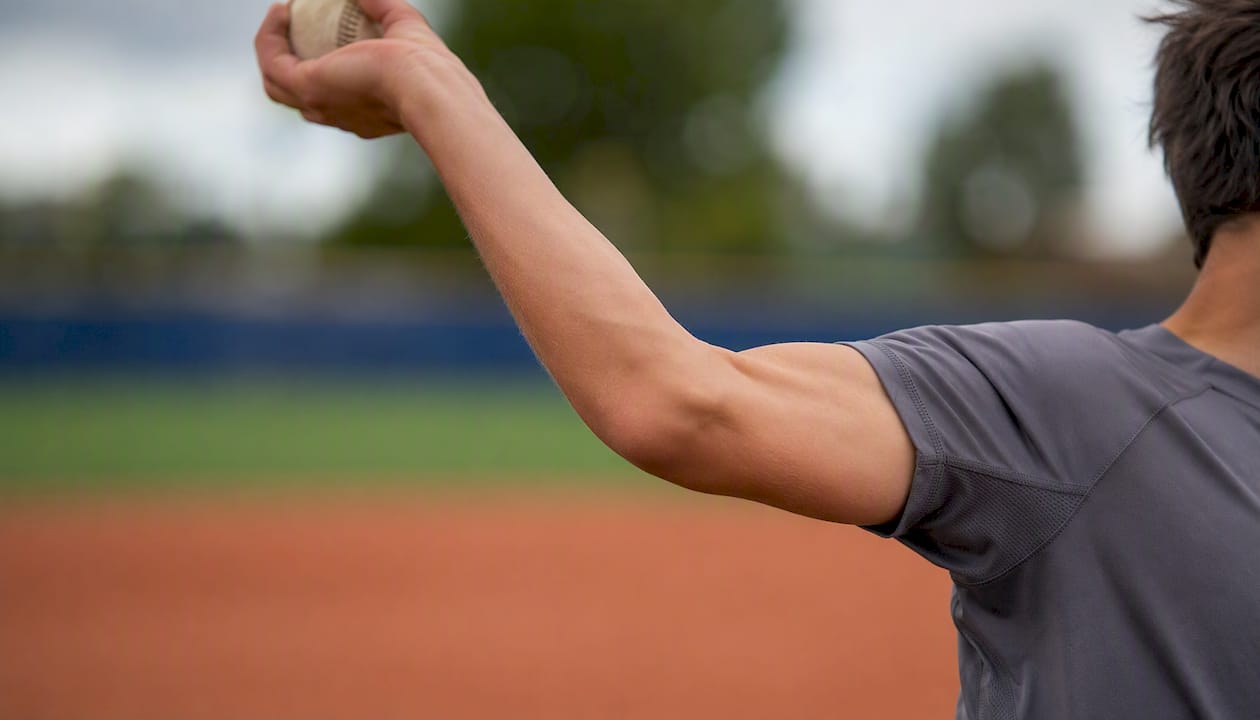
Two mechanical patterns raise risk the most: excessive arm drag, where the elbow lags behind the shoulder during rotation, and shoulder abduction/rotation issues that push extra torque onto the UCL. Overuse compounds both. Throwing too many pitches, too many days in a row, without adequate rest is consistently linked to a higher rate of elbow and shoulder injury in youth pitchers.
Prevention comes down to a few concrete habits: following age-appropriate pitch-count and rest guidelines, building a mechanically sound delivery before chasing velocity, and treating any joint pain, as opposed to normal muscle soreness, as a stop signal rather than something to pitch through. Pitchtrainingbaseball’s breakdown of pitching biomechanics and arm health covers the kinetic chain in more depth, and current coaching guidance for youth mechanics is worth a read for any parent managing a young pitcher’s workload.
A Coach’s Take on Teaching the Fastball
The single biggest mistake I see in fastball instruction is chasing velocity before a pitcher owns a repeatable release. A fastball that arrives from the same arm slot, with the same spin quality, pitch after pitch, will beat a faster fastball with inconsistent mechanics almost every time, because command is what actually gets outs at every level below the majors.
If I had to pick one micro-drill to build that consistency, it’s the “same spot” bullpen: throw 15 fastballs at a fixed target, and after each one, call out whether the release point felt identical to the last. Not whether it was a strike, whether it felt the same. Pitchers who can answer honestly usually see their command tighten up within a few sessions, because they start noticing their own inconsistencies instead of just their misses.
How Training Aids Support Fastball Development at Home
Good coaching builds the foundation, but the reps that turn a mechanically sound fastball into a repeatable weapon happen between lessons, often in a backyard or driveway. A well-designed target or a reliable set of practice balls doesn’t replace a coach’s eye, but it does make solo reps far more productive than throwing at a wall and guessing.
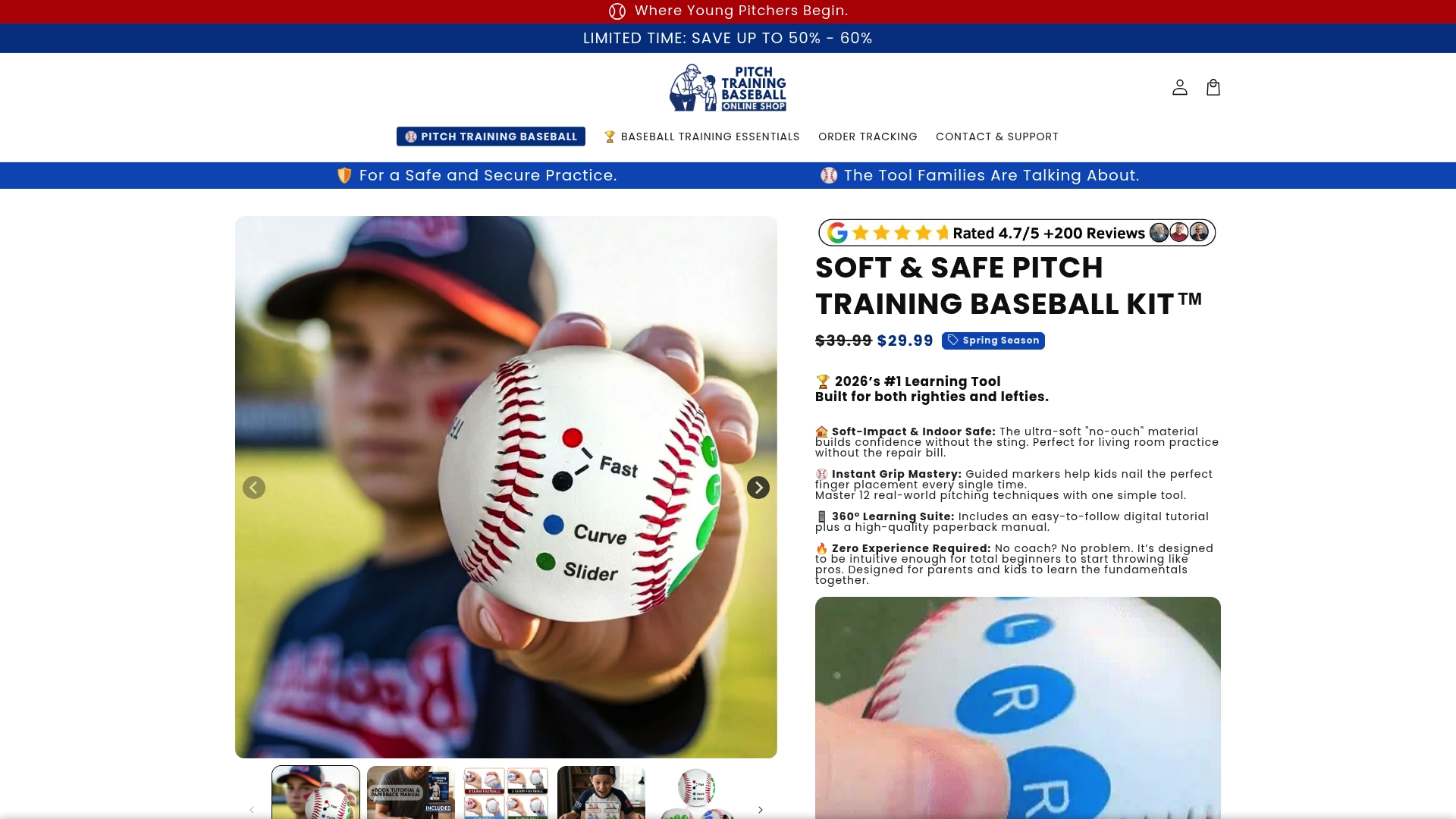
Pitchtrainingbaseball’s pitching target net with a colorful 9-zone strike layout gives a pitcher immediate visual feedback on the release-point consistency drills covered earlier in this guide, turning “throw 15 fastballs at a target” into something a kid can actually track and improve on their own. For high-rep sessions like long toss progressions or simulated bullpens, a dedicated set of practice balls keeps the focus on volume without wearing through gear meant for games. Fastpitch players working on the same command-first principles have a softball-specific training option built around the same mechanics. None of this replaces a coach’s feedback on mechanics. Think of it as what makes the time between lessons count. If you’re building a home practice routine around the drills in this guide, start with the target net and a set of practice balls, and track release consistency the same way the bullpen drill above describes.
Frequently Asked Questions
What is a fastball in simple terms? A fastball is a pitch thrown for maximum speed, usually with backspin, designed to reach the hitter as hard and as straight (or with minimal drop) as possible.
What is the difference between a fastball and a curveball? A fastball uses backspin to minimize drop and maximize speed, while a curveball uses topspin to create a sharp, large vertical break, trading velocity for movement.
What makes a good fastball? A good fastball combines a repeatable release point, quality spin, and command of the strike zone, not just raw velocity.
How fast does a fastball need to be to reach the majors? There’s no fixed cutoff, but scouting standards have long treated the high 80s mph as a baseline worth serious attention, with most current MLB fastballs sitting in the 90 to 100+ mph range.
Can a two-seam fastball and a sinker be the same pitch? Yes, many coaches and pitchers use the terms interchangeably, since both rely on a similar grip and both produce downward or lateral movement rather than a straight line.
Sources
- Four-Seam Fastball (MLB Glossary)
- Physics can explain the fastball’s unexpected twist (Ars Technica)